CONGO – Jerry Goldsmith
 THROWBACK THIRTY
Original Review by Jonathan Broxton
Following the success of Jurassic Park in 1993, screenplays adapted from the action/adventure novels of Michael Crichton were suddenly hot commodities; one such screenplay was Congo, which was adapted by John Patrick Shanley from the 1980 novel of the same name, and which had been kicking around Hollywood for more than a decade. The resulting film was directed by Frank Marshall and stars Dylan Walsh as Dr. Peter Elliot, a primatologist who is traveling to the Congo to return a gorilla named Amy – who he has taught to communicate using sign language via a special glove – to her home in the wild. Meanwhile, Dr. Karen Ross (Laura Linney) is sent to the Congo to find a missing research team led by her ex-fiancé Charles Travis, which was in the area on an expedition to find rare blue diamonds that could revolutionize laser communications, but which vanished after a violent, mysterious attack. Elliot and Ross end up on the same plane together, where they are joined by Herkimer Homolka (Tim Curry, sporting one of the weirdest accents in movie history), a mysterious Romanian treasure hunter who is obsessed with finding the mythical Lost City of Zinj, which is rumored to contain vast diamond reserves.
I thought the original novel was outstanding and I was eagerly anticipating the movie, but although it was commercially successful it received mostly negative reviews, with many critics pointing out the poor dialogue, unexpectedly campy tone, inconsistently-rendered animatronic gorillas, and surprisingly shaky special effects during the film’s volcanic climax.
The score for Congo was composed by Jerry Goldsmith, who came into replace original composer James Newton Howard early in the production phase, with Howard having only written a brief tribal chant for South African vocalist Lebo M. before he departed. Goldsmith’s score is really quite excellent – it’s lush, adventurous, and exotic, blending orchestral elements with African percussion and vocalizations to match the film’s jungle setting and mysterious tone. There are moments of adventure and wonderment that capture the grandeur of the African wilderness, emotional sequences involving Elliot’s relationship with Amy the gorilla which are more sensitive and melodic, and plenty of action, suspense, and even some horror, particularly in the scenes involving the Lost City of Zinj and the killer gorillas that guard its treasures.
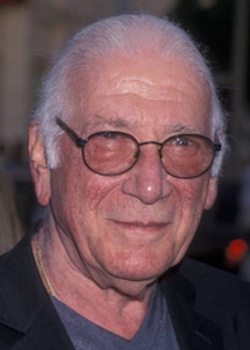 Goldsmith picked up Howard’s collaboration with Lebo M. on the score – the South African was in great demand at the time mostly due to his iconic vocal work on Hans Zimmer’s The Lion King the previous year – and his main contribution to Congo comes via the song “Spirit of Africa,” which opens and closes the album. It’s an unexpectedly peaceful, lyrical song, where the vocals are backed by various pan flutes and percussion textures which range from watery to more robustly rhythmic, and which rises to a lovely stirring orchestral flourish in the middle of the piece.
The rest of the score then develops several additional themes, some of which appear to be expansions of elements of the song. By way of comparison, it’s sort of a more mature take on the ‘jungle adventure sound’ of early 1980s scores like Baby: The Secret of Lost Legend, or perhaps even King Solomon’s Mines, combined with the pastoral parts of something like Medicine Man. It also acts as something of a dry run for the music Goldsmith would write for another African-set adventure, The Ghost and the Darkness, in 1996, as well as the ‘lost in the wilderness’ sound from scores like The Edge.
The theme for Amy the gorilla is the score’s emotional core, a pretty and innocent melody that appears in numerous cues, notably the whimsical “No Customs,” and the second half of “Kahega”. Meanwhile, the Adventure theme that emerges from the main title song accompanies Elliot, Ross, and their party as they head off to the Congo to achieve their respective aims, and Goldsmith captures the majesty of the location and the anticipation of what awaits them with an expansive sweep; cues like the first half of “Kahega,” the opening moments of “Deep Jungle,” and the misleadingly peaceful beginning of “Hippo Attack” set the tone with a heady blend of brass-heavy orchestra and African tribal percussion.
However, for me, as was often the case with his scores, the action music is the standout, and here it sees Goldsmith engaging in some full-throated rip-snorting orchestral carnage as the party’s plans are ripped to shreds – literally – by the vicious gorilla horde guarding the entrance to the Lost City of Zinj and the vast riches held deep within it. In cues like “Amy’s Nightmare,” the powerful and agitated “Bail Out,” the second half of “Deep Jungle,” the second half of “Hippo Attack,” the occasionally quite harsh and aggressive “Crash Site,” and the forceful and belligerent “Gates of Zinj,” Goldsmith employs an array of pulse-pounding rhythms that jump between energetic strings, staccato brass, layers of throbbing percussion, and rousing explosions of the main Adventure theme.
Fans of later scores like The Mummy will enjoy a lot of Goldsmith’s work here, as they share a lot of tonal and textural similarities. Interestingly, I was occasionally also reminded of some of the more modernistic music Goldsmith wrote in the 1960s and 70s, especially things like Planet of the Apes and Capricorn One, specifically in the way he would use off-kilter time signatures to make the percussion patterns seem wilder and more feral. Many of these cues also features synthetic embellishments, sometimes pitched to mimic ethnic woodwinds, as was Goldsmith’s way at the time, and as always these will either delight or annoy you depending on your tolerance for that specific tone. Whatever the case may be, Goldsmith always elevated things like this with his music, making the film seem bigger and more rousingly cinematic.
“Amy’s Farewell/End Titles” then offers an excellent 10-minute finale, presenting a sweeping and emotional final statement of Amy the Gorilla’s theme as she departs to her new home in the mountains, a quick blast of the Adventure theme for the full orchestra, and then a final reprise of the “Spirit of Africa” song as the survivors make their way back to civilization in a hot air balloon, high above the jungle canopy. Perhaps the one disappointment of the score is the fact that Goldsmith chose not to – or was unable to – make further use of Lebo M’s striking vocals in any meaningful way outside the main and end titles.
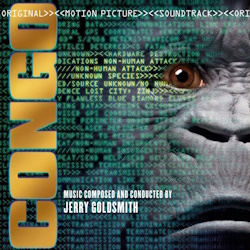
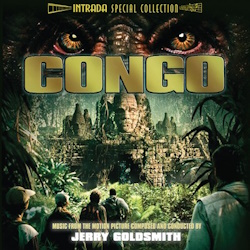 The original MCA Records Congo album offered a basic 35-minute overview of the score as a whole, but was quite badly produced, placing cues wildly out of order and omitting several key action sequences, while also making baffling choices in the art direction. In 2013 producers Douglass Fake and Roger Feigelson of Intrada Records released a 61-minute expanded album, re-ordered to more accurately convey the narrative of the film, and including several of the key action cues that the original album omitted. Of these, cues like “Meet Monroe Kelly,” “The Rapids,” and “The Mine” are the standouts, while the rest of the release adds depth to the emotional scenes between Elliot and Amy, and allows for some interesting development of the other themes.
This is a sentence that I could write 50 times in relation to Jerry Goldsmith, but here it is again: Congo is a good score for a bad film, which in context actually helps make the film seem better than it is, and which makes for an engaging listen on its own merits. Fans of Goldsmith’s ethnic action-adventure scores of the 1980s and 1990s will find this to be a solid entry that meshes well with that group of scores, and will appeal especially to anyone who has a liking for scores that combine rousing orchestral music with the distinct percussive sound of central Africa.
Buy the Congo soundtrack from the Movie Music UK Store
Track Listing:
- ORIGINAL 1995 MCA ALBUM
- Spirit of Africa (2:42)
- Amy’s Nightmare (2:59)
- No Customs (1:49)
- Kahega (2:34)
- Bail Out (2:27)
- Deep Jungle (2:00)
- Hippo Attack (4:03)
- Crash Site (2:12)
- Gates of Zinj (2:19)
- Amy’s Farewell/End Titles (10:28)
- EXPANDED 2013 INTRADA ALBUM
- Spirit of Africa/The Expedition (2:42)
- Zinj (1:17)
- The Eye (0:24)
- Meet Amy (2:43)
- Something I Lost (Alternate) (0:29)
- Meet Monroe Kelly (1:39)
- Road Block (0:39)
- Crossing the Border (1:29)
- Bail Out (2:58)
- No Customs (1:49)
- Deep Jungle – Picture (1:59)
- The Ghost Tribe – Revised (2:04)
- The Rapids (0:39)
- The Symbol (0:47)
- Hippo Attack (2:26)
- The Other Side – Revised (1:17)
- Crash Site (1:59)
- Sad Amy (0:37)
- Gates of Zinj (4:03)
- Help Me (2:18)
- We Are Watching (1:49)
- The Mine (0:53)
- Amy’s Nightmare (2:11)
- Kahega (2:18)
- Amy’s Farewell/Spirit of Africa/End Credits (10:29)
- Something I Lost (0:20) BONUS
- Deep Jungle – Album (2:33) BONUS
- The Ghost Tribe (1:21) BONUS
- The Other Side (1:20) BONUS
- The Collapsed City (2:21) BONUS
- The Villagers Chant (written by James Newton Howard) (1:50) BONUS
Epic Records 480938-2 (1995) – Original
Intrada Special Collection Volume 220 (1995/2013) – Expanded
Running Time: 33 minutes 33 seconds – Original
Running Time: 61 minutes 43 seconds – Expanded
Music composed and conducted by Jerry Goldsmith. Orchestrations by Alexander Courage and Arthur Morton. Special vocal performances by Lebo M. Recorded and mixed by Bruce Botnick. Edited by Kenny Hall. Album produced by Jerry Goldsmith. Expanded album produced by Douglass Fake and Roger Feigelson.

Shop at the Movie Music UK Store

Member of the

 MOVIE MUSIC UK