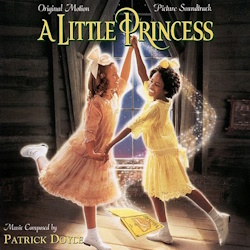
A LITTLE PRINCESS – Patrick Doyle
 THROWBACK THIRTY
Original Review by Jonathan Broxton
Director Alfonso Cuarón’s A Little Princess is an adaptation the 1905 novel of the same name by Frances Hodgson Burnett, which is now regarded as a timeless classic of children’s literature. The story centers on Sara Crewe, a kind and imaginative young girl raised in India by her wealthy British father, Captain Crewe. When World War I breaks out, Captain Crewe is called to the front lines, and Sara is sent to a boarding school for girls run by the stern and cold-hearted Miss Minchin. At first, Sara enjoys a privileged status at the school, thanks to her father’s wealth and her own charm, but her life is turned upside down when news arrives that Captain Crewe has died in battle and his assets have been seized. Stripped of her wealth, Sara is forced to become a servant at the school, but despite her hardships and Miss Minchin’s cruelty, Sara refuses to give up her belief that “all girls are princesses,” and with the help of her friend Becky, a fellow servant, and Ram Dass, the mysterious servant of a wealthy neighbor, Sara clings to her imagination and dignity.
The film stars Liesel Matthews as Sara, Eleanor Bron as Miss Minchin, Liam Cunningham as Captain Crewe, and Vanessa Lee Chester as Becky, and was the English-language debut of Mexican director Cuarón, who would later go on to make Great Expectations, Y Tu Mamá También, Harry Potter and the Prisoner of Azkaban, and Children of Men, and win Oscars for both Gravity and Roma. Upon its release the film was widely praised for its lush cinematography and rich color palette, as well as for how Cuarón blended realism with the magical and fantasy elements related to Sara’s vivid imagination, making it visually striking and emotionally resonant.
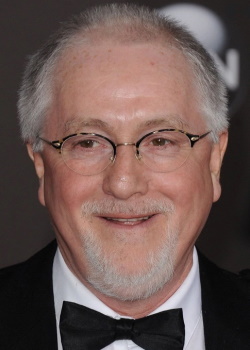
The score for A Little Princess was by Scottish composer Patrick Doyle, who by mid-1995 had reached a point in his career where he was consistently scoring A-List Hollywood studio films of great prestige. His scores immediately preceding A Little Princess – titles like Indochine, Much Ado About Nothing, Mary Shelley’s Frankenstein, and Une Femme Française – had deepened his reputation as for writing rich, classically melodic film music, and A Little Princess continues that trend.
 The score is lush, lyrical, and emotional, beautifully illustrating the film’s themes of loss, hope, imagination, and endurance. Interestingly, given that part of the film is set in British-colonial India, Doyle also incorporates Indian musical elements into the orchestration, using as exotic scales, tabla rhythms, bansuri flutes, and sitar-like sounds, giving the music a mystical, cross-cultural tone. Doyle had played around with ‘ethnic’ sounds in other scores before, notably the Irish sounds in Into the West in 1992 and the faux-Caribbean rhythms of Exit to Eden in 1994, but this was the first time Doyle has been given the opportunity to venture into the Indian subcontinent, and the end result is outstanding.
A lot of the film’s opening sequence, which takes place in India, blends the orchestra with the Indian elements, and as result cues like the evocative “Ramayana: A Morning Raga,” and the more ebullient and enthusiastic “Children Running” are superb illustrations of Sara’s idyllic childhood. These Indian elements recur frequently later in the score, notable during “The Shawl,” again often accompanying scenes in which Sara recalls her Indian upbringing.
The music that accompanies Sara when she initially arrives at “The Miss Minchin School for Girls” is magical and full of charm and wonderment, centering on a bank of cascading harps, as are the subsequent “Knowing You By Heart,” and “Breakfast, among others”. Then, in the stunning “Angel Wings,” Doyle introduces a recurring theme for orchestra and choir; in story context the idea of a little princess having ‘angel wings’ is of symbolic relevance, connecting to the underlying themes of innocence, hope, and eventual triumph, and the imagery of angel wings can be seen as a metaphorical representation of Sara’s pure and angelic nature. Later, cues like the sadly brief “Compassion” and the religioso “For the Princess” contain reprises of the Angel Wings theme, often incorporating a children’s choir, that are just exquisite.
Standing at odds with this whimsical and child-like elegance is the more serious music that underscores the experiences of Captain Crewe on the front lines of battle in World War I. Tracks like “The Trenches,” “Crewe and the Soldier,” and “Alone” are solemn and poignant, but no less beautiful, and add a touch of pathos to the score that gives it depth. The first part of “The Trenches” is actually an extract from Michael Haydn’s 1773 classical String Quintet in C Major, but the way Doyle segues from that into his own searingly emotional writing for strings and chorus is quite superb, and then later Doyle uses a string quartet, as well as prominent solos for oboes, to carry his themes.
Throughout the early part of the score Doyle only hints at his main theme for Sara and her relationship with her father Captain Crewe; it appears subtly in “Children Running,” and with gentleness and restraint in “Letter to Papa,” before it is finally emerges into full voice in “Kindle My Heart,” either side of a fragile vocal performance from Doyle’s then-13-year-old daughter Abigail. Sara’s happy memories of her father are the cornerstone of the film’s emotional content – they are quite literally what keep her going in the face of the abuse she suffers at the hands of Miss Minchin – and so it makes sense for this theme to be the score’s soul.
In addition to all this thematic depth, there are also a number of one-off cues worthy of special note. The gorgeous “Cristina Elisa Waltz” is a classically rich, effortlessly graceful piece that has a lot in common with the score for Sense and Sensibiity that Doyle would write later in 1995, and is amongst the loveliest pieces of this type in his entire career. “On Another’s Sorrow” features an effective, plaintive vocal performance by mezzo-soprano Catherine Hopper, and “Tyger Tyger” is a brief, celebratory explosion of renaissance trumpets and a children’s chorus that tonally reminds me a little of Benjamin Britten’s opera Noye’s Fludde. Interestingly, the lyrics from both “On Another’s Sorrow” and “Tyger Tyger” are taken from poems written by English poet William Blake, published as part of his collection ‘Songs of Innocence and of Experience’ in 1789.
Later, “The Locket Hunt” is a great, harrumphing piece of upbeat orchestral action-adventure music that blends a Ron Goodwin-esque British militaristic tattoo with a dash of childhood playfulness and the swash and buckle of a sword fight. The gorgeous pair “Just Make Believe” and “Touched by an Angel” reprise the both the Angel Wings theme and the main theme for Sara, but cleverly re-orchestrate them both in the style of other themes, bring in the ethnic Indian sounds and the cascading harps alongside the orchestra to outstanding effect. “Emilia Elopes” is a quirky but brief orchestral scherzo, while “The Escape” is the score’s only real moment of action, a more intense version of the main theme that adopts the brassy, raucous sound and scope of earlier scores like Henry V, Dead Again, and even Frankenstein.
The film’s sweeping finale, “Papa,” underscores the scene where – spoiler alert! – Captain Crewe unexpectedly returns from war very much alive, and is reunited with his beloved daughter in a stunning outburst of love, joy, and relief, which again blends the rousing orchestra with the Indian textures. The conclusive “The Goodbye” then offers a perfect end to the score, presenting several of the score’s main themes in suite fashion, including a vocal version of the main theme performed by lead actress Liesel Matthews.
Perhaps the only criticism of the score one could make is that, unlikely many other Doyle scores of the same period, the thematic content of A Little Princess is perhaps a little ephemeral and overly-subtle; even now, having listened to it several times back-to-back, they remain elusive, which is not something that can be said of things like Mary Shelley’s Frankenstein or Sense and Sensibility. With that one caveat in mind, A Little Princess is still an outstanding score, full of deeply earnest emotional content, lilting waltzes, appropriate Indian textures, and a sense of sparkling and whimsical magic fit for princesses (and princes) of any age.
Buy the Little Princess soundtrack from the Movie Music UK Store
Track Listing:
- Ramayana: A Morning Raga (2:02)
- Children Running (0:53)
- Cristina Elisa Waltz (3:02)
- The Miss Minchin School for Girls (1:38)
- Knowing You By Heart (2:33)
- Breakfast (0:56)
- Letter to Papa (1:38)
- Angel Wings (1:06)
- False Hope (1:57)
- The Trenches (1:02)
- Crewe and the Soldier (1:22)
- Alone (1:20)
- The Attic (2:00)
- On Anothers Sorrow (1:16)
- The Shawl (0:55)
- Tyger Tyger (0:32)
- Compassion (0:36)
- For the Princess (1:36)
- Kindle My Heart (3:00)
- The Locket Hunt (3:00)
- Midnight Tiptoe (1:11)
- I Am a Princess (1:13)
- Just Make Believe (1:33)
- Touched By an Angel (1:41)
- Emilia Elopes (1:36)
- The Escape (2:59)
- Papa! (2:29)
- The Goodbye (4:18)
Varese Sarabande VSD-5628 (1995)
Running Time: 49 minutes 24 seconds
Music composed by Patrick Doyle. Conducted by David Snell. Orchestrations by Lawrence Ashmore. Special vocal performances by Catherine Hopper, Abigail Doyle, and Liesel Matthews. Recorded and mixed by Paul Hulme. Edited by Roy Prendergast. Album produced by Patrick Doyle and Maggie Rodford.
Leave a comment

Shop at the Movie Music UK Store

Member of the

 MOVIE MUSIC UK
I listened tot it yesterday and boy I found it boring! No themes to remember, a lot of mishmash of different styles. Sound quality not good, loud moments and very soft, hard to hear. I heard better from Doyle.