THE ENGLISHMAN WHO WENT UP A HILL BUT CAME DOWN A MOUNTAIN – Stephen Endelman
 THROWBACK THIRTY
Original Review by Jonathan Broxton
There’s trouble brewing down in the Welsh valleys. It’s 1917, in the waning years of World War I, and there’s an Englishman who works for the ordnance survey in the village of Ffynnon Garw. He’s measuring the local mountain, Ffynnon Garw itself, but he’s come down from the mountain saying that it’s ten feet short of actually being classified as a mountain, and is now officially a hill. The villagers don’t like this one little bit, so they try to concoct lots of unusual reasons for the Englishman to stay in Ffynnon Garw while they physically make their hill ten feet higher, so that it’s a mountain again. And that’s why this smashing little film has one of the longest titles in living memory: The Englishman Who Went Up a Hill But Came Down a Mountain.
The film is a gentle comedy-drama with a nostalgic, feel-good atmosphere and a classic British eccentricity and charm. Hugh Grant plays Reginald Anson, the lead cartographer, while the locals are led by fiery publican Morgan the Goat (Colm Meaney) and his charming barmaid, Betty from Cardiff (Tara Fitzgerald). The director and screenwriter, Christopher Monger, adapted the script from a story reportedly told to him by his Welsh grandfather, and the whole thing has a loose grounding in real events that allegedly occurred in the village of Taff’s Well, near Cardiff in Wales.
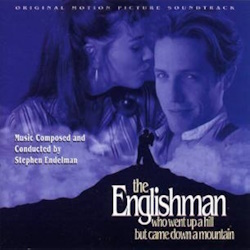
The score for The Englishman Who Went Up a Hill But Came Down a Mountain is by London-born composer Stephen Endelman. Endelman was just 33 years old in 1995, and was living in New York at the time, having moved there from the UK to work on film and theater projects several years previously. The Englishman Who Went Up a Hill But Came Down a Mountain was the first score of his that I ever heard, and I was immediately entranced by its beauty, and this is something that has stayed with me to this day.
 The score blends traditional orchestral elements with Celtic influences, including the use of Welsh folk motifs and instruments like the fiddle and harp. It’s lyrical, evocative, and at times deeply emotional, helping to underscore the film’s gentle humor, romantic undertones, and the film’s lush, pastoral setting. The first cue, “Opening Credits/English Drive,” sets the scene straight away with a beguiling concoction that blends the orchestra with skirling pipes, dancing flutes and pennywhistles, rattling sleigh bells, and sonorous voices, in a scherzo to die for. The Welsh, as a culture, are known for their musicality, both in the intonation of their accent, and in their love of powerful song, and this cue speaks to that concept perfectly with its rich, melodious, strikingly beautiful tone.
This Welsh Theme appears in several subsequent cues, and varies in tone from wistful to sweeping, notably in the hauntingly powerful “Johnny’s Barrow,” “Never Ending Rain,” the acapella “It’s A Hill,” and especially the incredibly atmospheric “The Rain,” the latter of which features the wonderfully rich sound of a traditional Welsh male voice choir, singing in solemn and dramatic tones.
Standing at odds to the Welsh theme is the theme for Ffynnon Garw itself and the salt-of-the-earth folk who live there, which appears in a series of playful cues that accompany the various schemes the eccentric villagers concoct to keep Anson in the village while they work on the mountain, and the humorous shenanigans that result from it all. Cues like “Hustle & Bustle,” the vivacious “The Brothers Tup,” “Villagers Begin Building,” and “Tommy Two Strokes,” are light and whimsical, full of delightful energy, and convey a mischievous sense of humor through their pizzicato strings, prancing woodwinds, and bouncy brass passages.
Finally, the delightful love theme for Hugh Grant and Tara Fitzgerald’s characters – first performed in “Lovers on the Mountain,” and then subsequently in the delightful “Anson & Betty” – is fresh and lush, makes outstanding use of violins and muted brasses above a solid ground cello countermelody, and usually ends with a powerful crescendo. There is a real sense of warmth and peaceful emotion to this music that I find enormously appealing.
Other cues that stand out as being of particular note include the pleasingly melodic “Johnny’s Barrow,” which has its roots in the great English patriotic classical music of Elgar and Vaughan Williams; the tragically beautiful “Reverend Jones’ Death,” and “The Sermon,” which features a lugubrious violin solo.
During the finale Endelman’s music swells with a sense of triumph and pride, notably during the scenes where the village bands together to ‘build’ their mountain. The arrangement of the traditional Welsh patriotic hymn “Men of Harlech” is appropriately stirring (and will be familiar to anyone who knows Alfred Newman’s score for the 1941 movie How Green Was My Valley, or John Barry’s score for the 1964 film Zulu), while the final song, “Magnificent Peak,” is a mysterious, poetic, utterly spellbinding track with exotically-tinged vocals by Welsh folk singer Siân James, and enhanced electronic textures behind the orchestra. The song combines Endelman’s evocative Welsh theme with lyrics adapted and translated into both English and Welsh from a famous poem by a 12th century Japanese monk, Musō Soseki; the original poem was written about Mount Fuji, but the people of Ffynnon Garw clearly think it applies equally to their mountain too.
The Englishman Who Went Up a Hill But Came Down a Mountain is a tremendous score, one of my dark horse favorites of 1995. As such, it’s been something of a frustration for me to see that Stephen Endelman’s career never quite went in the direction I anticipated after having this stellar opening. While he went on to score a number of popular films – including Flirting with Disaster in 1996, Jawbreaker in 1999, and Street Fighter: The Legend of Chun-Li in 2009 – and write some outstanding scores – my favorites include Tom & Huck (1995), The Proposition (1998), and Evelyn (2002) – his career trajectory was somewhat derailed in 2012 when he developed a rare form of brain cancer that put him in a coma for three months, and forced him to undertake a recovery which took years. Given everything that Endelman has endured, and considering that he is still only 63 years old, I continue to hold out hope that some major director will re-discover him and give him a late career boost. The quality of the music evident in The Englishman Who Went Up A Hill But Came Down A Mountain shows just what a superb composer he is.
Buy the Englishman Who Went Up A Hill But Came Down A Mountain soundtrack from the Movie Music UK Store
Track Listing:
- Opening Credits/English Drive (1:28)
- Johnny’s Triumph (1:51)
- Hustle & Bustle (2:40)
- Johnny’s Barrow (1:20)
- Never Ending Rain (0:44)
- The Brothers Tup (2:02)
- Lovers on the Mountain (2:11)
- Reverend Jones’ Death (2:00)
- It’s A Hill (0:44)
- Villagers Begin Building (2:59)
- The Sermon (1:50)
- The Rain (3:37)
- Anson & Betty (4:28)
- Tommy Two Strokes (1:13)
- Men of Harlech (traditional, arranged by Jonathan Romeo) (1:51)
- Ffynnon Garw (2:11)
- Magnificent Peak (written by Stephen Endelman and Musō Soseki, performed by Sian James) (3:59)
Epic Soundtrax EK-67151 (1995)
Running Time: 37 minutes 08 seconds
Music composed and conducted by Stephen Endelman. Orchestrations by Stephen Endelman. Featured musical soloist Giles Lewin. Featured vocal soloists Siân James and The Gwalia Male Voice Choir. Recorded and mixed by James P. Nichols. Edited by Todd Kasow. Album produced by Stephen Endelman and Jeffrey Kimball.

Shop at the Movie Music UK Store

Member of the

 MOVIE MUSIC UK