ROB ROY – Carter Burwell
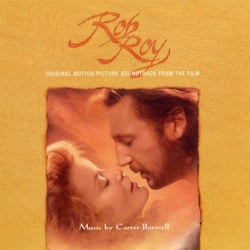 THROWBACK THIRTY
Original Review by Jonathan Broxton
One of two ‘historical Scottish epics’ released in 1995 – the other, of course, being Braveheart – Rob Roy is a historical drama set in the early 18th-century Scottish Highlands. The film follows Rob Roy MacGregor (Liam Neeson), a clan leader who strives to maintain honor and dignity while navigating the brutal social and political landscape dominated by aristocratic landowners and English influence. Rob borrows money from the Marquis of Montrose (John Hurt) to improve his clan’s welfare but is betrayed when the money is stolen by the cunning and sadistic Archibald Cunningham (Tim Roth), an associate of Montrose. Rob refuses to falsely implicate himself in a political scheme in order to regain the funds, choosing instead to uphold his principles. This decision makes him an outlaw and sets him on a dangerous path of vengeance, survival, and moral conflict. The film was directed by Michael Caton-Jones, and co-stars Jessica Lange as Rob’s devoted wife Mary, plus Eric Stoltz and Brian Cox in other supporting roles.
The real Rob Roy MacGregor, who lived from 1671–1734, was a Scottish folk hero, often likened to Robin Hood. Born into the Clan MacGregor, Rob lived during a time of great political unrest in Scotland, but thanks to tales of his cunning, swordsmanship, and code of honor, he became a symbol of Highland resistance and Scottish identity, especially during a period when Highland culture was being suppressed by the English. Sir Walter Scott later helped popularize Rob Roy’s legend further through his 1817 novel Rob Roy, which painted him as a noble rogue.
The film received generally positive reviews for its performances and cinematography; Liam Neeson’s portrayal of Rob was praised for its dignity and intensity, and Tim Roth’s villainous turn as Archibald Cunningham was especially acclaimed, eventually earning him a BAFTA win and an Academy Award nomination for Best Supporting Actor. Despite being overshadowed by Braveheart it was a moderate commercial success, and it is noted for its more intimate, character-driven story and its commitment to themes of personal honor. It also remains respected for its realism, especially the gritty and famously brutal sword fight between Rob Roy and Cunningham in the climax.
 The score for Rob Roy was by Carter Burwell, who previously worked with director Caton-Jones on Doc Hollywood in 1991 and This Boy’s Life in 1993. Burwell is usually associated with quieter, character-focused music, and while Rob Roy contains a decent amount of that type of music, the scope of the film also allowed him to really stretch his lyrical, romantic side, and as a result I feel that this is one of his most rewarding scores.
It’s also a treat for anyone who loves traditional Scottish music, as the score is awash with it. In order to create an authentic sound Burwell collaborated with the Scottish folk band Capercaillie and their brilliant lead vocalist Karen Matheson; as such, much of the score is a superb blend of a traditional western orchestra with regional instruments: bagpipes, whistles, recorders, fiddles, Bodhrán drums, and more. Together, this music beautifully captures both the grandeur of the Scottish Highlands, and Rob Roy’s culture, as well as the deeply personal struggles of the film’s characters.
The score’s main theme is essentially the love theme for Rob and Mary, as it is Rob’s love for her and desire to secure peace and freedom for his family that is his ultimate driving force. It is essentially the first thing one hears, at the beginning of the “Overture,” and it is a lush, lyrical piece that combines tender romance with just a hint of melancholy. It is ever-present throughout the score, offering emotional depth and haunting beauty at every turn, and when Burwell really leans into the melody the effect is spellbinding: “Home From the Hills,” the vocal variation in “Hard Earth,” the magical “The Last Peaceful Night,” the anguished and furious variation in “Honor Inflamed,” and “Hard Home on the Moor,” are all outstanding.
However, my choice for the best rendition of the theme comes during “A Standing Stone, A Silk Purse.” The cue accompanies a scene where, in a rare moment of calm and intimacy, Rob and Mary find time to make love against a standing stone high up in the hills; as they do so the camera swoops up and around them revealing the spectacular Highland vistas in the distance, and Burwell’s music just soars.
There are also several intense action sequences in the score, but to his credit Burwell resists the temptation to over-work them, relying instead on tight and insistent percussion rhythms backed by throbbing brass, skirling pipes, florid pennywhistles, and vivid wordless vocals to accompany Rob’s quest for justice. Cues like “The Rieving Party,” the darker and more menacing “Troops in the Mist,” “Call of the Claymore,” and almost all of the bitterly ominous 6-minute “Rannoch Moor Suite” are especially notable in this regard. There is a fantastic burst of action during the “Rannoch Moor Retreat” sequence of that suite that is really excellent.
The final part of the conclusive Love and Death Suite, “Cunningham’s End,” underscores the immensely satisfying climactic scene where Rob literally cuts Tim Roth’s annoyingly foppish but sadistically evil character Archibald Cunningham in half with a swing of his claymore; Burwell scores it less with grandeur and celebration, but more a sense of weary relief, which is much more appropriate.
Other cues of note include the brief burst of English classical pastiche at the beginning of “Blood Sport” as an acknowledgement of the Marquis of Montrose and Archibald Cunningham, plus several moments of intense vocal passion in the score’s second half – notably during “The Cave” – which use Karen Matheson’s vocals as a sort of secondary motif representing Rob’s righteous anger and vengeance. The final cue, “Robert and Mary,” is another score highlight, and sees Burwell reprising the main theme with a significant sweep, emphasizing Rob’s triumph, his reunion with his beloved wife, and the cementing of his legacy into Scottish folklore.
In addition to Burwell’s score, there are several traditional Scottish reels and songs performed by Capercaillie and vocalist Karen Matheson dotted throughout the album; “The Gaelic Reels,” “Ailein Dunn,” “The Blunt Reels,” “Theid Mi Dhachaigh (I’ll Go Home),” and “Morag’s Lament” range in style and tone from raucous dances and drinking songs to lyrical, poignant reflections of loss and sorrow, and they are all outstanding.
Something really quite special happens when Carter Burwell leans heavily into the music of a particular region or culture. It was evident in the Irish music of Miller’s Crossing in 1990, and it was evident again in his use of Scandinavian and Nordic elements in his score for Fargo in 1996, as well as his later explorations of the sounds of the American west in scores like The Hi-Lo Country and The Alamo. Rob Roy is very much a part of that tradition, and if you have an affinity for music which blends orchestras with Scottish and Gaelic instrumental textures, then this will immediately appeal. I myself have this affinity, and as such Rob Roy remains one of my all-time favorite Burwell scores.
Buy the Rob Roy soundtrack from the Movie Music UK Store
Track Listing:
- Overture: Rob Roy/The Rieving Party (4:42)
- Home From the Hills (2:46)
- Hard Earth (2:10)
- Procession for the Ill-Used (1:40)
- Blood Sport (1:16)
- The Gaelic Reels (traditional, performed by Capercaillie) (1:07)
- Ailein Dunn (traditional, performed by Karen Matheson) (2:37)
- The Last Peaceful Night (1:51)
- Troops in the Mist (1:15)
- Honor Inflamed (3:21)
- The Dispossessed: The Cave/Hard Home on the Moor (2:03)
- The Blunt Reels (traditional, performed by Capercaillie) (2:15)
- Highland Justice: Call of the Claymore/Assize of the Gregorach (2:58)
- A Standing Stone, A Silk Purse (3:37)
- Theid Mi Dhachaigh (I’ll Go Home) (traditional, performed by Capercaillie feat. Angus Grant and Karen Matheson) (1:20)
- Rannoch Moor Suite: Scorched Earth/Rannoch Moor Retreat/The Mists/Rob Come To Hand (6:07)
- Morag’s Lament (traditional, performed by Karen Matheson) (0:50)
- Born By Rapids (2:26)
- Love and Death Suite: My Beloved/A Matter of Honor/Cunningham’s End (4:10)
- Robert and Mary (3:14)
Virgin Records 7243-8-40351-2-9 (1995)
Running Time: 51 minutes 45 seconds
Music composed by Carter Burwell. Conducted by Carter Burwell and Sonny Kompaneck. Orchestrations by Sonny Kompaneck. Featured musical soloists Capercaillie (Karen Matheson, Charlie McKerron, Angus Grant, Marc Duff, Fred Morrison) with Davy Spillane, Máire Breatnach, Tommy Hayes, Ronan Brown and Miriam Stockley Recorded and mixed by Michael Farrow. Edited by Adam Smalley. Album produced by Carter Burwell.

Shop at the Movie Music UK Store

Member of the

 MOVIE MUSIC UK