THE KING OF KINGS – Tae-Seong Kim
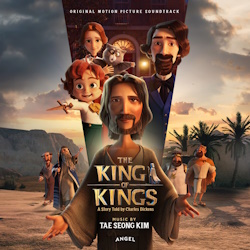 Original Review by Jonathan Broxton
For many years during Hollywood’s golden age one of the studio staples was the ‘biblical picture,’ big-budget star-studded epics adapting stories from the Christian bible. Ben-Hur, The Ten Commandments, The Greatest Story Ever Told, The Robe, Quo Vadis, and so on and on; films like these won Oscars, broke box office records, and are today remembered as some of the best and most important films in history. However, over the last couple of decades, the popularity of these biblical epics has decreased significantly, and now very few of them are made. The last one to achieve any sort of commercial success was Mel Gibson’s The Passion of the Christ in 2004, and efforts to revitalize the genre have mostly failed – Darren Aronofsky’s Noah, and Ridley Scott’s Exodus among them.
As such, it’s therefore something of a surprise to see The King of Kings, a new biblical film, open over Easter weekend 2025, and for it to be surprisingly well-reviewed. It’s also something of a surprise to learn that it is an animated film, made in South Korea by Korean director Seong-Ho Jang. It’s loosely inspired by the children’s book ‘The Life of Our Lord’ by Charles Dickens; in the film, Dickens tells the life story of Jesus to his young son Walter, which is then further brought to life as Walter imagines himself traveling side by side with Jesus and the disciples, and witnessing the various events in Christ’s life. The film has an astonishing voice cast – Kenneth Branagh as Charles Dickens, Uma Thurman as Charles’s wife Catherine Dickens, Mark Hamill as King Herod, Pierce Brosnan as Pontius Pilate, Forest Whitaker as Saint Peter, Ben Kingsley as High Priest Caiaphus, and Oscar Isaac as Jesus – and has an excellent original score by Korean composer Tae-Seong Kim.
Kim is the latest in a long line of Korean composers to break into the American mainstream, following on the heels of artists like Jae-Il Jung, Yeong-Wook Jo, Byung-Woo Lee, Dong-June Lee, Hye-Seung Nam, Mowg, and Dalpalan. As I wrote in my review of Mickey 17 earlier this year, Kim’s success here can also be seen as yet another instance of the growing global popularity of Korean culture – its cuisine, TV shows like Squid Game, K-Pop music acts like BTS and Blackpink, and the movies made by directors Joon-Ho Bong and his contemporaries.
 Something I found very interesting about Kim’s score for King of Kings is how different it is from those Hollywood biblical epics I mentioned before. I have no idea what personal religion Kim follows, if any, but I do know that Miklos Rosza, Alfred Newman, Elmer Bernstein, and others of that generation, were all either Christians or Jews from central European heritage, and as such they all tended to adhere to a certain set of expectations in terms of their approach, as informed by their faith and their heritage and by Hollywood convention: all those biblical epics had a very specific sound to them, and it was magnificent, and while Kim’s score is also very good it is also very different. Kim’s musical depiction of the life of Jesus is not in any way informed by those familiar Judeo-Christian traditions, and so it is quite fascinating to hear this very distinct take.
Kim provides the score with two main themes – one for the main setting in Jesus’s time, and one for the Dickensian framing story – as well as several recurring textures. Despite being literal millennia apart, Lee does allow some of these thematic ideas to bleed from one setting into another, which results in an unusual cross-pollenation of ideas and makes for fascinating listening overall. The Dickensian idea, which is first heard in the “Prologue” and also features strongly in both “The Beginning” the ”Epilogue,” is a lovely piece for pretty pianos and woodwinds, lyrical and delicate, backed by a set of captivating vocal textures performed in what sounds like Korean by an unnamed female vocalist whose timbre reminds me very much of Mai Fujisawa, the daughter of composer Joe Hisaishi; anyone who is familiar with Fujisawa’s contributions to her father’s score for Ponyo, or to Chad Cannon’s score for the 2023 offbeat comedy Tokyo Cowboy, will hear the similarities immediately.
The Jesus theme is introduced in the third cue, “Nativity,” after young Walter Dickens becomes enthralled by his father’s biblical stories and imagines himself being present at all the key moments in Jesus’s life. The Jesus theme is tender, appropriately hymnal, and beautifully elegant; it makes interesting use of a glockenspiel behind the pianos, warm strings, and soothing woodwinds, and features a fascinating passage of layered female vocals chanting and singing in what may be Latin, and which appears to be Kim’s musical representation of angels. The cue builds to a lovely triumphant finale full of excitedly dancing, highly classical strings, backed by a bed of robust percussion. More than once in the score I detected a hint of Georges Delerue in the way Kim combines pianos with woodwinds during his statements of the Jesus theme – there is something about the specific tone of the piano that gives it away – and that is very welcome indeed.
The Jesus theme and its associated textures appear regularly throughout the rest of the score, often appearing at especially notable moments of religious power – there are especially notable reprisals in “Surfacing,” Suffering,” and “The Cross” – but to Kim’s credit he constantly keeps the music fresh and interesting by composing unique passages of new ideas for the different stages of Jesus’s life. For example, “Maturity” moves easily between lovely writing for pianos and vocals, darker passages for churning strings, a beautiful variation of the Jesus theme transposed to cellos, and a grating and harsh sequence for dissonant orchestra and buzzing electronics backed by aggressive chanted Latin male voices.
Later, the aforementioned “Surfacing” features some engaging, if distinctly Zimmer-esque, ebullience in the string writing, along with another gorgeous rendition of the main theme for cellos, while the otherwise rather low-key “The Sign” ends with a celebratory explosion of orchestral power full of more of those unusual ‘angelic’ vocal inflections, as well as a bank of vivacious pianos backed by sparkling string runs.
“Storm” is a showcase for Kim’s enjoyable action music style, and features some wonderful writing for bombastic strings and powerful brass, but ends with a sequence of calmness and reflection, albeit one which is underpinned with a touch of trepidation. At the other end of the scale, “Hosanna” features the engaging sound of a children’s choir singing an upbeat, celebratory lyrical original hymn in English.
The Easter finale of the score – which, of course, deals with the crucifixion, death, and resurrection of Jesus, the central tenet of Christianity – is the darkest, more somber, but also the most overtly emotional of Kim’s music, and for me really underlines with an excellent composer he is.
“Suffering” opens with a slow, emotional variation on the main Jesus theme, anchored by intimate piano and cello writing, as well as some breathy hummed vocals that play alongside the unusual layered ‘angel’ vocal stylings from earlier in the score. The dark action finale has another touch of Hans Zimmer to it, especially some his late 80s/early 90s scores like Black Rain, and focuses on heavy electronically-enhanced percussion rhythms offsetting the powerful thrusting strings and nervous tremolos. “The Cross” is darker still, but hugely emotional, full of yet more haunting vocals and searching strings. Finally, the conclusive “Resurrection” underscores the most pivotal of moments with a sense of impending drama, slowly building to its celebratory and majestic finale with glorious religioso strings, softly angelic voices, and a sense of deep, profound emotion. It’s really quite superb.
The score is bookended by two versions of an original song, “Live Like That,” co-written by Broadway legend Kristin Chenoweth with Kellys Collins, Tim Nichols, and Matt Wynn, and performed by Chenoweth. It’s fine; it’s a contemporary Christian rock/pop song, but it’s not really my cup of tea.
Tae-Seong Kim’s score, however, is very much my cup of tea, and what I like about it most is how he brings such a markedly different emotional and tonal sound to such a familiar story. As I said earlier, this is not a biblical story in the classic Hollywood style; there is no Miklos Rosza or Elmer Bernstein to be found here. What there is instead is a sophisticated, stylish, interesting, modern score full of heart and emotion, but which comes at things from a distinctly non-western direction.
Buy the King of Kings soundtrack from the Movie Music UK Store
Track Listing:
- Live Like That (written by Kristin Chenoweth, Kellys Collins, Tim Nichols, and Matt Wynn, performed by Kristin Chenoweth) (4:16)
- Prologue (1:51)
- The Beginning (2:12)
- Nativity (3:36)
- Maturity (6:36)
- Surfacing (4:55)
- The Sign (3:58)
- Storm (6:28)
- Hosanna (3:53)
- Suffering (8:12)
- The Cross (4:37)
- Resurrection (4:23)
- Epilogue (4:51)
- Friends Adventure (written by Jun-Ha Park and Mi-Hyun Lim, performed by Jun-Ha Park) (3:10)
- Live Like That – Acoustic Version (written by Kristin Chenoweth, Kellys Collins, Tim Nichols, and Matt Wynn, performed by Kristin Chenoweth) (4:08)
Sony Classical (2025)
Running Time: 67 minutes 06 seconds
Music composed by Tae-Seong Kim. Conducted by Sunju Oh. Orchestrations by Mi-Hyun Lim. Additional music by Jeong-In Choe, Hye-Hyun Kim, Hyung-Suk Kim, Yeon-Jeong Kim, Tae-Hyun Lee, Mi-Hyun Lim, and Young-Min Ryu. Recorded and mixed by XXXX. Edited by Alex Olijnyk. Album produced by Tae-Seong Kim.
-
February 6, 2026 at 8:01 amMovie Music UK Awards 2025 | MOVIE MUSIC UK

Shop at the Movie Music UK Store

Member of the

 MOVIE MUSIC UK