PICNIC – George Duning
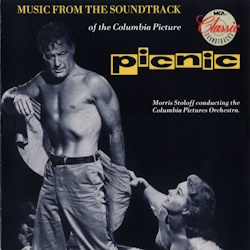 GREATEST SCORES OF THE TWENTIETH CENTURY
Original Review by Craig Lysy
Columbia Pictures took notice of the enormous success of the Broadway play “Picnic” by William Inge, which opened on February 19, 1953 at the Music Box Theater, ran for 477 performances, and won the Pulitzer Prize in Drama in 1953. The studio purchased the film rights in 1953 for $350,000, Fred Kohlmar was placed in charge of production with a budget of $3 million, Joshua Logan, the director of the Broadway stage production was tasked with directing, and Daniel Taradash joined William Inge in writing the screenplay. For the cast, the studio made the controversial decision to cast 37 year old William Holden, their marquee star, as 21 year old Hal Carter, joining him would be Kim Novak as Madge Owens, Rosalind Russel as Rosemary Sydney, Betty Field as Flo Owens, Cliff Robertson as Alan Benson, Nick Adams as Bomber, and Susan Strasberg as Millie Owens.
The film is set in 1955 in a small Kansas town and follows the fortunes of Hal Carter, a vagrant down on his luck, who makes a fateful decision to visit his fraternity friend Alan Benson over the Labor Day weekend. He becomes a catalyst for discord, a random element, and a disruptive agent of change for several of the people he encounters, forever altering their lives. The film was a massive commercial success, earning $9 million. Critical reception was universally good, with widespread praise for exceptional human drama and storytelling. As such, it received six Academy Award nominations, including; Best Picture, Best Director, Best Supporting Actor, and Best Music Scoring for a Dramatic Picture, winning two awards for Best Art Direction and Best Film Editing.
Studio veteran and Columbia Pictures ‘House’ composer George Duning was assigned to the project. Upon viewing the film, I believe he realized that Hal served as the nexus of the film’s narrative, the random element which serves as a catalyst for change, upheaval and chaos. What is masterful in conceiving his soundscape was the decision to first create Hal’s Theme, as his Main Theme and foundation for his musical narrative. It emotes with repeating seven-note phrases, which evoke loneliness, wander aimlessly without purpose, and never resolve, offering an embodiment of his loser life as a vagrant. There are undercurrents of dissonance, reflecting the changes he brings to everyone he meets. In a stroke of genius, Duning uses Hal’s Theme as the hub of a wheel, from which the spokes (other characters) connect. Each character has a kindred theme, derived from Hal’s Theme, as they in the end are all transformed from him for good or ill in some way. Flo’s Theme serves as her identity as Madge’s and Millie’s mother. It offers forthright romanticism, borne by warm, lush strings full of maternal warmth. Millie’s Theme is woodwind borne and offers a child-loke playfulness with comedic accents when she has to ditch her cigarette lest her mother discover her surreptitious smoking. Madge offers repeating refulgent ascending phrases full of hope, which reflect her aspiration to find love not based on her looks, but instead on her persona. Other girls would kill for her beauty, yet Madge finds it a curse, which results in her objectification.
 Rosemary’s Theme offers repeating woodwind borne four-note phrase full of sadness, which rise and fall. It offers another theme which never resolves, and speaks of her loneliness and longing for love, hidden by a hard thin veneer, which eventually shatters. To provide a contemporaneous sensibility to the soundscape, the following pop songs were woven into its narrative; “Ain’t She Sweet?” by Milton Ager and Jack Yellen, “In the Gloaming by Annie Fortescue Harrison and Meta Orred, “Love’s Sweet Song” by G. Clifton Bingham and J.L. Molloy, “Moonglow” by Will Hudson, Edgar De Lange, and Irving Mills, “It’s a Blue World” by Bob Wright and Chet Forrest, “Pennies from Heaven” by Arthur Johnston and Johnny Burke, “Old Black Joe” by Stephen Foster, “Camptown Races” by Stephen Foster, and the hymn “Juanita” by Caroline Norton.
The album opens with “Love Theme”, which is not attached to a film scene, but instead offers a concert piece presentation of Duning’s gorgeous theme. Bright and hopeful strings romantico full of yearning speak to Madge’s aspirations to find true love. The film opens with the Columbia Pictures logo supported by repeating train horn blows, and we segue into the film proper with “Hal’s Theme”. It opens with train horn blows and train sounds as a freight train arrives. The engineer opens a freight car door and rouses Hal, saying he had arrived. When Hal confides that he is friend’s father is a big shot in the grain business, the engineer says he knows, adding, that is how he got this job. He departs and Hal angrily slams shut the door supported by blaring horns irato and drums as he walks to the river to freshen up. Horns declare his theme and the flow of the opening credits commences. Duning offers an extended exposition of Hal’s Theme, which shifts at 0:57 to strings. Hal is down on his luck and this is reflected in the music, which wanders aimlessly, never resolves, and has an undercurrent of dissonance. The music ends with uncertainty as he sees two houses where an old lady (Helen Potts) comes out and with pride shows her neighbor Millie a cake she has baked for tonight’s picnic. Later, he comes across Mrs. Helen Potts and offers to rake and clean her property. But she says oh no, as it is Labor Day. She asks if he is hungry, he says yes and she brings him in for breakfast.
We flow into “The Owens Family” where we see tomboy Millie sneaking a cigarette. Duning introduces her carefree and playful child-like theme to support. At 0:18 a celeste waterfall effect supports water dripping onto Millie’s book as her sister Madge dries her wet hair from the bedroom window above. At 0:34 an exasperated woodwind descent supports Millie ditching her cigarette as their mother Flo comes out. At 0:37 we flow warmly atop sumptuous strings into a tender Flo’s Theme as she joins and complains about the heat. Interplay with Millie’s Theme supports as the two sisters argue when Millie refuses to dress up or act proper to get a date for the dance tonight. Later, Hal meets Madge who provides him directions to Alan’s house. She returns home, turns back, and at 2:00 a refulgent ascent on her five-note theme with harp adornment reveals nascent stirrings of attraction in her eyes. Hal surprise Alan with a visit, and they reacquaint. Music beginning at 2:06 seems to have been dialed out of the film. It offers a reprise of Flo’s Theme, shifting to Hall’s Theme at 2:36 to I believe support his arrival at the Benson residence. A light-hearted and whimsical musical narrative unfolds as Hal reminisces about a misadventure with two girls who got him drunk and robbed him. We close at 4:14 with a reprise of her theme.
“Flo And Madge” offers a score highlight where Duning masterfully scores a scene with intense and shifting emotional dynamics. It reveals Flo, who is sowing Madge’s dress, counseling her daughter on the need to get married while she is still young and beautiful. Music from 0:00 – 0:13 was dialed out. It offers an inverted rendering of Madge’s Theme used to support Millie and Madge saying hurtful things to each other about Millie’s non-interest in boys. Millie runs out sobbing saying Madge is the pretty one, and that I am not a goon! At 0:14 a warm and comforting Flo’s Theme brimming with a mother’s love counsels Madge that with marrying Alan she could live a wealthy and secure life in a mansion with credit accounts at all the stores. Slowly and subtly the music begins to sour with dissonance when Madge replies, that she is not comfortable being around the Benson’s and their friends. She adds, what good is it to just be pretty, and that she is tired of always being looked at. Flo then begins to probe, asking if she and Alan are kissing, and if he has tried to make love to her. Madge is flustered at this intrusion, and Flo eventually loses her temper and chides Madge for always being mean to Millie. At 2:23 strings of pain propel a tempest of hurt, which carries a sobbing Madge’s run upstairs to her bedroom. The caring and warmth of Flo’s Theme resumes as she realizes she was harsh, and joins Madge in her bedroom to comfort her. At 3:15 whimsical woodwinds tenero support Flo reminiscing of her joy when Madge was born, and how happy their family was. Yet, the music descends into sadness that she relates things changed with Millie’s birth, as her father began staying away and eventually left, never to return.
“Hal’s Boots” reveals Alan and Hal taking a car ride where they reminisce. Hal recalls how Alan was the ideal student, while he was only successful between the goal posts. Hal then discloses that his father died after final bender. Music enters sharply as they arrive at Alan’s family’s massive grain storage and processing center where he shows Hal how they load the rail cars. The music subsides as they ride up a lift to the roof where they gaze out on a massive complex with several banks of grain silos and trains, which ship it across the country to mills for processing. Hal asks Alan if he and his ole man could find him a job, and Alan says of course. Hal then relates his desire for an executive desk job with a secretary. Music reenters at 0:11 with a plaintive rendering of his theme, which supports his admission that he just has to make something of his life. Alan is understanding, however the music sours at when he says that he will have to work his way up in the company, as he did, starting at the bottom. Hal’s Theme supports as he slams a metal vent and says he understands, and must learn patience. Alan then declares that they are going swimming with two gals, including his girlfriend. At 2:03 woodwinds voicing Alan’s surprise support Hal saying, that he met his girl, Madge. We close on a coda of Hal’s Theme
In unscored scenes, we see that at the lake is a large platform with a diving board. Many people are swimming and Hal showboats for the girls with some spectacular springboard dives. On shore, Alan tells Madge that he wants to get away tonight on a boat on the river, just the two of them. She agrees and they kiss passionately. He then amorously offers effusive praise, declaring that she is the most beautiful girl he has ever seen, which makes her blush. Later in the locker room as they are changing out of their swim trunks Hal expresses hesitation joining the picnic, as he has never been on one. In the women’s locker room Millie frets to Madge that she doesn’t know how to talk to boys. Later everyone assembles at the Owen’s house; Madge and Alan, Hal and Millie, Rosemary and Howard, Flo and Mrs. Potts. Hal loads the cars, and they all head off for the picnic. In Alan’s car Flo complains about Hal’s lack of breeding, in Alan’s other car which Hal is driving, he and Millie sing “Ole McDonald Had a Farm”, while in Howard’s car he and Rosemary argue over him taking a little nip of whiskey.
(*) “Picnic” reveals hundreds of town folk arriving and setting up tables. A band setup on a roofed platform supports with a Sousa-like marcia festivamente. Kids are playing, games like the three-legged race are seen, as a men’s barbershop quartet sings “Camptown Races”. The band offers a parade of folksy tunes, which support a montage of people having fun; “Old Black Joe” “Swanee River”, the Sousa-like march, and “Ain’t She Sweet?”. Later with everyone resting Hal talks about his father, the boots he left him, and how the man of the house has to own a pair of boots. As he talks, Rosemary makes a lustful scan of his crouch. His theme, again shorn of its confidence is offered subtlety, and sadly under the dialogue as he relates his gratitude for Alan and his father offering him a job. He then relates a lesson he has learned coming here, that he needs to stop rolling around like a pin ball, and settle down, in a town like this. He locks eyes with Madge, her mother and everyone notices, and the tension is palpable. His theme resumes its cockiness as he climbs a rope, swings down and changes topics. Later, at sunset the people sing as a chorus the solemn hymn “Juanita”. A new montage commences supported by the “Juanita” chorus as we see Helen reminiscing to Flo about her happiness living next door and watching the girls grow up, Rosemary relating to Howard the beauty of the sunset, Alan and Madge silhouetted walking hand in hand, and Millie sketching a portrait of Hal and relating that she also writes poetry she has never shown anyone. Returning to Alan and Madge, he says his father will be proud when she is picked as Queen tonight. We switch to the dance floor where couples dance as the band plays the classic tune “Pennies from Heaven” with a Swing sensibility. At the river dock heraldic trumpets resound as the MC declares the moment we have been waiting for, has arrived, as we declare our Queen of Neewollowah. Off key trumpeting fanfare announce her arrival. A paddlewheel boat approaches the dock as the quartet sings “Neewolloah” answered by the town in chorus. Cheers ring out and the crowd chorus begins singing “Ain’t She Sweet” as we see Madge wearing a crown and holding a bouquet of red roses. She gives a humble thank you speech and then the band leads everyone back to the dance floor playing “Ain’t She Sweet”.
“Moonglow And Love Theme” reveals Hal and Millie dancing to Moonglow, a slow dance Blue’s tune. Hal notices Madge dancing alone seductively and after hesitating, begins to dance towards her. He takes her hand and they start to dance with arms extended as Millie, Howard and a drunk Rosemary watch. They pause, slowly move into each other’s arms, and at 2:05 begin dancing intimately with the melody now shifting to the Love Theme borne by lush strings romantico. Their eyes are transfixed on each other, blocking out the world. On a bridge above, Helen and Flo look down and we see Flo seething with disapproval. The music ends, the crowd applauds, and Rosemary slaps Howard on the stomach asking; “Why can’t you dance that way. We flow into “It’s A Blue World Torn Shirt (Part 1)”, which offers a powerfully emotional score highlight as we see the two couples begin slow dancing to the Blues song instrumental. Rosemary decides she wants to dance with Hal, pulls Madge away, and forces herself into his arms as a dejected Madge, and shocked Howard watch. She is pawing him, and Hal has finally had enough, and at 2:00 a dissonant horn blare support Rosemary tearing his shirt as he pulls away. An aggrieved Hal’s Theme supports his embarrassment as he moves away and is comforted by Madge. Howard tells Rosemary to leave them alone as they are young. And she angrily counters with contempt; “What do you mean they’re young!” At 2:21 Millie runs aways saying she feels sick carried by a painful rendering of her theme. Madge tries to comfort her, but Millie pushes her away, tells her I want to die, and that she hates her! Repeating; “Madge is the pretty one!”. She runs away followed by Flo and Helen. Flo returns and demands to know who fed Millie liquor. At 2:57 and aggrieved Hal’s Theme joins as Howard lifts the empty bottle, and Rosemary enacts revenge for Hal’s rejection by shouting; “Hal did it!” Howard tries to intercede, but Rosemary now unleashes a horrible and hurtful diatribe against Hal supported by a painful, strident and dissonant musical narrative entwined with Hal’s aggrieved theme, and searing orchestral thrusts propelling each insult. We end on a climactic and shattering cresecendo violento as Howard forcibly yanks Rosemary away, saying that’s enough when a flood light is focused on them as Alan looks down.
“Torn Shirt (Part 2)” offers perhaps the score’s finest, and most dramatic cue with impassioned interplay of Hal’s Theme and the Love Theme. It reveals an angry Howard telling them to turn off the flood light as Alan runs down. He demands Hal tell him what happened, but Hal is clearly devastated by Rosemary’s attack, and cannot seem to speak. Alan becomes enraged and yells that he is the same old Hal and that he should have never trusted him. The scene is supported by Hal’s Theme rendered as a Pathetique, which carries his run away from Alan’s rebuke. Plaintive woodwinds of despair voice Rosemary’s Theme as Howard joins a distraught Rosemary to comfort her and she asks him; “Why did she do it? What made her do it? He asks her to take a night ride under the harvest moon, and she agrees. At 1:01 we surge on a painful rendering of Hal’s Theme as he retrieves his belongings from the car. At 1:30 Madge arrives at the car and says Alan had no right to treat you that way. The Love Theme supports, but he will have none of it. He pushes her away, yet she persists, and gets in the front seat. He brusquely says ok, I warned you, and they speed off together propelled by a pained rendering of his theme joined at 2:04 by a plaintive Love Theme as he tears of his shirt, throws it in the car, and tells her to thank Alan for it. As he walks away, she asks where is he going, and he says a freight train will be by soon and a 2:30 he walks way down to the river and refreshes himself, carried by his defeated and forlorn theme. Duning bathes us is despair as Madge joins and she says Rosemary embarrassed the whole female race. Yet he counters that she saw through him, saw him as he really is, a bum who will never amount to anything. She consoles and compliments him, and the music warms on the Love Theme. Yet at 4:07 his theme writhes in pain as he rages against his terrible childhood, how his mother rejected him, and his father was a drunk. He angrily tells her to go home, but instead at 5:20 she kisses him and we blossom on he Love Theme. When he asks what is she doing, she says she is tired of people liking her because she is beautiful. She runs from him, he pursues and catches her, and they again join in a kissing embrace. She says that they need to get back to the picnic, and he answers, “Do we?” as the Love Theme blossoms and the train roars by. We close powerfully on a crescendo dramatico.
“Rosemary Pleads” offers another emotionally poignant score highlight. It reveals Howard returning Rosemary to the Owens house where she rents a room. He bids her goodnight, but she is distraught and tells him after what has happened, he cannot leave her, pleading with him to take her home with him. She reminds him that he promised to marry her, and he responds that he is not a boy anymore, and now too fixed in his ways. He tells her that he is dead tired, and that they should discuss this Saturday. Music enters as he gets up and begins walking back to his car, but she grabs him from behind and pleads that he has to marry her. He says that she should at least say please if she desires marriage, and she gets on her knees and begs him, saying, please. But he declines, saying he will be by in the morning to discuss. As he departs, she says, do not come back unless you intend to marry me and take me away. He tells her to get some sleeps, and as he reaches his car and looks back, he sees her grasping the porch strut saying please. Duning supports this very emotional scene with a forlorn rendering of Rosemary’s Theme, which transforms into an aching Pathetique, which swells at 1:17 on an unbearable crescendo of pain, which crests with futility. At 1:35 we flow seamlessly into “Rosemary Alone” atop woodwinds affanato and a retinue of strings triste as she watches Howard drive away, knowing he will not return.
“Culmination” reveals that Hal has taken Madge home. He wants to see her tomorrow, but realizes he still has Alan’s car, and no job. He asks if she would mind seeing a man that worked as a grain scooper, and she says of course. He then asks her to kiss him goodnight, and she says no, which causes him to slump to his knees. He asks is she trying to punish him, and she says, yes, I guess I was. She then also slumps and asks him to kiss her. As they kiss the Love Theme blossoms for a stirring exposition as he professes that she makes him feel important. At 1:14 she says she has to go, and woodwinds bearing her theme carry her run to the house. As she slowly creeps up the stairs to the bedroom, quotes of Hal’s Theme are heard. In the room, Millie is sleeping, yet wakes up as Madge lays on her bed. Millie plaintive theme joins as she says, it is alright, adding that she was bad tonight and will never touch a drink again. We close with sadness as their two themes entwine as Madge falls to sleep sobbing. At 2:34 we segue atop foreboding horns into “Hal’s Escape” as he pulls up in Alan’s driveway to return the car and finds a police car parked in front. His tortured theme carries him into the house. The music pauses to support the riveting scene. Alan accuses him of stealing the car, and calls him a hobo. He tries to punch Hal, who sidesteps causing Alan to tumble to the ground. Alan asks that the police arrest Hal and they try, but he resists and yells angrily that he did not steal the car and that this is really about Madge. Alan tackles him, they fight, and Hal ends up pummeling Alan and both policemen. As Hal flees in Alan’s car, a strident rendering of his theme propels his flight as the police mount a pursuit. A kinetic musical narrative empowered by Hal’s Theme propels the action. Back at the house an angry Alan yells at his father that he is still going to marry Madge, and that he hopes Hal gets away. Hal reaches the Benson grain depot, gets out and flees into it with the two police in pursuit. Inside he dislodges the grain shoot and the police are pummeled by the outpouring grain. He decides to flee to the river and hides under a waterfall. At 5:22 a suspense diminuendo of strings supports the policeman scanning unsuccessfully with his flashlight and leaving. We close on a strident declaration of Hal’s Theme as he escapes to the other side of the river bank.
In an unscored scene, Hal arrives at Howard’s place, asks to stay for the night, and Howard takes him in. He gives him dry clothes and pours some whiskey, as they both have problems. As they drink, Howard confides that he knows Hal fell for the Owens girl, which he acknowledges. Then he adds, its not like you have to marry, is it? The next day
We flow into “That Owens Girl – Mille” atop Millie’s Theme borne by woodwinds tenero and languorous strings as she comes out on the porch in the morning and sits on the steps to smoke a cigarette. At 0:56 woodwinds comici support Flo’s arrival and Millie ditching her cigarette. Flo’s Theme joins on warm strings, but she is flustered when Millie says she was asleep when Madge came home, and that she did not say anything this morning. Miss Henderson and Miss Schoenwalder arrive and go in to retrieve Rosemary as they are scheduled to assist the school principal today. Then Howard arrives and tells Millie that it is his busy season, and that he cannot make any big plans right now. A frantic Rosemary grabs him, pulls him into the house where she declares to the other women that they are getting married. Madge then comes down the stairs and Flo tells her to count her blessings, that Alan still wants to see her, and that he blames that hoodlum, not her. The women pull Flo upstairs, and Howard tells Madge that Hal is in the car and has to see her. She hesitates, as Hal gets out of the car and hides in the shed. Rosemary pulls the dumfounded Howard by the arm, and off they go to get marries as they are showered in rice.
In “You Love Me” Madge sees Hal at the shed door and joins him. He says he could not leave town and never see her again. He then says that he is going to Tulsa as Flo, Millie and Helen see him and join. He asks if she likes him, and Madge says from the first moment I saw you. He then says he loves her, wants to marry and asks her to come with him. Flo grabs her, says she is going to call the police, and asks that she not listen. She says I can’t, but he kisses her, and says he knows she loves him. He the declares that his life is nothing without her as he runs to get on the train. Music enters on the Love Theme, which becomes impassioned as he runs and jumps on the train and waves goodbye as Madge watches. At 1:08 a flute triste reveals her sadness as Flo rushes to comfort her. But Madge runs away and so Flo joins Helen who tells her that she liked Hal, and that he changed everything for her and her mundane life. The Love Theme carries her up to her bedroom where Millie says she will never marry, but that she should not be so dumb and instead follow your heart. Their two themes tenderly entwine as they hug. At 2:28 warm strings voice Flo’s Theme as Madge comes down with a suitcase and advises that she is going to Tulsa. Flo tries to convince Madge that she is making a mistake. They argue and the musical narrative shifts between Flo’s string borne Theme as she begs Madge not to go, followed by interludes where the music sours as Madge resists. Helen gives her a hug, and then Madge tells Flo that she does not love Alan. At 4:02 we segue harshly into “Madge Decides” as she yanks away her mother’s clasping arms and leaves. Madge says goodbye to Millie and we close the film with a hopeful exposition of the Love Theme, which shifts to a travel motif brimming with hope as we see the bus driving the country roads, joined by a shot of Hal’s train churning along the tracks. We conclude with the Love Theme soaring with a flourish to conclude the film.
The CD is marked AAD and the audio contains some minor source tape anomalies. George Duning was an unheralded composer who received five Academy Award nominations, including; Jolson Sings Again (1949), No Sad Songs for Me (1950), From Here to Eternity (1953), Picnic (1955), and The Eddy Duchin Story (1956). I believe “Picnic” to be his Magnum Opus and one of the most well-conceived and emotional scores in his extensive canon, for a career spanning five decades, from 1946 – 1980. Hal, our protagonist, is a good natured, and well-meaning vagrant who is down on his luck and living a loser’s life. He tries to forge a new path to better himself and become productive by leveraging a job from a fraternity friend yet by doing so, he enters the lives of seven people living in a small Kansas town. He has no ill-will, yet he serves as a catalyst that potentiates transformative change, in all seven people, some good, and some bad. As such, Duning masterfully chose to create a musical narrative of interconnected, kindred themes, which were all derived from Hal’s Theme. This for me is genius, and I believe his execution of this concept in creating his musical narrative not only empowered, and enhanced the film in every way, that it was largely responsible for its success. A physical CD can be purchased at secondary markets, and the score is also available from streaming services. I highly recommend that collectors purchase this album, and that you take in the film to truly appreciate in context, the genius of Duning’s handiwork.
For those of you unfamiliar with the score, I have embedded a YouTube link to the Love Theme; https://www.youtube.com/watch?v=S6etUc8KkDo
Buy the Picnic soundtrack from the Movie Music UK Store
Track Listing:
- Love Theme (2:36)
- Hal’s Theme (1:58)
- The Owens Family (4:11)
- Flo And Madge (4:23)
- Hal’s Boots (2:15)
- Moonglow And Love Theme (3:44)
- It’s A Blue World Torn Shirt (Part 1) (1:58)
- Torn Shirt (Part 2) – Hal’s Turmoil (5:37)
- Rosemary Pleads — Rosemary Alone (2:10)
- Culmination – Hal’s Escape (5:50)
- That Owens Girl – Mille (1:32)
- You Love Me — Madge Decides (5:45)
MCA Records MCAD-31357 (1956/XXXX)
Running Time: 41 minutes 59 seconds
Music composed by George Duning. Conducted by Morris Stoloff. Orchestrations by Arthur Morton. Recorded and mixed by XXXX. Score produced by George Duning. Album produced by MCA Records.

Shop at the Movie Music UK Store

Member of the

 MOVIE MUSIC UK