DON JUAN DEMARCO – Michael Kamen
 THROWBACK THIRTY
Original Review by Jonathan Broxton
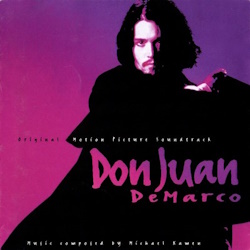
Don Juan DeMarco is a romantic drama written and directed by Jeremy Leven, based on his own short story, Don Juan DeMarco and the Centerfold. The plot follows a mysterious young man who believes he is Don Juan, the figure from Spanish literature who presents himself as the world’s greatest lover. After a dramatic suicide attempt, he is placed in a psychiatric hospital under the care of Jack Mickler, a caring doctor nearing retirement. Mickler is intrigued by the young man’s passionate and elaborate tales of romance, seduction, and adventure, and as he listens to his stories rather than dismissing them outright he is encouraged to rediscover the passion in his own life, particularly in his marriage to his wife Marilyn. As the film unfolds, it becomes ambiguous whether Don Juan is truly delusional or if there is some deeper truth to his claims; either way, his influence ultimately revitalizes not only Mickler’s marriage but also the lives of others around him, and ultimately ‘Don Juan’ is allowed to leave to continue his life as an enigmatic and romantic figure.
The film starred Johnny Depp as Don Juan, Marlon Brando as Mickler, and Faye Dunaway as Marilyn, with Depp’s performance being widely praised for its charm and intensity. It also offered a nice late-career performance from the legendary Brando, who brought a real sense of charm and warmth to his role as the psychiatrist looking to reignite the spark in his own life. It wasn’t particularly successful at the box office when it first came out, but it has become something of a cult film in the years since it was released.
The score for Don Juan DeMarco was by the late great Michael Kamen, and for me is one of the best and most engaging romantic scores of his career. Despite being rightly well-known for his action-adventure work in the Die Hard franchise, the Lethal Weapon franchise, and on films like Highlander and Robin Hood: Prince of Thieves, I have personally always felt that Kamen’s true personality emerged when he was asked to score films with deep emotions, and the sweeping romance of this film gave him a perfect opportunity to do exactly that. The score is ravishing, awash in gorgeous orchestral textures and themes, which are in turn accentuated by beautifully florid Spanish flamenco guitars, many of which performed by the BAFTA-nominated composer and guitarist Paco de Lucía.
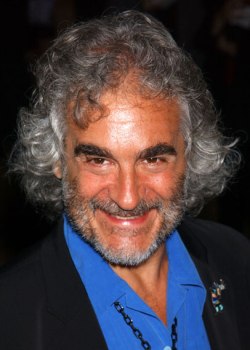 The score’s main theme is initially presented as an original song, “Have You Ever Really Loved a Woman,” which was written by Kamen in collaboration with Canadian rocker Bryan Adams and producer Robert John “Mutt” Lange, and is performed by Adams. The song became a major hit in 1995, reaching #1 on the Billboard Hot 100 chart and earning an Academy Award nomination for Best Original Song. The song’s soft, passionate tone combined with its Spanish flamenco guitar style makes it a perfect match for Don Juan’s character – who sees love as an eternal and sacred connection – while the lyrics offer a heartfelt exploration of deep, selfless love, perfectly aligned with Don Juan’s romantic philosophy. People consider Adams cheesy these days – perhaps not without good reason – but, personally, I adore this song unironically. In context the song is performed two additional times: once by Tejano superstar Selena, and once by a mariachi band serenading the characters in Spanish. That Spanish-language arrangement of the song, “Has Amado Una Mujer De Veras,” is performed by vocalists Jose Hernandez and Nydia Rojas, and is absolutely beguiling.
The score itself is a romantic masterpiece, sweeping and swooning and intoxicating. Many of the cues are built around variations on the main Don Juan theme, but Kamen also introduces various new and different themes in multiple tracks, fleshing out the score into something really quite special.
The opening “Habanera” is clearly inspired by the rhythms and gestures of Bizet’s “Carmen” – a nice little bit of self-referencing there, considering that Paco de Lucía’s BAFTA nomination came for his score for the 1983 film of the same name – but despite the classical quotations the wittiness and vitality of the piece is quintessential Kamen. A bank of no less than nine classical guitars give “Don Juan” a wonderfully authentic flavor of old Spain, but here again Kamen’s signature gestures and compositional stylistics continue to shine through, with flourishes and textures that recall his writing for Eric Clapton on Lethal Weapon.
There is a sense of pastoral intimacy to the opening moments of “I Was Born In Mexico,” but then the whole thing explodes into a joyful, playful celebration of Mexican musical culture, albeit one run through a Hollywood filter full of scampering violins, clattering castanets, and even a subtle choir. The fabulous “Doña Julia” is perhaps the score’s most traditionally romantic piece, which begins as an intimate arrangement of the main Don Juan theme, but then turns into a stunning orchestral opus with a sublime violin solo at its core. This style is a hallmark of the entire score; the music blends fantasy and reality, just like the film’s narrative, and whenever Don Juan recounts his grand tales to Mickler, Kamen’s music swells to match the grandiosity of his words.
There is a sense of swashbuckling adventure to large parts of “Don Alfonso,” which often abandons romance for a classic Hollywood Erich Wolfgang Korngold/Max Steiner style, conjuring up images of a silver screen matinee idol dueling with a mustache-twirling villain for the hand of the heroine. The little flash of Bizet’s “Toreador March” – performed with gusto by violinist Christopher Warren-Green – is a delight. The cue’s dramatically bombastic but sadly brief middle section contains some of Kamen’s most expressive and richly textured action music – think Die Hard, or The Three Musketeers, enlivened with rousing flamenco guitars – and then the finale is a magical expression of passion and love.
There is an intoxicating Middle Eastern flavor to the orchestrations of “Arabia,” which sees Kamen arranging his theme with the stereotypical sounds and textures of a Turkish bazaar. This cue is, again, a Hollywood approximation of what Middle Eastern actually music sounds like, but at times I was reminded of the wonderfully seductive and sultry Arabic pastiche that Miklós Rózsa adopted on scores like The Thief of Bagdad, and the sound remains as superb as it always has, irrespective of how authentic or not it may be.
The brief “Don Octavio Del Flores” is lush and flighty, full of twittering strings, pretty gestures, and gentle harp glissandi, and this then segues into the score’s pièce de résistance, the magnificent “Doña Ana,” during which Kamen revisits all the score’s main thematic ideas and arranges them at their boldest, most romantic peak. Caroline Dale’s gorgeous cello performances emerge from the orchestra and take center stage with pleasing regularity, the recurring four-note motif taken from the main Don Juan theme provides a motivic anchor, de Lucía’s guitars are warm and inviting, and the final flourish of orchestral lyricism is sumptuous, showcasing Kamen at his warm and romantic best.
As I mentioned earlier, although he is most famous for his intense action scores, I always connected the most with Michael Kamen when he was expressing sincere, heartfelt, direct emotions through his music, and Don Juan DeMarco is one of the best examples of him doing just that in his entire career. Yes, it leans into old Hollywood musical tropes of Latin romance, but that’s the point: that’s how Don Juan sees himself, and it’s that air of sophistication and seduction that gives him confidence, which in turn inspires Mickler to rekindle the flames of passion in his marriage. The themes are gorgeous, the orchestra is lush, the arrangements are sublime, and the guitar performances overflow with exquisite tenderness. Even the song is great. This is an essential Kamen score, and is a timely reminder of what a talent he was, and how we lost him far too soon.
Buy the Don Juan DeMarco soundtrack from the Movie Music UK Store
Track Listing:
- Have You Ever Really Loved A Woman? (written by Michael Kamen, Bryan Adams, and Robert John “Mutt” Lange, performed by Bryan Adams) (4:51)
- Habanera (2:08)
- Don Juan (4:08)
- I Was Born In Mexico (2:25)
- Has Amado Una Mujer De Veras? (written by Michael Kamen, Bryan Adams, and Robert John “Mutt” Lange, performed by Jose Hernandez and Nydia Rojas) (2:45)
- Doña Julia (4:58)
- Don Alfonso (6:47)
- Arabia (7:53)
- Don Octavio Del Flores (1:46)
- Doña Ana (7:31)
A&M Records 31454-0357-2 (1995)
Running Time: 42 minutes 12 seconds
Music composed and conducted by Michael Kamen. Performed by The London Metropolitan Orchestra. Orchestrations by Michael Kamen and Robert Elhai. Featured musical soloists Paco de Lucía, Julian Bream, Júan Martin, Chucho Merchan, John Themis, Luis Jardim, Caroline Dale, and Christopher Warren-Green. Recorded and mixed by Stephen McLaughlin. Edited by Christopher Brooks. Album produced by Michael Kamen.

Shop at the Movie Music UK Store

Member of the

 MOVIE MUSIC UK