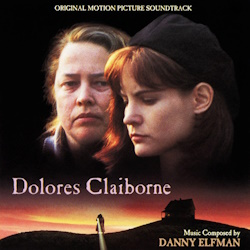
DOLORES CLAIBORNE – Danny Elfman
 THROWBACK THIRTY
Original Review by Jonathan Broxton
Dolores Claiborne is a psychological drama-thriller directed by Taylor Hackford, adapted by Tony Gilroy from the 1992 novel by Stephen King. The story centers on the titular character, played by Kathy Bates, who is accused of murdering Vera Donovan, her wealthy, elderly employer on a remote Maine island. The investigation brings Dolores’s estranged daughter, Selena St. George (Jennifer Jason Leigh), back to the island. Selena is a troubled New York journalist with a complicated history with her mother, marked by years of resentment. As the investigation unfolds, the film shifts between the present day and flashbacks to the 1970s, gradually revealing the dark events that shaped Dolores and Selena’s relationship – specifically, the horrific abuse that Dolores endured at the hands of her alcoholic husband, Selena’s father.
The film co-stars David Strathairn, John C. Reilly, Eric Bogosian, Judy Parfitt, and Christopher Plummer, and is a fascinating exploration of numerous complicated themes, including familial relationships, cycles of abuse, and suppressed trauma. Critics at the time praised Bates for her performance, comparing it favorably with her Oscar-winning turn in another Stephen King adaptation, Misery from 1990, and Bates herself stated in a subsequent retrospective interview that her performance as Dolores was her favorite performance she had ever given. It’s also a very atmospheric film, visually, with lots of symbolism to do with lunar eclipses, and a brooding color palette of grays and browns courtesy of cinematographer Gabriel Beristain.
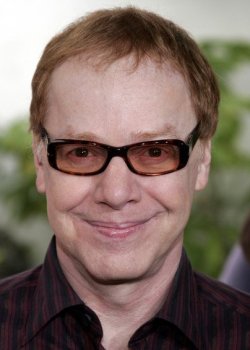 The score for Dolores Claiborne was by composer Danny Elfman, and came right at the end of what I personally consider to be the peak period of his career, from Beetlejuice and Batman in 1988 and 1989, through to Black Beauty in 1994. The reason Dolores Claiborne is, in my opinion, a sort of ‘transitional score’ is because it is one of the first times in Elfman’s career to that point that he wrote a score that was less reliant on themes and melodies, and was more about atmosphere and texture. It had been ten years, more or less, since Elfman had made his proper film music debut with Pee-Wee’s Big Adventure (Forbidden Zone notwithstanding), and it was becoming apparent that Elfman was now confident enough to start experimenting a little bit with the way he wrote for orchestra. Dolores Claiborne still has themes, of course, and is still steeped in the ‘dark romantic Gothic’ sound that dominated his work, but there is perhaps a little more abstraction, and a little more moody nuance to the score than was apparent in his previous works.
Whether this represents a step forward or a step back is open for debate – personally, I love the Batman and Edward Scissorhands and Sommersby era more than any other era in his career – but even though I don’t enjoy Dolores Claiborne as much as I do those earlier efforts, it’s clear that Elfman was eager to try new things from a musical perspective, and that is very commendable.
The score has, for the most part, two tones: firstly, somber, restrained, intimate writing for heavy strings augmented by harp and piano; and secondly, vivid, vicious explosions of noise and chaos which underscore the moments of murder and death. There are two main recurring themes that run through the score; the first is the theme for Dolores herself, which is introduced clearly in the “Main Titles,” but thereafter sort of settles down into a series of meandery, seemingly aimless variations carried by endless banks of elongated strings. However, this apparent lack of direction is actually a clever depiction of Dolores’s personality; throughout the film, her actions and motives for doing what she does are continually hidden and obscured, and are never properly exposed until the revelations of the film’s final act, and the music supports this by being similarly reluctant to reveal itself for long periods of time.
There is also a secondary theme, an undulating four-note piano motif, which runs through several of the film’s flashback sequences and is often associated with the concept of eclipses, and the symbolism of how eclipses tend to coincide with significant moments in Dolores’s life. Another way to look at it would be to say that this motif ties in with the concept of abuse and trauma, and it plays a major role in sequences dealing with death, especially the deaths of Dolores’s first husband, Vera’s first husband, and then Vera herself. A minor motif representing the relationship between Dolores and her estranged daughter Selena appears in a few cues, but is not significant enough to warrant much additional comment.
I love the edginess of “Vera’s World,” which uses plucked skittery violin textures alongside the deeper, more sonorous cellos and basses, to create an oppressive atmosphere of palpable dread. This sound had its genesis in earlier scores like Nightbreed, Darkman, and to some extent Sommersby, and would quickly become an Elfman staple across numerous subsequent scores, so it’s fun to experience its development here. The piano motif is prominent throughout this cue too, as well as in the subsequent “Flashback”.
The brief but brilliant “Getting Even” is one of the cues that erupts into bolder and more intense territory, cleverly balancing ground bass string rhythms and pounding piano lines against the more crystalline sound of a music box. This continues later through both “Ferry Ride” and “Eclipse,” the latter of which underscores the pivotal scene where the audience is finally given the full story of what happened to Dolores’s brutal husband. “Eclipse” features one of the score’s most prominent uses of brass, embedded into a Batman-esque pulse-pounding chase sequence that overflows with shrilly distorted string figures and insistent, heavy percussion patterns focused on timpani, snares, cymbals, and gongs. Both Dolores’s theme and the Eclipse motif are prominent throughout this cue too, Elfman cleverly working them into the fabric of the action, and the piece concludes with some beautifully bittersweet choral textures that offer a touch of dark romance to the resolution.
The almost 11-minute “Finale” and “End Credits” sequence sees Elfman taking all the score’s prominent ideas – mostly Dolores’s theme, the Eclipse motif, and some of the bombastic action material – and bringing the orchestra up to its fullest heights, performing the themes with the most sweeping gusto and brooding melodrama in the entire score. These darkly romantic pieces are quintessential Elfman, emotional but not maudlin, relief tempered with a sense of melancholy, a sound that I have always loved. The themes in Dolores Claiborne may not be as grandiose as any of the ones he wrote at any point in the previous decade, but the beautifully bleak style and atmosphere he surrounds them with is outstanding. When the chorus comes in, as it does at the beginning of the “End Credits,” the effect is notably terrific.
 The original 1995 album from Varèse Sarabande was yet another ’30-minute special,’ due to the prohibitive costs of soundtrack album re-use fees at the time, but thankfully producers Bryon Davis and Cary E. Mansfield were able to put out a limited-edition 2-CD expansion album in 2020 that includes the bulk of the score, plus various bonus tracks and alternate takes. This longer release finally does justice to the full scope of what Elfman wrote, and is vital for fans of his work. The liner notes by composer and film music journalist Brian Satterwhite are notably excellent too.
As I mentioned earlier, I find that the best way to think of Dolores Claiborne is as a sort of ‘transitional’ score between Elfman’s career-defining late 80s/early 90s work – the Batman scores, Edward Scissorhands, Sommersby – and the slightly more experimental and edgy sound that he would regularly explore through the late 1990s and into the 2000s. There is more than enough ‘traditional Elfman’ here, in terms of his compositional hallmarks and his instrumental choices, to keep his fans happy, but it’s also fascinating to see him starting to expand his horizons and explore more complex sounds and ideas. The lack of clearly prominent and memorable thematic content may frustrate some listeners, but for me Dolores Claiborne still ticks enough boxes for me to give it a recommendation. I don’t like it as much as I do his earlier works, but I appreciate it for what it is trying to do.
Buy the Dolores Claiborne soundtrack from the Movie Music UK Store
Track Listing:
- 1995 ORIGINAL RELEASE
- Main Titles (2:45)
- Vera’s World (3:42)
- Flashback (1:55)
- Getting Even (1:48)
- Ferry Ride (0:55)
- Sad Room (0:52)
- Eclipse (7:16)
- Finale (5:35)
- End Credits (5:21)
- 2020 EXPANDED RELEASE
- Introduction (3:46)
- Main Titles (2:46)
- First Meet (1:50)
- Ride Home (3:44)
- 1st Flashback (1:53)
- Better Times (2:49)
- Joe’s Entrance (1:21)
- Ouch (2:17)
- Getting Even (1:49)
- Vera’s World (3:50)
- Mackie Interrogates, Pt 1 (1:49)
- The Bar (1:00)
- All Fucked Up (3:16)
- Room At Vera’s (0:58)
- Sad Room (0:52)
- The Will (3:11)
- Vera’s Death (3:04)
- Family Life (2:59)
- The Ferry Ride (1:04)
- Passbook (1:20)
- Nag, Nag, Nag (1:05)
- The Old Well (5:28)
- They Die (2:10)
- Wheels In Motion (1:44)
- The Eclipse (9:13)
- Bad Dad (3:51)
- The Inquest (6:13)
- End Credits (5:14)
- Broken Glass, Part 2 (Alternate Version) (0:25)
- All Fucked Up (Alternate Version) (3:44)
- The Old Well (Alternate Version) (4:42)
Varese Sarabande VSD-5602 (1995) – Original
Varese Sarabande CD Club VCL 1115-1199 (1995/2020) – Expanded
Running Time: 30 minutes 09 seconds – Original
Running Time: 89 minutes 27 seconds – Expanded
Music composed by Danny Elfman. Conducted by Richard L. Stone. Orchestrations by Steve Bartek and Edgardo Simone. Recorded and mixed by Robert Fernandez and Shawn Murphy. Edited by Curt Sobel. Score produced by Danny Elfman and Curt Sobel. Expanded album produced by Bryon Davis and Cary E. Mansfield.
Leave a comment

Shop at the Movie Music UK Store

Member of the

 MOVIE MUSIC UK
Hi Jonathan – via IMDb I stumbled upon your blog and enjoyed your reviews! You’re also from Sheffield too! ⚔️
If you have access to an app called ‘Global Player Radio’s you can access Jonathan Ross’s weekly ‘At the Movies’ show where he plays music from films. Really enjoyable show.
Keep ’em coming!
This movie looks promising one… Great in depth review. Don’t forget to check out my site, OTT Release this week.