CAPTAIN AMERICA: BRAVE NEW WORLD – Laura Karpman
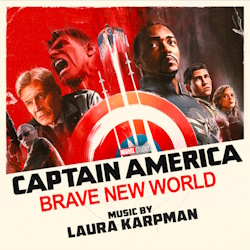 Original Review by Jonathan Broxton
WARNING: THIS REVIEW CONTAINS PLOT SPOILERS. IF YOU HAVE NOT YET SEEN THE FILM, YOU MIGHT WANT TO CONSIDER WAITING UNTIL AFTER YOU HAVE DONE SO TO READ IT.
Somehow, over the course of some 17 years, we have now racked up an astonishing 35 films in the Marvel Cinematic Universe, the enormously ambitious interlocking series of super-hero films that first began with Iron Man back in 2008. If you also include the 15 or so multi-season live action TV shows, plus the various animated shows and one-off specials, we are now at a point where viewers have to keep track of more than 100 hours of story in order to understand what is happening – and, to be frank, it’s starting to become a chore.
Captain America: Brave New World is the 35th MCU movie, and it picks up plot strands from the movies Avengers: Endgame, Eternals, and The Incredible Hulk, as well as the TV series The Falcon and the Winter Soldier, many of which I had entirely forgotten. The film stars Anthony Mackie as Sam Wilson, formerly the super-hero Falcon, who has been named as the new Captain America following the retirement of his predecessor Steve Rogers. When his former adversary Thaddeus Ross (Harrison Ford, replacing the late William Hurt) is elected President of the United States, Ross invites Wilson to establish a new alliance between them, and offers him a chance to start a new Avengers program. However, when an unexpected assailant tries to assassinate Ross during a peace summit at the White House, Wilson is drawn into a sinister conspiracy, the roots of which stretch back decades, and which results in the emergence of an unexpected new super-villain. The film is directed by Nigerian-American filmmaker Julius Onah and, in addition to Mackie and Ford, stars Danny Ramirez, Shira Haas, Carl Lumbly, Giancarlo Esposito, and Tim Blake Nelson.
The score for Captain America: Brave New World is by composer Laura Karpman, who at this point has now taken over from the likes of Alan Silvestri, Brian Tyler, Henry Jackman, and Michael Giacchino, and has established herself as the current musical voice of the MCU. I for one am absolutely delighted by this; her scores for previous Marvel entries like Ms. Marvel, The Marvels, and the animated What If series were all excellent, not to mention her equally outstanding recent work outside Marvel on things like Lovecraft Country and the Oscar-nominated American Fiction.
 What I like about Karpman’s music is how music-y it is; this might sound like an odd thing to say because all music is music, but whenever I listen to Karpman’s work – especially her superhero scores – I get the sense that there is more going on here, intellectually and compositionally, than there is in your common-or-garden superhero blockbuster. The way Karpman writes is ‘out of my league’ a little, in that I can hear all these interesting things going on in terms of technique, but I don’t have the theoretical knowledge to understand it, let alone write about it. Maybe it’s her background in jazz, maybe it’s her love of really dense and complicated orchestral lines… I can’t quite put my finger on it. But what I do know is that it’s really, really good.
The problem, unfortunately, is that in context none of that comes across because of how the score is mixed. It sounds appropriately loud and bombastic, and it erupts into big heroic flamboyance from time to time, but almost all the nuance and intricacy of Karpman’s work is lost underneath all the sound effects and explosions and everything else. This is, of course, the action composer’s curse – you could write the most challenging and brilliant score in history, but if no one-can hear it clearly, no-one will notice, and ultimately no-one will care. That, sadly, seems to be what is happening here with Captain America: Brave New World, if the mainstream reviews are to believed.
One other thing that Karpman did for Captain America: Brave New World is re-invent the wheel in terms of her themes. Naturally, there are no references to any of the themes written for the previous Captain America by Alan Silvestri or Henry Jackman – no Steve Rogers, no theme – but interestingly Karpman also does not make any clear references to the music that Craig Armstrong wrote for The Incredible Hulk, or the music that Ramin Djawadi wrote for Eternals, or that Jackman wrote for The Falcon and the Winter Soldier. Instead, she forges her own way entirely, writing new musical identities for the protagonists, and wrapping them all up in a vast array of complicated action music and powerful dissonance. At this point it’s basically a given that each new composer will put their own stamp on a character, or be asked to do so by the director/producer, but I still can’t help missing that thread of musical continuity.
The score was recorded in Vienna, Austria, with the Synchron Stage Orchestra, and is a big, beefy ton of fun. The new theme for Wilson’s Captain America is actually two themes – first, a pulsating 7-note action brass riff with a slightly jazzy/funky vibe, which is often accompanied by electronic textures and throbbing string ostinatos, and then second, a more long-lined and noble-sounding theme which is usually carried by either brass or strings. The Cap action motif is much more prominent than the Cap noble theme in the score, and it emerges from out of the score’s many action cues with pleasing regularity. The noble theme is fine – nice, pleasant, does what it needs to do – but it is perhaps a little anonymous, even when compared to Henry Jackman’s Falcon theme from previous iterations of the character.
The score’s other major main theme is the Conspiracy Theme, and is related to the political thriller mystery at the heart of the story. Like the Cap action motif, the Conspiracy Theme is based more on rhythm than melody, and is a staccato 4-note cluster, usually repeated, resulting in a prominent 8-note motif. This theme is actually the first thing heard in the score, in the “Captain America: Brave New World Main Title,” where it is surrounded by clattering percussion in militaristic rhythmic patterns, muted trumpets, and is then embellished with an elegant string theme, but has an overall emotional vibe of being moody and sinister. In addition there is a secondary theme related to President Ross heard in cues like “President Ross” and “Betty and Ross,” built around a melody for warm strings and piano, and which has both a patriotic flavor and a slight undercurrent of tension. Elsewhere, in “Discovery of the Millennium ,” Karpman plays the Ross theme and the Conspiracy theme in clever tandem, foreshadowing some of the revelations to come later in the film.
However it is those three main ideas – the Cap action motif, the Cap noble theme, and the Conspiracy Theme – that dominate most of the score, and often they find themselves embedded into the action and suspense sequences, which are universally outstanding. Karpman is a truly tremendous action composer, and throughout the five main action sequences (the Oaxaca/Serpent Society rescue, the White House assassination attempt, the Camp Echo One sequence, the Celestial Island sequence, and the conclusive Red Hulk chase), she excels. What I really love about Karpman’s action writing is how dense it is, how creative it is, and how much fun she has coming up with new settings for the three main ideas. Her electronic use is fascinating, she incorporates excellent choral textures, she engages in some really superb moments of dissonance, and her percussion writing is terrific.
In the Oaxaca/Serpent Society rescue cues – “Courtyard,” “Hostages Saved,” and “Aftermath” – Karpman brings the Cap action motif out to play on several occasions, often accompanied by excellent dissonant orchestral writing. Later, in “White House Confusion,” Karpman unleashes an impressive barrage of noise – harsh orchestral and electronic phrases, chaotic explosions of sound, thunderous timpani hits playing pummeling rhythms. I especially like the use of stereo effects in this cue, as Karpman moves the focus of the music around the channels to create an appropriate sense of disorientation and confusion; listen with headphones to experience this best. Sam’s subsequent encounter with Sidewinder, the leader of the Serpent Society, is captured with ballsy intensity in the “Junkyard” cue, a thunderous exploration of everything the Cap action motif has to offer.
The Camp Echo One sequence – which comprises the cues “No Phones,” “Camp Echo One,” “Samuel Sterns,” “Camp Echo One Fight,” and “Corridor Fight” – again features some outstanding action and suspense writing; listen for the low groaning brass and the statement of the heroic Cap theme in “No Phones,” the impressionistic electronics and harsh brass clusters that accompany the re-introduction of the mastermind “Samuel Sterns” decades after his first appearance in The Incredible Hulk, and the vivid, pulsating brass calls in the brilliant “Camp Echo One Fight”.
The Celestial Island sequence takes place on and around the gargantuan statue that appeared in the Indian Ocean during the ‘emergence’ at the end of the Eternals film, and sees Sterns using mind control techniques to provoke a war between the United States and Japan as both nations attempt to control the massive amounts of the element adamantium contained within the celestial – a war which Wilson attempts to prevent. “Make the Call” builds to a huge revelatory brass crescendo augmented with buzzing electronics as the island is first revealed. The rest of the sequence is essentially an opportunity for Karpman to showcase her talent for counterpoint as, in cue after sequential cue, she pits the Cap action motif, the Cap noble theme, and the Conspiracy Theme against each other, following the action as first Sterns gains the upper hand, and then eventually Wilson saves the day. There is what seems to be a clever foreshadowing of what will eventually become the Red Hulk motif in “Heart Talk” – more on that later – and then all through “Birds in the Air,” “Fire,” “One Down,” and “Still Chasing” Karpman raises the stakes with cue after cue of massive, complicated, hugely entertaining action. The conclusion of “Fleet Saved,” during which Karpman pits the Cap action motif against the most patriotic and rousing statement of the Cap heroic theme, is a score highlight.
However, the big reveal is yet to come as, during a press conference on the lawn of the White House to discuss what happened on Celestial Island, Sterns uses his mind control on Ross, and it is further revealed that Ross had been secretly taking pharmaceutical supplements created by Sterns to control his cancer. However, the pharmaceutical supplements also contain gamma particles, and these cause Ross to transform into the fearsome Red Hulk, who then wreaks havoc on Washington DC. After the eerie and slithery dissonance of the “Confrontation” Karpman unleashes a new 2-note brass motif for Ross’s Red Hulk “Transformation”. The Red Hulk motif contains a furious, almost Elliot Goldenthal-esque intensity, and Karpman piles on with lots of challenging orchestral writing, odd electronic sounds, and aggressive choral textures performing what sound like Latin chants. Throughout “Lure” and “Prove It” Karpman pits the Red Hulk motif against both the Cap action motif and the Cap noble theme as the two duke it out mano-a-hulko, and it’s absolutely monumental; only in the final moments of “Prove It” – as the President regains control of himself and the Red Hulk withdraws – does the music calm down, and Karpman ends with an emotional return to the Ross theme.
The finale of the score is quieter and more low key, including a tender version of the Ross theme in “Another Visitor,” and some understated and emotion writing in “Sam and Joaquin” that touches on the strong bonds of friendship between the two new superheroes. The final cue is actually a concert arrangement of the “Conspiracy Theme” for the end credits, an array of slithery rattling woodwind textures, echoplex trumpets, and the now-familiar 8-note percussive motif with its complicated counterpoint for orchestra and whooping choral textures.
If one was to be critical of the score, perhaps its biggest drawback is the fact that the central themes are less memorable than earlier takes on the same characters by other composers in other films; this is likely due to the fact that Karpman’s themes tend to rely more on bombastic rhythms and percussive grooves rather than hummable melodies, as well as her tendency to arrange the themes in multiple different and complicated ways. These themes don’t jump out and hit you over the head the way other earlier MCU themes do, and whether you appreciate that or not is going to come down to your taste, as well as your capacity to dig into the score and make the intellectual connections yourself.
For me, however, Captain America: Brave New World succeeds for the same reasons that others might think it fails. Karpman’s writing is endlessly creative, the orchestrations are wonderfully thick and dense, the action music is relentless and rhythmically fascinating, and the way the themes constantly shift and move around and on top of each other makes for an engrossing listen. The rewards in this score come not from simple musical pleasures, but from really getting down into the weeds of the detail, and anyone with the patience to do that will find it very satisfying.
Buy the Captain America: Brave New World soundtrack from the Movie Music UK Store
Track Listing:
- Captain America: Brave New World Main Title (3:44)
- Brave New World (2:50)
- President Ross (1:46)
- Courtyard (0:43)
- Hostages Saved (2:18)
- Aftermath (2:35)
- Discovery of the Millennium (2:44)
- White House Confusion (3:03)
- Mystery Unfolds (1:39)
- Sidewinder (1:30)
- Junkyard (1:53)
- No Phones (2:06)
- Camp Echo One (1:57)
- Samuel Sterns (4:38)
- Camp Echo One Fight (1:14)
- Corridor Fight (0:57)
- Make the Call (1:37)
- The Island (2:09)
- Heart Talk (3:27)
- Birds in the Air (1:45)
- Fire (2:06)
- One Down (0:56)
- Still Chasing (4:15)
- Fleet Saved (0:57)
- Aspire (2:22)
- All Is Not Well (1:40)
- Betty and Ross (1:42)
- Confrontation (2:48)
- Transformation (3:24)
- Lure (3:47v
- Prove It (2:49)
- That’s Three (1:24)
- Another Visitor (2:46)
- Sam and Joaquin (2:46)
- Conspiracy Theme (2:53)
Hollywood Records/Marvel Music (2025)
Running Time: 81 minutes 10 seconds
Music composed by Laura Karpman. Conducted by Gottfried Rabl. Orchestrations by Jeff Kryka. Additional music by Nora Kroll-Rosenbaum. Recorded and mixed by Peter Cobbin and Kirsty Whalley. Edited by Stephanie Lowry. Album produced by Laura Karpman.

Shop at the Movie Music UK Store

Member of the

 MOVIE MUSIC UK