REBEL WITHOUT A CAUSE – Leonard Rosenman
 GREATEST SCORES OF THE TWENTIETH CENTURY
Original Review by Craig Lysy
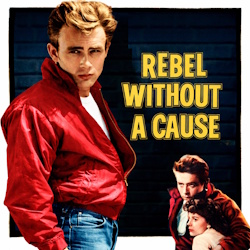
Warner Brothers Pictures was looking for a vehicle to showcase their new, young contract actor James Dean. In 1954 they decided that they had finally found it with a 1944 novel by Robert M. Lindner, “Rebel Without A Cause: The Hypnoanalysis of a Criminal Psychopath”. They purchased the film rights, David Weisbart was assigned production with a $1.5 million budget, Stewart Stern was hired to write the screenplay, and Nicholas Ray was tasked with directing. For the cast, James Dean would star as Jim Stark, and joining him would be Natalie Wood as Judy, Sal Mineo as John “Plato” Crawford, Jim Backus as Frank Stark, Ann Doran as Carol Stark, Corey Allen as Buzz Gunderson, and William Hopper as Judy’s father.
The film offers an unflinching commentary on the moral decay of America’s youth, with a story which portrays middle class teenagers who are emotionally confused, alienated and destructive. It follows the life of Jim Stark, who feels anguish and alienation from his parents who constantly argue, with their parental roles clearly reversed; his cold and dominating mother, and an emasculated, hen-pecked father. Judy feels alienated and unloved as she acts out in a desperate attempt to get her father’s attention and love. John “Plato” Crawford, desperately seeks a father figure as he is a product of a broken home with no father and a mother who is always away traveling. Their sad lives all converge as they get caught up in a confrontation with a gang. Jim and Judy are lucky enough to survive and fall in love, however Plato tragically shoots a gang member and then is himself gunned down by the police. The film was a commercial success, earning the studio a profit of $3 million. Critics however were harsh, criticizing the film’s graphic and disturbing brutality and violence. Nevertheless the film earned three Academy Award nominations for Best Supporting Actor, Best Supporting Actress, and Best Writing.
The creative team at Warner Brothers was impressed by Leonard Rosenman’s score to for East of Eden and offered him his second scoring assignment. Rosenman was happy to take the offer as it presented him with very different challenges than East of Eden. Rebel Without a Cause was a gritty, raw and damning commentary on America’s rebellious post WWII youth who are emotionally estranged from their parents, and socially alienated from the traditionalist establishment culture. Rosenman understood that his music would have to give voice to this generational chasm, alienation, and the violence it spawned.
 In conceiving his soundscape, Rosenman incorporates inspirations which would appear at first glance, to be incompatible; big band jazz, twelve tone atonality, jagged dissonance, Bartók, Schoenberg, and Stravinsky. As a composer, he never loses his singular voice, but the sensibilities associated with these three 20th century modernists are felt in the notes, expressed with Rosenman’s inimical style. There are two recurring themes for the film; the Main Theme, and the Love Theme for Jim and Judy. The Main Theme offers a bleak, meandering and repeating, seven-note phrase, which never resolves. For me it voices the estrangement, disillusionment and alienation, of Jim, Judy and Plato, thus supporting the primary impetus of the film’s narrative. The Love Theme reveals that Rosenman is quite capable of eloquent melodic consonance, offering a Steineresque romanza for lush strings romantico with warm contrapuntal horns in the finest of Hollywood Golden Age traditions. It is composed with an ABA construct with a forthright, and declarative A Phrase, yet it is the rapturous B Phrase where the theme blossoms and takes wing. The theme juxtaposes the film’s graphic violence, providing a refuge, which allows us to see Jim’s sensitive and gentle side. The remainder of the score offers a dazzling display of modernism, atonality, strident, thrusting and jagged dissonance, which offer fuel to the onscreen violence. Lastly, a number of classical pieces and pop songs were woven into the fabric of the soundscape to offer a contemporaneous cultural sensibility, including “Ride of the Valkyries” from “Die Walküre” by Richard Wagner, “I’ll String Along with You” by Harry Warren, “Five O’Clock Whistle” by Gene Irwin and Josef Myrow and “Wiegenlied (Lullaby) Op. 49 No. 4” by Johannes Brahms.
“Main Title” offers a score highlight, where Rosenman unfurls his Love Theme. It opens dramatically with two statements of the seven-note Main Theme, which supports the Warner Brothers Pictures studio logo. At 0:08 we flow into the opening credits, which unfold in bright red letters against the back drop of a drunk Jim Stark laying on the pavement mesmerized by a mechanical, cymbal clashing toy monkey. At 0:34 we flow into the Love Theme, a classic Golden Age romanza born by sumptuous strings romantico. We are graced for an extended ABA exposition with the B Phrase blossoming at 1:33. We return briefly to the A Phrase as Jim tries to get comfortable for a night sleeping outdoors on concrete. We close with foreboding at 2:33 on a final statement of the Main Theme as a police car arrives.
(*) “Police Station” reveals a drunk Jim being brought in by the police. He joins John, who is charged with shooting a litter of puppies, and Judy who was brought in for a curfew violation. Rosenman supports with a bleak and amorphous ambiance. The sergeant agrees to let Jim keep his toy monkey and they take him to stand by the wall. Judy looks up and a sultry saxophone voices her interest, although she quickly averts her eyes. The ambiance lightens as an investigator escorts Judy into his office. She is distraught and mutters; “He must hate me” as her theme borne by a flute triste supports. She cries as she relates that her father does not like anything about her, her friends, and calls her a dirty tramp. The officer tries to console her and offers her two choices; she can stay here or he can call her father to come and pick her up. She hesitates, and offers his telephone number. In the reception area Jim howls like a police siren and is warned twice by a policeman, whom he defiantly mocks. John’s housekeeper, his surrogate mom, comes to pick him up as Rosenman weaves a Pathetique. John is cold, and Jim walks over and offers his jacket, but is declined. Through the office glass Judy weeps, as does her string borne theme as she awaits her father’s arrival. She becomes upset when the officer advises that her mother will be picking her up. As we see Jim, John and Judy going into separate rooms, a forlorn Main Theme is woven into the musical narrative.
(*) “Two Sad Stories” reveals Jim’s parents arriving and the emotional tension is immediately palpable as he mocks his father and ignores his mother. In John’s interview, he cannot explain why he shot the puppies, refusing the officer’s offer of help, saying no one can help. The policeman suggests to the housekeeper that given John’s behavior, and that his father has left, while his mother is always traveling, that a psychiatrist may be needed. Shifting outside Jim hums Wagner’s “Ride of the Valkyries”, knowing it irritates his mother. As inspector Ray tries to make sense of things, we see a dysfunctional family; a dominating mother, a hen-pecked father, and a son deeply alienated. Jim is taken into his office and he lunges at Ray in anger, only to be easily cast to the ground. Jim says he is afraid he is going to hit someone out of anger, and the officer suggests he try the desk. Jim hesitates, and then begins a brutal fist barrage, which hurts his hands and shocks Ray. Writhing dissonance supports both his physical and psychic his pain. He relates his anger of how his mother and grandmother constantly emasculate his father. Eventually Ray wins Jim’s respect and trust after he offers him an invitation to see him if he becomes angry and frustrated again. Jim is released to his parent’s care, and they depart the station.
(*) “The Next Day” reveals mother calling Jim to breakfast. Rosenman offers a bleak, emotionally barren atonal ambiance as Jim joins and looks out the window at Judy. He skips breakfast, and departs with a bag lunch and thermos as mother and grandmother snipe at his hapless father. As Judy smokes in the alley a non-romanticized variant of her theme supports, assuming a strolling sensibility as Jim joins her. As they walk, he tries friendly banter, but she is jaded by her life and standoffish. He offers her a ride, but she turns him down, calling him a real yo-yo, and instead joins a car full of rowdy kids that pulls up. Jim pulls up alongside, asks for directions to the high school, and they all laugh at him, pointing in different directions. Jim arrives at Dawson High School, as does John, and Judy. We see John open his locker, which displays the photo of a man, as Jim looks at a poster displaying a field trip to the planetarium today. A forlorn Main Theme usher in foreboding musical narrative as Jim at last finds the boys restroom. (*) “Field Trip” reveals the buses, and Jim in his car, arriving at the Los Angeles Griffith Park Observatory supported by a spritely rendering of the Main Theme. “The Planetarium” reveals a narrator offering a guided tour of the cosmos using a planetarium projector, which displays the universe on the domed ceiling. This composition offers a masterpiece of atonality, with waves of sparkling dissonance, where Rosenman channels Bartok and creates an other-worldly soundscape with what I believe to be one of the most unique compositions in his canon, but also in cinematic history. At 2:45 as the narrator describes the apocalypse of two galaxy’s colliding, we swell on a crescendo di orrore, which explodes as the collision occurs, dissipating on an ethereal misterioso.
“Knife Fight” offers a remarkable score highlight where Rosenman displays his singular and unique modernism pitting intra-orchestral ensembles against each other. Everyone has departed the planetarium, but Buzz and his gang are lying in wait for John and Jim. John joins Jim on a balcony and says they can sneak out to avoid the gang and take refuge in an abandoned mansion, which he points to in the hills. Rosenman supports with the Main Theme rendered as a misterioso of unease. At 0:32 a free form, jazzy saxophone joins when they are spotted by two members of the gang as they prepare to depart using the back stairs. They run and alert the gang, which return on two ramps, trapping John and Jim in between. A strident musical narrative unfolds as they encircle Jim’s car with a saxophone seducenti supporting Judy, who looks up with a wry smile. We shift to an amorphous passage where Rosenman ratches up tension as Jim and Buzz stare off. The camera pans down to reveal Jim’s white wall tires, and as Buzz looks down at them a dissonant and menacing staccato portends violence. A crescendo di violenza swells and crests at 1:42 as Buzz pops open his switch blade. A strident agitato enters as Buzz rubs the knife against the tire as Jim tries to remain cool. Buzz stabs the tire and at 2:25 an angry Main Theme joins and empowers Jim’s descent to confront Buzz. He walks past Buzz, opens his trunk and prepares to change his tire. But Buzz is spoiling for a fight, and eventually provokes him with repeated taunts of “chicken”. A knife fight ensues and Rosenman unleashes a strident, and stabbing maelstrom of jagged dissonance offering a musical narrative fully unrestrained, unstable and devoid of a tonal center. It seems as though the orchestra is at war with itself with ever shifting rhythms and synchrony propelling each knife thrust. Jim prevails, spares Buzz’s life, but Buzz does not relent, instead challenging him to a game of chickie-run at the Millertown bluff at 8 pm tonight, which Jim accepts.
(*) “Jim and Judy’s Despair” reveals Jim at home cleaning his knife wounds. The music once again is bleak and amorphous. As he slugs down some milk from the refrigerator, he hears a crash, and goes upstairs where he finds his father in an apron, on his knees picking up a broken dinner server. He says he was getting mom some supper as she is ill, and Jim begins laughing because he dropped it. Dad then hurries to clean up the mess so she does not see it, and Jim tells him to stop, and let her see it. When he refuses, Jim leaves not wanting to see him humiliated. Shifting to the Judy’s house, her father reproaches her for giving him a kiss, saying that she is too old for that. Her younger brother comes in and receives dad’s affection. Judy then asks why a girl cannot love her father? She kisses him on the cheek and he slaps her, which causes her to bolt in tears. He goes to retrieve her and says they will stay home tonight, but she says, this is not my home and storms out. Back at the Starks, dad goes into Jim’s room and finds him in bed. Dad reaches out to his son and Jim asks him for advice regarding a matter of personal honor. The musical narrative is again bleak, intangible and meandering without resolving as dad deflects the question, fearing he is being set up. He instead turns on the light and the music darkens as he notices the blood stains on Jim’s shirt. He again dons an apron and offers a father’s concern, by trying to clean the wounds. He counsels that he should not make a snap decision on this matter, and instead thoroughly analyze it. He then offers a patronizing speech, and we see in Jim’s eyes that his father is useless to him as he dresses and prepares to head out to the bluff. Jim runs out of the house, and speeds off before his father can stop him.
(*) “The Cliff” opens with dire horn declarations as Buzz and the gang wait at the cliff, which overlooks the Pacific Ocean. Dozens of cars with schoolmates await as Jim arrives, carried by a plaintive Main Theme. The theme warms as Plato runs up to greet Jim. An unsettled musical narrative develops joined by the Main Theme as Buzz greets Jim and invites him to go see what they are driving. Jim tells John to wait with Judy, and the two begin to bond as she inquires about Jim, who John describes as his best friend. Buzz shows Jim the two cars that will be used and they flip a coin, with Jim winning and choosing the car on the right. As the two look over the cliff Rosenman sow’s unease, within which is woven a forlorn woodwind borne Main Theme. Buzz admits that he likes Jim, and they get in and start their cars with the gang giving Buzz a send-off. Judy yells to Crunch, “Line them up”, and jagged musical rhythms cloaked with dissonance infuse both the energy of excitement, but also trepidation as seen in John’s eyes as he watches. Buzz tells Jim that they drive fast to the edge, and the first guy that bails, is a chicken. Jim nods, and asks Judy for some dirt, which her rubs on his hands. Judy then kisses Buzz, while giving Jim a wry smile. Jim calls Judy over to his car, and when he tells her, me too, she gives him some dirt as her tender theme joins.
(*) “The Chicken Run” reveals Judy running up front between the two rolls of cars that line the path to the cliff. Provocative jazz joins with an eerie dissonance to raise tension as Jim coolly smokes a cigarette. She yells “Hit your lights!” and the two banks of cars turn on their head lights empowered by a refulgent crescendo. A horrific storm of dissonance charged with a tremolo and fluttering trombones engulfs us as Buzz and Jim prepare for take-off. Judy lowers her arms and the two cars roar off toward the cliff propelled by a deafening and shrill Main Theme. A crescendo di orrore roars as a sleeve loop in Buzz’s leather jacket catches on the door release, preventing him from bailing. Jim bails out as Buzz runs off the cliff and plummets to his doom with a fiery explosion on the rocks below. We flow seamlessly into (*) “Aftermath” atop a writhing, shrill and horrific dissonant maelstrom as everyone but John, rush to the cliff edge. Horns of death resound as Jim asks where Buzz is, and they point, down there! Everyone flees in a panic and a diminuendo of sadness supports Judy fixated on the wreckage below.
(*) “Jim & Judy & Plato” reveals Jim extending his hand to Judy, who slowly accepts as her theme emerges. A musical narrative of sadness carries the drive to Judy’s home. They arrive, and her theme and the Main Theme entwine gently as he lets her out. He asks if she is alright, and gifts her with a warm and inviting smile, a mirror case, which she cradles to her cheek. Rosenman weaves a narrative of pathos as Jim parks the car and John asks repeatedly for Jim to come home with him, offering breakfast in the morning. Jim says no, and John tells him, that he wished you were my dad. Jim goes in and John says he’ll see him in the morning, carried by a sad Main Theme as he goes home. Judy goes to her room as her parents watch from the bedroom. Beau, her younger brother comes out and gives her a hug, but the tender moment is ended by dad sternly telling Beau to go to bed. She goes into her room, and dad closes their door without words being spoken. As she lays on her bed, she cradles the keep safe gifted her by Jim. Back at Jim’s house strings tristi draped with dissonance offer the Main Theme as he slugs down some milk and discovers his father sleeping in a chair. Slowly the music loses cohesion and deconstructs into a forlorn narrative as Jim lays down to sleep on the couch. As he begins to nod off, his father awakes as mother descends the stairs and expresses relief that he is all right.
(*) “I Need a Direct Answer” reveals Jim moving away from his mother and telling his dad that he is in trouble and needs a direct answer. He tells them he was involved in the accident, driving a stolen car. He adds that he had to go as a matter of honor, because they called him a chicken, and if he did not defend his honor, he could never face his schoolmates again. A huge fight erupts that unleashes all the repressed chronic problems of the family as mother firmly opposes him going to the police, as it will ruin their lives. Jim asks his dad to stand up for him and answer mom, but he instead once again cowers. Music enters as an eruption of dissonant violence unleashes a tempest as an enraged Jim grabs his father, shouts answer her! He then drags him to the floor and begins strangling him. Mother pulls him off and as Jim runs out of the house, he kicks in a portrait of her in spite. He speeds off in his car, and we end with musical devastation as husband and wife look at each other and close the French doors in disbelief.
(*) “Police Station” reveals Jim going to the police station to confess carried by a foreboding musical narrative. As he walks up the stairs, the music takes on an agitated jazz vibe as Crunch, Goon, Moose, and their fathers exit the station. The three gang members asks if Jim is fond of this place? He does not answer and walks past them into the station. The three believe Jim is ratting on them and plan retribution. Inside Jim tries to meet with Ray, but he is told he is out on assignment and to come back in the morning. Jim hesitates to leave and calls Judy. A sad musical narrative, full of disappointment and woodwind borne futility supports as she overhears her father answer, and then angrily hang up saying that he does not know a Jim Stark! (*) “Hello Jamie” reveals Jim pulling up to his garage and finding Judy siting on a ledge. She greets him with “Hello Jamie”, remembering Plato mentioning that only people important to Jim call him that. The source song “I’ll String Along with You” is heard from the car radio supports as he gets out and lays next to her. On the radio, the announcer says that the following song is dedicated to you Jim, from Buzz, and we switch to a jazzy, blues vibe as the two contemplate the meaning of the dedication. We flow into “Love Theme” a score highlight where we are graced by a tender exposition of the Love Theme. He turns off the radio and asks how she is doing. She replies that she is numb and they drop all pretenses. She apologizes for treating him mean earlier, blaming it on the pressure of Buzz and the gang. He is receptive, sympathetic, and gives her a soft kiss on the cheek. When she asks why, he says, I felt like it. She likes that he is genuine and they both declare that they will not be going back to Dawson. He speaks to her of a mansion Plato told him about, and asks her to trust him, and join him.
(*) “Plato Assaulted” reveals Plato ambushed outside his house by Goon, Moose and Crunch who demand to know where Jim lives. A struggle ensues and Plato escapes to the porch where his housekeeper comes to his rescue. She chases them away, but hey escape with his address book. He grabs the mail and runs into his bedroom. A dire chord resounds as he opens a letter from his father and finds a note “for support of son” and a check for $687.50. He crumbled the check, and grabs a pistol from under his pillow as the housekeeper joins him. Rosenthal weaves terror and desperation with another jagged narrative when she becomes frantic upon seeing the gun. She reaches for it, but Plato runs out and escapes saying he has to warn Jim. We shift to the three gangsters and they finally locate Jim Stark’s address. At home Mrs. Stark is alarmed by pounding on the door. She forces Frank to investigate and as he opens the door, a dire quote of the Main Theme supports a dead chicken hanging from the door molding while the three gangsters cluck like chickens, mocking his son as a chicken. Frank and Carol frantically search the house with the free form jazzy saxophone motif propelling them. Plaintive woodwinds support the arrival of Plato on his scooter, and we shift to an eerie misterioso as Frank confronts him and he asks if he knows where Jim is. Plato panics, rushes off, and escapes as Frank is too slow to catch him. A dissonant and aggrieved variant of the Main Theme supports Frank as he goes inside and frantically calls officer Ray. The music becomes dramatic and dire as we see Plato’s housekeeper on the telephone, and then Judy’s father.
(*) “The Old House” reveals Jim and Judy exploring the deserted mansion. Plato arrives and they flee deeper into the mansion as he calls out to them. Jim comes to him and Plato warns that the gang is after him, believing he ratted them out to the police. Jim lets him in, and Plato lights a candelabra and gives them a tour of his castle. We shift to the three gangsters driving, and voicing their determination to get Jim, no matter how long it takes. As Plato, Jim and Judy play in the empty pool, a playful musical narrative supports. The music shifts to a child-like romp as Judy dumps a pail of water on Jim, and runs away with him in pursuit. He catches her, lies down on a couch as she wipes his forehead with a handkerchief given by Plato. The music dissociates, loses cohesion and tonality as they kid around. However, the music descends into sadness when Plato relates that he found this place and used it often for a hideaway during all the times he ran away from his parents. He adds that now that he no longer has them, he wished he had never run away. Judy hums Brahms’ Wiegenlied (Lullaby) as she comforts Plato by stroking his hair. He falls asleep and Jim asks Judy if she wants to explore. She answers yes and as they depart, strings tenero emote her theme, yet ominous, woodwinds lurk in the background. They giggle when they discover Plato is wearing mismatched blue and red socks. Tension slowly creeps into the notes as they set off by candlelight as Goon, Moose and Crunch arrive and discover Jim’s car. Upstairs they lay on a rug and she gives him a peck on the cheek and asks him; “Is this what’s it like to love somebody?”. They begin speaking to the qualities one seeks in love, yet the musical narrative is amorphous, not romantic suggesting what they seek, is illusive. They cuddle and he says that they will not be lonely anymore. A tender and yearning Love Theme joins on strings as she relates that she has finally found someone to love her. She then confesses her love and the theme blossoms as they kiss, however there is no warmth, but instead minor modal sadness in the notes.
“The Hunt” opens with dire horns empowering a menacing musical narrative as Crunch wakes Plato as he swings chains in his hand. Plato bolts, and the terror of pursuit follows as he ends up trapped in the empty pool. Rosenman unleashes a dissonant torrent as Plato again escape, and retrieves his jacket with the pistol. He hides under the piano with the gun drawn as the three enter. As was done in the knife fight cue, an intra-orchestra war erupts, a maelstrom of violence with shifting ensembles, savage thrusts, and jagged rhythms. Plato emerges from under the piano as a police car arrives at the mansion. He begins sobbing, uttering please save me and when Crunch descends the stairs towards him, he shoots him in the chest. Jim arrives, but Plat shoots at him and misses, and they wrestle for the gun as Plato sob’s; “Why did you run out on me!” Plato escapes and runs out and we flow into (*) “Police Pursuit” where police confront Plato. He fires, runs and a pursuit follows. Once again Rosenman propels the hunt with a loss of tonality, launching an intra-orchestra war, from which erupts a maelstrom of violence with ever shifting ensembles, savage thrusts, and jagged rhythms. Plato breaks into the Planetarium, again shoots at the pursuing officer, who backs off. More police arrive, along with inspector Ray, the housekeeper, and Jim and Judy’s parents. Jim and Judy manage to slip into the planetarium, and we shift to an atonal misterioso as he searches for Plato. He finds him, talks him down, and reassures him of his and Judy’s friendship.
“Plato’s Death” reveals they escorting Plato out, but he panics at the sight of so many police. Jim intercedes and convinces them to turn off their lights. He coaxes Plato to come out but as he does they turn on the lights, Plato panics, and runs down the stairs holding the gun. Agonal strings, horn wails and savage drum strike erupt as Plato is shot dead. A distraught Jim runs to him sobbing as the police move in along with a medical team. In “Finale/End” Rosenman offers uncertainty by entwining the Main and Love Themes, with neither achieving resolution. Jim takes comfort in his father’s arms as Judy brings to the stretcher, Plato’s missing shoe. The housekeeper weeps over Plato, saying that he didn’t have anyone. Frank hugs Jim and promises that they will face this together, as Carol stares with a cold and unfeeling expression. As Plato is taken away, Jim introduces his parents to his friend, Judy. At 2:44 a molto tragico exposition of the Main Theme unfolds, concluding with a dissonant flourish as everyone gets into police cars and depart the Planetarium.
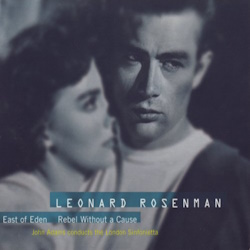 I wish to thank Tommy Krasker for this splendid rerecording of Rebel Without a Cause. The audio quality is excellent as is the performance of the London Sifionietta under John Adams. In 1955 Rosenman established himself as herald of a new age for the scoring of Hollywood films with his pioneering use of twelve-tone chromaticism for “The Cobweb” and his avant garde atonal modernist effort for “Rebel Without a Cause”. Just as Max Steiner, Erich Wolfgang Korngold, and Dimitri Tiomkin brought European Romanticism out of the concert hall and repurposed it for Hollywood films, so too did Leonard Rosenman bring the music of Modernists out of concert halls, adapting its techniques and sensibilities for films. His score for “Rebel Without a Cause” is audacious, innovative, and remarkable in its conception and execution. Cues such as “Knife Fight”, “The Hunt” and “Police Pursuit” offer such complex musical narratives as to confound the brain’s aural processing. In these action scenes, Rosenman unleashed a strident, and stabbing maelstrom of jagged dissonance offering a musical narrative fully unrestrained, unstable, with ever shifting rhythms, and devoid of a tonal center. It seems to me as I listened, as though the orchestra was at war with itself, with ever shifting ensembles pitted against each other. Yet somehow, it worked hand in glove with the film’s narrative. Elements of big band saxophone led Jazz, were often woven into the score’s matrix successfully, along with a traditional Hollywood romantic Love Theme, which offered a welcome respite from the score’s strident and violent tempest. Folks, this score takes us on a road less traveled and for me offers a testament to Leonard Rosenman’s genius. I listened to it several times, trying to grasp its elements and found something new every time. I highly recommend you purchase this wonderful compilation, however let us hope that one day a full re-recording of each score can be made available. Lastly, do watch the film to experience the entire score in context.
For those of you unfamiliar with the score, I have embedded a YouTube link to the “The Hunt”: https://www.youtube.com/watch?v=Caaf5BOtokc&list=PLqeu8TskTf4j_3Tc6kA4NAr0SRqPEhSrh&index=3
Buy the Rebel Without a Cause soundtrack from the Movie Music UK Store
Track Listing:
- Main Title (2:46)
- The Planetarium (3:58)
- Knife Fight (6:02)
- Love Theme (1:24)
- The Hunt (5:00)
- Plato’s Death/Finale (3:53)
Nonesuch Records/Warner Music 79402-2 (1955/1997)
Running Time: 20 minutes 03 seconds
Music composed by Leonard Rosenman. Conducted by John Adams. Performed by The London Sinfonietta. Orchestrations by Leonard Rosenman. Recorded and mixed by John McClure. Score produced by Leonard Rosenman. Album produced by Tommy Krasker.

Shop at the Movie Music UK Store

Member of the

 MOVIE MUSIC UK