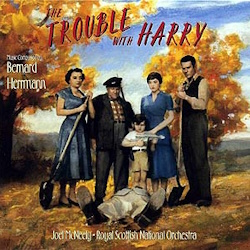
THE TROUBLE WITH HARRY – Bernard Herrmann
 GREATEST SCORES OF THE TWENTIETH CENTURY
Original Review by Craig Lysy
Director Alfred Hitchcock took a liking to the 1950 black comedy novel “The Trouble With Harry” by Jack Trevor Story and purchased the film rights for $11,000. Hitchcock used his own production company to finance the film, with him overseeing production with a $1.2 million budget. He would also direct and hired John Michael Hayes to write the screenplay. For casting, Hitchcock embarked on an experiment – not hiring any established stars as he believed that many times a big star can hinder the narrative flow of his movie. As such, the cast included; Edmund Gwenn as Captain Albert Weiss, John Forsythe as Sam Marlowe, Shirley MacLaine in her acting debut as Jennifer Rogers, Mildred Natwick as Miss Ivy Gravely, Mildred Dunnock as Mrs. Wiggs, James Mathers as Arnie Rogers, and Royal Dano as Deputy Sheriff Calvin Wiggs.
The film is set in rural Vermont and offers a black comedy that develops after the discovery of a corpse on the hill overlooking the town. There are several townsfolk who believe that they may have accidentally killed Harry Worp, and each hope that the corpse will not come to the attention of Deputy Sheriff Wiggs. They constantly move the body in a cat and mouse game to prevent Sheriff Wiggs from discovering Harry. When all is said and done, they discover that Harry died of natural causes to the relief of all. The film was not profitable in the US, however it had good reception in Europe and ended up a commercial success, earning a profit of $2.3 million. Critical reception was a net positive, although the film received no Academy Award nominations.
The selection of Bernard Herrmann to score the film lay with fellow composer Lyn Murray, who was working post production to complete the score for Alfred Hitchcock’s prior film “To Catch a Thief”. Hitchcock was eager to begin his next film and given Lyn Murray’s unavailability, commenced a search for a new composer for “The Trouble With Harry”. Murray suggested Bernard Herrmann, a seminal event in Hollywood, which began the now legendary collaboration of ten films between Hitchcock and Herrmann. Herrmann had always wanted to score a comedy, and while this film was a black comedy, he never the less was enthused at gaining the project. Regarding the score he related; “It is gay, macabre tender, and with an abundance of sardonic wit”. Late in his life he would lament not getting the chance to work more often in the genre.
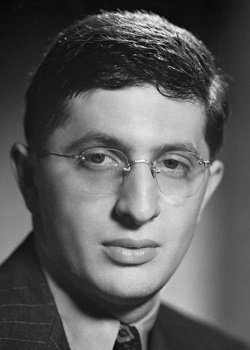 Herrmann throughout his career was known to bring unusual sonorities and non-traditional instrument ensembles for his films. For this film, he shed the percussion section, and assembled an ensemble consisting of double woodwinds, four French horns, strings, and harp. The soundscape he envisioned was intimate, often including various woodwinds soli, and themes offering cantabile melodies. Also, given the setting of small-town Vermont during the Fall season, he underpins the film with some of his most lyrical writing, gracing us with autumnal beauty. In a departure from his usual sensibilities, Herrmann composed several themes and motifs. The Murder Motif is attached to Harry Worp’s corpse and emotes as an emphatic, and dire, repeating four-note phrase, which never resolves. He varies the instruments declaring the motif, but it is always associated with Harry’s corpse, and the conspiracy related to hiding it. The Befuddlement Theme speaks to the odd manner in which people react when discovering the Harry’s corpse. Herrmann offers one of the quirkiest themes in his canon, borne by a percolating bassoon buffone, which leads woodwinds comici, and harsh horns in an odd, off-kilter musical narrative over an undercurrent of ominous strings, entwined with the four-note Murder Motif.
The Autumn Theme offers a wistful pastorale led by solo English horn, kindred woodwinds and warm strings. It speaks to the autumnal beauty of the Vermont countryside whose maple trees are drapes with golden canopies. It serves as an idée fixe and is pervasive throughout the film, the essential musical thread which weaves, and holds the film together. For our characters, Dr. Greenbow’s Theme offers a prancing, happy-go-lucky narrative borne by blissful, spritely strings. It is an odd pairing as the doctor is not an animated character and never smiles. Albert’s Theme is gorgeous, offering a woodwind borne valzer gentile, which carries you like a gentle autumn breeze. Ivy’s Theme offers a lyrical ballad for oboe, harp and strings. She is a spinster, and we discern both tenderness and romantic yearning in the notes. Harry is buried four times in the film and Herrmann scores each with either an ostinato, or macabre and demented waltzes. As was his usual practice, Herrmann also offers a number of short, repeating motifs to propel narrative pacing or sow tension. Lastly, a folk song sung by Sam, “Flaggin’ the Train to Tuscaloosa”, written by Raymond Scott and Mack David, was used to bring a folksiness to the film.
“Overture” offers a score highlight, where Herrmann joins the comic with the macabre to perfectly set the tone of the film. We open with a four-note declaration by horns sinistri of the Murder Motif that usher in the flow of the opening credits. The credits unfold against a child-like cartoon drawing, soon joined by the Befuddlement Theme rendered by percolating bassoon buffone, which leads woodwinds comici, and harsh horns in an odd, off-kilter musical narrative over an undercurrent of ominous strings. We close the credits with a reprise of the dark opening Murder Motif, which supports on screen; “Directed by Alfred Hitchcock”. “Autumn” takes us into the film proper as we hear church bells ringing from a classic white steepled New England church with grounds covered with fallen leaves. We shift to a montage of panoramas of a quaint town with surrounding hillsides alight with autumnal beauty. Herrmann graces us with a wistful pastorale borne gently by woodwinds and warm strings as we follow Arnie, a young boy walking with a toy gun through the forest. We flow seamlessly into “The Murder” atop the dire declarations of the Murder Motif as three gunshots ring out, causing the boy to fall to the ground and look about warily. He gets up and begins moving towards the site of the gun shots carried by comic buffoonery of the Beffudlement Theme. We hear a man shout “I know how to handle your type!” as Arnie runs up a hill. At 0:36 the dire horns of the Murder Motif resound as he stumbles upon a body with a bleeding gunshot wound to the head. The Befuddlement Theme propels his run away, punctuated by a muted reprise of the Murder Motif.
“The Captain” offers a score highlight, and a woodwind lovers delight. It reveals the old Captain Albert Wiles sitting under a tree uttering; “Well, old faithful, that’s your shooting for the day” as he cleans his rifle barrel. He reminisces about the joys of hunting, gets up, and prepares to return home. Herrmann graces us with Albert’s Theme, which bathes us with a wistful, warm and gentle exposition, by strings tenero, which immediately endears us to the man. The transfer of the melody at 0:30 to warm French horns usher in a woodwind pastorale, which supports his trek home through the forest. We close darkly as he comes upon the dead man, and flow seamlessly into “The Body” atop the dire declarations of the Murder Motif. Herrmann sow unease with shifting and repeating quotes of the four-note Murder Motif as Albert frets that he has accidentally shot the man. He reaches into his suit pocket and pulls out a letter addressed to Mr. Harry Worp, from Boston Massachusetts. He decides furtively to pull the corpse into the bushes only to have Mrs. Ivy Gravely arrive unexpectantly. In “Miss Gravely’s Test” a tentative Murder Motif repeats as she asks what he is doing. He confesses to a tragic accident, in which he admits to shooting the man, believing him to be a rabbit. At 0:17 harsh horns resound with the Death Motif as Ivy softly kicks the man twice to confirm his death. She succumbs, to Albert’s entreaty to forget what she saw here. Herrmann continues to unsettle us with repeating quotes of the Murder Motif by woodwind soli answered by woodwind chords. She is oddly detached from what has occurred, strangely unaffected by the dead man, and makes an unexpected offer for him to join her at her place for coffee and blueberry muffins, which he accepts.
We flow into “Jennifer” with eerie strings emoting the Murder Motif as Albert again attempts to pull the corpse into the bushes. Suddenly, he hears voices and sees Mrs. Jennifer Rogers and her son Arnie approaching, as Herrmann continues to repeat an ominous Murder Motif. He hides behind a tree as Arnie describes to his mother how he found the body. Wiles is stunned by her reaction, when she smiles and says; “Thank Providence that it is the last of Harry”. With the same odd detachment as Ivy, she instructs Arnie to forget what he has seen, and takes him home for some lemonade. Herrmann again supports the scene with the Murder Motif unsettling us as it shifts back and forth between grim bassoons, and eerie strings. In “The Doctor”, Albert emerges and comments that she also does not care what I do with it. Suddenly, foreboding strings herald the arrival of Dr. Greenbow. As he approaches, his theme borne by spritely strings offers a prancing musical narrative of delight. Albert is vexed, as he retreats again behind the tree saying “I couldn’t get more people here if I was selling tickets!” He is walking while reading a book, and at 0:31 trips over the corpse and falls, as harsh horns offer repeated declarations of the Murder Motif, answered by a grim bassoon. Remarkably, at 0:40 the doctor stands up, and resumes reading his book as he walks away carried by his spritely theme. We close darkly as Albert again emerges, dumbfounded by events, uttering that this could be the luckiest day of my life.
“The Tramp” reveals yet another arrival, a tramp, which again forces Albert to hide behind a tree, uttering if he will have to wait for the entire world to pay their respects! Herrmann introduces the Tramp’s Theme, a descending, repeating seven-note motif borne among the woodwinds. At 0:17 strings sinistri declare the Murder Motif as the tramp discovers the corpse. A tête-à-tête between the Tramp Theme and Murder Motif unfolds as the Tramp kicks the body and sits down. He removes the rags on his feet, takes off Harry’s dress shoes, and places them on his feet. To his delight they fit and he departs carried by his theme borne by woodwinds comici, as Albert watches with amazement. (*) “Flaggin’ the Train to Tuscaloosa” reveals a panorama of the autumnal beauty of the Vermont countryside as we hear Sam Marlowe, the town artist, singing the happy-go-luck folk song, which brings Jennifer out to her porch, and later Mrs. Wiggs to her roadside Emporium stand.
“The Cup” reveals Sam complaining to Mrs. Wiggs that he just cannot seem to sell his paintings. They enter the shop and converse as she issues him more credit for his groceries. They turn and behold Ivy captivated by an ornate ceramic tea cup, and Herrmann introduces her theme, a lyrical ballad for oboe tenero, strings, with harp adornment, in which I discern an intangible tinge of sadness. She asks Sam for his opinion, and then for him to slip his finger through the holder as strings move to the forefront. He asks why, and she says she want to make sure it fits a man’s hand. She then purchases it and the saucer saying she will be having a gentleman caller. Sam decides that she needs a make-over to update herself and make her look more youthful. He runs outside to get scissors, and ignores a wealthy man who wishes to buy his painting. As he runs back to the house, the gentleman orders his chauffeur to drive away. Inside, Mrs. Wiggs cuts Ivy’s hair. Later, in “Autumn Afternoon” Herrmann graces us with the Autumn Theme again rendered wistfully, as a pastorale led by a solo English horn with harp tresses. Sam sits on a log, opens his sketch pad and colored pencils, and begin sketching a panorama of autumnal beauty. We flow seamlessly into “The Sketch” where Herrmann offers musical farce in an amazing, and imaginative way! The music shifts to a quirky narrative of the Befuddlement Theme with repeating three-note woodwind phrases eliciting a reprise of the Murder Motif as he discovers Harry’s red toed socks. The motif becomes more sinister when he discovers the man is dead and flees. Yet at 0:40 the theme resumes its quirkiness, with one woodwind permutation after another creating a truly weird musical narrative as Sam begins sketching the corpse. Again, a tête-à-tête between with the string borne Murder Motif unfolds as Albert wakes up, and cannot believe his eyes, uttering; “Next thing you know they’ll be televising the whole thing.” He approaches Sam, who sees the gun and asks; “Is this you body little man?” Albert again defends himself saying it was an accident.
“The Doctor’s Return” reveals Albert bonding with Sam who decides to assist him bury the body. As they begin dragging the body away, dire muted trumpets sound to emote the Murder Motif, followed by a grim stepped descent. They look up and observe the doctor approaching and scurry behind a tree to hide. At 0:18 the doctor, who is reading a book while walking, arrives, once again carried by his spritely theme. Staccato horns resound at 0:36 as once again the hapless doctor trips over the corpse and falls. Sam and Albert are incredulous as he gets up, apologizes to the corpse, and continues his spritely walk away again engrossed in his book. We close darkly as Sam and Albert again come out and drag the corpse away. “The Police” reveals Albert walking in town carried by his theme rendered as a valzer felice at 0:07 dire muted trumpets sound as he sees a State Police car parked in front of Mrs. Wiggs Emporium. He shields the rifle from their view as he walks by, his waltz theme carrying him with contrapuntal muted trumpet declarations as the policemen observe. “The Country Road” reveals Sam walking home under golden canopies of autumnal beauty, and Herrmann graces us with the wondrous serenity of the Autumn Theme pastorale. It carries him to Jennifer’s house, where she greets him on the porch. She deflects his effusive compliments of her beauty, and desire to paint her nude, saying she promised Arnie lemonade. However, since he did want to speak to her on another matter, she invites him to sit on the porch while she brings him a lemonade. Arnie rushes out and he and Sam bond, exchanging his live frog, for Arnie’s dead rabbit. Music ceases at this point as she explains to Sam that she planned to marry Robert Worp, but he died unexpectantly and then she discovered she was pregnant with Arnie. His brother Harry offered to marry her as a noble gesture for his dead brother, and she accepted, however when he never consummated their marriage, she left him and went home to mother.
“Tea Time” reveals Albert walking to Ivy’s house for their tea date again under the golden canopies of autumnal glory. He is carried by his lyrical theme rendered as a valzer gentile. He arrives and is greeted by Ivy, who is dressed immaculately in a beautiful blue dress with a ribbon in her hair. She invites him in, and at 1:03 a dissonant diminuendo supports a scene change to Arnie who is carried by a repeating five-note happy-go-lucky motif as he skips through the countryside. At 1:15 a warm rendering of his theme by oboe brings us back to Ivy’s porch where they pleasantly snack on blueberry muffins and coffee. The conversation turns towards Harry, and she agrees with his decision to bury him in an undisclosed location, and we flow into “The Burial” atop a woodwind quote of the Murder Motif as we see Sam and Albert bringing shovels to where they intend to bury Harry. An eerie musical narrative unfolds with a repeating six-note misterioso motif, joined with a contrapuntal child-like lullaby. At 0:55 the Murder Motif sounds as they probe for soft ground to which to bury him. We end with trepidation as they begin to break ground.
In the next three cues, Herrmann offers us a trio of disparate waltzes, a testament to his creativity and genius. “Waltz Macabre” reveals Sam and Albert digging and finishing the grave. Herrmann supports masterfully with a quirky Valzer Macabre. Afterwards, Albert realizes that he fired three shots, with two striking rabbits, and one a can, which means he could not have killed Harry. He resolves to dig him up over Sam’s objections. We flow into “Waltz Reprise”, which graces us with quirky Viennese gentility until 0:10 when forlorn, repeating quotes of the Murder Motif by woodwinds support them digging up Harry. They find the body, but Sam says that the head wound is not from a bullet, but instead from blunt trauma. As such, they decide it is best to keep him buried, and once again fill in the grave. In “Valse Lent” we shift scenes to a quaint cottage along a lake where we see a dapper Albert escorting Ivy from his boat, along the dock, and into his house. At 0:36 a diminuendo of embarrassment supports him removing his underwear hanging on lines around his furnace as she spots a memento; a busty woman figurehead taken from the bow of his ship. The waltz resumes playing under the dialogue as he asks her to take a seat and they engage in conversation. The music stops when she then drops a bombshell, saying that she invited him over for muffins in gratitude for “burying my body”. She says that the man you thought you shot was instead killed by her by a blow to his head using her hiking boot, which had a metal cleat. He is incredulous, asks why, and she responds, that he annoyed her, crazily asserting that she was his wife, and then pulling her into the bushes. In the struggle her shoe came off and she hit and killed him. She apologizes for letting him take the blame, and says she has to fix this.
In “Miss Gravely Digs” she departs and says that they should unbury him as she was acting in self-defense, adding that afterwards she will offer him hot chocolate at her place. Forlorn woodwinds support her departure, with Albert following. At 0:08 a quirky and farcical musical narrative unfolds as we see Albert sitting on a log as Ivy unburies Harry. “Homebodies” reveals Jennifer serving Sam coffee in her living room. The Autumn Theme creates a soothing and warm ambiance as she opens up and expresses to Sam how she is comfortable with him. Yet the mood is lost with the arrival of Albert, and Ivy, who is soiled with dirt. She sits down to make an announcement – declaring that she killed Harry Worp with her hiking boot. Sam asserts that he is buried, and that she has nothing to fear. He looks at her, and asks, “He is still buried, right?” and with that, we flow into “The Closet”, which offers an eerie misterioso as the closet door opens mysteriously, only to have Jennifer get up and close it. Ivy is determined to alert the police; however, Sam dissuades her as it would not only force open her private life to detectives and the newspapers, but also Jennifer’s. She reconsiders, and so they decide to once again bury Harry. As they depart, a coda of the closet misterioso (not on the album) supports its door opening again.
“Harvest Eve” reveals a panorama of harvested fields and autumnal tree colorful canopies. Herrmann’s offers pastoral serenity alight with twinkling harp arpeggio tresses. The scene was edited, taking with it the music from 0:17 – 0:45. After reburying the body a third time, they begin their walk back to town and we flow into “The Phantom Coach” atop spectral trumpets (not on the album). Ivy relates that they announce the arrival of the “Phantom Coach” that used to pass by the town every night two hundred years ago, her revelation supported by a misterioso by harp arpeggios with counters by strings grave. A wistful Autumn Theme joins, but the ambiance is lost when Mrs. Wiggs shouts: “Sam Marlowe!” She arrives and says a millionaire wants to buy all of your paintings! He agrees to see the man, and in “The Walk”, a gentle strolling rendering of the Autumn Theme carries their return. “The Wish” reveals their return to the Emporium. The millionaire offers to buy the entire collection, but instead of taking money, he asks Jennifer what she desires, and she says strawberries. He stipulates two cases of strawberries per month, and then asks what Arnie desires, and she says a chemistry set. He asks Wiggy what she desires, and she says a chrome plated cash register with a bell. For Ivy, she asks for a hope chest, full of hope, and for the Albert, he asks for a new shotgun and hunting clothes. The music enters with soft strains of the Autumn Theme draped with harp arpeggios when they all ask Sam what he desires for himself. Sam whispers into the millionaire’s ear, and he turns to say, “Yes, that can be arranged”. As he departs, he says he will pick up his paintings in the morning.
“Proposal” offers a romantic score highlight. It reveals Sam coming to Jennifer and telling her that he loves her, and wants to marry her. Herrmann supports with a beautiful and tender string borne romanza with harp adornment. The transfer of the melody to solo oboe d’amore is exquisite. A quick camera pan to Ivy and Albert reveals romantic yearning in her eyes. The moment is lost and tension rises when Deputy Sheriff Calvin Wiggs enters with a pair of dress shoes he took from a tramp, who said he got them from a dead body. He investigated but found no corpse. As he calls the state police, everyone makes a quick exit. In “Suspicion” the Murder Motif sounds when Calvin looks down and sees a painting with a face resembling that of the dead man. Herrmann uses repeating two and three note woodwind motifs to sow suspicion as Calvin relates to his mother that the painting matches the description of the dead man by the tramp. “Porch Talk” reveals Sam, Jennifer, Albert and Ivy arriving a Jennifer’s house with their shovels. Albert stops Sam and expresses concern over Calvin’s discovery of the shoes. Sam expresses confidence that they remain safe from suspicion. Herrmann sow unease with a meandering passage for woodwinds, which flow under the dialogue. In “Duo” the men come inside and a solo oboe d’amore reprises the romanza as Jennifer informs Sam that she accepts his proposal saying that she believes he would be good for both her, and Arnie. The melody blossoms at 0:48 as the join in a kissing embrace. Albert and Ivy congratulate them, but Sam expresses a new complication – before they can marry, Jennifer needs to prove that Harry, her husband, is dead. Ivy voices support to digging him up over Albert’s sharp objections. But he relents, and they set off with urgency to dig him up for the fourth time before Calvin follows up.
“Ostinato” reveals the two men digging up Harry as the two women sit and watch. Herrmann support unobtrusively with a two-note piano ostinato, which plays over bass grave. Later, they discuss how they will explain this, and his soiled clothes. They decide to clean him up a bit, however voices are heard and they scurry to hide as we flow into “Encore” carried by the spritely strings of Dr. Greenbow’s Theme as he arrives voicing poetry. At 0:28 trombones of alarm sound as he discovers the body and kneels down. Sam leads the others out of hiding and says that he believes the man met with an accident. Jennifer then states that he was her husband, and the doctor offers condolences. They ask the doctor for the cause of death, and he says he will need to examine him with better light, and they agree to take Harry back to Jennifer’s house. “Cortege” reveals the four walking to Jennifer’s house. There is an album-film variance. Both versions offer a repeating Murder Motif, however in the film it is emoted by high woodwinds, while on album, low register strings. I believe the album version works better in context. “Slumber” reveals Jennifer, Ivy and Sam all working to prepare Harry’s clean clothes for his dressing. Albert slowly wakes up in a chair supported by a quirky woodwind ostinato, which is severed at 0:15 by the dire Closet Motif, and then a saxophone of alarm as he sees the closet door open on its own.
“Afterbeats” opens darkly as they hear Calvin’s car arrive. A contrapuntal string ostinato carries his walk to the house. We end grimly as Jennifer greets him and he asks to speak to Sam. Rather than wait, he walks in and finds Albert and Ivy playing Bridge as Sam watches. He presents the painting of the dead man ask asks about where he painted it, and who was the model. Sam denies there was a model, and attributes it to artistic inspiration. Calvin does not relent, saying the imprisoned tramp confirmed the painting was the face of the dead man he saw. Calvin is convinced Sam is hiding something and says that he will return in the morning with the state police. “The Bathtub” reveals the Closet Motif reprising, as the door again opens. Then Arnie opens the hallway door and, in the bathroom, we see Harry’s feet protruding as Arnie asks “What’s he doing in the bathtub?” supported by the Murder Motif. The bathroom is out of Calvin’s line of sight, and musical farce unfolds as Sam says that’s where frogs belong as Jennifer shuts the door. At 0:29 a musical oops by bassoon support the arrival of Dr. Greenbow, who asks; “Where is he?” Everyone is tensely silent until Jennifer says that he is in the bathroom playing with his frog, as Sam escorts the doctor in. Calvin then departs to find out who keeps blowing his car horn, and reproaches Albert for messing with his car. To Albert’s relief, Calvin departs and he returns to the house.
“Confession” reveals Albert making a confession to Ivy, saying he was not a ship’s captain, but a tug boat captain on the East River who never was more than a mile from shore. Herrmann graces us with a beautiful exposition of his theme by solo clarinet tenero with warm strings as Ivy responds that it makes no difference to her. He then smiles and pulls out Harry’s shoes, which he lifted from Calvin’s car. The doctor then joins them and states that the man died from a heart seizure. The doctor asks why he was in the bathtub half naked, and Jennifer tells him the tale of Harry from beginning to end, which leaves the doctor, incredulous as he bolts out of the house. “The Solution” offers repeating phrases of the Tramp’s seven-note motif by woodwinds, followed by a diminuendo. At 0:24 the motif becomes frenetic as they all spring into action to dress Harry. We close with unease as they conspire to create a new story for Harry as they prepare to return the body to the forest. “Finale” opens with dire horn declarations of the Murder Motif, which support a panorama of the forest. As they all watch from behind a log, the percolating Befuddlement Theme carries Arnie’s arrival. As he stares at the corpse, grim reprises of the Murder Motif sound on woodwinds. Harsh horns launch his run home, carried by the Befuddlement Theme, which also supports the four making preparations to leave. Before they depart, Albert asks Sam what request did he whisper to the millionaire, and at 1:10 the music softens with delight as Albert shares the secret with laughter – a double bed! We close emphatically with a repeating Murder Motif as the screen displays; “The Trouble With Harry is Over”, followed by a quirky woodwind flourish.
I would like to thank Robert Townson for this exceptional re-recording of Bernard Herrmann’s score to “The Trouble With Harry”. The audio quality is excellent, and the performance of the Royal Scottish National Orchestra under the baton of Joel McNeely, superb. Herrmann relished the opportunity to score a comedy film, albeit a black comedy in this case, and it is a shame his first effort in the genre, would also be his last. What is so delicious about this score is that we are blessed with another facet of Herrmann’s genius. His handiwork is a fine example of musical farce, where his quirky, buffoonish, off-kilter, and wildly weird compositions bring the characters to life, and the absurdity of the film’s narrative, with a masterful blending of the comic and the macabre. Woven within this dichotomous musical narrative are found compositional gems that offer exquisite passages of pastoral autumnal beauty, romanticism, and nostalgia. In my judgment we see clearly in this collaboration why Alfred Hitchcock and Herrmann clicked from the start, became close friends, and went on to forge seven films and three seasons of “The Alfred Hitchcock Hour”. In 1975 Herrmann stated that “Hitchcock only finishes a picture 60%. I have to finish it for him.” To which I say, indeed. Folks, this score is the road less traveled, and a side of Herrmann which must be heard. I highly recommend the quality album for your collection, and counsel that you take in the film, as it is great fun!
For those of you unfamiliar with the score, I have embedded a YouTube link to the Main Title: https://youtu.be/FeOt3rQ9d3w?si=PPLYBncVaDggZDMK
Buy the Trouble With Harry soundtrack from the Movie Music UK Store
Track Listing:
- Overture (1:24)
- Autumn (0:53)
- The Murder (0:55)
- The Captain (1:44)
- The Body (1:24)
- Miss Gravely’s Test (0:33)
- Jennifer (0:49)
- The Doctor (1:00)
- The Tramp (1:33)
- The Cup (1:00)
- Autumn Afternoon (0:52)
- The Sketch (1:48)
- The Police (0:43)
- The Police (0:43)
- The Country Road (0:50)
- Tea Time (1:36)
- The Burial (1:24)
- Waltz Macabre (1:20)
- Waltz Reprise (0:38)
- Valse Lent (2:17)
- Miss Gravely Digs (0:33)
- Homebodies (1:24)
- The Closet (0:20)
- Harvest Eve (0:44)
- The Phantom Coach (1:06)
- The Walts (0:33)
- The Wish (0:36)
- Proposal (1:08)
- Suspicion (1:00)
- Porch Talk (1:05)
- Duo (1:21)
- Ostinato (1:01)
- Encore (0:44)
- Cortege (0:44)
- Slumber (0:27)
- Afterbeats (0:38)
- The Bathtub (0:36)
- Confession (0:46)
- The Solution (0:54)
- Finale (1:45)
Varese Sarabande VSD-5971 (1955/1998)
Running Time: 40 minutes 51 seconds
Music composed by Bernard Herrmann. Conducted by Joel McNeely. Performed by the Royal Scottish National Orchestra. Original orchestrations by Bernard Herrmann. Recorded and mixed by Jonathan Allen. Score produced by Bernard Herrmann. Album produced by Robert Townson.

Shop at the Movie Music UK Store

Member of the

 MOVIE MUSIC UK