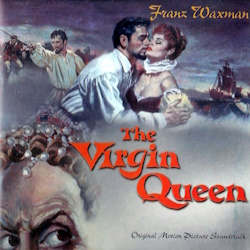
THE VIRGIN QUEEN – Franz Waxman
 GREATEST SCORES OF THE TWENTIETH CENTURY
Original Review by Craig Lysy
In 1954 20th Century Fox executive Daryl F. Zanuck conceived of a film to be titled “Sir Walter Raleigh” set during the reign of Queen Elizabeth I. He offered Bette Davis the role of Elizabeth, yet she bristled at the film title, which made no reference to her. The title was changed to “The Virgin Queen” and she agreed to reprise her portrayal of Queen Elizabeth, first performed in 1939 with “The Private Lives of Elizabeth and Essex”. Charles Brackett was assigned production with a budget of $1.6 million, Henry Koster was tasked with directing, and Mildret Lord would write the screenplay. For the cast, joining Davis would be Richard Todd as Sir Walter Raleigh, Joan Collins as Elizabeth “Beth” Throckmorton, Jay Robinson as Chadwick, Herbert Marshall as Robert Dudly, Earl of Leicester, Dan O’Herlihy as Lord Derry, and Robert Douglas as Sir Christopher Hatton.
The film is set in England 1581 in the 23rd year of Queen Elizabeth’s reign. The story explores a tempestuous love triangle between Raleigh, Queen Elizabeth and Beth. Raleigh gains the queen’s favor with his charisma and chivalry, supplanting her current lover Sir Christopher Hatton. Raleigh uses his position to petition Elizabeth for three ships to establish a colony in the new world. Yet Hatton sow division and precipitates Raleigh’s fall from grace. He is stripped of his titles, and as a consequence leaves court and marries Beth. Elizabeth is mercurial and restores him to his position and grants him one ship for the expedition, with the caveat that he will remain in England. He will not suffer this and plots to seize the ship and sail with Beth. They are captured, sentenced to death, but ultimately forgiven by Elizabeth and allowed to sail to the new world. No information regarding the film’s box office success was found. Critical reception was favorable for its lavish production and a tour de force performance by Bette Davis. The film received one Academy Award nomination for Best Costume Design.
Producer Charles Brackett had collaborated with Franz Waxman on a number of films, and secured his services on this latest endeavor. Upon viewing the film, I believe Waxman understood that he would have to infuse the royal court with the requisite fanfares, military marches, pomp and circumstance. I believe he also understood that the film’s narrative was driven by two enormous egos; Elizabeth’s and Walter’s. Their relationship was mercurial, volatile, and a classic love – hate relationship, which exacerbated Elizabeth’s conflict between her as queen, and her as a woman. A tangential sub narrative involving Walter and Beth’s romance needed complex development as the two struggled with their feelings, as well as how their love contributed to Elizabeth’s and Walter’s conflict.
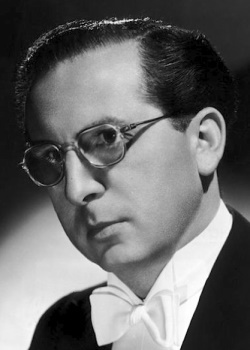 For his soundscape, Waxman composed three original themes, and interpolated the British Army’s Grenadier’s March as the fourth. The march was used infuse the film with the requisite cultural sensibilities by empowering fanfares and marches, which spoke to English prowess, pride and power. The Queen’s Theme reveals the dichotomy of her existence. In her formal capacity of Queen, supreme ruler of the realm and head of state, she is empowered by horns regali declarations, which offer a testament to her prestige, imperious power and pride. Yet, in intimate settings as Elizabeth a woman, her theme is shorn of its regal splendor, and instead expressed with warmth, tenderness and love. Walter’s Theme also has a duality of expression, being forthright, proud, defiant, and imbued with masculine strength when in court settings, or when challenged by the Queen or men of court. Like Elizabeth’s Theme, his theme also becomes warm, and tender during intimate settings. The Love Theme speaks to the romance between Walter and Beth. Expressed warmly by strings romantico, it is song-like in form and rendered with dance-like rhythms. For intimate scenes in settings where Elizabeth is not acting in her capacity of queen, Waxman infuses Elizabethan Age auras with a small ensemble of violas, cello, and harpsichord. Lastly, in establishing a scene’s mood, and emotional dynamics, Waxman remained true to his usual compositional sensibilities.
(*) “Logo” reveals Alfred Newman’s iconic 20th Century Fox fanfare supporting the studio logo and Cinemascope. “Main Title” opens with three consecutive chords grave with timpani strikes, one for each of the principal actors; Bette Davis, Richard Todd and Joan Collins. At 0:17 Waxman interpolates a spirited and ornately embellished British Army’s Grenadier’s March, which supports the film title and the roll of the opening credits. We enter the film proper ominously with “A Rainy Night” where script declares; “In 1581 all roads led to London – for better or worse”. A dramatic kinetic galloping motif propels a carriage at night through a rainstorm. At 0:33 a grave diminuendo supports a carriage wheel sunk deeply in the mud, halting its progress. A foreboding musical narrative unfolds as the coachman informs Lord Leicester that they cannot proceed. His Lordship decides to walk to a nearby inn to solicit assistance. (*) “The Duel” opens with heraldic fanfare as Lord Leicester enters the inn. His request for assistance is rebuffed by several veterans of the Irish wars. Walter Raleigh who is drinking and wenching with his friend Lord Derry sees opportunity and comes to Leicester’s aid. Yet his exhortation to the patrons is also rebuffed and a sword fight ensues, which Waxman chose not to score. Raleigh prevails, wins the admiration of the men, and they all join in freeing Leicester’s coach. Raleigh’s identity is revealed after refusing Leicester’s offer of gold for a reward. Leicester, who was friends with Walter’s father, also fondly remembers Walter as a young boy, So, he invites Walter to join him at Whitehall Castle, where he will introduce him to the queen.
“Leicester & Raleigh” reveals Derry incredulous for Walter turning down a reward of gold. Horns orgogliose declare Walter’s Theme as he replies; “My hopes soar higher than that”. We shift to the next day with horns orgogliose, an octave higher, once again declaring Walter’s Theme as he rides into Whitehall castle. In a meeting with Lord Leicester Walter declines offers for a command in the military, as well as a position at court. Instead, he asks Leicester to facilitate an audience with the Queen where he will pitch his idea, a commission to build ships of his own design and sail to seek fortune in the new world. Waxman supports unobtrusively with a small ensemble of strummed harp, oboe, strings gentile and muted horns. We close with an oblique reference to the Grenadier March. “The Queen’s Court” reveals an assembly of the royal court who await the arrival of Queen Elizabeth. Waxman eschews pomp and circumstance, instead embracing a song-like elegance by infusing the scene with an Elizabethan auras borne by violas, cello, harpsichord and a retinue of woodwinds. At 1:37 an introduction to Elizabeth Throckmorton, who seems smitten, is supported by the string borne Love Theme, which flows with a minstrel like sensibility. There is no overt romanticism, but instead formality and gentility. At 2:20 muted horns regali declare the Queen’s Theme to support her arrival and Walter’s awkward introduction given that he is bend over attempting to retrieve a strand of pearls that broke from Beth’s nervous twisting. His good looks, manners, and Leicester’s intercession save the day as we flow into “A Supper Invitation”. A plodding and sour string ostinato (reflecting her mood) supports the Queen, Walter and her retinue’s walk to her private residence. The ostinato cadence shifts at 0:24 as Walter accepts her invitation to sup with her. At 0:37 heraldic trumpets regali resound with declarations of the Queen’s Theme as she enters a courtyard cheered by her adoring subjects. A muddy water mire flows through the courtyard, and in an act of chivalry, Walter empowered by an austere statement of his theme, lays down his cloak creating a bridge to keep the queen’s feet dry. She is thankful, yet remains wary telling Walter that she does not know if she likes him yet, but does admire qualities in him that are much needed in the court.
In “Talk Of Ships” woodwinds bear Walter’s Theme replete with nautical embellishments as he makes his impassioned case to the queen. She toys and probes, as she is unaccustomed to forthrightness and honesty at court. When he promises her to bring back bounty to fill her coffers, she slights him by tossing her wine at him. He is furious, yet we see she was testing him and insists he stay and at 0:24 aggrieved woodwinds comici support him pouring her a new goblet of wine, which delights her and brings a wry smile. The scene seems to have been edited with music from 0:38 – 1:58 joining it on the editing room floor. At 1:59 film-score synchrony resumes with drama as the musical narrative darkens when Walter departs the royal residence and passes stoically past Sir Hatton and Chadwick. At 2:21 an insidious musical narrative unfolds as Hatton and Chadwick conspire against, and voice their disdain for, this upstart. Muted trumpets at 2:45 herald Hatton being summoned by the queen. At 2:57 a celeste led playful statement of the Love Theme full of enchantment supports Beth intercepting Walter in the corridor. She offers him his muddied cloak and expresses happiness that his request for ships were denied and that he will remain at court. A soft rendering of Walter’s Theme joins as she is not coy and advises that she intends to pursue him, which brings a smile of intrigue as she departs.
In (*) “Leicester Bring News” he advises Walter and Derry that the queen has not approved his request for ships, but instead named him Captain of her Royal Guards. He adds, that the queen moves slowly and deliberately and this is a test to reveal his loyalty. Walter grudgingly agrees and the next day in his first official duty, inspects the guard empowered by fanfare regali and martial drums. Beth taunts and toys with him and he dismisses the guards to converse with her. A drum empowered marcia militare supports the departure of the guards. (*) “The Royal Hunt” reveals the queen and her entourage out for a hunt. Sir Hatton fells a deer; however, the queen misses the mark twice, earning laughter from the French ambassador, whom she rebukes. A series of hunting horn declarations support the scene. Afterwards she orders Walter to prepare a barbecue under the shade of some large oak trees. We flow into “Barbecue Party” where Waxman supports the ambiance with festive Elizabethan sensibilities. Once again Beth and Walter engage in playful repartee, with allusions of the Love Theme. Yet at 0:47 woodwinds doloroso reveal that she has wounded him, reminding him that he has no ships and is now reduced to attending the queen’s whims. Yet at 1:02 the musical narrative becomes spritely as the queen arrives, sits, dismisses her entourage, save Walter whom she engages. Warm renderings of his theme support and usher in at 1:28 a romanticized rendering of Elizabeth’s Theme as the queen commands that he have no dalliances with the women of her court, but instead focus on her exclusively. The music offers a warm and intimate interlude that does not go unnoticed, with the music darkening ominously with ill-purpose at 2:27 as Hatton and Chadwick conspire to sow discord between the queen and Walter.
“Open That Door” offers a magnificent score highlight. It reveals the queen overseeing her privy council. She excoriates the French ambassador for again seeking her consent to marry a young and hapless French prince. Sir Hatton then with malignant purpose masterfully engineers a fight between the queen and Walter by impugning the integrity of his Irish subordinate, Lord Derry. She orders Derry to the tower, which enrages Walter who resigns his post and storms out. This elicits the queen’s fury who follows and loudly orders him to stop in open court empowered by bristling horns irato and a grave rendering of her theme. She berates him, yet he remains aggrieved and defiant. He lambasts the little men that surround her, supported by an aggrieved rendering of his theme. He then declares his love for England, saying that her destiny lies on the seas and lands of the new world. At 0:21 Waxman supports his impassioned oratory with a stirring crescendo nobile. At 0:57 a dire musical narrative unfolds as she commends him to leave her house, which he does with defiance. She then castigates all the little men, and becomes dizzy, commanding Hatton and Chadwick to take her to her chambers. A molto tragico reprise of Walter’s Theme informs us that she does care for Walter and is devastated that her personas of queen ruler and Elizabeth the woman are at odds. We close in Walter’s chamber with a grim bass sustain as he angry changes out of his uniform and prepares to depart.
“Love Scene” reveals Beth entering Walter’s chamber. A tentative musical narrative unfolds borne by woodwinds and strings. His anger still rages, but the music softens on strings with a glowing harp glissando as she comes not to criticize, but instead to console and comfort. At 0:38 she offers him refuge in her house in Devonshire as she at last expresses her feeling for him supported by the song-like Love Theme borne by warm strings romantico. He reciprocates by expressing his love for her, and takes her into a kissing embrace. In a scene change the town’s lamplighter is supported by bell chimes as he announces 9 o’clock. A foreboding musical narrative, replete with tolling bells unfolds as Walter frets about their separation and her fate as the queen’s ward should she choose to marry her off. At 2:14 Waxman sow urgency as Walter summons the innkeeper and his wife as witnesses and then the two exchange marriage vows in the name of God and the Reformed Church of England. After the innkeeper and wife depart at 2:35 the Love Theme resumes with uncertainty borne by celeste and violins. At 3:02 an urgent British Army’s Grenadier’s March joins with a rising tension as our lovers prepare to escape London.
“Another Horse” opens with a sense of urgency with a horn ostinato supporting the arrival of Derry with a horse for Walter, only to be ordered to get another one for Beth. Their conversation is ended with a grim diminuendo due to the queen’s guards pounding on the door. Beth hides behind some bed drapes as the guards enter and order Walter to come with them by the queen’s command. Ominous fanfare portends doom as Walter is refused time to fully dress, grabbing his tunic and sword as they exit. At 0:52 drums militare, strident strings and grim horns support Walter’s departure. On the street Walter asks Derry to care for Beth, and as he is escorted away, Beth watches from the window supported by an aggrieved rendering of the Love Theme. Derry comes to her and is taken aback with news that she and Walter are married. She is distraught, and wants to join Walter, but is dissuaded saying she must return to court and for the time being, keep her marriage a secret lest both their heads roll. At 2:28 a grim Queen’s Fanfare supports her being tucked into bed. Waxman sow tension as her doctors order her bled to relieve strain on her heart and she agrees to accept the visit of the French ambassador. A comic-playful musical narrative carries his arrival. She uses her ailment to again postpone talk of a marriage, accepts his gift of a sword, and offers to exchange courtiers; four ladies sent to the French court, and four gentlemen sent here.
“Sir Walter” offers a score highlight where Waxman masterfully supports complex emotional dynamics. It reveals Elizabeth’s impatience for Raleigh’s arrival as he is escorted in. She declares that she has forgiven him and beckons him to sit bedside. Her theme is shorn of its imperious regality and is instead tender and vulnerable. Yet the intimate moment is shattered at 1:42 by a raging surge of strings irato as she again rages at his audacity of bringing his Irish cutthroat friend into her guard. Yet the music quickly subsides as she, weary of fighting, asks him to do the deed, exposing her throat. Yet Walter, with affection instead declares his fealty. Now reconciled, the musical narrative again warms as she asks him to kiss her and offers her hand. As he kisses it, she tells him to stop his incessant arguing with Hatton, and to take an oath against any swordplay. He does so and when he answers forthrightly her query is she is old, she rewards his candor at 2:31 with regal horns of nobility by presenting him the sword gifted to her by the French ambassador. He is impressed by its craftmanship and her now sumptuous and loving theme blossoms, entwined with his as they now bond. She orders him to kneel and at 3:58 horns regali support her declaring him a knight of the realm. The music swells with regal and noble purpose empowered by noblesse oblige as she then declares that while she cannot give him three ships, she will give him one. She then summons the chamberlain empowered by a slow building crescendo dramatico. It is joined by her regal theme at 5:48, which culminates gloriously, resounding at 6:00 atop trumpets regali declarations of the Grenadier March fanfare as she commands him to announce Sir Walter Raleigh to the court. At 6:19 the chamberlain announces at her majesty’s command, Sir Walter Raleigh to a stunned, yet congratulatory court. Waxman crowns the glorious moment of triumph with grandeur and grandiosity.
In “Beth”, she witnesses the announcement, but flees up the stairs to her quarters. Walter follows, and is clearly noticed by members of court. Waxman sows foreboding auras with a joining of muted horns and trombones. Inside he finds Beth distraught and feeling betrayed as he has given up on departing to find a new life together, choosing instead for the price of one ship and a title, to become the queen’s lap dog. An aggrieved Love Theme full of disappointment supports and crests in pain as he storms out, vowing to never see her again. At 1:18 tense woodwinds and pizzicato strings support him meeting Hatton, who was waiting in the hallway. At 1:34 the music darkens as he again challenges Walter’s honor both with words and a hand slap to the face. Aggrieved horns of the Queen’s Theme sound as Walter honors his pledge to her, suffers the insult, and departs leaving Hatton perplexed. “Raleigh’s Farewell” reveals a blessing ceremony attended by the queen and court for Walter’s departure from Plymouth for the New World. Music enters as Elizabeth calls Walter to step forward towards the throne. She wishes him well; however, we see joy neither in Walter, the Queen, or Beth. Waxman sows a sad, heavy, and almost dirge-like musical narrative. At 1:08 a crescendo dramatico empowers Walter’s departure, as the queen dismays at losing him for months. At 1:19 portentous and foreboding horns declare the Queen’s Theme as she departs with her ladies. We see she is suspicious of Beth and summons her personally to attend her. At 1:51 a nautical iteration of the Grenadier March Theme, which ends on a diminuendo of uncertainty supports a camera shot of Plymouth harbor.
In an unscored scene Walter directs Master Randall to retrofit the Golden Falcon with additional sail canvass fore and aft, as well as fourteen canon ports a beam. At the castle in “The Poem” Waxman reprises his Elizabethan small ensemble of two violas, cello and harpsichord to set a gentile ambiance as the queens relaxes with her court ladies as Sir Hatton recites poetry. He is taken aback when Elizabeth discloses that the author was Walter. At 1:01 the music darkens as the queen informs everyone that Walter will not be sailing to the New World as she intends to recall him to court. Beth is shocked and drops the queen’s jewelry. At 1:13 variations of the Love Theme, draped in sadness join as Elizabeth delivers another announcement – that all four of her court ladies are being sent to the French court for two years or longer. “The Message” reveals a courier delivering a command from the queen for the Golden Falcon to sail up the Thames to London so that she may have her additional canons installed. Walter frets at a two-week delay until the courier drops a bombshell of gossip – that the four ladies in waiting will soon be sent to the French court, with one of them at risk should the queen be informed that she is pregnant. Horns dramatico resound and propel a galloping motif as Walter races to Beth’s home in Devonshire. Upon arrival a tense musical narrative unfolds as he orders the butler to announce his arrival. At 0:38 when he returns saying the mistress refuses to meet with him, horns irato resound as Walter barges into her chamber. She asks him to leave, but he refuses and discovers that she intends to resign from court and not go to France. Forlorn woodwinds adorned with harp arpeggios drape them in sadness, shifting to sad strings of yearning. The music darkens at 1:52 when he informs her of court gossip that she is pregnant, to which she assures him that she will never divulge him as the father. He comes to her supported by a yearning cello romantico, and declares his love, crowned with an impassioned kissing embrace, which she welcomes. The celli borne Love Theme buttressed by hope, and enriched by contrapuntal strings blossoms as he promises that they will sail together in three weeks for the New World to begin their new life together.
In an unscored scene Walter informs Derry of his plan to elope to the New World with Beth, who are now formally wedded by the church. Derry warns of the queen’s wrath, but Walter is undeterred, saying he intends to return and earn her favor with a ship laden with gold. In his cabin, her and Derry discover the weasel Chadwick who has brought a letter from the queen that commands that he fly this scarf of hers from the main mast as he sails up the Thames, as a symbol of the one you serve. Back at the castle in “Raleigh’s Secret” Waxman weaves a narrative of slow growing, foreboding tension as Chadwick and Hatton conspire to arouse the queen’s anger. They disclose that Raleigh has constructed a new large bed more accustomed to a married man. That he is making haste to depart with who they suspect is Lady Beth from Devonshire. At 0:53 when she asks what exactly does he mean, a crescendo of rage erupts as Hatton declares that Raleigh is a married man. She exits to her chambers at 1:16 carried by the fury of her theme as she smashes the model of the Golden Falcon. At 1:41 dire horns sound and empower the queen’s guard led by Sir Hatton surrounding the Golden Falcon. He presents Derry with orders for him to arrest Sir Raleigh and bring him to London. In the cabin, Walter dispatches Derry to retrieve Beth and smuggle her into Ireland, while he delays Hatton. In an unscored scene Hatton again insults Walter’s honor, but this time he responds saying his oath forbade swords, not fists, and the two men begin a brutal fight in the cabin. Hatton begins to lose the fight, and cheats, grabbing a spear, which he throws, missing its mark. As Walter pummels him, Hatton orders the guards to arrest him and Walter is overcome.
In “Derry’s Death” he and Beth ride on country roads hoping to escape the dragnet by the queen’s guards. A trombone propelled flight motif empowers their desperate ride to freedom. At 0:19 a diminuendo supports Beth stopping, her dress caught in a stirrup, yet trumpets bellicoso resound at 0:32 as a four-man patrol led by Chadwick approaches. They flee but Derry sees it will be for naught, and orders her to go on to the rendezvous as he attempts to fight off the guards. A charging tempest furioso erupts as one guard pursues Beth while Derry valiantly fights the other three. Beth is caught and at 1:20 a chord of death supports Derry impaled in the back. A mournful passage of expiration follows as Beth comes to Derry and comforts him during his passing, declared at 2:20 by horns of despair. Chadwick then announces to Beth that she is under arrest. A foreboding musical narrative supports Chadwick escorting Beth to Hatton at Whitehall. The music shifts to fear and sadness as Lord Leicester informs Beth that Walter is in the tower under a death sentence, his intercession, rejected. An ominous walk of doom supports guards escorting Beth to her quarters where she will be placed under guards. A wind gust blows out the guard’s candle, allowing her to escape while they are distracted. At 3:15, empowered by a pleading solo piccolo voicing of the Love Theme, Beth reaches the queen’s bedchamber to plead for Walter’s life. “Beth Pleads To The Queen” reveals her pleading for Walter’s life, using various arguments, all for naught until she declares that under English law a pregnant woman cannot be executed. When she adds that Walter is loyal and that jealousy is unworthy of a monarch, Elizabeth asks her to fetch a candle. A musical narrative of sadness and regret unfolds on her theme as Elizabeth removes her head cap to reveal that she is bald, thanks to small pox. She then voices the sadness of her life, that she could never bare children nor attract men with her lack of beauty, instead using her intellect and spirit to appeal to them.
We flow seamlessly into “Finale” a powerful and dramatic score highlight. atop a crescendo of pain, which erupts as a furious Elizabeth orders her guards to take the wench away. Her theme shifts to dissonance as we see that Elizabeth is distraught, and conflicted. At 0:25 a despondent Walter’s Theme supports as we see him contemplating death. At 0:39 bells and reserved regality usher in a musical narrative of despair borne by Elizabeth’s Theme as she visits Walter in his cell. The musical narrative is one of disappointment and despair as her theme gains intensity, expressed with pathos. He disputes his treason and pleads with her to continue the Golden Falcon’s mission for the greatness of England with another captain. She is not persuaded, says that after the brat is born, Beth will follow him in death. He is furious and at 2:23 tolling bells usher in a drum empowered dirge that presage his fate as he, a dead man, orders her to leave his presence. She begins to leave, yet turns and says that she needed him, but you betrayed me. He again attests his love for her as his queen, but adds that it was her who betrayed his love. She adds that she is also a woman, and he kneels and kisses her hand. However, at 2:44 she never the less departs as a crescendo of pain explodes. Yet the fury dissipates as she tarries outside his cell, clearly conflicted. At 3:17 muted horns support her return. There is interplay of their two themes as she declares that he will captain the ship, and having been a brat that suffered her mother’s beheading, she will not force this on his brat. She declares he had better bring back enormous wealth or else and departs at 3:45 with dire timpani strikes and muted horns regali. At 4:04 woodwinds emote a lonely Elizabeth’s Theme in a sad descent as Leicester visits her in her study. He alerts her to the Golden Falcon sailing on the Thames to her destiny, and entices her to observe something special. At 4:48 Walter’s Theme sounds on French horn nobile as she looks through a telescope, she sees Walter and Beth together on deck. She takes no pleasure in what she sees. He asks her to raise the glass higher, and her theme sounds as she sees a scarf with her emblem flying on the main mast. At 5:13 bittersweet strummed harp support as she returns to her desk saying seven more months of waves and a puking wench. She dismisses Leicester so she can attend to the business of state, with the music struggling to gain hope. She drops her quill and at 5:51 a last sad declaration of the Grenadier Fanfare speaks of her isolation and unrequited love. Yet at 6:08 the Grenadier Fanfare resounds with proud and indomitable declarations to close the film in a flourish.
I would like to thank the late Nick Redman for this premiere of Franz Waxman’s score for “The Virgin Queen”. The mixing, editing and digital remastering of the score from the 35mm source masters is excellent and offers a rewarding listening experience. Bette Davis and Richard Todd’s acting performances of Queen Elizabeth and Sir Walter Raleigh were a tour de force, and Waxman was hard pressed to match their massive egos musically, but in the end, I believe he succeeded. There was a dichotomy of both their personas with Waxman tasked to express Elizabeth’s struggle between her role as Queen ruling in a man’s world, and beneath this regal veneer, a woman’s yearning desiring love. As Queen, Elizabeth’s music is regal, imperious, and proud, while in private the hard edges were softened, feminized and made tender. Indeed, it is within the notes of Waxman’s compositions that Elizabeth’s struggle is felt. So too was Waman’s challenge with Walter, who lived in an age where a man dares not publicly let down his guard to reveal emotional weakness. The musical interplay of these two egos was masterful and a testament to Waxman’s talent. The song-like Love Theme, which supported Beth and Walter’s mercurial romance was well conceived, evolving over the course of the film as mutual attraction is transformed into romantic love. Musically, the cultural sensibilities of the age were well expressed with the requisite marches, fanfares, pomp and circumstance all bringing the royal court to life. Folks, this score is not generally associated with the finest in Waxman’s canon, however, it is well-conceived, and executed, finding a wonderful confluence with the film’s narrative and acting. I recommend you purchase this quality album and take in the film.
For those of you unfamiliar with the score, I have embedded a YouTube link to a 15-minute suite: https://www.youtube.com/watch?v=0aBmXFp_8PY
Buy the Virgin Queen soundtrack from the Movie Music UK Store
Track Listing:
- Main Title (1:25)
- A Rainy Night (1:33)
- Leicester & Raleigh (1:20)
- The Queen’s Court (2:33)
- A Supper Invitation (0:59)
- Talk Of Ships (4:12)
- Barbecue Party (2:45)
- Open That Door (2:01)
- Love Scene (3:32)
- Another Horse (3:37)
- Sir Walter (6:56)
- Beth (2:01)
- Raleigh’s Farewell (2:06)
- The Poem (2:24)
- The Message (3:18)
- Raleigh’s Secret (2:11)
- Derry’s Death (4:03)
- Beth Pleads To The Queen (1:01)
- Finale (6:30)
Varese Sarabande CD Club VCL 0502 1009 (1955/2002)
Running Time: 54 minutes 27 seconds
Music composed and conducted by Franz Waxman. Orchestrations by Edward Powell and Leonard Raab. Recorded and mixed by XXXX. Score produced by Franz Waxman. Album produced by Nick Redman.

Shop at the Movie Music UK Store

Member of the

 MOVIE MUSIC UK