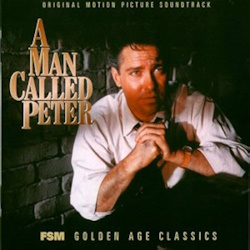
A MAN CALLED PETER – Alfred Newman
 GREATEST SCORES OF THE TWENTIETH CENTURY
Original Review by Craig Lysy
The genesis of this film lay with the book A Man Named Peter, a biography of preacher Peter Marshall, who served as Chaplin of the United States Senate from 1947 to 1949. 20th Century Fox believed that the inspirational life of this well-respected preacher would translate well to the big screen. Samuel G. Engel was placed in charge of production with a $1.74 million budget, Henry Koster was tasked with directing, and Eleanore Griffin was hired to adapt the novel and write the screenplay. A fine cast was assembled, including Richard Todd as the Reverend Peter Marshall, Jean Peters as his wife Catherine Marshall, Marjorie Rambeau as Miss Laura Fowler, and Jill Esmond as Mrs. Findlay.
The film is set in 1915 in Scotland and then shifts to America. The biopic follows the life of Scotsman Peter Marshall who answers the call to preach the word of God and so journeys to America to attend divinity school. He graduates and is assigned to a rural church in Georgia where he meets Catherine Wood. Hey fall in love, marry and move to Washington D.C. as Peter has accepted an offer to be pastor of the New York Avenue Presbyterian Church. He acquaints himself well, comes into the public’s eye and accepts an offer to be Chaplin of the United States Senate. Unfortunately, his health declines, and after two years of service he dies of a heart attack at the young age of 46. Despite his short tenure, he left a lasting legacy from his inspiring sermons. The film resonated with the public and was a massive commercial success, earning a profit of $2.75 million. Critical reception was also favorable with many commending Michael Todd’s inspired acting performance, but the film only received one Academy Award Nomination for Best Cinematography.
Director Henry Koster had four prior collaborations with Alfred Newman, including his impressive and inspiring score for the religious epic “The Robe” (1953). As such, he offered him the assignment without hesitation. I believe Newman understood that the film’s nexus was the spiritual quest of Peter who found his life purpose as a preacher. Woven into this narrative was a love story for the ages, with Catherine, who I believe was his soul mate. Though a proud Scotsman, Peter loved his new adopted country and became a supreme patriot, while always remaining true to his Scottish roots.
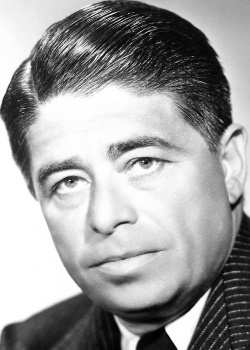 For his soundscape, Newman anchors the film with three primary Themes. Peter’s Theme was perfectly conceived with Newman masterfully capturing the very essence of Peter. It offers a song-like lyricism, reverence, and a folksy sensibility, which speaks to this devout man, who is blessed with an irrepressible optimism and faith in God. It offers a long-lined, strings nobile borne expression in a traditional ABCA form, with the A Phrase being confident, forthright and declarative, and the B Phrase yearning and hopeful, while the C Phrase embraces Scottish folksiness. Catherine’s Theme serves as both her personal identity, but also a Love Theme for her and Peter. It is long-lined, lyrical, and offers a romanza by yearning strings. It should be noted that this theme is a permutation of a melody used in four prior films; “The Blue Bird”, “This Above All”, “Leave Her To Heaven” and “O’Henry’s Full House”. The America Theme is bold, forthright, and patriotic fanfare empowered anthem exuding confidence and the irrepressible American spirit. It also was a permutation of a melody used in “The Young Mr. Lincoln” and “The Blue Bird”. Lastly, Newman interpolated and infused into his score folk songs for the requisite Scottish cultural sensibilities, religious hymns, and patriotic Americana.
“20th Century-Fox Fanfare with CinemaScope Extension” offers Newman’s iconic fanfare, extended to also support the studio’s Cinemascope credit. “Main Title” offers a score highlight where Newman graces us with an extended exposition of the film’s primary theme, Peter’s Theme, which opens with solemnity as the golden script of the opening credits unfold against a starry twilight sky. His theme offers a song-like lyricism, reverence, and a folksy sensibility, which speaks to this devout man blessed with an irrepressible optimism and faith in God. Strings nobile emote its confident, forthright and declarative A Phrase, shift at 0:22 to the yearning and hopeful B Phrase. At 1:45 we flow into the folksy C Phrase, and the close with a reprise of the A Phrase. At 1:10 the theme softens and unfolds with a tender musical narrative as we enter the film proper, a prologue with narration by Catherine Marshall. We see the bustling port of Glasgow Scotland in the year 1915 as she relates that this is story of a man, Perter Marshall, and his close friendship with God. Although he grew up inland in the town of Coatbridge, his heart belonged to the sea. He is caught a third time trying to stowaway and a constable brings him home, telling his stepfather that this is a final warning to desist.
Nine years later in “The Revelation”, Peter is now a young man working in the mills and earning $9 a week, which was barely enough to pay his stepfather and night classes at the Glasgow Technical School. His folksy Scottish C Phrase supports Catherine’s narration. At 0:33 Newman sow unease when the music shifts to an eerie and nebulous narrative as Peter walks home in a dense fog. He stops twice calling out “Who’s there?” to no avail. At 1:32 muted portentous horns slowly strengthen to herald danger cresting with terror as Peter stumbles due to an elevated tree root and almost falls off a cliff. At 2:01 in the aftermath distraught strings speak to his fear, yet a calmness follows from which arise religious auras. Peter has an epiphany, and realizes that God was calling him to his service, and saved his life. We see that he is thankful, and accepting, and close with solemnity on a crescendo of religious exaltation. “The Bonnie Banks of Loch Lomond” offers Peter singing the traditional Scottish folk song as he arrives home and relates his experience to his mother: “O you take the high road, and I’ll take the low road, And I’ll be in Scotland afore ye, But me and my true love will never meet again, On the bonnie, bonnie banks of Loch Lomond.”
“The Immigrant” reveals Peter advising his mother that God has called him to His ministry. Supported by a happy and confident rendering of his theme. He relates he will journey to America to be trained for the ministry. Narration informs us that after working hard that Peter had saved enough money to travel to America. At 0:22 Newman introduces his stately, and reverential America Theme as a wide-eyed Peter gazes at the Statue of Liberty as his ship arrives in New York. Narration informs us that he spends his early days doing manual labor in New Jersey as he awaits God’s calling. That calling was finally heard, and Peter enrolled in the Columbia Theological Seminary in Decatur Georgia, graduating three years later Summa Cum Laude. Loyalty and Courage” reveals that Peter is offered two Georgia ministries, one in Atlanta, and one in the small town of Covington. With humility Peter chose Covington and scenes of his ministry are supported with the hymn by Henry F. Henry borne by an organ reverenziale. At 0:13 we segue into the hymn “The Holy Trinity”, which supports Peter’s new assignment to a large church in Atlanta. His sermons gain recognition, leading to huge crowds and Catherine’s interest, which are supported by this hymn by John B. Dykes on an organ reverenziale.
In “Jesus Christ the Lord” Peter has concluded his sermon and meets with appreciative members of the congregation. Catherine, whose narration reveals for two years she has lived for his Sunday sermons approaches him, but stops, reticent to introduce herself. Newman supports with the hymn borne with confidence and optimism by organ reverenziale. At 0:37 we segue into “Alma Mater” for an external shot of Catherine’s college, Agnes Scott College, which Newman supports with a stately musical narrative.
“Catherine” offers a beautiful score highlight. It reveals Catherine’s narration of her happiness that her college assignment calls for her to meet Peter. She is dressed immaculately in a pink dress and sits on a bench with sweet anticipation reading poetry. Newman introduces her long-lined theme, borne by soft strings tenero, which flows like a spring breeze through magnolia tree blossoms. He arrives in a truck and we see her disappointment when he introduces his rotund pianist, who sits between them in the cab. They are cramped, and Catherine plans for time alone are dashed when Peter advises that our boy from Georgia Tech will drive her home. “That Old Time Religion” reveals the three arriving for an outside “Youth Rally” with bleachers filled with a young and rowdy crowd. Catherine sits with two other college students, who flee from the rowdy crowd when Peter asks them to speak. But not Catherine, who to his surprise, climbs up on the truck bed and gives an inspiring speech lauding traditional Christian women values. Having won over the crowd, Peter asks that they celebrate with a song, and an old man leads the group in singing the joyous traditional hymn.
“Goodnight, Peter Darling” offers a beautiful score highlight, which features extended expositions of Peter and Catherine’s Themes. It reveals Peter personally driving Catherine home and voicing his great satisfaction from her inspiring speech. His marital status and plans come up as she probes to see if he has a girl and is engaged. She is relieved that he does not. Sadly, the music through 1:30 is dialed out of the scene, and it is a shame as it offers a wonderful rendering of Peter’s Theme, which strolls with happiness. The transfer of the melody from strings, to woodwinds, and then back to strings is exquisite. Music enters at 1:31 with a tender rendering of Catherine’s Theme, in which we discern a nascent romantic yearning, as they arrive at the college and he walks her home. We see that he is attracted to her, and when he asks if she will join him for dinner next week, she says yes, with joy and thankfulness revealed in her eyes. “One Week Later” reveals Catherine’s narration expressing her disappointment when Peter fails to call. Newman drapes her theme with sadness to support the narration.
“God the Father” reveals Peter’s impassioned sermon on marriage, which is supported by the Franz Joseph Haydn hymn emoted by organ maestoso. As she departs Peter’s secretary requests that Catherine please remain as he would like to drive her home. Catherine is ecstatic and, on the way home she accepts his offer for a day trip as it was such a beautiful day. They drive out to Stone Mountain, which he scales, waving to her from the summit. “The Proposal” reveals Peter at last realizing that God has intended for him to marry Catherine. He proposes and she tearfully accepts as the join in a kissing embrace. Newman entwines their themes in a beautiful romantic narrative. At 0:51 we segue into “The Cedars Waltz”, which offers a valzer gentile, which supports the ambiance of them dining at his favorite restaurant. At 1:26 we segue into “The Way of Love” a molto romantico score highlight. Catherine voices that after two years of dreaming, her wish has finally come true. They plan for marriage and their new life together, which because of his busy schedule and prior commitments make the end of summer the earliest they can marry. She is joyous and they once again join in a kissing embrace. Newman once again entwines their two themes, which unfold with a number of variations, in a romantic musical narrative, blossoming on her theme at 3:44 in rapturous crescendo romantico. We close with their hearts, and themes joined, bound in love.
“The Marriage” reveals their church marriage in her hometown in West Virginia. Newman adapts the Wedding March from the opera Lohengrin by Wagner, by expressing it with twinkling chimes draped in Scottish auras. At 0:14 we segue into “The Honeymoon” and we are graced with a blissful musical narrative empowered by a spritely exposition of Peter’s Theme as we see our happy couple enjoying their honeymoon along the Cape Cod shoreline. Afterwards in “Washington, D.C.”, they move to the capital as Peter relocates his ministry to the Church of the Presidents. A montage of famous Government buildings and monuments is supported with a proud, patriotic and stately declaration of the America Theme. At 0:32 an alternate, unused trumpet led version of the music was attached. “The Lincoln Memorial” reveals Peter and Catherine driving past the Lincoln Memorial, which elicits him to visit his new church, which contains the pew where President Lincoln sat. Newman supports with a wistful rendering of the America Theme.
In “A Mighty Fortress” Peter first sermon is introduced by the famous hymn by Martin Luther, which is sung by a mixed voice quartet with accompaniment by organ solenne. After the sermon and as the congregation departs in “O Rest in the Lord”, an organ reverenziale supports with this hymn by Felix Mendelssohn. “The Church of the Presidents” reveals Peter’s ministry being lauded by a montage of newspaper headlines and magazines, supported by a proud and stately rendering of the America Theme. In “Eternal Father” the popularity of his sermons causes people through the city to throng to his church, undeterred by even a rainstorm. The hymn “Eternal Father” by John B. Dykes, lyrics by William Whiting (0:00 – 0:48) was dialed out of the film. At 0:49 in “A Mighty Fortress”, a large mixed choir sings the Christian anthem. “Hospital Scene” reveals Peter joining Catherine at hospital to celebrate the birth of their son. Newman offers a remarkable score highlight, a wondrous lullaby, which draws inspiration from Mozart’s nursery rhyme “Twinkle, Twinkle, Little Star”. It offers a tender, childlike composition draped with Scottish auras.
“Annapolis Chapel” reveals Peter accepting an invitation to give a sermon to the graduating class of the Annapolis Military Academy. The scene opens with cadets walking to the chapel supported by the traditional navy hymn “Eternal Father, Strong to Save” (1860) by John B. Dykes, lyrics by William Whiting, rendered as a proud marcia patriottica. At 0:32 we segue into “Eternal Father” with the hymn now sung with reverence by men’s chorus. Peter upon seeing the young men, discards his prepared sermon, and instead offers an impromptu one on death, which he declares is not and ending, but a portal to eternal life. “Symphony No. 1” reveals Peter picking up a navy cadet hitchhiking to return home. On the car radio plays the grand striding melody from the Adagio of Johannes Brahms Symphony No. 1 in C Minor (1876). The music is severed by the dire news announcement of the Japanese Attack of Pearl Harbor. With Christian charity, Peter turns the car around and takes the cadet back to base as all leaves have been cancelled.
To support morale during the war, Peter setup a Saturday night Canteen in the basement of his church to entertain the troops and families. Three folk songs are used to support the festivities, including the silly and comedic “Mairsie Doats” by Milton Drake, Al Hoffman and Jerry Livingston, the Scottish traditional “Comin’ Through the Rye” by Robert Burns, and “Don’t Sit Under the Apple Tree”, a soldier’s testament of love to his gal by Lew Brown, Charlie Tobias and Sam H. Stept.
“Tuberculosis” reveals Peter playing alphabet blocks with his son. Happiness abounds supported by a blissful rendering of his theme. At 0:24 we descend into profound depths of sadness borne by weeping strings as Catherine comes homes, pushes away her son’s attempt to hug her and goes upstairs where she informs Peter that she has tuberculosis. She is devastated and weeps and he hug and consoles her. We flow into “Illness”, which offers a montage of Catherine bed bound as we see the seasons pass, a grim chest x-ray report, and an endless stream of medical bills. Newman, a renowned master of the string section of the orchestra supports masterfully with auraltography, using a grim descending undercurrent of low register strings over which emote eerie, shimmering violins. “Soliloquy” offers a poignant score highlight in which Newman masterfully supports Peter’s questioning his faith and motivations. It reveals that Catherine has been ill for three years, and as Peter attends to the coal furnace in the basement, we see that she remains ever-present in his thoughts. After fixing the furnace he is distraught, collapses on the stairs, questions his faith, and voices a soliloquy of despair. Newman supports synergistically with an extended exposition of Peter’s Theme rendered as a Pathetique. The confluence of acting, Peter’s soliloquy and music, is profound, and deeply moving.
“Faith and Recovery” reveals Catherine also experiencing a crisis of faith, where her despair of being an invalid for the rest of her life elicits a last heartfelt beseeching of the Lord. Newman supports her soliloquy with a dispirited, and despairing iteration of her theme. Yet at 1:00 her theme soars on a crescendo glorioso as Peter races home and is filled with joy as he finds her standing downstairs, fully healed by the grace of God. At 1:24 a diminuendo religioso supports their kissing embrace and praise of God. “Cape Cod” offers a score highlight with delightful interplay of Peter’s and Catherine’s themes. Catherine’s warm, homey theme supports her narration that the Marshalls were summer vacationing at Cape Cod. At 0:22 we shift to a blissful Peter’s Theme as we see him and his son Peter John building a row boat and taking it to sea. The theme becomes tentative when they return home with a surprise; Jeff, a Coker Spaniel puppy. However, Peter’s Theme warms once more when Jeff wins over Catherine’s heart. At 1:33 we return to Catherine’s Theme as the family locks up the cottage and heads back to Washington D.C.
“Prayers for Peter” reveals Peter suffering an apparent heart attack while performing his Sunday sermon. He is admitted to hospital with his doctor advising Catherine that it is serious and tests need to be performed before he can make a definitive diagnosis. Music enters in the aftermath as they learn later it was a heart attack. They all gather in his office and pray for Peter’s recovery. Newman reprises the sad musical narrative of the “Soliloquy” scene draped in religioso auras. “If With All Your Hearts” reveals Peter returning to his ministry with an impassioned sermon. Afterward he finally gains the approval of the church’s austere matriarch Miss Fowler. Mendelssohn’s hymn from “Elijah” (1846) is played softly with reverence by an organ solenne under the dialogue. “Our New Chaplain” reveals a group of senators offering him the prestigious position of Chaplin of the United States Senate. Catherine decides with some hesitation to support Peter taking the post, much to his and the senator’s delight. Music enters against an external view of the Senate wing of the capitol building with a grand declaration of the America Theme by fanfare nobile as he ascends its massive stairway. “Annie Laurie” reveals the family singing a traditional Scottish romantic ballad by Alicia Scott with Catherine playing the piano. “Peter’s Death” opens with resounding declarations of the America Theme by horns orgogliose, which usher in a heartfelt exposition of the theme, which support Peter taking his family for a nigh time walk to the Capitol building. At 0:35 later that night, Newman sow trepidation as Peter who is lying in bed, asks Catherine to call the doctor as he is in great pain. As he is taken by stretcher to hospital, we see Catherine is distraught, fearful, and wants to accompany him, which Newman reflects in his music, but he says she must remain home with Peter John. The next day at 1:01 we shift to a dirge as Catherine receives a phone call that Peter has died. At 1:23 a mournful solo violin voices her theme with devastation as Peter John joins her. He sees she is distraught, and runs to her embrace. At 2:03 we close with grand declarations by mournful horns solenne as newspaper headlines declare “Peter Marshal Has Died!” “Finale” reveals Catherine and Peter John returning to their summer cottage at Cape Cod with her narration supported by her wistful theme. She panics when she sees Peter John launching the rowboat and runs out to him. She accedes to his pleads that she ride with him, and at 1:03 we flow into a blissful rendering of Peter’s Theme as mother and son shove off as father and son did before. Her face slowly changes from apprehension to happiness as she begins to enjoy the ride in their bonny boat. We close atop a grand and hopeful declaration of her theme as she calls out, see you in the morning honey to conclude the film.
I commend Lukas Kendall for the restoration and issue of the complete score to Alfred Newman’s inspiring score for “A Man Called Peter”. The technical team used the original 35mm source tapes to remix and digitally restore the score. Some audio imperfections are present, but they do not in my judgement detract from the beauty and eloquence of Newman’s handiwork. Newman was a non-practicing Jew who throughout his career demonstrated a gift for composing music of inspiring religiosity; “The Song of Bernadette” (1942), “The Keys To The Kingdom” (1945), “The Robe” (1953), “The Egyptian” (1954), and “The Greatest Story Ever Told” (1965). Such is the case here, as we bear witness to music, which uplifted and brought Peter and his ministry to life, achieving a sublime religious and cultural confluence. His romanza theme for Catherine gave voice to their love, and the joining of soulmates. The use of, and inclusion of Christian hymns on this album was well-conceived and executed as they inspired, ennobled and enhanced the film’s storytelling. Folks, this is a classic Golden Age score with melodic eloquence and at times, profoundly stirring religiosity. I highly recommend you purchase this quality album and take in the film to experience the music in context.
For those of you unfamiliar with the score, I have embedded a YouTube link to ten-minute suite; https://www.youtube.com/watch?v=tzOghyaigjg
Buy the Man Called Peter soundtrack from the Movie Music UK Store
Track Listing:
- 20th Century-Fox Fanfare with CinemaScope Extension (0:20)
- Main Title (2:09)
- The Revelation (2:50)
- The Bonnie Banks of Loch Lomond (traditional) (0:44)
- The Immigrant (1:14)
- Loyalty and Courage/The Holy Trinity (1:23)
- Jesus Christ the Lord/Alma Mater (0:51)
- Catherine (1:03)
- That Old Time Religion (0:46)
- Goodnight, Peter Darling (3:05)
- One Week Later (0:36)
- God the Father (0:32)
- The Proposal/The Cedars Waltz/The Way of Love (6:17)
- The Marriage/The Honeymoon (1:24)
- Washington, D.C. (1:03)
- The Lincoln Memorial (1:02)
- A Mighty Fortress (1:20)
- O Rest in the Lord (2:05)
- The Church of the Presidents (0:37)
- Eternal Father/A Mighty Fortress (2:00)
- Hospital Scene (Lullaby) (1:05)
- Annapolis Chapel/Eternal Father (1:50)
- Symphony No. 1 (written by Johannes Brahms) (1:35)
- Mairsie Doats (traditional) (1:01)
- Comin’ Through the Rye (1:23)
- Don’t Sit Under the Apple Tree (0:58)
- Tuberculosis (1:02)
- Illness (0:35)
- Soliloquy (3:40)
- Faith and Recovery (1:54)
- Cape Cod (2:18)
- Prayers for Peter (1:01)
- If With All Your Hearts (1:02)
- Our New Chaplain (0:34)
- Annie Laurie (1:00)
- Peter’s Death (2:30)
- Finale (2:16)
Film Score Monthly FSMCD Vol. 4 No. 7 (1955/2001)
Running Time: 57 minutes 05 seconds
Music composed and conducted by Alfred Newman. Orchestrations by Edward B. Powell. Recorded and mixed by XXXX. Score produced by Alfred Newman. Album produced by Lukas Kendall.

Shop at the Movie Music UK Store

Member of the

 MOVIE MUSIC UK