RUDYARD KIPLING’S THE JUNGLE BOOK – Basil Poledouris
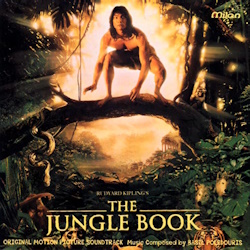 THROWBACK THIRTY
Original Review by Jonathan Broxton
Hot on the heels of Bram Stoker’s Dracula and Mary Shelley’s Frankenstein in Hollywood’s short-lived series of supposedly faithful film adaptations of classic novels, this live-action versions of Rudyard Kipling’s The Jungle Book reimagines the classic tale as an adventurous, romantic epic. Directed by Stephen Sommers, the film focuses on Mowgli (Jason Scott Lee), a young boy raised by animals in the Indian jungle after being separated from his family. Years later, as an adult, Mowgli re-enters human civilization when he encounters Kitty (Lena Headey), his childhood friend and the daughter of a military officer working within the British Raj. As Mowgli navigates the clash between his jungle upbringing and human society, his relationship with Kitty deepens, eventually becoming a forbidden romance; however, he faces hostility from the corrupt Captain Boone (Cary Elwes), Kitty’s fiancé, who seeks to exploit Mowgli’s knowledge of the jungle to find the legendary treasure of Monkey City.
Rudyard Kipling’s The Jungle Book was the third major adaptation of the work, after director Zoltan Korda’s live action epic from 1942, and the classic animated film from 1967 which brought Baloo the bear, Bagheera the panther, and Shere Khan the tiger into the Disney family and gave us numerous memorable songs. For this version of Jungle Book, director Stephen Sommers turned to composer Basil Poledouris for the score, and asked him to write a big, thematic orchestral score in the grand Hollywood tradition. Sommers has a great film music pedigree – his last film prior to The Jungle Book was The Adventures of Huck Finn scored by Bill Conti, and he would later retain the services of composers like Jerry Goldsmith for Deep Rising and The Mummy, and Alan Silvestri for The Mummy Returns and Van Helsing.
 Poledouris responded in kind with a score that easily sits alongside genre efforts like White Fang, Free Willy, and Lassie, all of which had been released over the course of the previous two or three years. It’s a bold, sweeping action-adventure score for the full orchestra, overflowing with themes and lovely textural ideas, as well as some subtle allusions to traditional Indian folk music in his judicious use of tablas and other similar regional instruments in the percussion section. Interestingly, Poledouris completely dispensed with the electronic enhancements that he often worked into scores like this, leaving The Jungle Book with an entirely symphonic and traditional sound.
The opening cue, “Main Title/The Caravan,” acts as an overture of sorts, introducing several of the score’s main themes one after the other. The main theme for Mowgli is introduced first at the 0:11 mark, a majestic and long lined theme that speaks to the nobility and heroism of the character, and his deep connection and relationship with the jungle where he grew up. The Monkey theme for King Louis first appears at 0:38, a playful and whimsical piece, almost like a dance, which features dainty interplay between woodwinds and brass, and some amusing wooden tick-tock percussion. The stirring theme that appears to represent Mowgli’s ties to the jungle is introduced at 1:07, a proud and determined melody for strong strings, and then the love theme for Mowgli and Kitty appears for the first time at 1:51, a romantic, sweeping flourish. The second part of the cue is “The Caravan,” and after a few moments of magical and atmospheric buildup featuring expressive combination writing for strings, delicate woodwinds, and Indian percussion, the pretty theme for Mowgli’s childhood friend Kitty – who grows to be his adult love – appears at the 3:15 mark, a soft and gentle piece for strings and harp which has some stylistic similarities to the more romantic parts of Poledouris’s score for The Blue Lagoon.
The subsequent “Shere Khan Attacks” is a score highlight, underscoring the film’s pivotal scene where the fierce and vicious Bengal tiger attacks a British expeditionary force deep in the jungle, killing Mowgli’s mother and leaving him an orphan. The Jungle theme is arranged for sonorous woodwinds, but this is quickly overtaken by a set of tense, nervous figures as Shere Khan stalks the group, and then eventually explodes into riotous action. There is a surprising hint of Robocop in some of the phrasing of the brass, but it is all wonderfully chaotic and intense, a burst of musical color, thunderous percussion, and dense orchestra.
As a result of Shere Khan’s attack Mowgli grows up amid the jungle animals, being raised by Bagheera the panther, Akela the leader of the wolf pack, and also befriendig Baloo, a bear cub. “Mowgli” is the representation of this idyllic upbringing; sentimental, innocent, but also playful and mischievous. Poledouris uses dainty woodwinds and pianos backed by lithe strings and metallic percussion textures to create a peaceful picture of verdant tranquility, and works in several allusions to both the main Mowgli theme and the Jungle theme, which often play in counterpoint.
“Monkey City” underscores the scene where, years later, the now young adult Mowgli is forced to try to infiltrate the titular location, an abandoned shrine to the Hindu god Hanuman, to retrieve a lost bracelet that belonged to his mother; the shrine is now the domain of King Louie, an orangutan who is the leader of a community of monkeys who live there. Poledouris initially revisits the Monkey Theme in a quirky and almost mischievous way, but the music quickly shifts gears to become dark and imposing, and then builds into another powerful action sequence as Mowgli fights off Kaa, a giant snake that is guarding the mountains of treasure hidden deep within the temple.
“Kitty” jumps around from style to style in a way that comes close to mickey mousing – it is romantic one moment, curious and spirited the next, full of energetic light action the next – but it mostly plays off variations on the main Mowgli theme and Kitty’s theme as the two childhood friends meet each other again after many years apart. The way Poledouris plays with the two central motifs for Mowgli and Kitty is very clever; it’s almost like a game of hide and seek, neither fully revealing themselves in anything other than short snippets, and it perfectly captures the whimsical nature of their interaction at that point in the story.
“Treasure Room” is another fun and light action sequence, full of flourishing orchestrations underpinned by Indian tabla percussion and finger cymbals, with some notably outstanding solo trumpet work, and a galloping rhythmic beat. Poledouris does some really great things with both Kitty’s theme and the Jungle theme here, embedding them into the fabric of the action and re-arranging then for brass. “Civilization” is part of an amusing sequence where Kitty and her friend, the kindly doctor Plumford (played by John Cleese), attempt to teach Mowgli the ways of mankind – good manners and British decorum – without much success. Lightly comedic writing for strings and woodwinds underscores this comedy of errors, and there are numerous clever allusions to the main Mowgli theme, the Jungle theme, and Kitty’s theme in the chord progressions, representing the pull of all the different competing forces on Mowgli’s personality; these all eventually coalesce into a cautious statement of the love theme for Mowgli and Kitty as their romance begins to blossom, and then a majestic statement of the Jungle theme to finish.
The cues “Baloo” and “Spoils” play a major part in the film’s final sequence as Mowgli is forced to lead Kitty’s greedy and arrogant suitor Captain Boone to the Hanuman temple, and its hidden treasures. “Baloo” becomes anguished and intense in its second half when the brave bear is shot while defending Mowgli from Boone’s men; the brass shrieks at the moment of impact, and the strings lament for what appears to be Mowgli’s loss of his closest friend. “Spoils” underscores the conclusive action scene back in King Louis’s domain as Mowgli leads Boone and his men into a series of traps, and with the help of various animals – including Shere Khan himself – rescues Kitty and protects the law of the jungle.
Poledouris works almost all the score’s main themes into the sequence, and allows his orchestra to reach some tremendously powerful heights; fans of Poledouris’s late 80s and early 1990s action music, especially scores like Farewell to the King and On Deadly Ground, will find this to be on a par or even superior. That layered brass writing is unmistakable. It’s also worth noting the grand action statement of the militaristic English theme for Captain Boone at 6:12, one of the only times it appears on the album, despite it being much more prominent in the film. The majestic “Finale” then offers a set of rousing reprises of the main themes at their most bold and heroic, including a performance of Mowgli’s theme on a soaring set of bright brasses.
One thing I should talk about is the fact that, despite that the fact I have talked a lot about the intricate thematic interplay within the score, for some reason the score never really allows one theme to dominate over all the others, which is not something that Poledouris often did; his themes were his strength, as was their instant memorability. The Jungle Book is slightly different as it places a little more emphasis on the ‘mickey mousing,’ adopting different tones and styles, and constantly switching between them within the same cue. It’s not something I have ever had a problem with, but some might find the lack of clear focus to be a little frustrating.
One other thing that collectors should also note is the fact that some European versions of the Jungle Book soundtrack also include an original song, “Two Different Worlds,” written by Marc Jordan and Spencer Proffer, and performed by Kenny Loggins; this does not appear on the standard US edition released by Milan Records.
Although Rudyard Kipling’s The Jungle Book is not regularly listed among Poledouris’s career best scores, and although the film itself has somewhat faded into obscurity, I have always had a soft spot for this score. It’s a grand entry into that series of ‘nature adventure’ scores that I alluded to before, alongside the likes of White Fang, Free Willy, and Lassie, and anyone who found those scores appealing will likely be equally enthralled with this one. There is a lot more music in the film that did not make the album, which makes this score a prime candidate for an expanded release from as specialty label, but until that happens this album is enough to cover the bare necessities.
Buy the Jungle Book soundtrack from the Movie Music UK Store
Track Listing:
- Main Title/The Caravan (4:22)
- Shere Kahn Attacks (4:48)
- Mowgli (3:40)
- Monkey City (4:39)
- Kitty (5:22)
- Treasure Room (4:11)
- Civilization (5:33)
- Baloo (2:51)
- Spoils (9:11)
- Finale (3:29)
Milan Records 73138 35711-2 (1994)
Running Time: 48 minutes 06 seconds
Music composed by Basil Poledouris. Conducted by David Snell. Orchestrations by Grieg McRitchie, Nick Ingman, Lawrence Ashmore and John Bell. Recorded and mixed by Geoff Foster and Tim Boyle. Edited by Tom Villano and George A. Martin. Album produced by Basil Poledouris.

Shop at the Movie Music UK Store

Member of the

 MOVIE MUSIC UK