THE LORD OF THE RINGS: THE RINGS OF POWER, SEASON TWO – Bear McCreary
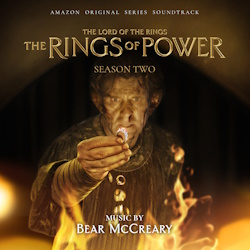 Original Review by Jonathan Broxton
WARNING: THIS REVIEW CONTAINS PLOT SPOILERS. IF YOU HAVE NOT YET SEEN THE SHOW, YOU MIGHT WANT TO CONSIDER WAITING UNTIL AFTER YOU HAVE DONE SO TO READ IT.
Despite being one of the most lavish, ambitious, and expensive television shows in the history of the medium, the first season of The Lord of the Rings: The Rings of Power was not quite the overwhelming success that Amazon Prime Video hoped and expected it to be. Although it quickly became the most-watched Prime Video original series in history, and although it received generally positive reviews from critics – particularly for its visuals and designs – many Tolkien purists took great exception to the fact that showrunners J. D. Payne and Patrick McKay took some creative liberties with the source material. Not only that, the show was also the victim of racist online ‘review bombing’ stemming from complaints about the casting of non-white actors in key roles, as if that matters in a fantasy setting. Such is the way of toxic fandom today. Despite this, I thought it was absolutely outstanding, one of the most impressive television productions I have ever seen.
The show is a spiritual prequel to Peter Jackson’s Lord of the Rings film series, and is based on J.R.R. Tolkien’s Lord of the Rings histories, The Silmarillion, and its various appendices. It is set in the Second Age of Middle-Earth, thousands of years before the events of The Hobbit and The Lord of the Rings took place. Essentially it tells the ‘origin story’ of several key events in LOTR lore, and Season Two of the show builds further on the threads introduced in the first season, while also addressing the fallout of the first season’s main revelation: that the supposed King of the Southlands, Harbrand, was actually the resurrected dark lord Sauron, and that his actions and machinations led to the elf-smith Celebrimbor forging the rings of power, as well as to the eruption of the volcano Mount Doom and the creation of the land of Mordor.
Several plot strands run through the new season: the unlikely alliance between the elf warrior Galadriel and the orc leader Adar as they try to stop Sauron; Sauron’s continuing corruption of Celebrimbor, who is coerced into making more rings; the feud between King Durin III and his son Durin IV in the dwarf city of Khazad-Dûm, and how their mining of mithril awakens an ancient evil; the political machinations for control of the island kingdom of Númenor; and the adventures of the wizard Stranger and his harfoot companion Nori in the land of Rhûn, specifically the threat they face from a Dark Wizard who appears to know the Stranger’s true identity. The show has an outstanding ensemble cast including Charlie Vickers as Sauron, Morfydd Clark as Galadriel, Robert Aramayo as Elrond, Benjamin Walker as Gil-Galad, Daniel Weyman as the Stranger, Markella Kavenagh as Nori, Charles Edwards as Celebrimbor, Owain Arthur as Durin IV, Peter Mullan as Durin III, Sophia Nomvete as Disa, Lloyd Owen as Elendil, Maxim Baldry as Isildur, Trystan Gravelle as Pharazôn, Cynthia Addai-Robinson as Queen Míriel, Ismael Cruz Córdova as Arondir, and Sam Hazeldine as Adar, all returning from Season One, plus Season Two newcomers Ciarán Hinds as the Dark Wizard, Rory Kinnear as Tom Bombadil, Ben Daniels as Círdan, Nia Towle as Estrid, Jim Broadbent as the voice of Snaggleroot, and Olivia Williams as the voice of Winterbloom.
 Returning to score Season Two is composer Bear McCreary, who in Season One wrote what I believe to be one of the greatest scores in the history of television. That’s not hyperbole or an exaggeration – that is a straight fact, based on my personal opinion and taste, of course. McCreary built on the sound established by composer Howard Shore on the Lord of the Rings and Hobbit movies and crafted a massive, elaborate, intricate, powerful, emotional, sometimes devastatingly beautiful orchestral fantasy score of the highest order. I have repeatedly praised the first season score for its thematic architecture; there are at least seventeen individual themes relating to different characters, concepts, and overall cultures and races (men, elves, dwarves, orcs, etc.) Each theme uses specific choirs for specific cultures singing in specific languages depending on context, uses specific instrumental ideas drawn from specific world music styles that are only heard in certain places, and uses specific compositional techniques that are applied only to one specific theme, including an idea whereby each theme has a unique interval between the first and second note, so that listeners can identify them in only two notes. But it’s not just the intellectual design of the score that’s impressive; in context, the music enhances the narrative beautifully, adding a spiritual element to the elves, giving power and intensity to the battle scenes, and so much more.
I gave the score for Season One my own top honors in the Movie Music UK Awards, and it was named Score of the Year by the International Film Music Critics Association – the first time it had ever been won by a TV score – but, to my complete astonishment and (frankly) disgust, it was entirely ignored by the Emmys, who instead gave the award to Cristobal Tapia de Veer’s White Lotus, and somehow saw fit to nominate the dull droning of Gustavo Santaolalla’s The Last of Us over it. Hopefully, Emmy voters will see their way to rectifying this travesty next year, because the score for The Lord of the Rings: The Rings of Power, Season Two continues the trend of excellence.
As one would expect, McCreary’s remit for Season Two was essentially “more of the same,” and he has delivered that in spades. All seventeen major themes from Season One are back, and while McCreary is careful to maintain the thematic specificity and leitmotivic application of each idea throughout the score, he also finds ways to adapt and modify them in interesting new ways, through subtle changes to the orchestration, in a variety of intense action and battle arrangements, and in the way he combines different themes together to illustrate the various shifting alliances and conflicts. Some of the thematic allusions and foreshadowings initially heard in Season 1 come to fruition in Season 2 too, specifically the theme for the Mystics of Rhûn, the Valinor theme that here develops into a personal theme for the elf Círdan, and the spectacular ‘Nolwa Mahtar’ theme that represents elves in battle. Of course, as one would expect, many of the new characters in Season Two have new thematic ideas too; at least seven of them emerge as the story progresses, taking McCreary’s musical cache up to an astonishing 24.
EPISODE 1: ELVEN KINGS UNDER THE SKY
The seven new themes each receive a ‘concert performance’ on the main Season Two album, with several of them being used as end credits music in specific episodes. “Old Tom Bombadil” is the theme for the character of the same name, a mysterious, friendly, carefree and child-like character who presents himself as a merry old soul at one with the countryside, but who hides a much deeper ancient power. His theme is presented here as a song, initially performed by singer-songwriter Rufus Wainwright, and then later in a reprise by actors Rory Kinnear and Daniel Weyman in character as Tom and the Stranger. It has a whimsical, lilting, soothing folk-like melody, and lovely lyrics that speak of the gentle beauty of trees and rivers, and the passing of seasons.
“Rhûn” is the theme for that location, a barren land far to the east of Middle-Earth, where Nori and the Stranger encounter and do battle with a dark wizard and his metal-masked guadrim servants. The theme features The Mystery of the Bulgarian Voices, a long-established female vocal choir which specializes in recording traditional Bulgarian folk music and is best known for its 1975 album ‘Le Mystere des Voix Bulgares’ (parts of which will be very familiar to James Horner fans). The theme is beautiful but strange, clearly indicating that Rhûnish culture is very different from anything that Nori has experienced before; the voices are slightly harsh and alien-sounding, and unexpectedly aggressive at times, while the instrumental complement features a vibrant mix of Middle Eastern woodwinds and clattering percussion items amid a thundering brass-led orchestra. The subsequent “Concerning Stoors” is the culture theme for the Stoors, who are essentially harfoots from Rhûn and, like the harfoots, are racial precursors to hobbits. Instrumentally the Stoor theme is a sort of mix, combining the Celtic-adjacent bagpipes and fiddles of the Harfoot theme from Season One with a dulcimer and the Middle-Eastern influences of the new Rhûn theme, but emotionally it is warmer and more approachable, showing the kindred spirit between the two related cultures.
EPISODE 2: WHERE THE STARS ARE STRANGE
“Golden Leaves” is a song containing the personal theme for Gil-Galad, the High King of the Elves in Lindon, and is performed by actor Benjamin Walker, singing in character in the elf language Quenya. Tonally it is related to the other elf themes for Galadriel, Elrond, and Valinor – elegant, noble, spiritual – but like the theme for Tom Bombadil it also has an earthy sound, deeply tied to the environment and the natural world. Gil-Galad is singing a lament for the death of Lindon’s ancient tree, and Walker’s gorgeous tenor voice sells the depth of emotion his character feels at having to abandon their home – until the tree is miraculously healed by the mithril inside Celembrimbor’s elven rings. Continuing with the elf theme, “Eregion” is the theme for that location, an elvish stronghold ruled by master smith Celebrimbor, where the rings of power are forged. There is a lightness and a sense of magic to the Eregion theme, which uses a children’s choir and twinkling metallic textures to flesh out the sound of the delicate orchestrations. The cellos often carry the melody, and the harmonies during the second half of the piece are especially gorgeous.
“Estrid” is the theme for the character of the same name, a human woman who is rescued by the Númenorian warrior Isildur in the aftermath of the Battle of the Southlands. Her theme adopts the Nordic-sounding Southland orchestrations from Season One, hardanger fiddle and nyckelharpa, but with a more lilting and romantic tone overall, and as the relationship between Isildur and Estrid develops over the course of several episodes, the theme deepens with it. There is some especially beautiful writing for oboe here, making this one of the prettiest traditional love themes McCreary has ever written. Finally, at completely the opposite end of the scale, “The Last Ballad of Damrod” is the theme for Damrod, a massive hill troll who joins Adar’s army of orcs as a way to exact his own personal vengeance on Sauron. The theme features vocals by Jens Kidman of the Swedish extreme metal band Meshuggah, and is essentially the type of vicious, dark, brutal music one can imagine hill trolls listening to themselves. McCreary used Damrod as an excuse to write some massive orchestral hard rock, and it’s just fantastic, pounding drums, huge howling brasses, and unexpectedly complicated string figures, all surrounding the sound of Kidman screaming his death metal growl for all he’s worth.
EPISODE 3: THE EAGLE AND THE SCEPTRE
The rest of the Season Two main album features select cuts and highlights from the series underscore, and includes some spectacular moments of dramatic excellence, power, and beauty. “Círdan’s Perfection” contains some superb interplay between the themes for Elrond, Valinor, and the Rings themselves, with the Valinor theme morphing into the new theme for the ancient and wise shipwright elf whose admiration of Celebrimbor’s handiwork crafting the rings causes him to betray Elrond and bring them to Gil-Galad and Galadriel. I especially love how McCreary’s arrangement of his Rings theme here – all high, slithery strings – matches how Howard Shore pitched his own ‘seduction of the ring’ theme from his Lord of the Rings scores, making emotional and intellectual connections between the two. Later, this same theme will come to establish itself as a character theme for Celebrimbor, and how his obsession with crafting the rings leads to his downfall.
“Stone Singers” features actress Sophia Nomvete singing in character as the dwarf princess Disa, a powerful and resonant and increasingly desperate chant representing her deeply spiritual relationship with the literal rocks within Khazad-Dûm, and the horrible realization that Sauron’s influence has caused her to lose it. “Sandstorm at the Well” is a superb vibrant action sequence containing references to both the Stranger theme and the Rhûn theme, underscoring the scene where the Stranger and his harfoot companions are attacked by the Dark Wizard’s minions, and the Stranger tries to conjure a sandstorm to protect them – but loses control, resulting in both Nori and Poppy being swept away.

EPISODE 4: ELDEST
“Emissary at the Forge” is a terrific exploration of the seductive power of Sauron, as he successfully convinces Celebrimbor that he is in fact an elf of the Valar named Annatar who has come to help make rings of power for dwarves and men. McCreary engages in some outstanding interplay between the Sauron theme, the Rings/Celebrimbor theme, and the Eregion theme, especially in one sequence where he brilliantly arranges Sauron’s theme with the instrumentation usually reserved for elf themes – harps, high strings, soaring vocals – masking his true identity, until the massive statement of the Rings theme at the 4:17 mark, dark and powerful, accompanies the first appearance of Sauron in his Annatar guise.
“Shelob” is a one-off horror cue, a brutal orchestral assault accompanying the scene where Isildur escapes from the lair of the eponymous giant spider; skittery pizzicato string textures and imposing brass writing is the order of the day here. “The Pyre” is another one-off, a haunting vocal restatement of the love theme for Arondir and Bronwyn from Season One, accompanying the scene where the elf warrior Arondir burns Bronwyn’s body on a funeral pyre and mourns the death of his love; you can hear the pain coursing through Raya Yarbrough’s voice. The subsequent “Forgiveness Takes An Age” also offers a version of the love theme for Arondir and Bronwyn, gentle and reflective, with a prominent part for a solo oboe. Yarbrough comes back later too, performing a lovely variation on Tom Bombadil’s theme in “The River-Daughter” in character as Tom’s wife Goldberry.
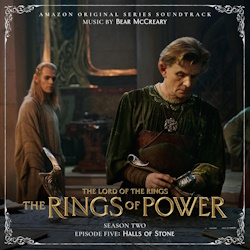
EPISODE 5: HALLS OF STONE
One of my favorite themes from Season One was the soaring fanfare for Númenor, and it gets a similarly spectacular reprise here in “The Great Eagle,” underscoring the scene where the titular bird interrupts Míriel’s coronation ceremony. The related Season One theme for the father-and-son Elendil and Isildur is also reprised during the latter half of “Candles on the Tide,” although interestingly part of their theme features vocals by R&B backing singer Clydene Jackson; her voice is unexpectedly deep and sonorous and adds a level of guttural tragedy to a scene of Elendil being arrested for treason by Pharazôn, who has usurped the throne of Númenor from Míriel and installed himself as the new king.
“Barrow-Wights” begins with a unnerving passage of creepy whispered poetry, which eventually emerges into a sequence of dark orchestral and choral horror accompanying the scene where Galadriel, Elrond, and a company of elves are attacked by the zombie-like titular creatures; I love the action settings of both Galadriel and Elrond’s themes towards the end of the cue, surrounded by frantic racing strings, and interspersed with more of the whispered Barrow-Wight poetry. “Army of Orcs” is essentially a reprise of the overwhelming shouted ‘Nampat’ motif that represents Adar and his gruesome children, although interestingly McCreary often inserts the unusual tone of a ney flute into the harshness as a representation of Adar’s thoughtfulness, insinuating that orcs are much more than mindless bloodthirsty brutes. The second half of the cue underscores a battle scene between Galadriel’s elves and Adar’s orcs, and shifts backwards and forwards between the ‘nampat’ orc vocals and the more intricate orchestral lines for the elves, following the ebbs and flows of the fight; there’s even a hero statement of Galadriel’s personal theme at the end that is just outstanding.
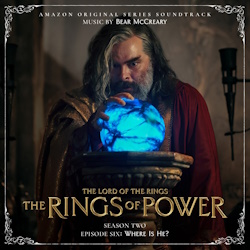
EPISODE 6: WHERE IS HE?
This then leads into the score’s spectacular highlight, the 11-minute “Battle for Eregion,” which sees two groups – one led by Adar and the orcs, one led by Galadriel and the elves – battling beneath the walls of the city of Eregion, which has now been fully taken over by Sauron in his Annatar form. The cue is a masterpiece of thematic interplay as Galadriel’s theme, Adar’s orc theme, Elrond’s theme, the magnificent ‘Nolwa Mahtar’ elf battle theme, and even an action variation on the Arondir and Bronwyn love theme all compete in an increasingly complex tapestry of outstanding leitmotivic composing. McCreary pulls out all the stops here with an assortment rich and complex orchestral textures, powerful percussive writing, and a relentless pace that drives the cue forward; it’s just brilliant. Every time Galadriel’s theme emerges from the cue and stands on its own the music just soars; it really is one of McCreary’s most stirring and memorable creations.
Meanwhile, “Durin’s Bane” underscores the increasingly desperate situation in the dwarf city of Khazad-Dûm, where the king Durin III is being slowly twisted by a ring given to him by Sauron/Annatar, and is mining more and more of the precious mithril mineral, despite warnings from his son Durin IV and daughter in-law Disa that doing so risks bringing about Khazad-Dûm’s downfall. Like the previous cue, this track is a work of art in terms of leitmotivic interplay, but the motifs involved here are the warm and approachable theme for Durin and the solid and dependable theme for Khazad-Dûm itself, and the interplay is with the themes for Elrond and Galadriel – who are trying to help – and the themes for Sauron and the Rings themselves – which are enticing yet full of corruption. It’s a slow-burn, mostly an exercise in intellectual manipulation rather than action and adventure, but one which perfectly foreshadows the terrible tragedy that we know befalls them. As I mentioned in my review of Season One, I love McCreary’s intentional allusions to the sound Howard Shore brought to the scenes set in Khazad-Dûm in The Fellowship of the Ring, but how McCreary’s Khazad-Dûm is a massive city, teeming with life and industry, whereas Shore’s Khazad-Dûm is an empty, cold, dark tomb.
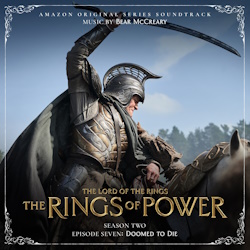
EPISODE 7: DOOMED TO DIE
“Last Temptation” accompanies the final confrontation between Galadriel and Sauron in the forest outside Eregion as Sauron – who has now discarded his Annatar guise and murdered a horrified Celebrimbor – attempts to seize control of the numerous rings of power, including the one which Galadriel herself wears. For the third cue in a row, McCreary offers a magnificent master class of thematic contrapuntal writing, weaving together elements of the Rings theme, Sauron’s theme, and Galadriel’s theme, into yet more wonderfully intricate rhythmic action patterns. The music, like Sauron, is often enticingly elegant but also simmering with hidden danger, and his theme especially churns and bubbles against a bank of constantly shifting strings. The clever insertion of the Halbrand/Southlands motif from Season One at 2:31 plays on Galadriel’s emotions and her memories of their friendship when she thought he was Halbrand, but this is swiftly usurped in response by an impossibly rousing burst of Galadriel’s theme thirty seconds later, played contrapuntally against the rhythms of the ‘Nolwa Mahtar’ elf battle theme. The cue ends with a massive, haunting statement of Galadriel’s theme as she steps off a cliff and seemingly sacrifices herself to stop Sauron from obtaining her ring.
Back in Rhûn, The Stranger has travelled to the stronghold of the Dark Wizard to save his friends Nori and Poppy, and refuses to join with him, which angers the Dark Wizard to such an extent that he destroys the canyon where the Stoor halflings live, forcing them to flee in search of a new home. The lilting strings and soothing vocals in “The Staff,” which are inflected with references to both Nori’s theme and the Stranger’s theme, underscore the scene where The Stranger, Nori, and the Stoors leave for pastures greener; arriving back at Tom Bombadil’s home, the Stranger announces that his name has been revealed to him, and that it is Gandalf.
Finally, “The Sun Yet Shines” underscores the conclusive scene in which the elves – Elrond, Gil-Galad, Arondir, and a magically healed Galadriel – escape to what will in time become the city of Rivendell, and resolve to fight against Sauron’s newly-acquired orc army as it marches across Middle-Earth. Powerful, resilient statements of both Galadriel’s theme and the ‘Nolwa Mahtar’ elf battle theme resound, setting up the conflict that will surely resume in Season Three.
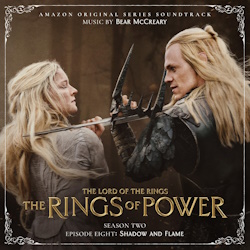
EPISODE 8: SHADOW AND FLAME
As was the case with Season One, there are also eight episode-specific Season Two albums containing roughly an hour of music from each installment. As I wrote in my Season One review, there’s really no point in me repeating what I’ve said before, because if you’ve heard and liked the music on the overarching Season Two album, then the episode-specific albums essentially offer more of the same excellence in chronological scene context. All the main themes are reprised in numerous settings, with all the same levels of emotion and grandeur and power, and all the same levels of dramatic complexity and storytelling intelligence. I will note that the episode albums contain many more statements of the Númenor theme, the Elendil/Isildur theme, and the Stoors theme than the overarching album does, and that the brand new theme for the Ents Snaggleroot and Winterbloom can only be heard in the albums for Episode 3: The Eagle and The Sceptre and Episode 4: Eldest (they do not appear in the main album). However, as the combined running time of the eight episodic albums is an eye-watering 5 hours 48 minutes, this is where I will end things. They are across-the-board brilliant.
As you can clearly tell, I thought the score for Season Two of Lord of the Rings: The Rings of Power is a masterpiece. It is the equal of the score for Season One in every way, because not only does McCreary revisit each of his fantastic recurring themes in Season Two, he augments them with a handful of brand new ones, and incorporates them all together to create a dramatically potent, musically compelling, emotionally satisfying, intelligently structured blockbuster that, to me, confirms why this type of leitmotivic approach to film scoring is the pinnacle of the art. It will take something absolutely mind-blowingly good to knock it off of top spot, and considering how unlikely that is, you can basically consider 2024’s race for score of the year to be done and dusted.
Buy the Lord of the Rings: The Rings of Power soundtrack from the Movie Music UK Store
Track Listing:
- SEASON TWO ALBUM
- Old Tom Bombadil (feat. Rufus Wainwright) (3:11)
- Rhûn (feat. The Mystery of the Bulgarian Voices) (2:36)
- Concerning Stoors (3:33)
- Golden Leaves (feat. Benjamin Walker) (3:19)
- Círdan’s Perfection (6:31)
- Stone Singers (feat. Sophia Nomvete) (1:16)
- Sandstorm at the Well (3:47)
- Eregion (3:43)
- Emissary at the Forge (6:37)
- Shelob (1:49)
- The Pyre (feat. Raya Yarbrough) (2:29)
- Estrid (3:13)
- The Great Eagle (2:58)
- The River-Daughter (feat. Raya Yarbrough) (1:10)
- Barrow-Wights (2:25)
- Forgiveness Takes an Age (2:41)
- Candles on the Tide (feat. Clydene Jackson) (3:41)
- Army of Orcs (4:12)
- The Last Ballad of Damrod (feat. Jens Kidman) (3:18)
- Battle for Eregion (11:33)
- Durin’s Bane (8:38)
- Last Temptation (7:12)
- The Staff (4:18)
- Old Tom Bombadil Reprise (feat. Rory Kinnear and Daniel Weyman) (2:21)
- The Sun Yet Shines (4:35)
- EPISODE 1: ELVEN KINGS UNDER THE SKY
- Dawn of the Second Age (12:56)
- The Last Hope for All Middle-Earth (3:24)
- Bow or Bleed (3:18)
- Trees of Stone (3:22)
- Círdan (7:36)
- Warning in the Words (2:34)
- To Serve the Lord of Mordor (2:02)
- Three Rings for the Elven Kings (6:45)
- The Rings of Power – Season One Overture (3:40)
- EPISODE 2: WHERE THE STARS ARE STRANGE
- Catastrophe at Khazad-Dûm (2:15)
- Glimpses of the Unseen World (5:33)
- Caras Gaer (4:38)
- The Gaudrim (3:44)
- Despair Under the Mountain (4:42)
- Before Darkness Blinds Us All (8:06)
- My Name Is Not Halbrand (9:35)
- Invitation to Eregion (1:40)
- EPISODE 3: THE EAGLE AND THE SCEPTRE
- Shelob’s Nest (4:50)
- Númenórean Grief (4:20)
- Enter Damrod (0:57)
- Mithril for Rings (4:14)
- The Road to Pelargir (3:53)
- Funeral Pyre and Reconciliation (4:31)
- Isildur and Estrid (3:05)
- The Wild Men (2:02)
- The Great Eagle and the Forging (6:46)
- The Rings of Power – Title Announcement Trailer (1:06)
- The Rings of Power – Season Two Overture (1:26)
- The Rings of Power – London Premiere Season One Fanfare (4:19)
- EPISODE 4: ELDEST
- Elves Embark (2:29)
- Meeting Tom Bombadil (3:19)
- Concerning Stoors (5:12)
- The Dark Wizard (2:27)
- Eldest (5:36)
- Lair of the Barrow-Wights (3:17)
- Mud Beast (2:55)
- The Sûzat (4:24)
- Snaggleroot and Winterbloom (6:53)
- Galadriel Stands Alone (3:48)
- EPISODE 5: HALLS OF STONE
- Seven for the Dwarf-Lords (4:48)
- Unveiling the Doors of Durin (3:17)
- Gazing to Eressëa (5:36)
- Gil-Galad’s Vision (2:13)
- Disa in the Depths (4:36)
- Mirdania Emerges (3:33)
- Assault on the Faithful (feat. Clydene Jackson) (4:42)
- Deceit in the Craft (9:05)
- Sauron’s Design (2:27)
- EPISODE 6: WHERE IS HE?
- Celebrimbor’s Burden (4:40)
- The Crown of Morgoth (3:44)
- Accused in Númenor (2:36)
- The Secret Fire (6:25)
- Tempest of Bats (5:29)
- Trial by Abyss (5:49)
- The Legions of Adar (5:19)
- Sauron’s Illusion (3:29)
- The Siege Begins (2:33)
- EPISODE 7: DOOMED TO DIE
- Nine for Mortal Men (6:00)
- Shattered Illusion (2:40)
- The Battle for Eregion Begins (7:22)
- Dwarven Loyalty (5:20)
- The Orc Camp (5:07)
- The Light of Celebrimbor (5:27)
- War at the Wall (3:57)
- Damrod (feat. Jens Kidman) (3:47)
- Never Make War in Anger (5:31)
- EPISODE 8: SHADOW AND FLAME
- True Wealth of the Mountain (6:04)
- Confronting the Dark Wizard (3:34)
- The White Flame (6:11)
- Sauron and Celebrimbor (2:31)
- No Passage for Low Men (5:16)
- Wounds That Have Endured (4:19)
- The Fall of Galadriel (12:06)
- Shadow and Flame (feat. Rory Kinnear and Daniel Weyman) (16:02)
Running Time: 449 minutes 30 seconds – Complete
Running Time: 100 minutes 52 seconds – Main Album
Running Time: 45 minutes 35 seconds – Episode 1
Running Time: 40 minutes 11 seconds – Episode 2
Running Time: 41 minutes 25 seconds – Episode 3
Running Time: 40 minutes 15 seconds – Episode 4
Running Time: 40 minutes 12 seconds – Episode 5
Running Time: 39 minutes 59 seconds – Episode 6
Running Time: 45 minutes 08 seconds – Episode 7
Running Time: 56 minutes 00 seconds – Episode 8
Amazon Music/Sparks & Shadows (2024)
Music composed by Bear McCreary. Conducted by Bear McCreary, Gavin Greenaway, Cliff Masterson and Anthony Weeden. Orchestrations by Edward Trybek, Henri Wilkinson, Jonathan Beard, Benjamin Hoff, Jamie Thierman and Sean Barrett. Main title theme by Howard Shore. Featured musical soloists Malachai Bandy, Eric Byers, Sandy Cameron, Paul Jacob Cartwright, Bruce Carver, M.B. Gordy, Olav Luksengård Mjelva, Eric Rigler, William Roper, Erik Rydvall and Zac Zinger. Special vocal performances by Raya Yarbrough. Recorded and mixed by Jason LaRocca, Nick Wollage, Bernd Mazagg, Ryan Sanchez, Ben Sedano, John Prestage, Milton Gutierrez, Damon Tedesco and Rasmus Faber. Edited by Michael Baber and Jason Douglas Smith. Album produced by Bear McCreary.
Leave a comment

Shop at the Movie Music UK Store

Member of the

 MOVIE MUSIC UK
“Not only that, the show was also the victim of racist online ‘review bombing’ stemming from complaints about the casting of non-white actors in key roles, as if that matters in a fantasy setting.”
Right. Because expecting properly representative characters based on the lore of the fantasy world in question is now racist. Criticizing an arbitrary, surface-level, bigotry of low expectations, current day quota (which Amazon Studios harbors) of skin pigmentations being represented on screen is review bombing. It’s not insulting to an actor or actress at all when they can never know if they were truly hired for their talent and merit or if they were merely a fucking check mark in a box to satisfy a multinational corporation CEO’s greed and ego.
I look forward to the all-Asian remake of Black Panther, since the casting of non-black actors in key roles clearly doesn’t matter in a fantasy setting.
“Such is the way of toxic fandom today.”
Ah, yes, the same toxic fans who also had a great many problems with the number of ways in which Peter Jackson’s Lord of the Rings films broke canon (and were quote vocal about such in those early, horrific, toxic days of the [superior] fledgling internet)– films which still enjoyed great success because they hewed truer to the spirit of Tolkien’s work even with liberties being taken as regards the story and characters here and there.
The same toxic fans who also rightly called out the even more extensive canon breaking and incompetence rendered by The Hobbit trilogy.
Oh, wait, except they weren’t called toxic then– because they weren’t, aren’t and never have been. They were fans. They are fans. Always have been. Always will be. The best ones. The real ones, seeing as it is their wish for the original artist’s vision to be respected and reflected wherever it is adapted from its original source.
Christ, we once had the ability to say that many a Goldsmith-scored project was godawful even if the accompanying music was fantastic. That’s no different here in the case of McCreary scoring this abomination of a series in a manner for which it is not remotely worthy. But, hey, enjoyed your soulless, mega corporation-produced swill. Sucking it down like a good little modern audience member whose sole happiness seemingly resides in not asking questions, perfectly content to “consume product and get excited for next product.”
Hey, Josh! Good to see you’re still reading me. I’m glad you focused on such a miniscule part of the review rather than the thousands of words I wrote about the music. You do you, boo-boo. You could have posted under your own name, though, instead of hiding behind a nom-de-plume.