SEVEN BRIDES FOR SEVEN BROTHERS – Gene de Paul, Johnny Mercer, Adolph Deutsch, Saul Chaplin
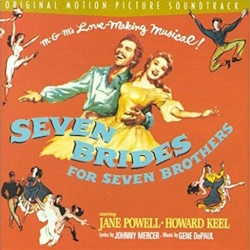 GREATEST SCORES OF THE TWENTIETH CENTURY
Original Review by Craig Lysy
MGM was seeking to produce another in its fine line of musicals and decided they had found their story; “The Sobbin’ Women” by Stephen Vincent Benet, which was itself derived from the ancient roman mythological tale “The Rape of the Sabine Women”. Jack Cummings was assigned production with a budget of $2.54 million. Albert Hackett, Frances Goodrich and Dorothy Kingsley were hired to write the screenplay, Michael Kidd was brought in as choreographer, and Stanley Donen was tasked with directing. For the cast of the seven brothers and their brides, we have; Howard Keel as Adam and Jane Powell as Milly, Jeff Richards as Benjamin and Julie Newmar as Dorcas, Matt Mattox as Caleb and Ruta Kilmonis as Ruth, Marc Platt as Daniel and Norma Doggett as Martha, Jacques d’Amboise as Ephraim and Virginia Gibson as Liza, Tommy Rall as Frank and Betty Carr as Sarah, and Russ Tamblyn as Godeon and Nancy Kilgas as Alice. Joining them would be Ian Wolfe as Reverend Elcott, Howard Petrie as Pete Perkins, Russell Simpson as Mr. Bixby and Marjorie Wood as Mrs. Bixby.
The story is set in the Oregon Territory circa 1850. Adam Pontipee goes into town looking for a bride, finds Milly who impresses him with her cooking and work ethic. He proposes marriage, she accepts and travels with him to his backwoods home where she discovers to her horror, that he lives with his six unmarried brothers. They are all uncouth and socially inept, so she wins them over to accept her training in the social graces, and how to relate to women so they all may find a wife. Afterwards, they go into town, and all become smitten with six women. Lonely, and with winter approaching, the brothers decide to kidnap the women, and escape successfully with snow blocking the pass. Milly is outraged, forces the men to live in the barn, while the women live in the cabin, as there is no reverend to marry them. In the spring the pass thaws, the townsfolk arrive and given the situation, decide to have a shotgun wedding for the six couples. The film was a huge commercial success, earning MGM a profit of $3.2 million. Critics praised the film for its song and dance extravaganza. It went on to earn five Academy Award nominations, including Best Picture, Best Film Editing, Best Cinematography, Best Screenplay, winning one for Best Score for a Musical Picture.
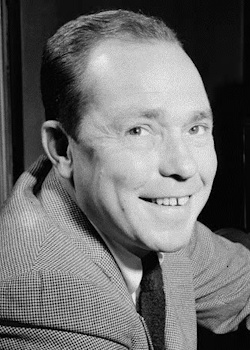
 Producer Jack Cummings originally conceived of a score consisting of traditional American folk songs, but abandoned the idea in frustration, ordering director Stanly Donen to hire Adolph Deutsch to score the film, Saul Chaplin for musical supervision, and for the songs, the songwriting team Gene de Paul and Johnny Mercer. Deutsch was an acclaimed composer for musicals with an Oscar win for “Annie Get Your Gun” (1951), and two nominations for “Show Boat” (1952), and “The Band Wagon” (1954). He understood that with musicals, the formula for success is to utilize song melodies as leitmotifs that would weave together the film’s song and dance vignettes into a cohesive musical narrative. To that end he used the confident and vibrant song melody for “Bless Yore Wonderful Hide” as his Main Theme, the romantic melody from “When You’re in Love” as a Love Theme, and the melody from “Sobbin’ Women” for propulsion, which energized the film and fueled its forward momentum. Eight songs by Gene de Paul with lyrics by Johnny Mercer were performed, including; “Bless Yore Beautiful Hide”, “Wonderful, Wonderful Day”, “When You’re in Love”, “Goin’ Co’tin’”, “Lonesome Polecat”, “Sobbin’ Women”, “June Bride” and “Spring, Spring, Spring”.
Main Title” opens with fanfare grandioso declarations of the Sobbin Women Theme as the MGM logo displays. At 0:15 we flow into the opening credits empowered by a vibrant instrumental rendering of the “Bless Yore Beautiful Hide” song melody as we see Adam Pontipee riding a storage wagon into town looking for a bride. At 0:54 we segue into “Wonderful, Wonderful Day” rendered as a valzer romantico. At 1:31 a banjo usher us into the film proper empowered by a spritely reprise of the “Bless Yore Beautiful Hide” song melody as script displays “Oregon Territory 1850”. We see Adam arriving at the Bixby’s General Store with some beaver pelts. He has ten pounds and is offered $6 a pound. He buys supplies and relates that he is looking for a wife. Four young women enter the store and he with masculine swagger, compliments them on their beauty. He then prepares to depart telling the Bixbys that he must look at all the women who are available before making up his mind. As he departs, he whistles the song melody of “Bless Yore Beautiful Hide”, before launching into it singing the aspirational love ballad. Here he observes Milly chopping wood and being sassy with her boss and decides “she’s the girl for me…”
(*) “Adam Discovers Milly” reveals him entering the saloon carried by a Jewish (mouth) harp where we see a table of men raving about her cooking skills as she serves them. He sits down to sample her cooking, is impressed, and we see she is clearly attracted to him. The Main Theme joins softly under the dialogue as she continues her service. Later in “Do Unto Udders” he joins her outside as she milks a cow. An optimistic Main Theme supports as he relates the beauty of his farm, which has a house, and then proposes. The theme becomes tender as she hesitates, but finally relents, succumbing to his masculine charm. He departs happily to freshen up and find a preacher carried by a buoyant Main Theme. We flow into “Bless Yore Beautiful Hide Reprise” atop a happy Main Theme as we see Adam washing and shaving off his beard. He pays the owner and departs singing with confidence the song’s closing line; “She’s the girl for me!” (*) “Marriage” the reverend voices his opposition to the marriage as he knows nothing about Adam. Yet he is persuaded by her genuine advocacy and agrees to marry them. Afterwards a playful Main Theme supports her boss placing a “Cook Wanted” sign in his saloon window. The melody carries their departure in Adam’s wagon. As they travel the countryside, the theme shifts to a gentile strolling iteration as Adam reprises singing the Main Theme song. He stops to water the horses and Milly gets out to pick flowers from the mountain meadow. She relates her happiness of living a solitary life with him, (as he grimaces behind her back as he has not yet told her of his six brothers). She begins singing “Wonderful, Wonderful Day,” a joyous song of thankful happiness, a musical highlight.
As they continue the journey to the ranch in (*) “The Greeting”, the joyous melody carries their progress. They arrive and she is shocked to discover that he lives with his brothers, the house is dirty and in disrepair with some farm animals running around it. The six other brothers present a bad first impression as they are unkempt, poor mannered, and brawl. We see that she is distraught, as she realizes this is not the “wonderful life” for which she hoped. As Adam departs, he tells her to ring the dinner bell when supper is prepared. Woodwinds sardonica emote the Main Theme as she contemplates her daunting circumstances. Yet, she rolls up her sleeves, and the music becomes determined as she tries to make the best of things. In (*) “First Night” we see her ringing the dinner triangle. The six younger brothers rush in and attack the table with no manners, or sense of decorum, earning a rebuke from Milly. Yet Adam comes in and behaves no differently, it evokes her ire. She says if you’re going to act like hogs, then eat like hogs, and with that she overturns the table and storms out.
 In “Adam In Treetop” Adam sets off to his bedroom for his wedding night as his brothers intently watch with wry grins. He enters and she drops all pretenses, letting him have it for deceiving her, and not wanting a wife, but a house servant. He apologizes, compliments her, and Deutsch supports with a cello led, instrumental romanza rendering of the “When You’re in Love” song melody. However, she firmly says she will not sleep with him, which causes him to leave the bedroom. Yet comedy joins at 0:35 when Adam is greeted by his brothers, and he feigns the excuse that he is fetching her water to avoid losing face. He returns to Milly, walks to the window, exits out onto a large tree branch, and reclines in its branches saying that he will bed down here tonight, which elicits her sympathy. At 1:01 the “When You’re in Love” melody is rendered as a romanza as Milly has a change of heart, as we flow into her singing the love ballad.
At 1:29 lush strings romantico take up the melody as she admits her love for Adam, and invites him to return for their wedding night, much to his delight. At 2:02 we end with a slapstick comedic musical narrative as Adam leaps onto the bed, and it collapses with a loud crash, which elicits wry grins from his brothers standing outside. In (*) “Milly Lays Down the Law”, the next morning the boys wake to the smell of coffee and fresh baked bread, but discover their clothes are missing. Outside the bedroom door Willy advises that she cleaned them, that they must hand over their underwear, freshen up, and shave if they want their clothes back. They resist, but yield to her threats to come in and strip them. Deutsch offers a mocking musical narrative as they undress. Later they show up clean shaven, and wrapped in blankets at the breakfast table where Milly compliments them on their clean shaved look. She sits, leads them in saying Grace, and then we behold good table manners with them politely passing the dishes amongst themselves. Later when Milly says she is going into town for supplies, all six brothers jump aboard.
In town as she shops, the brothers make a clumsy attempt to meet girls, which offends them. Men on the street respond and a fist fight ensues with the brothers pummeling the town folk. In “Goin’ Co’tin”, back at the ranch Milly instructs them on etiquette, how to act like a gentleman, and how to approach and speak to women. We flow into fun, playful, and very entertaining song, which features solo and choral vocal performances by all. At 2:28 we shift to and instrumental rendering of the song melody as a danza maestoso as they all pair off and practice dancing. At 3:19 an accelerando energico ushers in the concluding vocals.
“Barn Dance” offers a wonderful score highlight supporting a vibrant danza energico where Gene de Paul masterfully renders the Main Theme as a rhapsody, for one of the score’s finest moments. It reveals Willy’s inspection of the six brothers before they depart, each properly groomed and dressed in different colored shirts. When they arrive at town, six girls break off from their dates to greet Milly. Their dates stew, displeased and jealous at the arrival of the Pontipee brothers. One by one the brothers demonstrate their newly acquired social skills offering assistance to the six women, much to Adam’s surprise. A dance is called and the male dates reclaim their gals and head to the dance floor, as the brothers Pontipee watch from the sidelines. The men and women align in a contra-line and begin dancing, supported by the rhapsody. The women shift back and forth between their escorts, and the Pontipee brothers. The competition between the two sets of men escalates with each group performing acrobatic leaps and bounds to win over the women. We conclude at 5:32 atop an accelerando energico as the dueling dance ends in a flourish with the women leaping into the arms of the Pontipee brothers!
“Barn Raising” offers a score highlight, one of the most energetic and spirited compositions in cinematic history. It reveals that four competing teams, each one tasked with raising one side of Henry’s barn. The winning team will receive the prize of a young heifer. Well Adam lays down the gauntlet saying the brothers Pontipee will compete. After the call to begin, Deutsch unleashes an ever increasing, and seemingly boundless energy of his orchestra, a presto paced tour de force within which is woven the Main Theme. A team of competing suitors from town begins deliberating throwing hammers and wood planks at the Pontipees. They initially honor Milly’s request not to fight, however the assaults become so grievous that Adam finally retaliates, and a brawl unfolds, empowered by a seemingly inexhaustible accelerando. We end with the Pontipees triumphant as all four walls of the barn collapse! At home later that night, Milly tends to all the swollen knuckles, bruised cheeks, split lips and contusions.
 “Brotherly Advice” reveals a lovestruck Gideon opening up to Adam about being in love with Alice. He asks his older brother what it is like to be in love. Deutsch supports with the song melody of the song “When You’re In Love” playing softly under the dialogue as a prelude to Adam singing it (not on the album). Milly comes out unnoticed and stands by the open door. Gideon pines that after the fight there is no way the town will ever allow him to court Alice. Adam says that one woman is pretty much like the next and that he’ll find another. A plaintive quote of the theme joins as we see Milly wounded by this revelation as the two walk to the barn to feed the stock. At 0:33 we segue into “Lonesome Winter”. It is the next day, the ranch has been covered with snow, and the brothers are out doing daily chores. They are all forlorn and Deutsch supports with the “Lonesome Polcat” song melody, from which Caleb sings “Lament” (Lonesome Polecat). The sad song speaks of love sick sadness.
“Lovesick” reveals Milly joining Benjamin in the hayloft as he pitchforks hay to the ground. He is despondent, and no longer wants to spend long winters here alone. Milly leaves and informs Adam that all the brothers are love sick and want to leave. He says he will talk to them and joins them in the barn supported by a sad musical narrative led by a harmonica. Adam tells them the tale of the Roman’s taking the Sabine women for wives. At 1:09 as he exhorts them to do as the Romans did, a prelude of the song melody usher in Adam singing “Sobbin’ Women”, a song of confidence and exhortation, which raises the brother’s spirits.
Well, they all head out to the sleigh and ride off to town, determined to get their brides. “Kidnapped and Chase” reveals the brothers sneaking through town carried by a stealthy musical narrative with comedic accents. Their stalking is empowered by quotes of the “Sobbin’ Women” song melody, which marks each abduction. At 2:26 Deutsch unleashes propulsive flight and pursuit music as the Pontipees flee with their stolen brides with the men of the town following. At 3:26 a diminuendo of tension supports their slow passage through the narrow pass, as Adam is fearful that too much noise will trigger an avalanche. They safely pass and at 4:28 a thunderous crescendo dramatico swells as they begin shouting and firing their guns, which triggers a massive avalanche that blocks the narrow pass, barring the towns folk. (*) “Milly’s Outrage” reveals her unleashing her anger and disappointment to shame Adam and his brothers. She says that until Spring reopens the pass, that the women will sleep in the house, while the brothers, including Adam, will sleep in the barn with the animals. A plaintive rendering of the Love Theme, tinged with regret, plays softly under the dialogue. In the barn, Adam is angry, saddles his horse, and says he is going to the trapping cabin for the winter. The brothers try to dissuade him for naught, and Gideon’s plea to Milly is rebuffed.
(*) “The Women Strike Back” reveals the men shoveling snow from the walkways, only to be pummeled by snowballs, or doused with wash water by the women. Deutsch cleverly supports with a playful and animated musical narrative using the “Sobbin’ Women” song melody. In (*) “The Women are Lonely”, later that night Caleb visits the house for blanket, followed by Benjamin seeking medicine, and finally the other four brothers who Milly turns away. A yearning Love Theme plays softly under the dialogue. That night the women are going cabin crazy and a fight breaks out following accusations that each has been flirting. Milly arrives, breaks up the fights, and recruits their assistance when she announces that she is pregnant. “June Bride” reveals everyone dreaming of becoming June brides with all the women joining to sing a yearning, aspirational bridal song. At 1:54 Deutsch transforms the melody into a danza elegante as the women all begin dancing gracefully. At 2:52 singing resumes and they conclude the song.
 In “June Bride Reprise”, the next day while fetching water as it snows, the song reprises. At 1:10 we shift to an instrumental rendering of the “Spring, Spring, Spring” song melody as we see the dawn of spring as the snow melts away and life returns to blossom. The couples are seen performing chores and we segue seamlessly into “Spring, Spring, Spring”. At 1:44 Ephraim shouts for everyone to return to the house a Milly is having her baby. A playful musical narrative using the “Spring, Spring, Spring” song melody unfolds as the men pace, with bubbling woodwind descent motifs supporting the women running down the stairs for hot water and towels. At 2:29 tremolo strings usher in a baby crying, joined at 2:45 by a silly descent motif as a glazed eyed Gideon declares he is an uncle and faints. “When You’re In Love” (Reprise)(Outtake) was attached to a scene deleted from the film. It offers a score highlight with a beautiful rendering of the Love Theme, which opens with a prelude romantico joined at 1:22 by Adam’s vocal and then Milly’s. (*) “Milly and the Baby” reveals all the women and men paying their respects and bringing gifts to mother and child. A tender instrumental rendering of the “When You’re In Love” song melody supports. (*) “Gideon Updates Adam” reveals Gideon arriving at the snowbound trapping cabin to inform Adam that he has a daughter. Adam refuses to believe him, believing it is a ploy to get him to come back. Gideon lets him know how he feels with a punch to the jaw. Adam lifts him on his horse and sends him aways, saying he will not return. A dejected Main Theme carries Gideon’s departure.
(*) “The Pass is Open” reveals townsfolk advised that the pass is open. They assemble a caravan of armed men and set out to the Pontipee ranch to arrest and hang them. At the ranch the group plays musical chairs, and are shocked by Adam’s arrival. He warns them to arm themselves as the pass is open. With everyone gone, Adam confesses his love for Milly and they reconcile with a kissing embrace, supported by a gentle rendering of the Love Theme. He then informs Milly that he is taking the girls back to town, but outside he is confronted by his brothers who refuse to let them go, threatening to fight him if he tries. Adam convinces them that fighting the town folk will result in some of the women’s kin be killed, which will not sit well with them. He adds that the only way to get them back, is to return them. Milly then joins and says the women refuse to go back and have run away, which initiates a frantic mad cap musical narrative as the men search for them, with comedic accents marking the captured of each one. The townsfolk hear the screaming as they arrive and capture the brothers. The reverend heard a baby crying, and asks the women, whose baby, is it? When they answer in unison “Mine!”, their fathers line up with their rifles and shotgun weddings are performed with a comedic and mocking Main Theme supporting. “End Title” closes the film with a celebratory quote of the “Sobbin’ Women” song melody. At 0:16 we flow into the cast credits with a vibrant reprise of the Main Theme.
I would like to commend George Feltenstein, Bradley Flanagan, and Turner Classic Movies for Adolph Deutsch’s Academy Award winning musical score for “Seven Brides for Seven Brothers”. The original source tapes were digitally remastered to provide stereophonic sound, and the audio quality is excellent. The song writing team of Gene de Paul and Johnny Mercer struck gold, creating eight classic American folk songs, which when voiced by the sterling vocals of Howard Keel and Jane Powell brought this musical to life. I believe the musical merited its Academy Award win due to the outstanding cinematic confluence achieved by these songs, the choreography by Michael Kidd and Adolph Deutsch’s score. Deutsch had an innate understanding of musicals and his utilization of the song melodies for “Bless Yore Beautiful Hide”, “When You’re In Love”, and “Sobbin’ Women” for unifying leitmotifs resulted in a wonderfully expressive and cohesive musical narrative. His score was masterful in both conception, and execution, fueling and propelling the film’s forward momentum. Folks, they just do not make musicals like this anymore, and I highly recommend the purchase of the quality album, which offers an excellent Golden Age Hollywood musical.
For those of you unfamiliar with the score, I have embedded a YouTube link to the Main Title: https://www.youtube.com/watch?v=ymIQ_oDGsDs&list=PL-jq4DwiS5LQ5W6AWzfkeCTo0szFWVI72&index=1
Buy the Seven Brides for Seven Brothers soundtrack from the Movie Music UK Store
Track Listing:
- Main Title (2:10)
- Bless Yore Beautiful Hide (2:28)
- Do Unto Udders (1:30)
- Bless Yore Beautiful Hide (Reprise) (0:49)
- Wonderful, Wonderful Day (3:16)
- Adam In Treetop (1:41)
- When You’re In Love (2:11)
- Goin’ Co’tin (3:34)
- Barn Dance (5:51)
- Barn Raising (2:56)
- When You’re In Love Reprise (2:18))
- Brotherly Advice/Lonesome Winter (0:58)
- Lament (Lonesome Polecat) (3:36)
- Lovesick (1:22)
- Sobbin’ Women (2:48)
- Kidnapped and Chase (5:03)
- June Bride (3:18)
- June Bride Reprise (1:43)
- Spring, Spring, Spring (2:58)
- When You’re In Love Reprise (Outtake) (2:51)
- End Title (0:57)
- Bless Yore Beautiful Hide (Rehearsal Recording (2:33))
- Goin’ Co’tin (Demo Recording) (4:23)
- Queen Of The May (Outtake)(Demo Recording) (1:27)
- When You’re In Love (Demo Recording) (2:13)
- Spring, Spring, Spring (Demo Recording) (2:58)
- Sobbin’ Women (Demo Recording) (3:39)
Rhino Movie Music R2-71966 (1954/1996)
Running Time: 71 minutes 31 seconds
Music composed and conducted by Adolph Deutsch. Songs written by Gene de Paul and Johnny Mercer. Orchestrations by Leo Arnaud, Alexander Courage and Bob Franklyn. Additional music by Conrad Salinger. Recorded and mixed by XXXX. Score produced by Saul Chaplin. Album produced by George Feltenstein and Bradley Flanagan.

Shop at the Movie Music UK Store

Member of the

 MOVIE MUSIC UK