ALIEN: ROMULUS – Benjamin Wallfisch
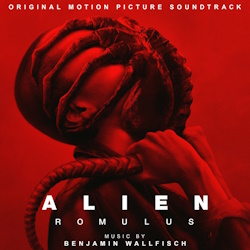 Original Review by Jonathan Broxton
The seventh film in the Alien franchise that began in 1979, Alien: Romulus expands the original universe created by director Ridley Scott and writers Dan O’Bannon and Ronald Shusett in new and interesting directions, exploring links between the original film and the recent ‘prequels’ Prometheus and Covenant. Chronologically the film takes place between Alien and Aliens and follows the adventures of a group of disaffected young adults seeking to find a way out of their soul-crushing life working at the Weyland-Yutani mining/terraforming colony Jackson’s Star on planet LV-410. They plan to steal a spacecraft and make their way to Romulus, what they believe to be a derelict research station in orbit, close to the LV-410’s belt of planetary rings. However, once they dock with the research station and begin exploring inside looking for cryo-pods, they soon realize that the dangers they faced on the planet are nothing like the ones they face here. To reveal more plot details would do a disservice to the story and how it unfolds… suffice to say, there are face huggers and alien xenomorphs involved, and much more besides.
Alien: Romulus is directed by Uruguayan filmmaker Fede Álvarez and features an excellent and diverse young cast including Cailee Spaeny, David Jonsson, Archie Renaux, and Isabela Merced. I enjoyed the film immensely; it is a love letter to the franchise as a whole, containing references to elements from all the previous installments, both explicit and subtle, while also offering some new and interesting angles on Alien lore that goes all the way back to the ‘black goo of life’ from Prometheus, and even some of the motivations and actions of the Weyland-Yutani corporation from the original 1979 movie. Visually, the film is outstanding, recapturing the ‘industrial space grime’ aesthetic of the original movie, while also presenting some wonderful vistas of LV-410 and its deadly planetary rings. The horror and action effects are also quite wonderful – the face huggers have never been so terrifying – while young Cailee Spaeny makes for an excellent new protagonist in the vein of Sigourney Weaver’s Ellen Ripley.
 The music for Alien: Romulus is by Benjamin Wallfisch, who with this score becomes the latest composer to join the Alien ranks. Much like the film itself, the score is a love letter to Alien music, as it blends Wallfisch’s own personal horror and action style with direct homages to the music from previous Alien scores by Jerry Goldsmith, James Horner, Harry Gregson -Williams, and even Elliot Goldenthal and John Frizzell. It’s really outstanding how Wallfisch was able to make this balance work, how he was able to make his music sit seamlessly within the established sound of the franchise as a whole, while also giving it a kick in a different direction that is in keeping with his own personal approach.
The music was recorded in England with the Chamber Orchestra of London and the RSVP Voices, and is a hybrid score that features bold and expansive symphonic sounds combined with some extremely aggressive electronic ideas that are intended to illustrate the futuristic setting. Thematically, the score is built around several main themes, including one for the lead character Raine, one for Raine’s ‘artificial person’ adopted brother Andy, and one for the Xenomorph aliens. Wallfisch tried to connect each of these themes together, structurally, by having them originate from the same melodic place, but then develop differently.
Raine’s theme, for example, is intended to represent the concept of hope, and initially relates to the idea that, as the colony experiences zero hours of daylight on the surface of planet LV-410, Raine associates sunlight with her dreams of escaping from there. It is only later that this ‘sunlight theme’ morphs into a personal theme for Raine herself. Similarly, the theme for Andy is derived from Raine’s theme, but it plays the melodic core of Raine’s theme both backwards and in a different key – the thinking being that the two are connected through their history, but that Andy’s journey is a different one, and is affected by his existence as a literal Weyland-Yutani product. Finally, the Xenomorph theme is the Sunrise theme with an added note in the middle, and again is intended to represent how the ‘hope’ of the explorers is interrupted by what they find on the Romulus.
To capture the sense of scale and the vastness of space, Wallfisch experimented with a combination of chords and layered sounds with tape delays in the woodwinds, resulting in an iconic ‘echoing’ idea that suggests endlessness, and is reminiscent of one of the main textures heard throughout Jerry Goldsmith’s Alien. Then, later in the score, Wallfisch writes a series of enormous, complicated orchestral action set-pieces that contain stylistic similarities to James Horner’s militaristic score for Aliens, while also presenting some overwhelming electronic tonalities that recall the music Wallfisch wrote for The Invisible Man and It, as well as Denis Villeneuve’s Blade Runner sequel Blade Runner 2049. This aspect of the score is likely to be the most divisive – while I understand why this music exists like this, and why it sounds the way it does, from a contextual point of view, I have to admit I greatly dislike it as a listening experience, and many others may react similarly. Cues like “There’s Something in the Water,” the second half of “XX121,” “He’s Glitchy,” and “Run!” are especially challenging from that point of view, and may cause listeners of a more gentle disposition to recoil in horror.
However, despite this, there is still a significant amount of other music that is very much worth your time and effort. The first, hesitant strains of Raine’s theme appear in the warmly appealing “That’s Our Sun,” and feature strongly in subsequent cues like “Wake Up,” and in parts of “Searching”. Similarly, the inverted theme for Andy appears prominently in the eponymous “Andy,” while the motif for the various xenomorphs – face huggers and chest bursters and full-grown aliens – is embedded deeply into action cues such as the angry and violent “There’s Something in the Water,” the aggressive “Guns v Acid Blood,” and “Get Away from Her”. These action cues, plus other cues like “Run,” “The Hive,” “Gravity Purge,” and “Elevator Shaft Attack,” contain some wonderfully vibrant and occasionally quite dissonant orchestral scoring that is thoroughly entertaining, but as I mentioned earlier some of them also combine this with some of the harshest and most ear-splittingly guttural electronic textures imaginable, which may cause some listeners to vault for the skip button.
Cues like the opening track, “The Chrysalis,” as well as cues like the aforementioned “He’s Glitchy” and “Elevator Shaft Attack,” feature an array of difficult, experimental vocal techniques that range from whispering and hissing to outright shouting, in a way which blends the styles of avant-garde classical composers like György Ligeti and Krzysztof Penderecki. Elsewhere, the tones of the RSVP Voices perform in a more traditionally ‘epic’ way in cues like “Get Away from Her,” and then in the finale during “Collision Warning” and the conclusive “Raine,” which is very satisfying indeed.
The first of the two direct quotes of previous Alien thematic material comes in “XX121,” where Wallfisch revisits Jerry Goldsmith’s trumpet-led main theme from Alien for a scene that offers a specific callback to one of that film’s iconic main characters. Then, in “Prometheus Fire,” Wallfisch quotes Harry Gregson-Williams’s ‘Life’ theme from Prometheus for a scene where the characters are discussing the black liquid ooze/goo that was a cornerstone plot element of that film.
Throughout all this Wallfisch’s chord structure, and the way he uses his orchestra, places the score firmly within the musical roots of the Alien world. Time and again there are little fleeting moments that are clearly inspired in Jerry Goldsmith’s Alien, or James Horner’s Aliens; the way the brass growls, the specific phrasing and layering of the strings, the unexpected lightness of the woodwinds, the frequent use of anvils in the percussion section. Wallfisch clearly did his homework on what these previous scores sounded like and felt like in the absence of specific melodies, and expertly connected his new music to that established world. I also really like Wallfisch’s use of brass in both “Elevator Shaft Attack” and “Get Away From Her,” which just screams Elliot Goldenthal in all the best possible ways.
“The Offspring” is likely to be the score’s most controversial cue; it underscores the conclusive encounter between Raine and the film’s ‘final boss’ alien, and the way Wallfisch chose to score it veers violently between outstanding, complicated orchestral and choral action, and migraine-inducing, near-unlistenable distorted electronic chaos accompanied by brutal-sounding extended instrumental techniques. The whole point of the cue is, of course, to illustrate the horrifying visage of the creature and the deadly threat it poses to Raine, and Wallfisch accomplishes that expertly… but, my God, it’s a rough listen, some of the most difficult and sense-assaulting scoring I have heard in some time. Thankfully the final two cues, “Raine” and “Sleep,” offer some moments of calm reflection, and even some hesitant optimism, with slow and almost reverent performances of Raine’s theme for orchestra and soft chorus.
Even at their best the Alien scores have always been challenging listens. Finding that right balance between spacey ambiance, cool distance, impressive grandeur, intense action, terrible horror, and eardrum-smashing dissonance is a difficult task for any composer, but over the years the hits have certainly outweighed the misses. Overall, for me, Benjamin Wallfisch’s Romulus joins Jerry Goldsmith, James Horner, Elliot Goldenthal, and John Frizzell in the hit column. The intentional homages to his predecessors is well-judged and appropriate, the new thematic ideas give the score depth and a structural intelligence I appreciate, and the action music is bold and engaging, even if it does descend into electronic madness perhaps a little more frequently than I would have personally liked.
Buy the Alien: Romulus soundtrack from the Movie Music UK Store
Track Listing:
- The Chrysalis (2:38)
- That’s Our Sun (2:55)
- Wake Up (1:40)
- Entering Nostromo (2:52)
- Searching (2:55)
- There’s Something in the Water (2:49)
- XX121 (3:37)
- He’s Glitchy (4:27)
- Run! (2:47)
- Prometheus Fire (4:19)
- Guns v Acid Blood (1:33)
- The Hive (1:41)
- Andy (1:38)
- Gravity Purge (2:13)
- Elevator Shaft Attack (1:22)
- Get Away From Her (4:31)
- The Offspring (6:07)
- Collision Warning (3:35)
- Raine (1:09)
- Sleep (2:08)
Hollywood Records (2024)
Running Time: 55 minutes 15 seconds
Music composed and conducted by Benjamin Wallfisch. Performed by the Chamber Orchestra of London and the RSVP Voices. Orchestrations and arrangements by David Krystal, David Butterworth, Evan Rogers, Michael J. Lloyd, Jeremy Levy, Sebastian Winter, Sturdivant Adams, Steve R. Davis, Jared Fry, Tori Letzler, and Steffen Thum. Themes and influences from Alien scores by Jerry Goldsmith, James Horner, and Harry Gregson -Williams. Recorded and mixed by Rupert Coulson. Edited by Clint Bennett. Album produced by Benjamin Wallfisch.
-
February 7, 2025 at 7:02 amMovie Music UK Awards 2024 | MOVIE MUSIC UK

Shop at the Movie Music UK Store

Member of the

 MOVIE MUSIC UK