COLOR OF NIGHT – Dominic Frontiere
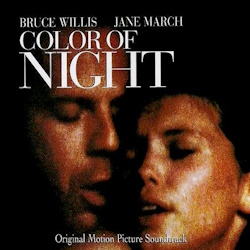 THROWBACK THIRTY
Original Review by Jonathan Broxton
Color of Night is an erotic mystery/thriller directed by Richard Rush from a screenplay co-written by Billy Ray, who would later go on to receive an Oscar nomination for writing Captain Phillips in 2014. The film stars Bruce Willis as Bill Capa, a New York psychologist who falls into a deep depression after one of his patients commits suicide in front of him; the sight of her bloody body in a bright green dress causes Bill to suffer from psychosomatic color blindness, hence the name of the film. Bill travels to Los Angeles to stay with a friend, fellow therapist Bill Moore (Scott Bakula), who invites him to sit in on a group therapy session. However, when Bob is violently murdered in the office, Bill is plunged into the mystery of his friend’s death; the police suspect that any one of Bob’s patients could be the killer. Making things more complicated is Bob’s torrid affair with a mysterious, sexy young woman named Rose (Jane March), who may have a connection to the crime.
Despite Richard Rush being an Oscar-nominated director (for The Stunt Man in 1980), despite the film having an excellent supporting cast (Rubén Blades, Lesley Ann Warren, Brad Dourif, Lance Henriksen, and Kevin J. O’Connor), despite the undeniable allure of leading lady March, and despite the genre as a whole being incredibly popular at the time thanks to films like Basic Instinct, Color of Night was an enormous critical and commercial flop. Director Rush and producer Andrew Vajna publicly clashed over who had control over the film’s final edit, to the extent that the Directors Guild of America had to intervene on the matter, and the whole thing was only resolved after Rush suffered a near-fatal heart attack and eventually relented to Vajna’s wishes.
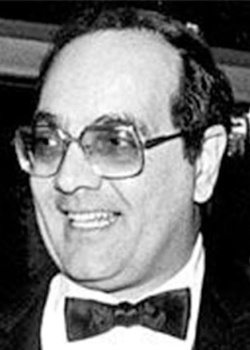 The score for Color of Night was by veteran composer Dominic Frontiere, who had won a Golden Globe for his last collaboration with director Rush, The Stunt Man in 1980. Frontiere’s career was interrupted during the mid-1980s when he was imprisoned for tax evasion (he was convicted of scalping tickets to the 1980 Super Bowl worth $500,000, which he obtained through his then-wife, Los Angeles Rams owner Georgia Frontiere), and he never regained the status he enjoyed previously. Despite him being nominated for another Golden Globe for the song he co wrote for Color of Night, it was ultimately the final mainstream score of his career; afterwards, he retired to New Mexico and lived comfortably there for the next 20 years or so, working on solo albums and electronic music, before passing away in 2017 aged 86.
A lot of Frontiere’s early career was spent playing jazz accordion, and he often leveraged that jazz sound into his film music; such was the case with Color of Night. To capture the erotic, mysterious sound of both the murder plot and the relationship between Bill and Rose, Frontiere wrote a “Love Theme” that uses a base of dreamy, breathy electronics and elegant textures for harps and chimes, over which is laid a lush and romantic orchestral theme. Frontiere then allows his undulating strings to intermingle with and dance around an impressionistic jazzy and florid piano line, creating a hypnotic final effect that I really enjoy.
I will say that, looking back at it with the hindsight of three decades, some of the electronic sounds that Frontiere uses now sound quite horribly dated; his use of sampled brass is especially grating, and the final effect of how the different samples are layered against the live instruments sometimes does seem a tad rough, bordering on the amateurish. Despite this, the actual melodic content of the theme is really quite lovely, and there is something oddly quaint and nostalgic about the whole thing – you can imagine this music playing against some sort of soft-focus montage from a 1980s primetime soap opera.
The love theme is counterbalanced by the much more seductive theme for Rose herself, a superb piece of contemporary smoky jazz which sees a sensual saxophone meandering moodily through a bed of electronic tones and mallet percussion textures, marimbas and xylophones. “Rose’s Theme” is probably my favorite musical element of the score; I’m a sucker for this sort of sultriness, and Frontiere captures the essence of the Rose character perfectly.
The other cues in the score are a mixed bag of styles and approaches. “Color Blind” is a pretty tune for music-box style marimbas and glockenspiels that turns darker and more sinister as it develops, as Frontiere adds in layers of moody woodwinds, scampering strings, and even a wordless cooing choral sound. “Sessions” is a quirky circus-like piece for harpsichords and strings moving to a classical dance-like rhythm in a pseudo-Nino Rota Italianate way; quite what this is saying about the people in Scott Bakula’s group therapy session, I’m not sure, but the musicality of the piece is superb.
The “Etude for Murder” is a terrific piece of solo classical piano pastiche that contains elements of the main Color of Night theme, and then combines the piano with the electronics in the second half of the cue, before ending with a dramatic and vivid flourish. Finally, “The Photograph” underscores the film’s revelatory final sequence with increasingly urgent writing for the sampled orchestral textures, all building up to a final sweep of grand guignol as the murderer is revealed alongside the film’s big twist.
The album also contains three original songs, one of which – as I mentioned earlier – was nominated for a Golden Globe for Best Original Song in 1994. “The Color of the Night” was co-written by Frontiere with Jud Friedman and Lauren Christy, is based on Frontiere’s main theme, and is performed by Christy with an alluring, breathy quality. I quite like it, although its chord progressions do keep making me think it is going to turn into Barry Manilow’s Chopin-inspired song “Could It Be Magic”.
I actually like Christy’s other song, “Rain,” much more; it was written by Christy with Scottish songwriter Gary Clark from the band Danny Wilson, and it has a more introspective vibe with stronger rhythmic content and an overall ‘early 1990s’ soft rock and pop sound that appeals to my aesthetic. Interestingly, Christy went on to have a successful career as a songwriter for others, penning hits for artists like Avril Lavigne, Enrique Iglesias, Kelly Clarkson, Jason Derulo, Leona Lewis, Ricky Martin, Chris Brown, Dua Lipa, and Bebe Rexha.
The thing about Color of Night is that, to contemporary ears, it is likely to seem incredibly dated, to the point that it actually might result in some listeners laughing at it in derision. Look; Dominic Frontiere was a product of the 1950s and 60s. His mentor was Alfred Newman, his forte was jazzy film and television scores, and by 1994 he was 63 years old and he was clearly having some trouble adapting his sound and his way of working to the more modern aesthetic. However, despite this, I still find that there is something oddly appealing about Color of Night.
It could be the fact that, because the sampled orchestra Frontiere uses is so out of place, it actually comes across as endearing. It could be the fact that Frontiere is clearly trying so hard to make his musical square peg fit into the round hole of 1990s film music. It could be the fact that, despite all this, Frontiere’s undeniable compositional chops still occasionally shine through, such as with the excellent jazz of “Rose’s Theme,” or the oddly comedic sound of the “Sessions”. I don’t know – all I know is that, despite all the things that are clearly wrong with Color of Night, I find myself enjoying it regardless, and listening to is now have me nice chance to write a career send off to a composer who, frankly, deserves to be better known than he is.
Buy the Color of Night soundtrack from the Movie Music UK Store
Track Listing:
- Love Theme (4:44)
- Color Blind (2:10)
- Sessions (3:22)
- Rain (written by Lauren Christy and Gary Clark, performed by Lauren Christy) (3:27)
- The Color of the Night (written by Jud J. Friedman, Lauren Christy, and Dominic Frontiere, performed by Lauren Christy) (3:55)
- The Color of the Night – Instrumental Version (written by Jud J. Friedman, Lauren Christy, and Dominic Frontiere, performed by Brian McKnight) (2:59)
- Rose’s Theme (3:33)
- Etude for Murder (3:33)
- The Photograph (2:23)
- Just To See You (written by Eric Lowen and Dan Navarro, performed by Lowen and Navarro) (3:55)
Mercury Records 522339-2 (1994)
Running Time: 34 minutes 01 seconds
Music composed and conducted by Dominic Frontiere. Orchestrations by David Campbell, Dennis Dreith and Eddie Karam. Recorded and mixed by XXXX. Edited by Robin Katz and Andrew Silver. Album produced by Dominic Frontiere.
Leave a comment

Shop at the Movie Music UK Store

Member of the

 MOVIE MUSIC UK
Excelente!