THE STORY OF THREE LOVES – Miklós Rózsa
 GREATEST SCORES OF THE TWENTIETH CENTURY
Original Review by Craig Lysy
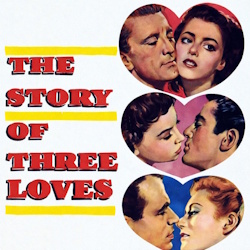
In 1952 MGM Studios decided to embark on a technicolor romantic anthology film, which would consist of three stories; “The Jealous Lover”, “Mademoiselle” and “Equilibrium”. Sidney Franklin was assigned production with a budget of $2.5 million, John Collier and George Froeschel were hired to write the three screenplays, and two directors were hired; Vincente Minnelli for “Mademoiselle” and Gottfried Reinhardt for “The Jealous Lover” and “Equilibrium”. The cast of “The Jealous Lover” included James Mason as Charles Coudray, Moira Shearer as Paula Woodward, and Agnes Moorehead as Lydia. The cast of “Mademoiselle” featured; Leslie Caron as Mademoiselle, Ricky Nelson as Thomas Clayton Campbell Jr., Ethel Barrymore as Mrs. Hazel Pennicott, and Farley Granger as Thomas the young man. The cast of “Equilibrium” included; Kirk Douglas as Pierre Narval, Pier Angeli as Nina Burkhardt.
For the three vignettes, “The Jealous Lover” explores the tragic death of a young ballerina (Moira Shearer) who in a effort to please her ballet choreographer and director Charles Coudray literally gives her life for her art. “Mademoiselle” offers a story of a boy who is magically transformed by a witch into a young man who falls in love with his governess, Mademoiselle. “Equilibrium” offers a story of Pierre, a widower trapeze artist, and Nina, a widowed survivor of a Nazi concentration camp who both blame themselves for the deaths of their spouses. They overcome their grief through a catharsis borne of falling in love. The film was deemed ‘too poetic’ and flopped commercially, losing $805,000. Critical reception was mixed, and the film received one Academy Award nomination for Best Art Direction.
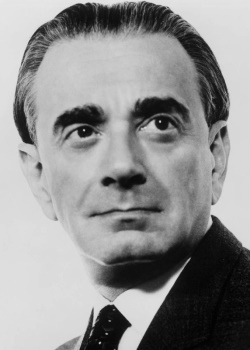 MGM’s premier composer Miklós Rózsa was intrigued by the film’s three romantic tales and took on the assignment. However, things got off on the wrong foot when Rózsa was informed that choreographer Frederick Ashton would begin choreographing Leslie Caron’s ballet performance and required the music to inform his choreography. He was asked to produce a ballet composition in one week. Rózsa said the assignment was beyond his range under the circumstances and Franklin deferred and suggested he interpolate a classical piece instead. He first offered the passionate romanza “Psyché” by César Franck, but Franklin and director Reinhardt rejected it. He then He next offered the renowned 18th variation from Sergei Rachmaninoff’s “Rhapsody on a Theme by Paganini” and the rest is history.
Rózsa chose to compose music specifically attenuated to the narratives of each of the three vignettes. For “The Jealous Lover”, Rózsa supported with several variations from Sergei Rachmaninoff’s “Rhapsody On A Theme by Paganini” (1938), offering the composer’s original two-piano arrangement and utilizing fifteen of the twenty-four variations, including; 1, 2, 6, 8, 9, 11, 12, 13, 14, 16, 18, 19, 21, 23 and 24. Jakob Gimpel, the renowned Austrian-born pianist would serve as the primary pianist joined by Agnes Neihaus on the second piano. For “Mademoiselle” Rózsa abandoned his renowned romanticism and instead embraced impressionism, offering exquisite lyrical passages for woodwinds. Four themes are provided, including Mademoiselle’s Theme, which operates both as her personal identity, but also as a Love Theme that for Tommy. The Eternal City is provided and expansive theme as the camera majestically pans across shots of the Forum and the Baths of Caracalla. Tommy’s Theme is child-like, mischievous, and playful reflecting his precocious 11 years of age. Lastly, we have the Witch’s Theme, which is very short, but readily identifiable with its little opening chromatic turn, canonic imitation and evocative orchestration.
For the final vignette “Equilibrium”, the story offered a darker narrative. As such Rózsa imbued his soundscape with a darker, film noir sensibility. Pierre’s Theme speaks to his tortured psyche that is stricken by guilt, and unable to find absolution. It is string borne, brooding, restless, never resolves, and draped in dark aura, incapable of escaping an unassuageable sorrow. Nina’s Theme is voiced by a mourning solo oboe triste, burdened with an aching regret. It repeatedly struggles for liberation, only to fail, despondently succumbing to a descending triplet figure with each futile effort. It is kindred to Pierre’s Theme in that its innate sorrow reveals she is bound, held captive by the past, forever longing for an absolution that never comes. For the Unity Theme Rózsa demonstrates his genius with musical alchemy, weaving Pierre’s and Nina’s themes with the healing power of love into a new collective identity; the opening dotted rhythm of his joined with the closing triplet of hers. Lastly, Rózsa infused the audition scene with a number of classic pieces, including the festive “Big White Top” by Victor G. Boehnlein, “Barnum and Bailey’s Favorite”, iconic and celebratory marcia festivamente by Karl L. King, “Sobre las Olas” (Over the Waves), a valzer gentile by Juventino Rosas, and the “Fanfare and Boccaccio March”, the famous marcia celebrativa from Franz von Suppé’s operetta Boccaccio (1879).
“Main Title” replaces the traditional MGM logo music with the bravado and syncopated rendering of the 1st variation of the rhapsody. The variation is sustained as the roll of the opening credits unfolds. At 1:10 we flow into the dramatic 2nd variation, followed at 1:28 with a leap to the energetic vibrancy of the 13th variation, before concluding with a coda of the heroic 14th variation, which flows seamlessly into the film proper as we zoom into a crowed deck of an ocean liner at sea bound for New York. In “The Audition”, renowned choreographer Charles Courtray relaxes alone on deck with two young Americans approaching him and asking why he closed his ballet, Astarte, after a single performance. He is defensive as if withholding a dark secret and refuses to tell them. A blank stare descends on him joined by a ghostly echo of the romantic 18th variation of the rhapsody, which supports a flashback to London. At 0:14 where Courtray reviews the ballet with the ballet director as a gifted young ballerina, Paula Woodward auditions empowered by the bold and aggressive 8th variation of the rhapsody. At 0:47 we flow into the energetic and rapid intensity of the 9th variation where Coutray at last looks up and becomes fascinated by the beauty, grace and flawless technique of her dance. The music is severed with her collapsing on stage to the horror of her mentor aunt Lydia and all those in attendance.
“The Audition – Conclusion” reveals a new ballerina auditioning supported the ornate and note-rich 6th variation of the rhapsody. Editing of the scene resulted in the music from 0:17 – 0:52 being also editing out of the film. In an intervening unscored scene aunt Lydia is devastated when Paula’s doctor warns her that Paula’s heart condition requires that she stop dancing or risk suffering a fatal event. She argues that she is destined to be a much greater dancer that she was, adding that she cannot live if she does not dance, to which the doctor replies, she cannot live if she does. She turns away as Paula enters unnoticed and hear her say “I cannot tell her.” Paula realizes the truth that her career s over and forces a smile that she will find a new passion. At 0:53 we segue into “Opening Night” for Courtray’s latest ballet, as a despondent Paula watches the performance from her solitary box seat. Side note: the camera reveals Rózsa in a rare onscreen performance, wielding the baton. The music here features the finale, empowered by the dazzling virtuosity of the 24th variation of the rhapsody, which includes a grandiose declaration at 1:25 of the renowned “Dies Irae” (Day Of Wrath) theme from the Roman Catholic requiem Mass. Within the words of the Dies Irae chant is revealed the Day of Judgment, which devout Christians believe they will ascend to heaven while the accursed will descend unto the fire pit of Hell.
“Paula Alone” reveals her eyes full of longing as the performance ends. After the last patron has left the theater Paula walks down to the stage. Beckoning tremolo strings emerge in her mind’s ear she hears the music of the ballet. Slowly, tentatively she unfurls her cloak and begins to dance, unaware of that off stage Courtray is observing her. Rózsa supports with the sequence of the 11th variation and at 1:32 the 12th variation of the rhapsody, which perfectly embody the hesitancy in which Rachmaninoff expresses Paganini’s theme as a danza tenero. In an intervening unscored scene Coutray interrupts her performance and convinces her to come and dance for him at his studio. She declines, however eventually succumbs to his persistence. For “Studio” Rózsa conceived using his own variations on Paganini’s theme for this cue, but they were not used in the film, which was unscored. Courtray induces Paula to dance for him, providing her with a costume and ballet shoes. We flow into “Ballet”, which offers a rapturous score highlight, where Moira Shearer ballet, Frederick Ashton’s choreography and Rachmaninoff’s music achieve a sublime cinematic confluence. While she changes into the ballet’s costume, she in her mind’s ear, hears the dazzling piano cadenza from the 22nd variation with an excerpt of the 23rd variation. Courtray plays the rhapsody on his phonograph and she begins to dance supported by several variations of the rhapsody as Courtray watches with amazement growing romantic affection. She opens her performance at 1:07 with the soft, delicacy of the 12th variation, at 2:24 the dream-like wonder of the 16th variation, at 3:43 the spritely vibrancy of the 19th variation, at 4:04 the tumult of the 21st variation, which leads to a short transitional passage at 4:25, that usher in at 4:46 a sumptuous exposition of the immortal molto romantico 18th variation. Worth noting is how Rachmaninoff ingeniously transmuted Paganini melody, which was written in A minor, by inverting it, and literally playing it “upside down” in D♭ major.
Afterwards in “Love Scene” Paula concludes the dance yet is clearly overcome with exhaustion, which causes Courtray to rush to her. She assures him she is just a little out of breath, but exhilarated with joy from her performance. Courtray, is overcome and impulsively kisses her. As he beseeches her to continue to dance for him as they can achieve greatness together, Rózsa reprises the 18th variation, re-orchestrated with woodwinds and harp replacing the piano. At 1:24 we segue into “Paula Disappears” where Paula returns to the dressing room to change out of her costume, while an inspired Courtray begins to sketch revised choreography for his ballet, inspired by his new muse. Rózsa supports with romantic, warm and ecstatic interpolations on Paganini’s theme. Yet at 2:42 an impassioned crescendo of desperation surges when Courtray realizes that Paula is not responding to his voice. He opens her door, finds the room empty, and then rushes to the window with the crescendo climaxes in pain at 3:16 as he sees her running down the street. At 3:21 we segue into “Mademoiselle Bridge”, which reveals Paula returning home, exhilarated, joyous, and exhausted. She confides to aunt Lydia that she danced for Courtray, expressing joy that she is alive again. Lydia sends her to bed, saying they will talk in the morning. Tragically her joy is short-lived when she collapses and dies on the stairs. The film closes with a return to the ocean liner where a grieving Courtray imagines what could have been as he notices a couple of wayward small children captured by their governess. Rózsa closes the film with an impassioned quote of the 18th variation, which dissipates with the heartbreak of what could have been.
We flow seamlessly into the next vignette, “Mademoiselle”, which opens with “Eternal City”, a score highlight. The ocean liner deck scene continues as we see a young woman, known simply as “Mademoiselle” lost in thoughts, which take her back to Rome, where she is employed as governess to a young American boy who is vacationing with his family. Rózsa introduces Mademoiselle’s Theme voiced by a sweet solo violin romantico. At 0:11 offers a grand sweeping exposition of the Italic Rome Theme as the camera majestically pans across shots of the Vatican, Forum and the Baths of Caracalla. Narration by the boy Tommy relates the wonder of the city and the beautiful hotel at which he and his family are staying. At 0:47 as he frets about his governess, his child-like, mischievous, and playful theme joins. He complains at the French poetry she reads to him and at 1:11 as Mademoiselle reads Verlaine to him, and he dreams of being twenty-five, an adult free of governesses, a tête-à-tête unfolds between their two themes. Later that night while his parents are out, he has had enough poetry and runs downstairs to the hotel bar, supported at 2:34 by a fleeting statement of Rózsa’s, Madame Bovary, arranged for a chamber ensemble.
In “Witch” another boy piques Tommy’s interest with the tale of a witch who resides nearby. Music enters as a fluttering motif followed by a misterioso as Tommy is spooked by a flight of birds over them. The music darkens as the boy taunts him to join him in visiting the witch and Tommy reluctantly follows. At 0:26 the eerie Witch’s Theme draped in mystery supports them gazing at her through a gate as she takes her evening tea. A dog bark frightens Tommy, who is again taunted by the boy. At 1:00 a determined Tommy’s Theme joins as he summons the courage to approach her. As he enters the garden, he accepts her invitation, and sits as she directs her dog Miss Sneider, to frighten away the other boy, whom she dislikes. A friendly conversation unfolds and we flow into “Wish” with a glass shattering stinger as she accidentally breaks her tea glass. His theme entwins with a harp glissando led misterioso as he is anxious. His attempt to excuse himself using his governess as an excuse, elicits sympathy from Hazel who confides that she also did not like her governess. The music narrative shifts to and fro between his nervous theme and her mysterious theme. At this point Tommy initiates a gambit, seeking to leverage her witch powers to liberate him once and for all from his governess. Hazel consents, however with the warning caveat that her spell will only last four hours – 8:00 pm to 12:00 am. She extracts a red ribbon from her bag, cuts it in half and issues instructions to use her name to initiate the spell; Hā – Zel – Pen – Ni – Cot, which introduces at 1:34, the eerie other-worldly five-note Spell Motif, which joins in a misterioso as all three of their themes entwine.
“Phony Witch” reveals Tommy’s growing desire as the magic wight o’clock hour approaches. He climbs into bed, wraps the ribbon around his finger, presses it against his temple and begins invoking the spell by repeating Hazel’s name. Rózsa supports the scene by transforming his orchestra into a ticking clock motif with chimes. We segue at 0:50 into “The Miracle” atop churning, mechanistic music, in which Hazel’s five-note name-motive dominates as Tommy’s room is enveloped to an eerie, surreal, and ominous musical narrative. At 1:34 shock erupts in the musical narrative as the camera pans from Tommy the boy, to the image in the mirror of Tommy the man. Repeating quotes of the Spell Motif dissipate in to an abyssal descent of uncertainty. At 2:01 a happy Tommy’s Theme enters and gradually gains confidence and strength as he welcomes his transformation. His theme swells for a grand statement at 2:22 and he appears in a tuxedo, intent on enjoying his evening as a man. At 2:34 we descend in to playful and comedic musical narrative with variations of his theme by clarinet and kindred woodwinds as he struggles to find money. We conclude with the orchestra punctuating him smashing his ceramic piggy bank.
“Viso Perduto” reveals Tommy returning to the hotel bar and asks the bartender to serve him the green liqueur Mrs. Pennicot drinks. When a beautiful woman (Zsa Zsa Gabor) flirts with him, he responds as any 11-year-old boy would, clumsily with immaturity. Rózsa supports the scene by interpolating a piano rendering of his Love Theme from the film “The Light Touch” (disc 2, cue 26 of the box set). After gaging on the strong liqueur, he exits the bar and we segue into “Nocturne” a romantic score highlight, as Tommy wanders the streets of Rome at night. Rózsa carries his progress carried by a pensive rendering of his theme. By chance he comes across a book of French poetry lying on the ground. He picks it up and as he begins to read a poem aloud in French, the music shifts at 0:33 to Mademoiselle’s Theme, for what I believe to be its most beautiful and sumptuous performance, led by a solo violin d’amore. He sees a young lady on a balcony overlooking the city, walks to her, and offers her the book. As she turns, he is love struck as he discovers that it is Mademoiselle. He moves her heart when he recites the very passage from Verlaine from which she had been reading to him earlier in the day. We conclude at 2:59 with a sweeping romantic statement of the Eternal City Theme, which blossoms on solo cello beneath his poetic verse.
“Romance” and the following track offer an exquisite romantic score highlight. Tommy experiences feelings he has never had before as he is overcome and impelled to initiate his first kiss, followed by others as they walk among the ruins of the Roman Forum. Rózsa supports the tender moment with motto romantico exposition of Mademoiselle’s Theme led by a solo violin d’amore. We flow seamless atop the romanza, which entwines with the Eternal City Theme into “Midnight” as our lovers enjoy a carriage ride under the stars and discuss poetry, love and the precious gift of youth. The theme of the Eternal City appears first on solo cello and then briefly in canon with a solo violin until Mademoiselle’s solo violin underscores their final kiss. Suddenly at 2:58, a muted trumpet of alarm sounds, joined by midnight bell chimes, and a distressed rendering of his theme, which causes Tommy to make a panicked exit, agreeing to her wish to see her in the morning. As he runs the Witch’s and Spell Themes returns and catalyzes his transformation back to an eleven-year-old boy as we see him running to the hotel in his pajamas. We close at 3:30 with an oboe tenero bearing his theme as we see him asleep in his bed.
“Farewell” reveals the next day departure of Tommy and his family. At the train station Mademoiselle joins theme and advises that she has decided to remain in Rome, which elicits Tommy begging for her to come. He recites the verse of Verlaine in French, which elicits her tears. Rózsa supports with Tommy’s Theme full of longing, tinged with desperation, which transforms romantically as he recites Verlaine. At 0:35 after his departure, Mademoiselle bumps into Hazel Pennicot supported by her Witch Theme, joined gently by Mademoiselle’s Theme tinged with sadness as they exchange pleasantries. Her theme slowly intensifies with romantic yearning as Hazel gifts her with the other half of Tommy’s red ribbon, and advises that she not wait too long for love as they will find you no matter where you are. At 1:40 a pensive oboe voices her theme as we see her lost in thought while sitting on the deck of the ocean liner. As she opens her hand bag the breeze carries her red ribbon to the deck where a young man retrieves it. Her theme plays softly as he recognizes her, saying that he first saw her at the train station, and regrets going to Paris instead of staying. Slowly her theme becomes tinged with regret when he adds that sometimes people just do not know what they really want, and with this meeting he does not want to make the same mistake. At 2:01 the music saddens as the camera shifts to a pensive Pierre Naval gazing upon the sunset cloudscape auras.
“La Java de la Seine” reveals Pierre’s on deck flashback to Paris where he reads a newspaper on a walkway overlooking the Seine River. Rózsa composed a wistful set piece, a danza Parigina, written for a small ensemble led by accordion, which imbues the scene with classic Parisian auras. A flirtatious woman stops and asks for him to light her cigarette. He does so, but to her dismay, he is clearly uninterested as he returns to his newspaper. Shouts that a woman has jumped off the bridge into the river elicits him diving in and rescuing her. Later in “Visit in Hospital” he visits her in the hospital. Rózsa supports the scene by introducing Pierre’s Theme, which speaks to his tortured psyche that is stricken by guilt and unable to find absolution. It is string borne, brooding, never resolves, and draped in dark auras. It carries his arrival and his consoling conversation with Nina Burkhardt. He counsels her to say she leaned over to far and accidentally fell in so she can secure a release. As he departs, he says to have courage and to keep her spirits up. “Le Joli Tambour” reveals that Pierre remains despondent and goes to a movie theater as a diversion. Rózsa interpolates a French folksong, which he also utilized in his score for “Madame Bovary”. Rendered as a marcia militare, it accompanies newsreel footage of celebratory planes in flight.
“Balance” reveals Pierre visiting Nina the next day. He asks her why she did it? She said that she should also be finished, but that she is still alive. He says that he can relate to that, and asks if she intends to try to do it again. She shakes her head no, and says she does not have the strength to try it again. When asked if she is Italian, she answers yes, from the Tyrol. Music enters with an extended brooding and restless exposition of his theme as she relates how she would ski. When asked if she was good, she says they all said so. When he declares that she does not look strong, she replies that it is just a matter of balance and timing. He is intrigued as in his mind he realizes that these are also the qualities he uses for his trapeze work. She asks him to leave as she is tired and he does, only to return and offer her chance for a new life supported by a crescendo of hope, which crests at 1:28, dissipating on a diminuendo of uncertainty as he writes down his address asks her to come to him. “Dark Is the Night” reveals Pierre attending a party thrown by his friend and aerial partner, Marcel. Marcels entertains his guests by playing the piano and singing the song “Dark Is The Night” by Nicholas Brodszky and Sammy Cahn. It is a song of regret with sadness in the notes that was originally used in an earlier MGM film, “Rich, Young and Pretty (1951). Pierre is brooding and remote. Rose approaches him, pours him a drink, and says there is a guest missing, to which he replies, yes, that he has been missing for some time – too long.
In “Fate” Pierre drops a bombshell, declaring that he is leaving the bicycle shop and intends to resume his career as a circus aerialist. His manager and Marcel decry this, with Rose saying that it was his obsession with pushing the limits hat killed his wife. He denies it and is impervious to his friend’s warning, realizing that his destiny lies with the exhilaration of an aerialist, not a loser job in a bicycle shop. When Nina arrives downstairs, Rose, who bears her heartache of unrequited love to Pierre, pleads with him not to use her to achieve his ambition, as it will only kill her. He is dismissive and descends to greet her with music entering atop the wandering restlessness and brooding of his dark, string borne theme, yet we discern new undercurrents of longing in the notes, which speak to him seeing Nina as a new means of achieving his destiny. At 1:06 a diminuendo of uncertainty emoted by repeating phrases of his theme support him obtaining a room key from the apartment owner and then taking Nina to her room. “Offer” provides a score highlight. It reveals she accepted his offer to come, as he is the only person in her life, she can call friend. She then discloses her sad secret – that she had a husband, who is now dead. Pierre then makes his pitch, asking her to join him as a partner for his aerial trapeze act as he feels she has the talent to make a good new partner. His theme joins with a solo oboe leading kindred woodwinds with the offer, brightening with anticipatory rebirth atop a crescendo gioioso as we see his passion as he describes the joy and freedom he feels performing in the air. However, instead of cresting, the crescendo dissipates at 0:48, his theme resuming its dark, restless brooding as he discloses the accidental death of his partner. Yet this digression is fleeting for at 1:01 his theme shifts to yearning strings, which emote an uplifting and beckoning musical narrative as he tries to convince her to join him, and not worry about dying, instead embracing freedom and living for the moment.
“Nina’s Story” offers a sad, and aching score highlight where Rózsa introduces Nina’s Theme. It reveals her agreeing to train as his partner. A training montage follows with Pierre demonstrating trapeze technique and fundamentals, with Nina practicing and gradually learning the various grip, mounts, and swinging technique. After a fall they take a break where she says that she understands his feelings of guilt. Strings bellicoso surge with force to emote his theme, which gradually dissipates, flowing seamlessly into her theme voiced by a mourning solo oboe triste, burdened with an aching regret. It repeatedly struggles for liberation, only to fail, despondently succumbing to an inescapable, descending two-note figure with each futile effort. It is kindred to Pierre’s Theme in that its innate sorrow reveals she is bound, held captive by the past, forever longing for an absolution that never comes. She at last discloses her dark secret, confiding that she blames herself for husband’s death in a Nazi concentration camp. She says she wrote him a letter counselling him not to proceed with an escape attempt because she had heard that the war was almost over. The confidant to which she entrusted the letter betrayed her, alerting the Nazi’s for a reward, which resulted in her husband’s execution. Pierre is profoundly affected by this revelation, realizing that the two both suffer from guilt regarding their lover’s death.
“Man” reveals Nina returning to her room. As she ascends the stairs, Marcel advises that a man came by looking for her, saying that he knew her husband. At the top of the stairs, the confident confronts her begging that she please listen to him. He explains that he was tortured by the Nazis, seems genuinely sorry, and pleads for her to forgive him. Rózsa supports with her theme empowering a gut-wrenching musical narrative of anguish. Shaken and devastated by her psychic wounds being torn open, she goes up to her room, unable to speak. In “Electrical Café Piano”, Marcel joins Pierre in a café and advises that he return home to Nina, as she has been shaken by a visit from a man asserting, he knew her husband. Rozsa reprises his Parisian melody for “La Java de la Seine” to provide a soft ambiance.
“Nightmare” reveals Pierre entering Nina’s room and finding her lying in bed holding a box of memorabilia, awake, yet cold, and unresponsive. He covers her with a blanket and tries to use his charisma to get her to speak. When this fails, he exhorts her to let her husband’s death go, and stop blaming herself. He turns off the light, tells her to get some sleep, and then beds down in a chair next to her. Music enters with horrific dissonance and a grotesque tortured exposition of his theme propelled by a trumpet orribile. He wakes with the grim realization that he was indeed, responsible for his partner’s death. A diminuendo of anguish bring him weeping to her, kneeling at her bedside. We segue at 0:37 into “Transformation”, a passionate and brilliant score highlight. Pierre admits his guilt to both himself, and Nina, she drops her wall of silence and informs him about her visitor, the confidant betrayer who came to her seeking absolution. They experience a catharsis when they at last realize that they must forgive themselves and move forward together to forge a new life. In a testament of love, Pierre makes a fateful decision to give up the act for her sake, and cancel an audition with a prominent American circus manager. Rózsa demonstrates his genius with musical alchemy, weaving their two themes with the healing power of love into a new collective identity. At 1:48 a breath-taking crescendo appassionato swells empowered by strings romantico with contrapuntal horns as they seek to liberate themselves from their past to embrace a hopeful future together.
“Decision” offers exquisite beauty. It reveals Pierre practicing as he finds himself unable to give up the trapeze. To his surprise, Nina arrives and declares that she will be his partner for the upcoming audition. Music joins with her arrival, expressed by the Unity Theme borne by a solo clarinet tenero with a retinue of warm strings. As she enters the ring at 0:20 their melody shifts to a solo flute delicato supports her ladder climb to join him aloft, ushering in a sumptuous crescendo romantico by refulgent violins as they join in love to forge a new destiny. “Big White Top” reveals the long-awaited audition, which Rózsa supports by interpolating a marcia energico by Victor G. Boehnlein, replete with heraldic fanfare brillante as they enter the ring. As the announcer greets their arrival, we segue into “Barnum and Bailey’s Favorite”, an iconic and celebratory marcia festivamente by Karl L. King, which over time became indelibly associated with the circus. The music empowers Pierre and Nina’s first act. As she climbs to the platform, we see that she is nervous, but steadies herself. We the flow into the iconic “Sobre las Olas” (Over the Waves), a valzer gentile by Juventino Rosas. From below, a nervous Rose watches nervously. We segue atop fanfare dramatico into “Memphis the Majestic”, a famous rousing marcia circense by Russell Alexander, which supports the second act of their audition. We conclude the final act, which offers the most dangerous trapeze work, made even more dangerous when the American financier demands that it be performed as it will be done in the live performance – without a net. Pierre refuse, but Nina overrides and so the net is taken down and they proceed to have Nina do a blind dive through a paper barrier that requires precise timing to be grabbed by the swinging Pierre or she falls to her death. A snare drum roll sets the stage and they perform the act flawlessly.
In “Fanfare/Boccaccio March”, fanfare trionfante resounds upon completion of the audition, and we flow into Rózsa’s arrangement of the famous marcia celebrativa from Franz von Suppé’s operetta Boccaccio (1879) as they rope down to the ring. They ignore their manager and the financier and walk out of the arena, having decided that they wish to live a happy life and less dangerous life together. We segue into “Finale”, which returns us to the ocean liner, where Nina joins Pierre on deck. Rózsa supports with a molto romantico rendering of the Unity Theme, which ascends sumptuously at 0:24 on a crescendo appassionato, which crests with a grand flourish as they walk arm in arm to a bright future together.
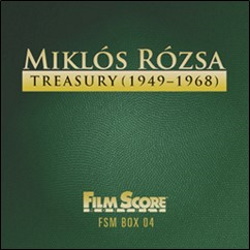 I would like to thank producers Lukas Kendall, Bruce Kimmel and the late Nick Redman for producing the Film Score Monthly Box Set ‘Miklós Rózsa Treasury (1949–1968)’, an invaluable gift for lovers of the art form, and the Maestro. For “The Story of Three Loves”, the ¼ inch monaural masters were digitally mastered and augmented with a subtle stereophonic reverberation to enhance listenability. The audio quality is good and allows the listener to experience an enjoyable listening experience of Miklós Rózsa’s handiwork. This assignment presented Rózsa with unique challenges; supporting a film comprised of three separate, yet interconnected stories. Time constraints forced him to offer Sergei Rachmaninoff’s “Variations on a Theme by Paganini” as the idée fix for the balletic first story, “The Jealous Lover”. The choice was brilliant in that its twenty-four variations offered fertile ground for supporting the story’s narrative, finding sublime confluence with Moira Shearer’s graceful ballet. For story two, “Mademoiselle”, Rózsa in a departure from his renowned compositional style, instead embraced a more modern and impressionist idiom. He anchored his score with the exquisite string borne romanticism of Mademoiselle’s Theme, juxtaposed by the mischievous Tommy’s Theme and eerie mysteriousness of the Witch and Spell themes. In my judgement the score for the third story “Equilibrium” is where Rózsa’s genius is revealed. This story required him to imbue his soundscape with a darker, film noir sensibility. The themes for both Pierre and Nina speak to their shackled, tortured psyches, which suffer, stricken by guilt, and unable to find absolution. Masterful is Rózsa’s use of musical alchemy by joining Pierre’s and Nina’s themes into a new collective identity, the Unity Theme, which liberates them from the shackles of the past, thus allowing them to reengage life and forge a new future together. Folks, this film is not found on lists, which feature Rózsa’s greatest achievements, however I counsel that after you view the film you will perceive all the stylistic elements that make you love him, masterfully conceived and executed, enhancing each story’s narrative. Sadly, this treasured box set is now only available at tertiary sites for extraordinary prices. If you cannot obtain the score, do take in the film and see Rózsa native gifts once again demonstrated.
For those of you unfamiliar with the score, I have embedded a YouTube link to a 13-minute suite; https://www.youtube.com/watch?v=WxtUH1QaTSY
Buy the Story of Three Loves soundtrack from the Movie Music UK Store
Track Listing:
- Rhapsody on a Theme of Paganini (Main Title) (2:14)
- Rhapsody on a Theme of Paganini (The Audition) (1:21)
- Rhapsody on a Theme of Paganini (The Audition – Conclusion/Opening Night) (1:50)
- Rhapsody on a Theme of Paganini (Paula Alone)/Studio (3:48)
- Rhapsody on a Theme of Paganini (Ballet) (7:44)
- Rhapsody on a Theme of Paganini (Love Scene)/Paula Disappears/Rhapsody on a Theme of Paganini (Mademoiselle Bridge) (3:54)
- Eternal City (2:45)
- Witch (1:21)
- Wish (1:47)
- Phony Witch / The Miracle (3:19)
- Nocturne (3:28)
- Romance / Midnight (3:48)
- Farewell (2:11)
- La Java De La Seine (1:10)
- Visit In Hospital (1:18)
- Balance (1:52)
- Fate (1:36)
- Offer (1:40)
- Nina’s Story (1:24)
- Man (0:58)
- Nightmare / Transformation (2:46)
- Decision (1:00)
- Finale (0:48)
Running Time: 55 minutes 48 seconds
Film Score Monthly Box Set 04 [Miklós Rózsa Treasury 1949-1968] (1953/2009)
Music composed and conducted by Miklós Rózsa. Rhapsody on a Theme of Paganini composed by Sergei Rachmaninoff. Orchestrations by Eugene Zador. Recorded and mixed by XXXX. Score produced by Miklós Rózsa. Album produced by Lukas Kendall.

Shop at the Movie Music UK Store

Member of the

 MOVIE MUSIC UK