KINGDOM OF THE PLANET OF THE APES – John Paesano
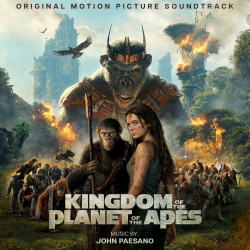 Original Review by Jonathan Broxton
Kingdom of the Planet of the Apes is the fourth installment of the rebooted Planet of the Apes film series, inspired by the novels of Pierre Boulle and the 1960s film series originally starring Charlton Heston. It is set several hundred years after the time of Caesar, the leader of a community of increasingly intelligent apes who in the first film, Rise of the Planet of the Apes, was given increased intelligence and the ability to speak after being infected by a genetically modified virus intended to cure Alzheimer’s disease, but which accidentally killed a large portion of the world’s human population instead. Through the second and third films – Dawn of the Planet of the Apes, and War for the Planet of the Apes – Caesar struggled to create a stable ape society while trying to broker an uneasy truce with the few humans who remained; he eventually died at the end of War for the Planet of the Apes, leaving the future of ape society uncertain.
Now, in this new film, ape society has split into several different and unique clans, and some of them are at war with each other. The story follows Noa, a young chimpanzee from a falconry-practicing clan, who is forced to explore the wider world when his home is attacked and raided by members of a rival colony led by their warlike bonobo king, Proximus. As he travels Noa joins forces with Raka, a wise and kind orangutan, and Mae, a young human girl who – much to Noa’s shock – is capable of speech; Noa and his clan have been led to believe that all humans (or ‘echoes’) are mute animals. However, despite their alliance, it soon becomes apparent that Mae may be helping Noa only because she has a hidden agenda of her own. The film is directed by Wes Ball and stars Owen Teague, Kevin Durand, and Peter Macon as the primary motion capture simians, with Freya Allan and William H. Macy as the humans.
Kingdom of the Planet of the Apes is a very good film, an enjoyable adventure romp with some spectacular special effects work, especially the CGI rendering of the motion-capture characters. It occurred to me while I was watching it just how easily I was invested in the story, and how quickly I got past the fact that there are essentially zero humans in the story, and a lot of that is to do with the realism of the world Ball created. The texturing of the fur – especially when wet, or covered in dust or dirt – the expressiveness of the eyes, the emotional range, was all just exemplary. I was especially impressed with Peter Macon’s performance as the kind orangutan Raka; I had only seen Macon before playing the character Bortus on Seth MacFarlane’s sci-fi TV series The Orville, but he was excellent here – enthusiastic, funny, a little ditzy, but with some real deep wisdom to share.
The score for Kingdom of the Planet of the Apes is by composer John Paesano, and this marks his fourth collaboration with director Wes Ball after working on all three films in his Maze Runner trilogy. He is the third composer in the series after Patrick Doyle and Michael Giacchino, and the seventh overall, with Jerry Goldsmith, Leonard Rosenman, Tom Scott, and Danny Elfman having all scored various entries in the past.
I’ve always found John Paesano to be one of those composers who has built a reasonably decent career by sounding vaguely like everyone else. I like a lot of his scores, but he seems to have no particular defining characteristics that make him him. I know that that sounds harshly negative, but really; I honestly couldn’t pick out anything in any of his music that is wholly and uniquely him – he doesn’t have a specific sound, doesn’t have any particular recurring things he does that clearly define what a John Paesano score sounds like. It wouldn’t be too much of a stretch to say that Kingdom of the Planet of the Apes is probably the best Paesano score to date, but even here he is basically doing his best Michael Giacchino impression, with some elements of classic Jerry Goldsmith and early Danny Elfman thrown in for good measure.
Before I go any further regarding the actual quality of the music, I want to address the elephant (orangutan?) in the room, and that’s the fact that the album for Kingdom of the Planet of the Apes is just too damn long. It’s 113 minutes – just shy of two hours – and very few of the all-time greatest film scores can justify having an album that long, let alone a fourth Planet of the Apes movie. Look; I understand that the prevailing wisdom for film music in 2024 is ‘release everything and let listeners choose how they listen to it’. Some people want every note. Some people make their own suites and playlists and want to have as much music available for them to do that. That’s fine, but that’s not how *I* want to listen to film music.
I want an album of music, preferably 50-60 minutes in length, which has been thoughtfully curated by the composer and/or a producer to present the score in the best possible light. To me, having every single note of creepy suspense music, every identical reprise of the same theme, is redundant, and makes me actually enjoy the score LESS than I would if it had been presented in a more sympathetic way. To be able to whittle down a two hour album into something more manageable requires, probably, an eight-hour time commitment to fully get to grips with the score, to understand it properly, and for me that’s just not practically feasible. I don’t absent-mindedly listen to film music as pleasant background noise – I love getting into the weeds of it all, trying to the understand the thematic connectivity, the dramatic impetus behind the composition, why the composer made the particular choices he made, while also feeling all the emotional nuance.
Doing that with an album this long is very, very difficult, and honestly I wasn’t going to do that here until I saw the film and experienced how good it was in context – so here I am, in hour seven of my review process for this score, doing what I didn’t want to do. I realize that this issue is entirely a me thing, and that many people are delighted by the monster length of these albums, but I can only respond truthfully about how I feel, and had the music not been as good as it is I would have refused to review it on principle.
So, with that out of the way, on to the actual music. Paesano’s score is a large-scale orchestral adventure score, recorded in Australia, which blends a large symphonic element with some unusual instrumental specifics; for example, Paesano often wrote parts for a detuned piano, the idea for which was “to use instruments that could exist in the world they were living in… maybe that piano had been sitting in a schoolhouse for 300 years, and they stumbled across it”. Similarly, Paesano’s percussion section makes prominent use of oil drums as a nod to their use in Proximus’s kingdom, while in some of the action sequences Paesano borrows a technique from Jerry Goldsmith’s original Apes score by having his French horn players blow through the mouthpieces instead of the body of the horn itself, creating an unnerving, guttural breathing sound.
The score is built around three main recurring themes: first, a theme for the ‘New World’ that Noa and Mae discover on their journey; second, a beautiful theme for the Eagle Clan to which Noa belongs; and finally, a personal theme for Noa himself. There are also a small number of minor themes and motifs, including a guttural percussive theme for King Proximus, a meandering motif for Mae, and some minor-key rumblings that accompany Proximus’s menacing activities, but these are less prominent. What’s frustrating about these main themes is that, although they are all excellent and appropriate in their own right, they are also similar enough to each other that they don’t have a lot of individual distinctiveness. It would be very easy for a casual listener not to realize that the score has three separate themes at all, because they are all arranged in similar ways, with similar chord progressions, similar orchestrations, and similar emotional aims, with the only real difference being in the slight variations in melody. Tonally they are all very inspired by Michael Giacchino – not only his two previous Apes scores, but also things like Super 8 and the TV series Lost – while also containing some references to 1990s Danny Elfman, especially his main theme from Edward Scissorhands.
Despite this, there are still some excellent moments where one or more of the themes shine. There is a wonderful statement of the New World theme in the opening cue “Discovery,” which starts slowly but eventually explodes into spectacular full-throated glory in its second half. There is a stunning rendition of the Eagle Clan theme in the second half of “The Climb,” which accompanies Noa and his friends Anaya and Soona as they make a dangerous mountain ascent to acquire eagle eggs as part of an imminent coming-of-age ceremony, and it again reaches superb heights in subsequent cues like “Eagle Clan”. Then, in both “Noa’s Purpose” and the magnificent “Memories of Home,” Paesano cleverly blends the New World theme with the Eagle Clan theme, and backs them both with lovely writing for piano and choir, solidifying Noa’s destiny and sending him on his honorable journey to rescue his people.
“I Am Raka” and “Caesar’s Compassion” are gentle and often make interesting use of quirky Elfman-POTA percussion. “They Are Like You” sees the New World theme being performed with a sense of mystical wonderment as Noa encounters a pack of ‘wild humans’ grazing by a river, and observes them as we would a herd of majestic wildebeest in a David Attenborough documentary.
Outside of these big thematic statements, the action music tends to be quite dense and violent, with intense clusters of sound, unnerving dissonances and abstractions, and some occasionally quite vicious rhythmic content. “Maybe Echo” is the first of these, underscoring Noa’s first encounter with the mysterious and possibly dangerous stranger who turns out to be Mae. “Marauders in the Mist” is shrill and eerie at the outset, trilling woodwinds and string sustains underscoring Noa’s first terrifying encounter with Sylva, the ferocious gorilla who leads Proximus’s pack of hunters and raiders. Then, as the cue develops, it becomes even more harsh and aggressive, with powerful horn pulses dominating the final moments, and carrying on into the opening salvo of the satisfyingly rancorous “For Caesar”.
However, for me, the pick of the action sequences is the “Human Hunt,” which is where Paesano unashamedly adopts the stylistics that Jerry Goldsmith used in the similar sequence featured in the original 1968 film. The off-kilter percussion patterns, the expressive combination writing for different sections of the orchestra, and the frenetic rhythmic ideas are just superb, and when he has his orchestra perform alongside Goldsmith’s wild and whooping rams horns at the 1:30 mark I erupted with nostalgic joy. Other action cues of note include “Broken” and “New Weapon,” which are effective pieces of eerie suspense that occasionally break out into explosions of noise, but these could easily have been excised from the album without losing anything.
Once the film settles down into its secondary setting in Proximus’s tyrannical oceanside kingdom, which is centered around numerous rusting ship hulls and a mysterious vault door set into the cliff face, Paesano’s music becomes similarly oppressive, making use of heavy brass motifs, unorthodox percussion sounds including Tibetan singing bowls and wooden sticks, more echoes of Goldsmith’s woodwind techniques, and an overall mood of subjugation and darkness. Paesano does weave threads of all three main themes into the music here – Noa’s Theme in both “A Kingdom for Apes” and the lovely “Together Strong” for example – but for the most part this music is overwhelmingly ominous and threatening. In the moments where the volume does rise – in “What a Wonderful Day,” for example – it is usually to underscore an example of Proximus’s dictatorial behavior, and to further support his menacing presence.
The sequence where Noa, Mae, Anaya, and Soona infiltrate the vault and discover its secrets are covered by a quartet of mystery and suspense cues comprising “Very Clever Apes,” “Simian Summit,” “A Past Discovered,” and “Cannot Trust a Human”. While most of its sound is rooted in the established instrumental palette of the rest of the score, I actually found that some of it reminded me a great deal of James Horner’s Aliens, with it being full of a great deal of similar-sounding metallic groaning backed by low string dissonances. The conclusion of “Cannot Trust a Human” and the subsequent “Ape Aquatics” are the climactic action cues, where Mae triggers a booby trap and floods the vault with seawater to prevent Proximus from accessing its contents. The final showdown between Noa and Sylva here is excellent, and is especially notable for a rampaging piano part that weaves its way around and in between the elaborate percussion patterns, bombastic orchestral runs, and noble chorally-enhanced statements of Noa’s theme.
The final three cues – “It Was Ours,” “We Will Rebuild,” and “A New Age” – offer a series of immensely satisfying renditions of all three main themes, providing a sense of resolution and catharsis, as Proximus is defeated, his slaves are liberated, and Noa returns home with his family to re-establish the Eagle Clan. The gorgeous statement of the Eagle Clan theme half way through “It Was Ours” is a score highlight, and it’s worth mentioning that Paesano’s use of piano all through these cues is a lovely echo of the emotional content Michael Giacchino brought to the finales of his Apes scores.
It’s interesting to me how, quite unexpectedly, the Planet of the Apes franchise has become one of the most musically satisfying film series in contemporary cinema. I liked Patrick Doyle’s score for Rise, I really liked Michael Giacchino’s scores for Dawn and War, and now John Paesano’s score for Kingdom has become easily their equal, offering an intelligent and enjoyable bridge between Giacchino’s work and the groundbreaking stuff Jerry Goldsmith did back in 1968. While it’s true that Paesano’s music doesn’t have a distinctive identity of its own, what he has done he has done very well; his trio of main themes are excellent, and the action music is enjoyably intense. As such, this comes with a hearty recommendation for fans of the series. I just wish the album had been curated with more care.
Buy the Kingdom of the Planet of the Apes soundtrack from the Movie Music UK Store
Track Listing:
- Discovery (6:31)
- The Climb (3:01)
- Maybe Echo (2:10)
- Eagle Clan (3:52)
- We Have Good Rain (2:04)
- Broken (2:47)
- Marauders in the Mist (3:45)
- For Caesar (4:27)
- Noa’s Purpose (4:12)
- The Valley Beyond (1:44)
- I Am Raka (5:21)
- Memories of Home (3:50)
- Caesar’s Compassion (2:07)
- She Is Different (3:03)
- They Are Like You (3:34)
- Human Hunt (4:44)
- New Weapon (5:15)
- A Kingdom for Apes (3:41)
- What a Wonderful Day (3:29)
- Apes Will Learn, I Will Learn (3:49)
- Together Strong (3:10)
- Very Clever Apes (7:57)
- Simian Summit (3:31)
- A Past Discovered (5:44)
- Cannot Trust a Human (5:21)
- Ape Aquatics (3:57)
- It Was Ours (4:40)
- We Will Rebuild (4:03)
- A New Age (2:08)
Hollywood Records (2024)
Running Time: 113 minutes 57 seconds
Music composed by John Paesano. Conducted by Pete Anthony. Additional conducting by Christopher Gordon, Elizabeth Scott, Tom Pearce, Edie Lehmann Boddicker and Ross Cobb. Orchestrations by Pete Anthony, Jon Kull, Andrew Kinney, Tim Davies, Philip Klein, Jim Honeyman and Jaimes Jimin Park. Additional music by Adam Hochstatter. Thematic inspirations from Michael Giacchino and Jerry Goldsmith. Recorded and mixed by John Witt Chapman. Edited by Ted Caplan. Album produced by John Paesano.
Leave a comment

Shop at the Movie Music UK Store

Member of the

 MOVIE MUSIC UK
Great review! I really enjoyed the score as well and have been a Paesano fan over the years! I’ve interviewed him a couple of times. I disagree with the idea that he sounds like everybody else. I normally don’t leave comments, but this feels like a bit of a cheap shot. That’s like saying Oppenheimer and Tenet sound like Zimmer, or John Williams just sounds like Korngold and Holst, or other classical composers he has drawn influence from over the years.
I interviewed him for this film, and he referred to the director (Wes Ball) and how they talked about making sure that the score is one part Goldsmith and one part Giacchino, and the rest was up to him. This is the 9th film in the franchise or something like that. I’m not sure the goal was to write something that was completely unique and different. He said he wanted to bring along the fanbase from the other films as well. I mean, the film starts off with Caesar’s funeral? Anyway, basically saying composers aren’t fully in charge of all creative direction on the music, and they are dealt a hand and have to play the cards they get. That’s what I have learned through interviews I’ve had in the past with composers!
I’ve interviewed him on a couple projects that were very outside of his normal sound like Tesla, or Penny Dreadful City Of Angeles. My All-American is more his world but another great soundtrack!
Hope to see Mr. Paesano score the director’s next film, none other than The Legend of Zelda. No pressure ;P