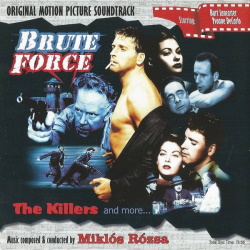
BRUTE FORCE – Miklós Rózsa
 GREATEST SCORES OF THE TWENTIETH CENTURY
Original Review by Craig Lysy
Following the huge commercial success of his film “The Killers” (1946), producer Mark Hellinger decided to continue his film noir journey with a descent into the brutality of prison life, inspired by the “Battle of Alcatraz” (1946) where prisoners revolted and fought a two day battle after a failed escape attempt. His production company would finance the project, Jules Dassin was tasked with directing, and Richard Brooks would adapt a story by Robert Patterson and write the screenplay. “The Killers” had launched Burt Lancaster to stardom and Hellinger recruited him to play the lead role of Joe Collins. Joining him would be Hume Cronyn as Captain Munsey, Charles Bickford as Gallagher, Yvonne De Carlo as Gina Ferrera, Ann Blyth as Ruth Collins, Roman Bohnen as Warden A. J. Barnes, and Art Smith as Doctor Walters.
The story follows the fortunes of Joe Collins who is imprisoned at Westgate Prison. Joe is spoiling for revenge after fellow inmate Wilson planted a weapon on him, which resulted in a bout of solitary confinement. Warden Barnes is under pressure to improve prison discipline and has tasked his Chief of Security Captain Munsey to make the necessary improvements. Munsey however is a sadist who foments prisoner snitching so he can victim to punish. Prison doctor Walters opposes Munsey’s methods and warns that they are sitting on a powder keg. Well, prisoner Stack snitches and the prison escape is thwarted, however it sparks a riot with brutal and horrific violence, which leads to the deaths of Munsey, Gallagher, Collins and several other inmates. The film was a commercial success, earning $2.2 million. Critical reception was favorable, and the film lauded for its no holds bar depiction of prison life, however it received no Academy Award nominations.
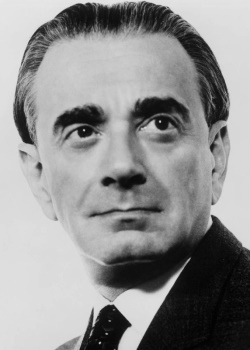 This was the second film of Mark Hellinger’s hard hitting film noir trilogy, which included; “The Killers” (1946), “Brute Force” (1947) and “The Naked City” (1948). Hellinger was very pleased with his first collaboration with composer Miklós Rózsa for “The Killers”, and so once again hired him for the project, despite opposition from the Department of Music. As with “The Killers”, Rózsa again chose to embrace the film’s brutality, violence, and gruesome narrative with music that was brutal, and dissonant, which also empowered its horrific, sadistic violence. Rózsa related in his autobiography “My Double Life”;
“It was a fine picture with a strong script by Richard Brooks and excellent characterization, and again I wrote a tough, stark score, which Hellinger loved. The front office, as I heard again from Schwartzwald, did not.”
The film offers a number of scenes with riveting dialogue, and Rózsa chose to let the conversations carry the scene. As such the score is spotted sparingly, however when present, the music is very impactful. For his soundscape, Rózsa supports the film with one recurring, primary theme; the dreaded Prison Theme. It is pervasive and blankets the film with a dark pall, emoting heavily as an oppressive, trudging, marcia brutale. It weighs down on the storytelling and evokes hopelessness, toil, misery and futility, analogous to a prison guard standing on the neck of an inmate. For me the theme is brilliantly conceived, informing us musically that there is no escape, no redress, and no hope. However, there is not only darkness and despair, but love, wistfully expressed during the flashback scenes where our inmates are revealed as good men, who went astray when they sadly chose the wrong path. Rózsa supports these three vignettes with romantic set pieces as Spencer, Tom and Joe flashback to the women in their lives, and recall better times. For a key scene in Captain Musey’s office, Rózsa supports with the “Tannhäuser Overture” by Richard Wagner, offering the juxtaposition of beautiful music against monstrous, and sadistic cruelty. Lastly, the inmate James offers narration, using the style of the ancient Greek chorus by offering commentary on the scene singing in the Afro-Caribbean calypso style.
00:00 “Logo” reveals the Universal International logo supported by tolling church bells. 00:13 “Prologue & Rainstorm” offers a powerfully persuasive score highlight as Rózsa immediately establishes the film’s brutal narrative. We open dramatically, with drum propelled aggression of the dire Prison Theme, which emotes as an oppressive, trudging marcia brutale. The opening credits display against a background, which features the prison beset by a rainstorm. At 0:44 horns bellicose propel an erupting crescendo di volenza, buffeting us with a truly brutal and harsh musical narrative. At 01:23 we flow into the film proper with the oppressive march slowing to a trudging cadence of hopelessness as we see a montage of shots of prison guards inside the prison. Morning roll call unfolds and at 2:09 James sings in calypso style; “I’m here, Mr. Man, I can’t tell no lie, and I’ll be right here till the day I die”. At 3:40 as the men take a last look at a hearse taking away Frank’s body, James sings in calypso style; “Today, they’re gonna bury Frankie McLane, no more aches and no more pain. The good Lord, he treated Frankie very fine. He let him out before he finished his time”.
In unscored scenes Joe Collins returns from solitary confinement, taunted by Captain Munsey. At 6:41 James sings in calypso style; “Me old friend Joe was in the hole, and it was worse than where they’re digging coal, He comes out holding high his head, and the man to blame soon be very dead”. Collins is angry that he was punished because a knife was planted on him and he is spoiling for revenge. His five other cell mates welcome him back and they plan to exact revenge on Wilson who betrayed them. Later in the cafeteria a desperate Wilson seeks protection from several other inmates to no avail as they all voice their contempt for a stool pigeon. Captain Munsey makes rounds, unsettling the cafeteria, which grows tense, as he is a sadistic provocateur who as a small man, enjoys his power over the inmates, some of which are deferential, while other can barely suppress their contempt. At 11:38 breakfast arrives at Doctor Walter’s door, and James sings in calypso style; “Ah the Warden’s breakfast ready and made, with the ham and eggs and the marmalade. Di–Di–Da, Di–Da–Di–Da, Da–Da–Da–Di”. When the doctor passes on breakfast and instead takes a belt of brandy, James sings; “Brandy is the very best drink in the world, If you drink enough, your toes get curled”.
In unscored scenes Mr. McCallum, the Director of State Prisons reads Warden Barnes the riot act, rejecting his focus on work and rehabilitation and demanding firm discipline. He adds that if the situation does not change, that the entire management team of the prison will be fired. Doctor Walters warns that they are sitting on a powder keg, a prison holding 50% more men than it was designed for, and that the Director’s punitive methods with ignite the fuse. The Captain and Warden however do not back up the doctor and the Director departs, once again leveling the threat of termination if there are any more problems. The conversation is intense and I agree with Rózsa’s decision to not score the scene. Later, at the visitation room, we see a montage of family members talking with the inmates. Joe’s attorney advises him that his wife Ruth stubbornly refuses to have an operation for cancer unless he can be there with her. Joe is furious and resolves to take revenge on the stool pigeon Wilson, who at Munsey’s instigation planted a weapon on him that resulted in a stay in solitary confinement.
In unscored scenes, Joe speaks to the doctor in his office at 10:27 am, inquiring about a person’s chances for cancer surgery. In the machine shop at 10:28 am the men pass a message down the line; “Wilson at 10:30”. Joe has organized a fatal attack on Wilson and provides himself with an alibi by talking with the doctor in his office while the murder occurs. At 10:30 a fight is staged with the other men loudly banging their tools. The two guards who intervene are overwhelmed and Wilson panics, tries to flee but is surrounded and forced back by men using a blow torches. They slowly force him to back up until he falls into a machine press and is crushed. The doctor receives the news, and advises Joe that he is lucky he was here and has him as a witness. Later Joe tries to induce Gallagher to escape with him, but with an office job and parole around the corner, he declines.
At 17:19 James comes to cell R17 and sings in calypso style; “White tie and tails for the movie night. The boy gets the girl, and that’s all right”. “Spencer Remembers” reveals Joe looking out into the courtyard lit up by a searching flood light as his cellmates play chess. Rózsa supports subtly with a harp. Joe leaves the cell, and at 29:06 Spencer reminisces about his girl Flossie, and a clarinet usher in strings romantico as we flashback supported by his narration, to a gambling joint where they were enjoying the night. Just as he wins big, the police arrive and Rózsa sow tension as Floosie helps him escape out a back door where they find Spencer’s car and speed off. Romance resumes, yet darkens at 30:24 when she pulls out a gun. A sardonic musical narrative unfolds as he surrenders his cash winning, gets out of the car, and watches Flossie drive off, never to be seen again. 31:34 “Joe Visits Regan” reveals him visiting his gravely injured friend in the infirmary. He counsels Joe that to escape you just need to get into that drain pipe, and then points to the number 633 etched on his bed frame. Rózsa supports the scene with a sad, folksy tune borne by a harmonica.
34:44 “The Letter” offers a supremely beautiful romantic score highlight. It reveals Tom in his cell writing a letter to his wife. We open darkly on low strings, which usher in a solo oboe tenero led pastorale joined by strings romantico as we see in his letter that he dearly misses her, as she has not written for a long time. He stares at the picture of a woman hanging in the cell and we shift in a flashback to his wife preparing dinner as he arrives home. He is happy to see her, but she seems dissatisfied with her life. Yet at 35:29 she warms and smiles after he kisses her on the neck, his love emoted by a solo violin d’amore. The romance for strings blossoms when he tells her to make a wish, and then turns her around, where she beholds a beautiful mink stole. She is overcome, saying it is the most beautiful thing in the whole world as he places it on her. Yet the music darkens at 36:20 when she asks “Where did you get it?” and “Where did the money come from?” He admits that he juggled the books and stole $3,000. A molto tragico musical narrative unfolds as he goes on to say that he feared she was going to leave him because he could only provide a meager life, and so he had to do it as he could not bear to lose her. She is thankful, but wonders if something happens. They embrace in love, but the moment is shattered by harsh knocks on the door, which returns Tom to the present, where he sees Munsey and his sergeant rattling the cell bars.
“Munsey Bears Bad News” reveals Munsey telling Tom that he is not a hoodlum like the others, and asks why he protects them? Tom advises that that they have been over this before, but Munsey counters that he is now in need of his help, and can make things easier for him. He leverages Tom’s desire for his wife by dangling parole support if he cooperates. Tom rebuffs him saying he knows he is a cheat, and failure, but that he is not an informer. Munsey now exacts a terrible revenge as he departs, informing Tom that a letter was received from his wife. Tom begs him for it, and Munsey offers a devastating reply at 39:24; “Tom, you’re a free man. She is divorcing you.” Rózsa supports with a molto tragico rendering of their Love Theme as we see an anguished Tom weeping in agony. In an unscored scene, the Warden delivers a message after conclusion of the night’s movie. He advises that he will revoke all privileges if inmates continue fighting among themselves, antagonize the guards, and arrange accidents that harm or kill other inmates.
41:17 “Tom’s Suicide” reveals a shadow of a dead Tom hanging in his cell. Rózsa supports with a dire stinger. Calypso offers a wordless threnody as Tom’s draped body is carried through the prison as Munsey watches stoically. Later Munsey admonishes the R17 cell mates accusing them of complicity in the murder of Wilson and suicide of Tom. At 42:06 a dire musical narrative by the Prison Theme erupts when he says since you cannot live a normal life, or prison life, you will be sentenced to the drain pipe – known as a graveyard due to its dangerous work. 42:50 “The Battle For Hill 633” opens with a misterioso as we see a floodlight scanning the prison at night. In their cell, Joe asks cell mate Soldier about hill 633. He replies that it is a hill in Italy, near Rome. He explains it was a hill occupied by the Krauts and that they had to storm it. He reenacts the battle using chess pieces, which Rózsa supports by slowly building tension as Soldier’s tale ends with victory. At 44:24 a tense string ostinato with dire muted horns supports the footsteps of an approaching prison guard, which ends the discussion as the men scurry to their bunks. Joe whispers, that the Krauts could not cover both sides, and when asked what he means, he answers we’ll see tomorrow.
In an unscored scene, Gallagher is furious when he learns that the Warden has revoked all privileges. He visits the Warden complains bitterly that this is unjust and due to Munsey. He is then outraged when the Warden hands him a letter that from the Department of Prisons that says effective immediately all parole hearings are cancelled. 49:22 “The Drain Pipe” reveals inmate Muggsy being escorted out of the prison so he may deliver lunch sandwiches to the drain pipe work crew. As he walks across the draw bridge a grim, and weary rendering of the Prison Theme supports. The tower guard slides his mounted machine gun along a rail and keeps Muggsy in his range as he walks along the riverside train tracks to the tunnel entrance. At 49:50 we see the men struggling in oppressive working conditions performing hard physical labor digging out the tunnel, which Rózsa supports with a toiling musical narrative of woe. Tension rises as an inmate collapses, and the guard forbids his fellow inmates from helping. A confrontation is diffused by the arrival of Muggsy and the food. As they eat the music becomes impassioned by forlorn woodwinds and strings lasso. At 51:10 a dramatic surge unleashes strings irato, which supports Muggsy insisting Joe take a sandwich. As he opens it, a note from Gallagher reads; “About next Tuesday, you were right. Meet me chapel. Seven O’clock. G.”
51:33 “Chapel Meeting” reveals Gallagher and Joe meeting in a pew feigning reading the bible as two guards sit behind and keep a wary eye on theme. The camera reveals a drawing of the main gate, proposing that to lower the draw bridge, they must seize the tower. He proposes a hill 633 tactic – attacking simultaneously from outside by the returning work crew, and inside, led by Gallagher. The machine gun can only protect one side. Joe says he has five men, Gallagher says he has six. Joe sets the date as tomorrow at 12:15, but Gallagher objects, saying they need more time. Joe insists and prevails, saying that he will control the tower by 12:17 and open the gate for a mass escape. Rózsa supports quietly with a church organ led musical narrative of ethereal religiosity. “Dreams of a New Life” reveals Joe’s cell mates bringing up concerns; no get away car, no clothes, and no money, which means they’ll be spotted quickly and captured. Spencer wavers, but in the end, casts his lot with the group. Coy imagines his new life coaching boxers and invites the others to watch for free, but soldier declares that most likely, they will all never see each other again. Music enters at 56:54 as Soldier relates his dream to return to Italy to break out of the life cycle, he is in. Rózsa supports sadly with wistful strings and woodwinds, which long for days when his life was better.
57:14 “Italy” Reveals the Soldier immersed in the image of the poster girl. We flashback to Italy where we see Gina waiting for Soldier (Robert) to arrive. He drives up carried by a crescendo romantico, runs to her and they join in a kissing embrace. Yet the music sours as she warns Robert that he must go as the military police were just here. Inside she and her father quarrel over whether they should accept Robert’s gift of food, with the music shifting to an aggrieved and quarrelsome narrative. At 58:38 as Papa departs to get the food, the impassioned Love Theme swells as Robert lovingly comforts her. Gina responds by asking him to promise that he will never come here again as she fears for him, and her family, as accepting army food, is against the law. Undeterred, he says my wife, not the law is all that matters, and their Love Theme blossoms as they kiss. But the moment is shattered when the military police return as Papa scampers in to hide the food in the oven. The music surges with anger as Papa swears, he will not lie to protect Robert, who draws his pistol and threatens to kill him. He hands Gina the pistol as he searches for his alibi, water for his truck. Yet dire horns empower a horrific crescendo di violenza, which erupts in fury at 1:00:05 as Papa runs to escape and is shot dead by Gina. Robert takes the pistol and orders her to say she had nothing to do with this. At 1:00:15 woodwinds tristi support his return to the present as Coy says to snap out of it. This was a multi-scenic film sequence with complex emotional dynamics, which Rózsa masterfully enhanced.
“Psychopath” reveals a meeting in the Warden’s office. Warden Barnes frets to the Doctor and Munsey over the lockdown conditions and the visit tomorrow of McCallum. When Barnes implies that Munsey’s enforcement methods may be to blame, he becomes angry and offers his resignation, which Barnes declines. After the Barnes departs, Munsey discloses that the Warden is the problem as he does not know that kindness, is actually, weakness, and weakness makes a man a follower, instead of a leader. The Doctor’s criticism becomes pointed and personal as he suggests Munsey was the cause of Tom’s suicide, and that he relishes torturing the inmates. He mocks Munsey as a want to be Caesar, trying out his new throne – the Warden’s chair. He riles him more saying that he is; obvious, a liar, a cheater, a psychopath, and a murderer, worse than he worse inmates in the prison. Music enters at 1:06:30 atop a violent stinger as Munsey snaps in a rage and slaps the doctor to the floor. A menacing musical narrative simmering with the threat of violence unfolds as the doctor rises, undeterred and tells Munsey; “That’s it, not cleverness, not imagination, just force, brute force. Congratulations. Force does make leaders, but you forget one thing. It also destroys Them.” Rózsa astutely lets the riveting confrontational dialogue drive the scene, until Munsey snaps.
1:07:09 “Joe Recalls” offers an evocative romantic score highlight. It reveals the R17 cellmates asleep with Rózsa supporting with a woodwind borne nocturne. Joe wakes, looks at the poster girl, and we flashback to him riding in a car at night with three other men. Rózsa sow tension as Joe orders the car to turn right at the next road. There is a pervasive sadness in the musical narrative as the car arrives at a cottage. At 1:08:07 Joe and Ruth’s Love Theme slowly emerges as Joe gets out, hands over his pistol, and says he will be back in a minute. There is sadness in the notes as Sadie the housekeeper greets and thanks him for the envelope, which contains money. Yet when he turns to see Ruth sitting by the fireplace asleep, their theme warms and blossoms as he walks to her at, sits down, and tenderly kisses her on the forehead. She wakes and says she was dreaming of him. He picks her up in his arms and she relates her dreams for them. As he says he loves her at 1:10:14 the Love Theme shifts to solo violin d’Amore. She asks Why? Saying she is sick, and again asks him why he loves her. He answers with an affirming kiss. He apologizes that he cannot stay, as he has one last job to complete before he can return and start their life together. The car horn sounds to break the moment, and he says his goodbye, promising to return. We close amorously on the Love Theme, yet woven portentously into the notes is sadness as we see in her eyes doubt that she will ever see him again. At 1:11:57 we return to the present with the nocturne resuming as Joe sadly goes back to sleep.
In an unscored scene Joe prepares his tunnel work team for action at 12:15 while in the machine shop Louie confirms reception of the eight petrol bombs and pistol cache by Andy. Later Louie passes the pistol to Gallagher, informs him that they have eight petrol bombs, but no dynamite. Gallagher says he has forty-five minutes to go to the drain pipe and inform Joe that they have no dynamite. When Louie attempts to get a day pass to visit the drain pipe, he is denied by a guard and ordered to follow him. 1:16:13 “Munsey Interrogates Louie” reveals Louie arriving at the guard lounge and escorted into Captain Munsey’s office. Rózsa supports the scene musically using Richard Wagner’s Tannhäuser Overture, a remorseful, yet powerfully dramatic classical piece, which is played on Munsey’s office phonograph. Munsey smells something fishy and he has the guard Jackson handcuff Louie to the chair Munsey slaps him, and then pulls down the shades in his office. The overture at this point offers juxtaposition as it belies Munsey’s diabolical intent. Munsey places his hard rubber bludgeon on the table and dismisses Jackson as we see fear now in Louie’s eyes. He demands to know why Gallagher sent him to the drain pipe. After a second face slap, Munsey begins to pummel Louie with the night stick, with the overture mutating to reflect Munsey’s brutal monstrosity. He then bends Louie’s head back and declares he knows Joe’s plan for a prison break at 12:15 today, which stuns Louie. At 1:20:07, Munsey walks over to the phonograph, turns up the volume and pummels him, yet Louie does not break. Slowly the overture resumes its lyrical flow as Munsey’s fury abates as he is unable to make Louie confess. He turns off the phonograph, recalls Jackson, and orders him to take him to the isolation ward, saying he was injured by an accident at the drain pipe.
“Ready to Go” reveals, Doc visiting the drain pipe and advising the guard that Joe’s cardiogram came back from the lab and that he has to check him. After the guard walks away, Doc advises Joe that Louie is near death. He then stuns Joe saying that Munsey knows of your plan at 12:15, wants you to proceed so he can kill you, and will use the riot to end Barne’s career, which will allow him to become Warden. Doc counsels Joe to abort the prison break. Music enters with grim finality atop the Prison Theme rendered as a marcia funebre at 1:23:31 when Joe responds; “Thanks for trying, Doc”. As Joe looks back at his men, the music writhes with pain empowered by portentous horns of doom as he realizes that he is leading them all to their death. As he meets with each man saying they are good to go, the music gains determination. They all defer to Joe’s order of positioning, except Freshman, who says he will go last – the toughest position as the music surges.
1:25:50 “Noon” reveals Munsey walking through the courtyard among the prisoners as Gallagher and Hoffman wait for the moment to strike. The Prison march treads grimly slowly swelling on a crescendo dramatico as Munsey enters the tower and inspects a new machine gun, he has placed at the tower bottom to cover the railroad track the inmates walk along to return to the prison. He coaches the guards that there is no reward for bringing them back to prison alive. As Munsey inspects his strategically placed guards the Prison March swells with dire purpose. At 1:27:17 we return to the pipe with a diminuendo of tension. They fill the cart and begin pushing it forward empowered by a resurgent Prison March. 1:27:40 “Warden Munsey” reveals inmate smashing the pipe’s lights and initiating their revolt, which Rózsa supports with a surge of violence. With the guards subdued, the Prison March resumes with a mounting determination and aggression as Joe organizes the assault on the guard tower. In an unscored scene in the Warden’s office, McCallum informs Barnes that he is relieved and there will be no discredit leveled against him. He says that after a vacation he may return for a new assignment, as yet undetermined. Barnes says he cannot resign, as this is his whole life, but McCallum forces the pen into his hand. McCallum then makes a live broadcast informing the prison that Captain Munsey is the new Warden, which elicits jeers from the inmates as a puffed-up Munsey takes in his new power. The inmates are furious and begin chanting repeatedly in unison’ “Yah! Yah! Yah!” as the guards become tense with the inmates crowding in towards the tower.
1:31:00 “Breakout” reveals a truck from the machine shop driving into the courtyard and a crescendo di violenza commences as we see Hoffman retrieving the petrol bombs. Rózsa whips his orchestra into frenzy as the prison guards are swarmed by inmates and petrol bombs pummel the tower and gate. Munsey orders the machine gun to fire and it begins mowing down the inmates, who scatter. In the tunnel Freshman, who betrayed them is tied to the front of the railroad cart and they push the cart forward using it to shield themselves from the machine gun. The music surges monstrously with anger at 1:31:44 as the guards shoot Freshman, kill Spencer, and mortally wound Coy as the cart hurls downgrade towards them. Coy climbs into the cart and as the cart crashes, he is thrown into the two guards, killing them. At 1:32:16 a brutal Prison Theme supports Soldier and Joe reaching the tower. Joe shoots the door open and begins his ascent, while Soldier is killed securing the machine gun. Dire horns slowly carry to guards down the spiral staircase. The music explodes with violence at 1:32:49 when Joe ambushes them. He kills one, but is mortally wounded before killing the second. Joe realizes his life is over, while above, Munsey gloats at the carnage. Joe struggles up the stairs, carried by a beleaguered musical narrative. At 1:33:00 the Prison Theme surges on a crescendo dramatico a Gallagher in desperation decides to ram the truck into the gate.
1:34:14 “The Bridge Is Down” reveals Joe reaching the observation deck as Munsey is busily reloading the machine gun. A harsh ostinato carries him to the gate control and he lowers the lever, but it is for naught as the truck prevents the gate from opening. Munsey finally notices Joe and a fight breaks out. When the inmates see this at 1:34:40, they rally and charge the gate propelled by an angry and resurgent Prison Theme. Joe finally manages to knock Munsey out, and the music swells with rage as he hoists him above his head and cast him down to his death. Joe’s life ebbs and a heavy, dirge like Prison Theme sounds as he collapses and guard reinforcement arrive, which subdue the inmates. As Doc tends to James’s wound, James hums a dirge as he decries the futility of prison breaks. At 1:37:18 “Finale” Doc speaks to the camera, saying; “Nobody escapes. Nobody ever really escapes”, and we conclude on a coda of the Prison Theme, which culminates with a flourish.
Miklós Rózsa understood that the film was brutally violent, controversial, and offered several scenes of intense dialogue. Crucial to the score’s success was conceiving an overarching theme, which spoke to the prison setting, and its resident monster – Captain Munsey. In a masterstroke, Rózsa created a theme, which embodied the sadistic cruelty, oppression and despair of the prison with a trudging marcia brutale. From the film’s opening to its last scene, the Prison Theme’s dark pall suffocates hope, joy, and happiness, offering instead eternal toil, pain, and woe from which there is no respite or escape. Woven within the film’s narrative were vignettes where inmates flashback to better times. Rózsa used these flashbacks to humanize the men, and juxtapose the oppressive Prison Theme with music, which was wistful, romantic and tender. These moments offered the audience respite, but also contrast, as to fully feel the impact of darkness, despair and sadistic violence, one must experience light, hope and love. When the prison rebellion and escape attempt erupt, so too does Rózsa music, resulting in a cinematic confluence of brutality and violence. Folks, I believe that Rózsa’s score brilliantly succeeded in its mission, enhancing in scene after scene the film’s emotional impact, masterfully elevating its storytelling. The score is rarely available these days, occasionally turning up on expensive secondary markets. I would hope that one day a label will rerecord and make a box set of Rózsa’s Hellinger Trilogy as it offers a testament to his mastery of this genre.
For those of you unfamiliar with the score, I have embedded a YouTube link to a twelve-minute suite; https://www.youtube.com/watch?v=EMbvh9KurqE
Buy the Brute Force soundtrack from the Movie Music UK Store
Track Listing:
- Prologue & Rainstorm (2:12)
- The Letter (2:54)
- The Bridge Is Down (3:24)
- Italy (2:24)
- Psychopath (1:18)
- Ready To Go (1:37)
- Noon (2:37)
- Breakout (4:37)
- Finale (0:29)
Running Time: 19 minutes 32 seconds
Tsunami TCI-0625 (1947/2005)
Music composed and conducted by Miklós Rózsa. Orchestrations by Eugene Zador. Recorded and mixed by XXXX. Score produced by Miklós Rózsa.

Shop at the Movie Music UK Store

Member of the

 MOVIE MUSIC UK