THE PAPER – Randy Newman
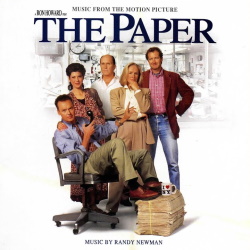 THROWBACK THIRTY
Original Review by Jonathan Broxton
The Paper is an ensemble comedy-drama directed film by Ron Howard that follows the hectic day of a New York City tabloid newspaper, the New York Sun. The plot revolves around Henry Hackett, played by Michael Keaton, the managing editor of the paper, who faces a series of challenges over the course of 24 hours. These challenges include breaking a major story about two young men wrongfully accused of murder, dealing with corporate interference and pressure to sensationalize stories, and navigating personal conflicts within his team, including with his pregnant wife who also works at the paper. Throughout the day, Henry grapples with ethical dilemmas, personal integrity, and the demanding nature of his job, all while trying to balance his professional and personal life amid the fast-paced and often chaotic environment of a tabloid newspaper. The film has a superb supporting cast that includes Glenn Close, Marisa Tomei, Randy Quaid, and Robert Duvall, among many others, and it was a relative critical hit, although it was almost entirely overlooked at the subsequent Oscars – with one notable exception.
The score for The Paper was by Randy Newman, who with this score was re-teaming with director Ron Howard for the second time, after Parenthood in 1989. In the early 1990s Newman was still in that pre-Pixar period when he was regularly hired to score prestige dramas and comedies; his films immediately preceding The Paper included several of his all-time great non-animated works, including Avalon and Awakenings, after which he took a three-year hiatus from film to work some more on would eventually be musical album Faust. For The Paper, Newman wrote a light, lively, busy orchestral score that successfully depicts the hustle and bustle of life in the newsroom, and also contributed an original song – “Make Up Your Mind” – which would eventually receive the film’s only Oscar nomination. It’s a good song – not one his best, not one of his worst – which feature Newman’s usual wry and sardonic lyrics, a jazzy-bluesy sound featuring prominent Hammond organs, and backing vocals by former Supreme Alex Brown.
 The score proper is one built around rhythm; the whole thing seems to have a breathless, energetic quality that is almost but not quite on the verge of spilling over into chaos. It contains a lot of very familiar Newmanisms in both tone and orchestration; a lot of it has the bluesy, jazzy sound that goes all the way back to his work on scores like Ragtime, while other parts are more subtle and quietly emotional in ways that acknowledge scores like the previously mentioned Avalon and Awakenings, although even here Newman’s bright brass writing and languid cascading strings are never far away.
Cues like the “Opening,” “Clocks,” “Henry Goes to Work,” “The Sun,” “The Newsroom: 7:00 P.M.” are heavily influenced by the busy, frenetic ‘office’ sound, and see Newman combining his vivacious orchestra with a series of different rhythmic and instrumental textures. In the “Opening,” for example, Newman uses dynamic rock percussion and jazzy, sexy, dramatic strings. In “Clocks” Newman introduces a recurring idea where tick-tock watch sounds are offset against urgent, vaguely neoclassical strings in a way that captures the passage of time and the relentless pressure of deadlines. Later in the cue there is some excellent brass writing, half militaristic half Nino Rota Italianate, that is very impressive. I also noticed that in “Henry Goes to Work” Newman’s writing has some vague hints of ‘circus music’ via Aram Khachaturyan’s Saber Dance, which may or may not be a piece of musical satire commenting on the state of 1990s print journalism.
At the other end of the scale, Newman’s more low-key sound is pretty, and tends to relate to the sub-plot involving Robert Duvall’s character as he tries to re-connect with his estranged daughter. Cues like “Bernie Calls Deanne” and “Bernie Finds Deanne” feature some sweet woodwind and string textures, and warm horns, although in the latter of these cues music is subtly underpinned with a sense of uncertainty. Another theme represents the relationship between Michael Keaton’s Henry and his heavily pregnant wife Marty (Tomei); “Marty and Henry” is lush and tender but also jazzy with that typically Newmanesque slur in the strings.
The finale of the score involves a double race against time, as on one hand the paper’s staff rush to fix a headline that, if left unchanged, would result in the incorrect incarceration of three Brooklyn teens, while on the other hand Marty is rushed to the hospital to undergo an emergency caesarean section. The sequence that comprises “Marty,” “Marty’s in Trouble,” “To the Hospital,” and “Little Polenta is Born” runs the gamut of emotions, starting out with some dark and shrill writing for agitated strings and dissonant brass, going through a brief moment of panic, before ending with warmth and relief.
The conclusive “A New Day: 7:00 A.M.” combines the elegant string and piano writing with some slightly less chaotic references to the main ‘office’ sound, as everyone returns to work the following day after their hectic day the day before – all ready to do it all again. Such is life at the New York Sun!
The Paper is a good score which will appeal to Randy Newman fans more than anyone else, as it contains a lot of the enjoyable and recognizable personal idiosyncrasies that features in many of his dramatic scores in the late 1980s and early 1990s. It’s also interesting at it marks something of a watershed in Newman’s film music life – he would write his first Pixar score, Toy Story, in the summer of 1995, and in doing so would change his career trajectory away from adult-themed comedies and dramas and into the world of toys, bugs, cars and monsters.
Having said that, others who are not Newman devotees may be less enamored with it; I enjoy it, but in terms of his wider career it doesn’t have the same emotional depth, and it doesn’t have the same thematic memorability, as many of his more acclaimed works – and even the song is one of his most overlooked.
Buy the Paper soundtrack from the Movie Music UK Store
Track Listing:
- Opening (1:14)
- Clocks (3:11)
- Henry Goes to Work (1:55)
- The Sun (0:46)
- Bernie Calls Deanne (2:11)
- Busting the Guys (1:14)
- Marty and Henry (1:14)
- The Newsroom: 7:00 P.M. (2:51)
- More Clocks (1:44)
- Henry Leaves With McDougal (2:51)
- Bernie Finds Deanne (1:07)
- Bernie (1:54)
- Stop the Presses (0:55)
- Henry’s Fired (1:00)
- Marty (0:42)
- Marty’s in Trouble (1:54)
- To the Hospital (0:41)
- Little Polenta is Born (2:26)
- A New Day: 7:00 A.M. (5:01)
- Make Up Your Mind (3:14)
Reprise Records 9362-45616-2 (1994)
Running Time: 38 minutes 05 seconds
Music composed and conducted by Randy Newman. Orchestrations by Jack Hayes. Recorded and mixed by Frank Wolf. Edited by Tom Kramer and James Flamberg. Album produced by Randy Newman.

Shop at the Movie Music UK Store

Member of the

 MOVIE MUSIC UK