ON DEADLY GROUND – Basil Poledouris
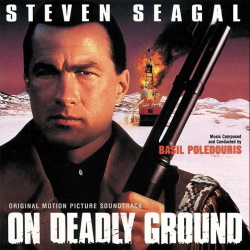 THROWBACK THIRTY
Original Review by Jonathan Broxton
An action thriller with an environmental protection theme, On Deadly Ground marked the directorial debut of action star Steven Seagal, who was hot off the unexpected critical and commercial success of his previous film Under Siege in 1992. Here Seagal plays Forrest Taft, an expert firefighter who gets involved in a conflict between an unscrupulous Alaska oil company and a local indigenous tribe, whose lands are being damaged by the oil company’s drilling methods and poor safety record. Things escalate when the head of the oil company orders his henchmen to eliminate anyone who knows about his company’s indiscretions, and the tribal leader is murdered; angered by the injustice, Taft teams up with the tribal leader’s daughter to take down the company. Despite an excellent supporting cast that included Joan Chen, John C. McGinley, R. Lee Ermey, a young Billy Bob Thornton, and Michael Caine chewing the scenery as the despicable head of the evil oil company, the film was unfortunately a critical disaster, appearing on many end-of-year ‘worst’ lists; much criticism was leveled at Seagal’s ham-fisted and amateurish direction, as well as the preachy tone of the film’s screenplay.
The score for On Deadly Ground was by the great Basil Poledouris, and was one of several B-level action movies he scored during the early and mid-1990s, with the others including titles like Flight of the Intruder, the belated sequel Robocop 3, and Under Siege 2: Dark Territory. What all these scores have in common is Poledouris’s generally over-achieving music, which usually blended punchy, dramatic main themes written for large orchestral forces with his usual array of synthetic and electronic textures, and several impressive action set pieces. On Deadly Ground very much fits that mold, but is notable for the fact that the score incorporates a pair of Inuit throat singers, Qaunaq Mikkigak and Timangiak Petaulassie, into the mix as a musical representation of the film’s Alaskan setting and tribal native protagonists.
The score is based mainly around two main recurring themes, and one or two secondary motifs. The most prominent main theme is the primary identity for Seagal’s character Forrest Taft, a darkly heroic and masculine march arranged mostly for a three-note barrage of brass underpinned by rolling timpani, ethnic woodwinds, and light electronic rhythms that occasionally recall parts of the scores for Robocop and The Hunt for Red October. This theme is introduced prominently in the “Main Titles” cue, and makes a significant impact throughout most of the score, often embedded into the rhythmic body of many of the action cues. The theme is fine – by no means a Poledouris classic – but it does convey the genuinely serious and worthy tone of the film, and the underlying importance of Seagal’s environmental message. Later in “Forrest Found” the main theme is surrounded by watery and fluttery synth textures that are actually more prominent than the orchestra, while the core rhythmic ideas underpinning the cue have an intentionally un-refined, clattery sound intended to represent tribal percussion, and are generally quite effective.
The main secondary theme is introduced in “Aegis Flameout,” and is generally a more lyrical and thoughtful idea that represents the native peoples and Taft’s connection to them. It is initially presented in a bombastic and brassy action setting in this cue, but then in the 8-minute centerpiece “The Journey” the ethereal aspects of the story come more into focus. This cue underscores Taft’s so-called ‘dream quest’ where he communes with the spirits and embraces his ancestors while trekking across the ice, or something – it’s not entirely clear – but to capture the essence of this Poledouris blends both Taft’s theme and the Native Theme, surrounds with the orchestra with the breathy synths and tribal percussion ideas, and brings in the sound of the throat singers to create quite an evocative mood. It’s a clever and piece which at times reminds me of the ’new age/poor moods’ sound that was popular at the time, through artists like Clannad and Enya, or Karl Jenkins and Adiemus.
“Forrest Decides/Horse Chase” and “Jennings Goes Down” are a pair of exciting action sequences, which again make use of both main themes in a variety of intense settings. Some of the thematic outbursts in “Horse Chase” are very satisfying, but these two cues really underline which is probably the score’s biggest negative, which is the generally under-powered nature of the ensemble. Poledouris, to me, was always at his best when given full reign to unleash a large symphonic ensemble, and although there are a few times where On Deadly Ground comes close to doing that, for the most part you get the sense that he was being held back by Seagal’s instructions not to make things too grandiose. Poledouris does try to compensate for this by adding in multiple layers of synthesizers, but unfortunately his composition techniques and attempts to add electronic depth can only go so far.
The final cue, “The Warning,” underscores the final scene of a victorious Taft narrating a sincere but overly-earnest documentary sequence at the end of the film, warning of the damage that unchecked industry was doing to the delicate environmental eco-system. To be fair, it’s impressive that Seagal was talking about this long before it was popular, but he does it in such a preachy way that unfortunately it was mocked at the time. Poledouris underscores the scene with some pleasant but somber and low-key orchestral tones, including a pretty oboe solo and an emotional string interlude, before launching into a final 3-minute restatement of the main themes over the end credits.
 The score for On Deadly Ground was released on CD by Varèse Sarabande in 1994 at the time the film was released, but unfortunately was one of their incredibly short albums, clocking in at less than half an hour and omitting several of the score’s second-half action set pieces. Thankfully a greatly expanded limited edition album was released by Varèse in 2018, bringing the score up to a much more comprehensive 78 minutes, and featuring improved sound quality. Of the expanded material, the peaceful “Chief Meets Forrest,” and several of the lengthy suspense and action cues such as “Hugh Torture,” “The Chief is Shot,” “Gunfight at Hugh’s,” “Safe House/Chopper Explosion,” “Lights Out,” and “Mutiny/Setting The Bombs” are among the highlights.
Overall, On Deadly Ground is a perfectly serviceable action score, typical of Poledouris’s output at the time, but it’s very much a tier below his similar-sounding work on scores like Robocop, The Hunt for Red October, and even Cherry 2000. The action sequences are at times very exciting, the lyrical moments are touching, and the acknowledgements of native Alaskan musical culture are tasteful and appropriate.
Buy the On Deadly Ground soundtrack from the Movie Music UK Store
Track Listing:
- ORIGINAL RELEASE
- Main Titles (2:20)
- Aegis Flameout (1:44)
- Forrest Found (1:36)
- The Journey (7:57)
- Forrest Decides / Horse Chase (3:55)
- Jennings Goes Down (4:47)
- The Warning (7:19)
- EXPANDED RELEASE
- Main Titles (2:21)
- Aegis Flameout (1:44)
- Fire Out (1:56)
- Forrest Doesn’t Fight (1:22)
- Kill Hugh (2:30)
- Hugh Torture (4:33)
- Forrest Blown Up (3:07)
- Forrest Found (1:37)
- Chief Meets Forrest (3:18)
- The Journey (7:56)
- The Chief Is Shot (5:03)
- Snowmobile Ride (1:56)
- Gunfight At Hugh’s (1:40)
- The Mercs/Forest Decides (3:08)
- Safe House/Chopper Explosion (4:34)
- Horse Chase (2:20)
- Forrest Enters Aegis (3:47)
- Lights Out (4:17)
- Mutiny/Setting The Bombs (4:43)
- Jennings Goes Down (Extended Version) (5:57)
- The Warning (4:08)
- End Credits (3:15)
- The Journey (Alternate Segment) (2:51) BONUS
- Seagal/Nasso Logo (0:15) BONUS
Running Time: 29 minutes 36 seconds – Original
Running Time: 78 minutes 18 seconds – Expanded
Varese Sarabande VSD-5468 (1994)
Varese Sarabande VCL-1018-1189 (1994/2018)
Music composed and conducted by Basil Poledouris. Orchestrations by Grieg McRitchie. Special vocal performances by Qaunaq Mikkigak and Timangiak Petaulassie. Recorded and mixed by Tim Boyle. Edited by Curtis Roush. Album produced by Basil Poledouris. Expanded album produced by Robert Townson.

Shop at the Movie Music UK Store

Member of the

 MOVIE MUSIC UK