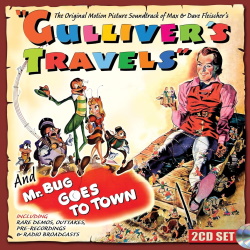
GULLIVER’S TRAVELS – Victor Young
 GREATEST SCORES OF THE TWENTIETH CENTURY
Original Review by Craig Lysy
Following the enormous success of the first animated film, Walt Disney’s “Snow White and the Seven Dwarfs” in 1937, Paramount Studios decided to cash in with its own film. It decided to base the new film on Part One of Jonathan Swift’s classic 1726 novel “Gulliver’s Travels”. In a joint venture, Paramount and Fleisher Studios placed Max Fleisher in charge of production with a $700,000 budget, his brother Dave Fleisher would direct, and the team of Dan Gordon, Cal Howard, Ted Pierce, Edmond Seward and Isadore Sparber would write the screenplay. The voice cast would include Sam Parker as Gulliver, Pinto Colvig as Gabby and Snitch, Jack Mercer as Prince David, King Little, Twinkletoes, Snoop, Horses and the Royal Chef, and Ted Pierce as King Bombo and Sneak.
The film is set in 1699 and explores Part I of Swift’s novel, which deals with the kingdoms of Lilliput and Blefuscu. Gulliver is shipwrecked and wakes up bound by the miniscule Lilliputians. The planned marriage of Princess Glory of Lilliput and Prince David of Blefuscu has been cancelled and war has broken out over the petty issue of which national anthem would be played at the wedding. An attack by the Blefuscu fleet is startled by Gulliver, whose enormous size frightens them, causing a retreat. Ever determined, King Bombo of Blefuscu attacks again with a plan to kill Gulliver, but the attack is thwarted when Gulliver pull all their ships by their anchor ropes to shore. He then fosters a truce, and the two kingdoms build him a ship so he can sail back to England. The film was a commercial failure, losing $500,000 due to Fleisher Studios relocated to Florida and the high labor costs incurred to meet an eighteen-month Paramount distribution deadline. Critical reception was favorable, and the film received two Academy Award nominations for Best Original Song and Best Original Score.
 Victor Young received two Academy Award nominations in 1938, and Paramount Director of Music Boris Morros provided him with the honor of scoring the studio’s first animated film. I believe Young understood that this was an animated fantasy-adventure film with children being the target audience, which he would have to bring to life. The team of composer Ralph Rainger and lyricist Leo Rubin was tasked with writing seven songs, with an eighth song, “It’s a Hap-Hap-Happy Day” being written by Sammy Timberg, Al Neiburg, and Winston Sharples. I believe Young also understood, that he would have to weave the various song melodies into the fabric of his score to ensure a cohesive and integrated musical narrative.
For his soundscape Young chose to utilize three song melodies as leitmotifs to unify the film’s musical narrative. For our hero Gulliver his theme interpolates the melody from the song “I Have A Dream”. French horns nobile offer a warm, friendly statement, which immediately informs us of his nobility, and goodwill. Even when he is forced to take aggressive action as seen in his confrontation with the Blefuscu fleet, the heroism of his theme never loses its nobility. The Lilliput Theme is derived from the “Faithful” song, and serves transpersonally as the kingdom’s national anthem, but on a personal level it supports Princess Glory and offers a yearning romance for strings. Additionally, it offers a Love Theme from Princess Glory’s perspective. The Blefuscu Theme is derived from the “Forever” song, and serves transpersonally as the kingdom’s national anthem. As the Faithful Theme does for Princess Glory, the Forever Theme on a personal level supports Prince David, and also offers a second, more forthright Love Theme from his perspective.
Cues coded (*) contain music not found on the album. The time index is associated with the film time where the music may be heard. “Introduction and Main Title” offer a score highlight where we are graced with a parade of the score’s primary song melodies. It opens with fanfare dramatico draped with harp glissandi and refulgent splendor as the Paramount Pictures logo display. At 0:09 we flow into a horn bravura declaration of Gulliver’s Theme, which supports the display of the film title and unfolding opening credits. At 0:17 we flow into the Faithful Theme atop strings gentile. At 0:29 the playful “All’s Well” song melody joins, followed by at 0:39 by the romanticism of “Bluebirds in the Moonlight”. At 0:48 the spritely “We’re All Together Now” tune joins, followed by the romantic “Forever” song melody at 1:09 and at 1:26 the bubbly and animated “It’s a Hap-Hap-Happy Day” song melody. At 1:36 (*) “The Scroll” we flow into the film proper atop fanfare, which resounds to usher in a tender choral rendering of Gulliver’s Theme. Script displays and informs us a fascinating sea adventure that began on 5 November 1699 when a storm of great fury fell upon the ship. 2:10(*) “The Storm” reveals the ship being pummeled by massive waves, and capsizing. Gulliver grasps on to wooden debris for his life. Young empowers the scene with a swirling and surging orchestral tempest. As he staggers onto shore and collapses a tender choral supported rendering of his theme supports.
“All’s Well” reveals the Lilliputian Gabby singing the comedic, and happy-go-lucky song as he walks through town towards the beach. At 1:21 the film and album diverge, with the rest of the album cue unused. (*) 5:26 “The Discovery” reveals Gabby’s singing ended abruptly as he stumbles on Gulliver’s massive hand. Young sows a misterioso with five xylophone strikes supporting Gabby counting Gulliver’s five fingers. He becomes frightened and tension surges in the music, shifting to strings of flight as he runs away terrified. An orchestral surge supports a lightning flash illuminating Gulliver’s massive arm. Gabby flees for his light carried by strings of flight and chattering xylophone. He reaches a hill, turns, and shrieks when a lightning flash illuminates Gulliver’s entire body. Once again Gaby flees terrified carried by strings spiritoso, intermixed with comedic accents. As he flees through town, he extinguishes the gas street lamps, which Young syncs musically. He wakes the town with his run of terror and eventually reaches the King’s castle, where fanfare reale resounds as he bursts into the castle. A slapstick collision with two guards is supported with musical buffoonery. Gabby is denied entry as the formal signing of the wedding contract is taking place in the throne room.
(*) 7:16 “The Marriage Contract” opens with a romantic rendering of the Lilliput Theme as King Little III signs the contract and hands it to King Bombo of Blefuscu supported by trumpets reale. A brief quote of the Blefuscu Theme yields to a graceful Lilliput Theme as Princess Glory descends the stairs and takes the hand of her betrothed Prince David. As King Bombo signs the contract, his theme with playful accents supports. Solemn strings maestoso empowered by trumpets reale support the two king’s shaking hands. A romance for strings supports the young couple embracing, joined with playful accents as two blue birds mimic them. A short self-congratulatory musical passage follows as the two kings congratulate each other. (*) 8:56 “Wedding Gifts” opens with horns reale resounding as a servant announces that the weeding gifts have arrived. A silly musical interruption supports Gabby yelling “There’s a giant on the beach”, only to be pulled back by the guards. A processione maestoso replete with playful accents joins as the servants bring in the gifts and Gabby is again pulled back by the guards. Sumptuous strings voice the Faithful song melody to evoke pleasantries as the kings examine and voice their approval of the beautiful gifts. At 9:59 bubbling woodwinds of delight and strings felice support the presentation of the wedding ring. At 10:33 playful woodwinds comici support a servant bringing in the massive wedding cake on his back, and King Bombo taking a finger lick of the frosting.
“Faithful” offers a beautiful romantic highlight, a perfect confluence of melody, vocals and lyrics. It reveals our lovers on a balcony illuminated by the light of a full moon as Princess Glory sings to Prince David. The intimate moment is supported by the soprano vocals of Jessica Dragonette singing the romantic song, with playful accents attached to two blue birds mimicking them.
12:25 (*) “The Dispute” reveals King Bombo commenting on how the song has a lovely melody to King Little. King Little replies that it is called “Faithful”, the song of Lilliput and that it will be played at the wedding tomorrow. Up until this point Young has supported with a musical narrative of gentility. At 12:55 after King Bombo replies that “Forever” the song of Blefuscu must be played instead, the “Forever” song melody joins. Slowly we begin to discern a rising tension in the notes as the two kings, supported by their kingdom’s songs begin to contest. King Bombo declares that it will be “Forever” or there will be no wedding! King Little tries to persuade him at 13:46 begins to dance to a sumptuous statement of “Faithful” rendered as a valzer romantico. King Bombo has had enough, and at 14:02 smashes the wedding and declares war as dire horns resound. King Bombo storms out supported by a marcia irato, while King Little sits on his thrown in despair.
14:26 (*) “It’s War!” reveals Gabby, supported by a comedic narrative running into the throne room shouting; “There is a giant on the beach!” as King Bombo departs shouting; “It’s war!” supported by horns bellicoso and a dire musical narrative. 14:43 (*) “Woe is Me” reveals Prince David entering from the balcony and departing supported by a plaintive statement of the “Faithful” song melody as King Little frets; “War. Woe is me.” Silliness joins as Gabby again alerts the king to a giant on the beach. Yet the king is preoccupied, walks away and at 15:29 a sad “Faithful Theme” supports him finding his daughter crying on the balcony. Fluttering woodwinds join as we see the two blue birds also sobbing. 15:46 (*) “King Bombo Departs” reveals him departing the castle with a plodding descent motif carrying his descent down the stairs. He informs his general, that it is war. 16:01 “Forever” offers a beautiful romantic highlight, a perfect confluence of melody, vocals and lyrics. reveals Prince David gazing up to Princess Glory on the balcony and singing romantically, the Blefuscu song, which is sung by the tenor voice of Bob Stevens.
As he sings the film cuts back and forth between our two lovers, and King Bombo who cries, with his thoughts of the wedding displayed as pictures above his head. We descend into sadness as a forlorn Prince David departs.v(*) 17:37 “Spies” offers a comedic and suspenseful musical narrative as the Blefuscu general dispatches three cloaked spies before departing the lilliput castle. 17:58 (*) “King Little Frets” offers a silly, comedic musical narrative as the king frets about the turn of events. Gabby again confronts him by repeatedly shouting that there is a giant on the beach! The king at last reacts to this revelation and orders the alarm.
18:41 (*) “There’s A Giant On The Beach!” reveals Gabby repeatedly ringing the town square bell to sound the alarm as he shouts “There’s a giant on the beach! Young sow a slow building crescendo of alarm as the towns people awake, with a full spectrum of emotional reactions seen. At 19:27 an accelerando spiritoso unfolds as the towns people rush to the square carrying torches. (*) 19:47 “Pussyfoot March” reveals Gabby issuing orders to bring supplies to restrain the sleeping giant, and the mob follows him to the beach propelled by a cadence of field drums militare, which empower an animated marcia bellicoso. At 20:30 as they near the beach, a diminuendo of tension commences as Gabby says shh! They slow their pace and approach the beach quietly with trepidation supported by a repeating six-note bassoon motif. A descent motif at 20:44 supports the hapless Gabby falling into a pond. As they resume their stealth approach, the bassoon led cadence supports, offering comedy and suspense.
(*) “Where Is It?” reveals Gabby and the mob standing on Gulliver’s chest as we see shirt buttons, however they do not realize this as the towns people castigate the flummoxed Gabby. Young supports with a sardonic, comedic musical narrative. At 22:28 a heart-beat motif supports the discovery of a heart beat by an old almost deaf man with ear trumpet. Tension slowly builds as they all listen and are lifted up as Gulliver cheat expands as he takes a breath. They fee in panic carried by woodwinds rapido as we see Gulliver asleep. In 23:16 (*) “It’s a Giant” the way Young uses his orchestra to animate the action and physicality on the screen is just remarkable. Critics would criticize this a “Mickey Mousing” run amuck, but I really believe it is the music more than the animation, which makes this a wonderful scene. It reveals torches reappearing one by one, supported by xylophone strikes and a rising musical narrative of tension as we see all of them amazed at what they see. Gabby orders the men to bind the giant with ropes and a Young sow suspense with accents of buffoonery as they cautiously, and comedically approach to begin their efforts.
25:28 (*) “Restraining The Giant” opens with trumpets declarations joined by bubbling woodwinds strings animato as dozens of catapults launch numerous arrows attached to rope over Gulliver, and the secure both ends in the ground to restrain him. Xylophone animato sync with the men’s footfalls as the travel over Gulliver and manage the ropes. Ascent and descent motifs support the lifting of Gulliver’s hand, which they also secure. At 27:15 a spirited musical narrative empowered by a strings energico ostinato support Gabby order to complete restraints as dozens of men work and add more and more rope binds. At 29:55 the string ostinato intensifies and tension slowly increases as they use a series of cranes, which strain to lift Gulliver onto a massive wheeled cart. At 31:11 horn sound and launch a crescendo dramatico as a team of dozens of horses strain to pull the massive cart under Gulliver. At 31:54 Gabby orders them to lower away and a descent motif with comedic accents of buffoonery supports them lowering Gulliver onto the cart. Once down, a playful musical narrative, again with silly accents, supports them binding the restraining ropes to the cart. 32:55 (*) “Let’s Go!” is a masterfully conceived composition, where Young uses the orchestra’s lowest register to propel the transport of the enormous cart hauling Gulliver, juxtaposed by high register strings, playful woodwinds animato and light percussion to animate the diminutive Lilliputians. Again the musical narrative contains numerous comedic accents to sync with the silliness on screen.
35:11 (*) “Gabby Wakes The King” reveals Gaby waking the king supported by a playful musical narrative and muted trumpets reale as the king gets up. Strings spiritoso and trumpets reale support servants dressing the king, followed by a silly musical narrative with playful woodwinds as Gabby and the King descend from the castle and board the massive cart in the courtyard. Upon seeing the giant, the king panics, orders the army to assemble, and flees back to his bed propelled by strings spiritoso, woodwinds animato, and bursts of horns reale with of course the usual comedic accents. 37:21 (*) “Search The Giant” opens with violins animato and horn bravura, which empower Gabby’s order to search the giant in case he is armed. Playful woodwinds animato and spritely strings support the discovery of a pocket watch, monocular, and pistol. At 38:05 a man falls on the trigger and the gun discharges, blasting a castle tower. This triggers a dire orchestral panic with strings of flight as Gulliver wakes up and people flee in terror. A string borne agitato joined a woodwind ostinato unfolds and tension swells as Gulliver yawns while Gabby and the king observe from the castle balcony.
38:43 (*) “Gulliver Breaks His Binds” reveals Gulliver uses his strength to break all the retraining ropes supported by a dramatic crescendo di terrore as we see the king and Lilliputians horrified and frightened. A silly, comedic interlude at 39:00 supports the king fleeing the balcony and locking the door, trapping the frantic Gabby. Horns nobile join and emote a warm rendering of Gulliver’s Theme as he reaches up and gently retrieves Gabby. Gabby is frantic and cries in terror asking that he not be eaten. At 39:56 horns reale declare the king’s fanfare as he arrives on the balcony and orders Gaby release. He then orders his archers to the castle parapets who draw their bows. Playful woodwinds join as Gulliver complies and places Gabby on the balcony. 40:50 (*) “Blefuscu Attacks” reveals the King Little preparing to issue the command to fire only to have the castle pummeled by canon and arrow fire from the Blefuscu fleet. Young unleashes the Forever Theme as an anthem propelled by a storm of strings furioso as King Bombo boasts on his flagship. King Little orders his army to defend the city, propelled by horns militare. At 41:32 Gulliver, who is also being hit stands up empowered by his theme borne by horns nobile. His massive figure shifts the musical narrative to panic as the Blefuscu sailors are frightened and abandon their posts. At 41:58 swirling strings of panic and tilling woodwinds support the fleet turning tale and fleeing. Distressed woodwinds support the Lilliputians hesitating to come out, fearful of this giant in their midst. Bubbling woodwinds felice support the king’s joyous declaration to Gabby that they had won!
42:48 (*) “Gulliver Introduces Himself” reveals Gulliver politely introducing himself to King Little supported by his theme borne by horns Nobile. Soothing strings join as Gulliver attempts to reassure them of his goodwill. A warm musical narrative of friendship unfolds as he wins the king’s good graces. The music becomes giddy atop woodwinds felice as the king expresses his joy that Gulliver is on their side. His declaration to the people brings them out to the streets supported by a paean of happiness. 44:11 “All’s Well” reveals jubilation as the city turns out to honor Gulliver. A military band parades supported by this choral rendered song expressed as a marcia celebrative. 44:42 “It’s a Hap-Hap-Happy Day” reveals the Lilliputians using a massive crane structure to hoist and sow new clothes onto Gulliver as they sing full of merriment this choral rendered song. At 45:41 an interlude with the playful song melody led by trumpet animato is rendered orchestrally to support various comedic antics by the Lilliputians. At 46:01 the chorus resumes, then another short orchestral interlude is heard, bfore returning to the song as we see Lilliputians buffing his boots, dressing, shaving and grooming Gulliver.
We close with an orchestral exposition, which embraces a big band jazz expression as we see Lilliputians dressing and grooming Gulliver. At 47:39 horns grandioso resound as the perfectly dressed and groomed Gulliver stands. He is very pleased and happy and we conclude with a grand orchestral flourish! 48:05 “Message from the King” reveals the Isle of Blefuscu, which is supported by grim horns. King Bombo dispatches a carrier pigeon to order his spies in Lilliput to find a way of disposing the giant. Trumpet reale launch the pigeon’s flight and a silly musical narrative carries his departure. At 48:56 a forlorn quote of the “Faithful” melody supports a sad Prince David longing gaze upon the horizon as he thinks of his beloved Glory. 49:10 (*) “The Princess Sadness” opens with a sad Princess Glory gazing upon the horizon from her balcony supported by her theme, so full of longing. 49:21 (*) “Celebration” shift to the town, where the king, people, and Gulliver celebrate, and partake of a feast. Young supports with a playful musical narrative full of merriment. At 49:51 fluttering woodwinds, and strings of flight replete with the usual slapstick comedic accents carry the pigeon to the three spies lurking on a nearby rooftop. The music darkens as they read the note; “Get rid of that giant or else… King Bombo”. We close with grim comedy as the spy’s fret.
50:40 “Bluebirds in the Moonlight” reveals a couple performing song dance on stage as part of the after-dinner entertainment. The song is playful and happy-go-lucky. At 51:36 the king takes to the dancefloor with big band energy and starts to perform as chorus sings. He is soon joined by Gulliver’s finger dancing. We end with applause, which shifts to the spies atop the forlorn rooftop. 52:38 (*) “How Do You Kill a Giant?” offers a silly musical narrative as the spies shoot down their youngest members ideas, with young syncing with slapstick; poison, a sword, and a sling shot. At 53:06 dire chord sounds as they salivate at another option – Gulliver’s pistol. The music brightens as the kiss their fellow spy and run to the gun. 53:18 (*) “Gulliver Departs” somnolent strings offer a lullaby as Gulliver tucks the king and friends in with the table cloth, blows out the torches, and departs. Shimmering xylophone and refulgent strings support his departing footfalls, joined at 54:13 by a dire orchestral chord as we see his pistol is missing. 54:22 “I Hear A Dream” reveals him laying down at the beach with his eyes affixed to the horizon. Women’s chorus sing a wistful song, which speaks of his desire to go home. He sits up, and sings with Harry Stafford’s wistful baritone voice full of longing another song stanza graced by women’s wordless voices.
55:54 (*) “The Sailboat” reveals Gulliver standing on the beach the next day carving a wooden sailboat, which he places with a sail in the water and blows it out to sea as the Lilliputians cheer. Young supports with an orchestral reprise of the “I Hear a Dream” song melody. Gulliver the departs and at 56:36 supports a playful musical narrative replete with sea shanty quotes and silly slapstick musical effects, as Gabby runs after Gulliver yelling “Ahoy Mate!”. In 58:04 (*) “The Spies Attack” the music darkens with an undercurrent of tension as Gulliver approaches a dilapidated manor house. Inside we see that the spies have mounted the pistol on a rolling cart. They load the spherical bullet and tilling woodwinds propel the scurrying youngest spy who races to alert his comrades of the giant’s approach. A panicked musical narrative erupts as the run to take cove, with the youngest spy stupidly hiding the lantern in a barrel, which he covers with straw. At 59:20 horns nobile sound Gulliver’s Theme as he strolls by. At 59:33 Young unleashes panic as the barrel erupts in flames, joined by silliness as the youngest spy uses his hands to make wall shadow figures. At 59:55 Gulliver notices the house in flames and returns carried by his warm theme. He scoops up water from a pond and doses the fire and we close with musical buffoonery as the spies cluck like chickens to hide their identity.
1:00:29 “A Spy!” reveals the princess sitting dejected on her patio when she hears the prince singing the song “Forever” romantically yet at 1:01:15 Gabby hears the Blefuscu song, yells out “Spy!” and rushes out, rousing the guards who engage the prince in a sword fight. Strings furioso contest with the “Forever Theme” rendered alla maestoso. The princess falls at 1:02:01, and as the guards prepare to strike him down, Gulliver blows them away with a large exhale and picks up the prince. At 1:02:08 Gabby castigates the princess for concealing a spy during a time of war. When Gabby turns away to summon the guards, Gulliver picks up the princess supported by her romantic theme. A comedic interlude supports Gabby’s being flustered. The Love Theme resumes as Gulliver reunites our lovers on her balcony as they join in a kissing embrace. 1:02:47 (*) “The Spies Letter” reveals them preparing a letter to King Bombo asking for permission to assassinate the giant, and suggestion as to what to do with the body. Young joins quirkiness, comedy and sinister purpose in an unusual musical narrative.
1:03:06 (*) “Gulliver and the Lovers” reveals him incredulous to their circumstances as he states; “Two heart in love broken by a melody?” A tender faithful melody supports as Gulliver has a Eureka moment; “Sing Faithful and Forever together as one song. 1:03:33 (*) “Spy Letter” reveals King Bombo receiving the latest carrier pigeon message. Tiny fanfare support as he reads the letter and voices his happiness. The music becomes sinister as he pens instructions; “Dear spies, Destroy. Crush. Obliterate. Annihilate! Kill him!”, and then declares that he will attack at dawn! A trilling piccolo propels the carrier pigeon back to the spies, but it loses vitality as the exhausted pigeon lands with a thud by a pond. Twinkling effervescence supports him parching his thirst as Gabby arrives. A swirling string storm supports the two fighting over the letter, which Gabby wins. He reads the Blefuscu attack plans. An energetic musical narrative propelled by martial horns of alarm support Gabby’s frantic running as he alerts Lilliput that war is coming! At 1:05:02 martial fanfare reale support King Little running from his palace to take command of his troops in the courtyard.
“We’re All Together Now” reveals King Little on horseback leading the Lilliput army to meet the Blefuscu. A confident marcia militare buttressed by trumpets supports as the king leads and the men repeat the phrases. The song continues to repeat these stanzas as the Lilliputians prepare to defend the motherland. A frantic Gabby rings the war bell and call to Gulliver who comes to his aid after the bell falls and traps him. Gulliver heads out ahead of the Lilliputians and as Gabby tries to catch up, he is captured by the spies who retrieve and read the letter.
1:08:45 (*) “Gulliver Stops the War” reveals him at the beach opposed by the Blefuscu fleet. The Lilliputians arrive and Gulliver tries to be a peacemaker, but is pummeled by Blefuscu catapults. Young unleashes a maelstrom as Gulliver walks out. He again asks King Bombo to cease fire to no avail. At 1:09:39 Trumpets bravura declare Gulliver’s theme followed by a tense violin tremolo as he grabs all the ship’s anchor lines. His theme blossoms into a grandiose choral empowered statement and he begins pulling them to shore. At 1:10:22 sinister music supports the spies positioning the pistol on a hill, while the Faithful Theme supports Princess Glory pointing out to Prince David the spies pulling Gulliver’s gun up the hill to a straining ascent crescendo. At 1:10:55 Prince David mounts his horse and rides to stop the spies carried by a martial, trumpet empowered rendering of his theme. Young sow a rising tension as the spies load the gun powder, place a buck shot, try pulling the trigger as the prince rides and Gulliver approaches with his back turned towards the pistol. The music crests at 1:11:45 as the prince leaps atop the pistol and changes its firing angle. It fires, misses Gulliver, but the prince and pistol cart crash off the cliff.
“Faithful, Forever” opens with fluttering woodwinds of flight as two bluebirds fly to Princess Glory, who begins to sing a song of healing and union, by joining the two kingdom’s anthems in one song. The song with vocals by soprano Wynne Davis and baritone Bob Stevens, and bass Harry Stafford offer a perfect confluence of music, lyrics and vocals. 1:13:35 (*) “Finale” offers a warm and heartfelt score highlight. It reveal the two kings christening the HMS Gulliver, a massive ship built to transport Gulliver home. The people offer a heartfelt choral farewell to Gulliver. A reprise of the song is sung as Gabby and the little spy weep on shore, and the people wave goodbye. At 1:14:55 we are graced by a warm and noble rendering of Gulliver’s Theme as he sails away under crimson cloud swept skies, with the music culminating in a grand flourish to end the film.
In 1937 Walt Disney crossed the Rubicon with his production of “Snow White and the Seven Dwarfs”, the first feature length animated film. Paramount Pictures correctly judged that opportunity existed to duplicate this success, and so embarked on “Gulliver’s Travels”. I believe Victor Young, a master of melody, realized that he had struck gold with the songs created by the team of composer Ralph Rainger and lyricist Leo Rubin. His choice to utilize three of the song melodies for his musical narrative was well-conceived. Wrapped with in this fantasy adventure was a love story and the melodies for the songs “Faithful” and “Forever” perfectly brought love, longing and tenderness to the film. Indeed, the joining of the two songs in “Faithful, Forever” revealed the power of love to overcome all obstacles, even war. Young’s understood that Gulliver was a very good-natured, kind, and virtuous man, and the decision to interpolate the melody from the song “I Have A Dream”, was well-conceived. In a masterstroke Young captured his heroism, warmth, nobility, and goodwill.
This was the second feature length animated film and Young chose to adopt a technique, very common in the 1930s which came to be called by critics as “Mickey Mousing” as it had become a hallmark of Disney animated films. This technique involves music-film literalism or parallel scoring; the precise matching of onscreen movement to music. Examples include a descent motif when falling, or an ascent motif when rising, or a ker-plunk when someone falls. Having watched the film, I am truly amazed at the extent and creativity Young conceived for this film, which involved significant slapstick, silliness and buffoonery. For a child’s fantasy adventure film, I believe the technique works and contributes to the fun and enjoyment. Folks, I believe Young, like Alfred Newman had a gift for using his orchestra to enrich and enhance songs in the musical narrative. I believe he succeeded on all counts, a highly recommend you take in both the album and the film.
For those of you unfamiliar with the score, I have embedded a YouTube link to the song “Come Back to Me”; https://www.youtube.com/watch?v=VEqawMf7fKo
Buy the Gulliver’s Travels soundtrack from the Movie Music UK Store
Track Listing:
- Introduction & Gulliver’s Travels Main Title (2:08)
- All’s Well (written by Ralph Rainger and Leo Robin, performed by Pinto Colvig) (2:04)
- Faithful (written by Ralph Rainger and Leo Robin, performed by Jessica Dragonette) (1:28)
- Forever (written by Ralph Rainger and Leo Robin, performed by Lanny Ross) (1:24)
- Bluebirds in the Moonlight (written by Ralph Rainger and Leo Robin) (1:27)
- It’s a Hap-Hap-Happy Day (written by Sammy Timberg, Winston Sharples, and Al Neiberg) (1:12)
- A Whale of a Tale! (written by Victor Young, performed by Pinto Colvig & Sam Parker) (1:10)
- Faithful Forever (written by Ralph Rainger and Leo Robin, performed by Jessica Dragonette, Lanny Ross, Sam Parker & Tedd Pierce) (1:26)
- All’s Well – Reprise (written by Ralph Rainger and Leo Robin, performed by Pinto Colvig) (1:03)
- Cheerio (Outtake) (performed by Leo Robin) (1:13)
- Faithful – Demo (written by Ralph Rainger and Leo Robin) (1:47)
- Forever – Demo (written by Ralph Rainger and Leo Robin) (1:42)
- I Hear a Dream (written by Ralph Rainger and Leo Robin, performed by Lanny Ross) (2:55)
- Faithful Forever – Demo/Duet Version (written by Ralph Rainger and Leo Robin) (1:45)
- Pussyfoot’in Around (Outtake) (performed by Leo Robin) (1:21)
- Faithful Forever (written by Ralph Rainger and Leo Robin, performed by Lanny Ross) (3:04)
- Faithful Forever – Demo/Finale Version (written by Ralph Rainger and Leo Robin, performed by Leo Robin & Company) (1:36)
- Gulliver’s Travels Film Selection #1 (performed by Vera Lynn, Jack Cooper & Evelyn Dall) (6:39)
- All’s Well (written by Ralph Rainger and Leo Robin, performed by Victor Young & His Orchestra with Soloists) (1:57)
- We’re All Together Now (written by Ralph Rainger and Leo Robin, performed by Victor Young & His Orchestra & Chorus) (3:00)
- It’s a Hap-Hap-Happy Day (written by Sammy Timberg, Winston Sharples, and Al Neiberg performed by Victor Young & His Orchestra with Soloists) (2:23)
- Bluebirds in the Moonlight (written by Ralph Rainger and Leo Robin, performed by Victor Young & His Orchestra with Soloists) (2:18)
- Faithful (written by Ralph Rainger and Leo Robin, performed by Victor Young & His Orchestra with Soloists) (2:35)
- Forever (written by Ralph Rainger and Leo Robin, performed by Victor Young & His Orchestra with Soloists) (3:09)
- Faithful Forever (written by Ralph Rainger and Leo Robin, performed by Victor Young & His Orchestra with Soloists) (2:56)
- I Hear a Dream (written by Ralph Rainger and Leo Robin, performed by Victor Young & His Orchestra with Soloists) (3:13)
- Gulliver’s Travels Songs & Scenes Studio Adaption #1 (performed by Jay Wilbur & His Band with Soloists) (7:08)
- I Hear a Dream (written by Ralph Rainger and Leo Robin, performed by Vera Lynn) (3:17)
- Opening Announcement & It’s a Hap-Hap-Happy Day (written by Sammy Timberg, Winston Sharples, and Al Neiberg, performed by Meredith Wilson & His Orchestra) (2:49)
- Introduction & Gulliver’s Travels Medley (performed by Al Goodman & His Orchestra) (3:04)
- All’s Well (written by Ralph Rainger and Leo Robin, performed by Al Goodman & His Orchestra & Company) (1:06)
- Faithful (written by Ralph Rainger and Leo Robin, performed by Jessica Dragonette) (2:20)
- Forever (written by Ralph Rainger and Leo Robin, performed by Lanny Ross) (1:51)
- It’s a Hap-Hap-Happy Day (written by Sammy Timberg, Winston Sharples, and Al Neiberg, performed by Al Goodman & His Orchestra & Chorus) (2:09)
- Bluebirds in the Moonlight (written by Ralph Rainger and Leo Robin, performed by Al Goodman & His Orchestra & Chorus) (1:11)
- We’re All Together Now (written by Ralph Rainger and Leo Robin, performed by Al Goodman & His Orchestra & Chorus) (2:14)
- Faithful Forever (written by Ralph Rainger and Leo Robin, performed by Lanny Ross & Jessica Dragonette) (3:13)
- The Making of Gulliver’s Travels (performed by Lanny Ross, Jessica Dragonette & Dave Fleischer) (1:24)
- Gulliver’s Travels Film Selection #2 (performed by Sam Browne & Evelyn Dove) (1:34)
- All’s Well (written by Ralph Rainger and Leo Robin, performed by Craig McDonnell with Soloists) (3:07)
- Faithful Forever (written by Ralph Rainger and Leo Robin, performed by Craig McDonnell with Soloists) (3:29)
- It’s a Hap-Hap-Happy Day (written by Sammy Timberg, Winston Sharples, and Al Neiberg performed by Craig McDonnell with Soloists) (2:40)
- Bluebirds in the Moonlight (written by Ralph Rainger and Leo Robin, performed by Craig McDonnell with Soloists) (3:06)
- Faithful Forever & We’re All Together Now (written by Ralph Rainger and Leo Robin, performed by Craig McDonnell with Soloists) (3:17)
- Faithful Forever & I Hear a Dream (written by Ralph Rainger and Leo Robin, performed by Craig McDonnell with Soloists) (3:32)
- Gulliver’s Travels Songs & Scenes Studio Adaption #2 (performed by Billy Thorburn & Company (6:43)
- It’s a Hap-Hap-Happy Day (written by Sammy Timberg, Winston Sharples, and Al Neiberg, performed by Celia Lipton) (3:00)
- Introduction & Mr. Bug Goes To Town Main Title (0:53) from Mr. Bug Goes To Town
- Boy, Oh Boy! (1:31) from Mr. Bug Goes To Town
- Katy-Did, Katy-Didn’t (performed by Stan Freed & Pauline Loth) (1:53) from Mr. Bug Goes To Town
- I’ll Dance At Your Wedding) (Honey Dear) (1:23) from Mr. Bug Goes To Town
- We’re The Couple In The Castle (performed by Kenny Gardner) (2:36) from Mr. Bug Goes To Town
- Mr. Bug Goes To Town Closing Medley (1:45) from Mr. Bug Goes To Town
- Boy, Oh Boy! (performed by The Swingmasters with Frankie Masters & his Orchestra) (2:50) from Mr. Bug Goes To Town
- We’re The Couple In The Castle (performed by Frankie Masters & Phyllis Myles) (2:54) from Mr. Bug Goes To Town
Running Time: 140 minutes 00 seconds
Sepia 1367 (1939/2021)
Music composed and conducted by Victor Young. Original songs written by Ralph Rainger and Leo Robin. Orchestrations by George Bassman, Charles Bradshaw, George Parrish and Leo Shuken. Recorded and mixed by XXXX. Score produced by Victor Young and Boris Morros. Album produced by XXXX.
-
January 29, 2024 at 9:08 amGULLIVER’S TRAVELS – Victor Young, Ralph Rainger, and Leo Robin – Urban Fishing Pole Cigars

Shop at the Movie Music UK Store

Member of the

 MOVIE MUSIC UK