NYAD – Alexandre Desplat
 Original Review by Jonathan Broxton
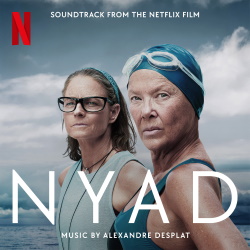
Diana Nyad is an American long-distance swimmer who gained international fame for her remarkable achievements in open-water swimming, particularly for her tenacity and determination in attempting to swim from Cuba to Florida, a feat she eventually accomplished in 2013 at the age of 64. Nyad’s early passion for swimming became evident at a young age, and she quickly rose to prominence as a competitive swimmer in her teenage years. She later turned to long-distance swimming, and in 1975 she swam from the Bahamas to Florida, covering a distance of 102.5 miles, which set a world record for both men and women. Despite her early success, Nyad faced setbacks, including failed attempts to swim from Cuba to Florida in the 1970s, but after more than three decades away from the water, Nyad made headlines with her historic swim from Havana to Key West in September 2013; the 110-mile journey took her approximately 53 hours, and in doing so she became the first person to complete the swim without the aid of a shark cage. This new film tells Nyad’s remarkable life story, concentrating specifically on the events surrounding the 2013 Havana to Key West swim. The film stars Annette Bening as Nyad and Jodie Foster as her lifelong friend Bonnie Stoll, and was directed by Elizabeth Chai Vasarhelyi and Jimmy Chin, the Oscar-winning filmmakers of Free Solo.
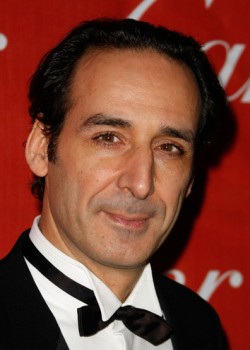
The score for Nyad is by the Oscar-winning French composer Alexandre Desplat. 2023 has been a comparatively quiet year for Desplat, who normally completes five or six scores each calendar year, but whose only output so far this year has been Wes Anderson’s Asteroid City (which I really disliked), although he does have three additional films – Roman Polanski’s comedy The Palace, George Clooney’s sports drama The Boys in the Boat, and the period drama Lee – scheduled to come out before the end of December. People familiar with Desplat’s past work will find Nyad to be something of a departure for him; it’s still elegant and tuneful and dramatic, but it has a much more contemporary sound than most of his most popular work, at times approaching an almost new-agey sound with its enhanced use of electronic textures alongside the familiar orchestra, as well as its frequent use of Latin guitars.
As described in an interview with Tim Grieving for the Los Angeles Times, Desplat wrote two themes for Nyad: the first is a “bright, rising tune” for orchestra with prominent electric guitars and flutes. Desplat says this theme is intended to convey Nyad’s simplicity – to “make us feel who she is” – and is free from overly-complicated, sophisticated writing. The second theme is about the sexual trauma Nyad experienced as a child, that appears in the film in flashback. The theme is initially mysterious and rhythmic, with dark flute chords playing over guitars backed by timpani, and Desplat describes the theme as “bringing out who she is, how she suffers, how she dreams, when she has delirium, what has traumatized her when she was a child”.
 These two themes dominate much of the score, and they appear sequentially in the first two cues, “Young Diana” and “Diana”. Both pieces are slow, gentle, intimate, and very appealing, although the second of them does throb with a sort of primal intensity, driven along by the thrumming electric guitar rhythm. These themes come back throughout the score in numerous guises. “Pier Chat” starts out low-key and introspective but gradually melts into a lovely piano solo. Both “Team Nyad” and “Second Attempt” have a sense of purposeful determination in the almost rock-like attitude that comes from the electric guitars and drums, while the theme for Diana floats around underneath, moving from strings to piano.
The way that the classicism in the strings clashes with the contemporary electronica and the moody woodwind figures in “Fighting the Waves” is really fascinating, a reflection of the fighting-against-the-odds attitude that Diana has throughout the film. There is a real warmth and tenderness to the opening part of “Race Flashback,” but this is quickly overshadowed by a dissonant and anguished musical depiction of the sexual abuse she suffers at the hands of her coach – something that will go on to define large parts of her adult life. The way Desplat morphs Diana’s theme through emotions raging from triumph to horror to numb resignation over the course of 4½ minutes is impressive. Some of this writing in these cues recalls the stylistics of some of Desplat’s early work, notably Birth, which is greatly appreciated.
One of the other important elements of the score is the action music, some of which is unexpectedly vivid and vicious. The not inconsiderable risk of Diana being attacked by a shark as she swims is covered in the dark, ominous “Shark Plan,” a mass of throbbing percussion and bubbling electronic textures overlaid with harsh string and shrill woodwinds. “Jellyfish Attack” underscores a scene in which, as the name implies, Diana accidentally swims into a swam of jellyfish, and is stung dozens of times as she frantically tries to escape from the tentacles; the music is chaotic and intense, a mass of buzzing strings, anarchic piano rhythms, panicky percussion, and low brass clusters.
Later, “Sand from the Sahara” has some of those wonderful, mesmerizing string-and-percussion rhythms, but which in this instance are given a new dimension through the combination of more rattling flutes and more bubbling electronica. Finally, “The Storm” is a terrific, driving, angry-sounding set of percussive textures, passing a pattern around between strings and piano while the brass performs a series of increasingly intense whole notes above it. Fans of his early 2000s thriller scores, especially things like Hostage and Firewall and Largo Winch, will find this music to be of a similar quality.
The final of the score begins in “The Stream,” builds through “Lights on the Horizon,” and then concludes in “Florida,” as an exhausted and near-delirious staggers out of the Caribbean Sea and on to the beach at Key West, having finally achieved her life-long goal. Desplat plays around with variations on both main themes through the first two cues – the magical flute rendition in the hilarious but visually spectacular “Lights on the Horizon” hallucination sequence is especially lovely, with some Indian-style percussion ideas that remind me of Thomas Newman – but then in the finale finally allows his music to soar in a glorious mixture of triumph, relief, and raw emotion. The gradually increasing use of brass in conjunction with the strings, piano, guitar, and percussion adds to the feeling, leading up the moment where the music begins to crescendo just after the 4:00 mark and Desplat surrounds Diana’s theme with a cavalcade of drumbeats and guitar licks that celebrate her achievement. The final moments of the cue are more intimate and personal, and allow Diana, Bonnie and her team to delight amongst themselves.
The soundtrack album also included an original song, “Find a Way,” performed by British singer-songwriter Jade Bird, the title of which is inspired by Nyad’s autobiography. Bird co-wrote the song with Linda Perry of the 1990s rock band 4 Non Blondes. It’s an upbeat, positive throwback to Perry’s prime decade with inspirational lyrics and a cool rock chick attitude that reminds me of Pat Benatar or Heart, and it might be in the conversation for a Best Song Oscar nomination.
It was an interesting experience, watching Nyad. Initially, in the first part of the film, I wondered whether the filmmakers had made a mistake by portraying her as unsympathetically as they did; Nyad is stubborn, pig-headed, rude, self-centered, and at times overly-dramatic and self-absorbed to the point of near-parody. She had a brass band accompany her to the starting point of her swim in Havana, and as she leaps into the ocean she shouts “excelsior!” However, the combination of Bening’s performance of Desplat’s music gradually worked its magic, and by the end of the film I was absorbed and cheering her every stroke, her every step. This is the essence of what good, appropriate, emotionally engaging film music can do, and it’s likely to put Desplat in the running for an Oscar nomination too.
Buy the Nyad soundtrack from the Movie Music UK Store
Track Listing:
- Find a Way (written by Jade Bird and Linda Perry, performed by Jade Bird) (3:11)
- Young Diana (3:21)
- Diana (2:59)
- Shark Plan (1:27)
- Pier Chat (2:09)
- Team Nyad (4:15)
- Fighting the Waves (5:41)
- Second Attempt (2:20)
- Jellyfish Attack (4:16)
- Race Flashback (4:22)
- Sand from the Sahara (3:04)
- From Miami to Cuba (1:38)
- The Storm (2:47)
- Bonnie Leaves (2:38)
- Pool Training (1:55)
- The Stream (2:58)
- Lights on the Horizon (2:46)
- Florida (6:23)
Running Time: 58 minutes 10 seconds
Netflix Music (2023)
Music composed and conducted by Alexandre Desplat. Orchestrations by Alexandre Desplat, Jean-Pascal Beintus, Sylvain Morizet and Nicholas Charron. Recorded and mixed by Stan Neff. Edited by Jim Schultz. Album produced by Alexandre Desplat and Dominique Lemonnier.

Shop at the Movie Music UK Store

Member of the

 MOVIE MUSIC UK