M. BUTTERFLY – Howard Shore
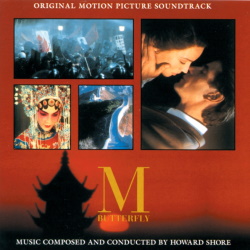 THROWBACK THIRTY
Original Review by Jonathan Broxton
M. Butterfly is an epic romantic drama film directed by David Cronenberg, based on the Tony Award-winning play of the same name by David Henry Hwang, which was itself inspired by the classic opera Madam Butterfly by Giacomo Puccini. The movie tells the story of Rene Gallimard, a French diplomat stationed in China in the 1960s and 1970s, who becomes romantically involved with Song Liling, a Chinese opera singer. As the years go by, Gallimard’s career flourishes, and he becomes entangled in espionage, sharing sensitive information with Song Liling, whom he believes to be a woman. However, Gallimard remains oblivious (or, perhaps, intentionally overlooks) to the fact that Song Liling is actually a male spy working for the Chinese government; eventually, the revelation of Song’s true identity, and his espionage activities, lead to dramatic and tragic consequences for Gallimard. The film is a fascinating exploration of issues related to gender, sexuality, and East-West cultural clashes, as well as the power dynamics within their unconventional relationship. The film stars Jeremy Irons as Gallimard, and John Lone as Song, with support from Barbara Sukowa and Ian Richardson.
When you think about ‘epic period romances,’ you don’t often think about the work of David Cronenberg, especially considering that his work prior to this had composed mostly of shocking horror and thriller films like Scanners, Videodrome, The Dead Zone, The Fly, and Dead Ringers, although many of these films did have an undertone of tragic romance and unconventional sexuality. Similarly, at that point in his career, composer Howard Shore was not well known for his explorations of romance – although, again, parts of The Fly and Dead Ringers did have elements of that – but M. Butterfly allowed both men to explore that side of their personalities to excellent effect.
 M. Butterfly is one of my favorite ‘conventional’ Howard Shore scores of the pre-Lord of the Rings period. It’s a lush, classical, beautiful orchestral score that makes use of a full symphony orchestra, performing a series of gorgeous, but slightly tragic romantic themes. It’s built mostly around statements of, and variations on, a single main theme, which is performed in its entirety in the opening cue, “M. Butterfly”. This piece plays over the opening titles, a stylized animated sequence which features iconic artifacts from Chinese culture – masks, fans, ying-yang symbols, and of course butterflies – floating across the screen, and it sets the scene perfectly. It’s built around a lovely four note motif, and is granted a thunderous opening statement on horns before moving on to be performed by woodwinds with a string backing and accompaniment from a delicate harp. The whole thing is elegant, romantic, slightly decadent, but underpinned with a hint of melancholy which foreshadows both Gallimard’s fate, and that of his relationship with Song.
Although the majority of the score is rooted in western classical music, and often performs in waltz-time, Shore also manages to subtly incorporate a number of traditional Chinese instruments into his orchestra, mostly woodwinds and dulcimers, but also the familiar haunting tone of an erhu. Thematically, Shore doesn’t stray too far from the two main melodies he introduces in his opening cue, but he does find ways to offer variations that keep the score interesting.
Many of the several subsequent variations on the main theme are gentle and reflective, and often feature calm, elegant strings, glassy harps, and tender woodwind performances. Cues such as the ethereal “Concubine,” the gossamer light and airy “Dragonfly,” and “Are You My Butterfly,” feature romantically rich and vibrant restatements of the full main theme, or deconstructed elements of the four note motif passed around between different sections of the ensemble. These cues tend to accompany the film’s more intimate scenes of Gallimard and Song falling in love, and as such they also often have a hint of mystery to them, stemming from Gallimard’s obliviousness – or, perhaps, willful blindness – to Song’s gender, as well as Gallimard’s implied latent homosexuality.
Outside of the main theme, parts of “The Great Wall” have a sense of scale and sweeping majesty that befits cinematographer Peter Suschitzky’s epic panoramas of the Chinese landscape. “Even The Softest Skin” features some unexpected instrumental textures that I really like, usually involving harps and accordions, and reaches for some dramatic heights during its second half. Similarly, “Bonfire of the Vanities” is moody and serious with some intense wandering string passages.
The final four cues – the dark and pensive “The Only Time I Ever Really Existed,” the striking “What I Loved Was the Lie,” the haunted and shellshocked “Everything Has Been Destroyed,” and “My Name Is Rene Gallimard” – really lean in heavily to the tragic nature of the film’s finale, as the shocking revelation of Song’s true identity leads to the end of their relationship, and Gallimard’s eventual imprisonment for treason. Shore’s music in these scenes is heavier than the rest of the score, as one would expect, but it still retains its strong sense of lyricism, offering numerous statements of the main theme. “My Name Is Rene Gallimard” is perhaps less of a rousing finale than one might hope, but it’s downbeat and slightly wistful nature is in keeping with the way Cronenberg and Hwang end the story, and is perfect in context.
In addition to Shore’s score, in keeping with the musical element of the film itself, the soundtrack album also includes two pieces from Puccini’s classic opera Madam Butterfly, “Entrance of Butterfly” and the aria “Un Bel Dì, Vedremo,” as well as three pieces of traditional Chinese music; an operatic piece from one of the most famous masterpieces of the Mei Style of Peking Opera, “Drunken Beauty,” performed by Lone himself; a percussion-heavy excerpt from the Chinese revolutionary opera “Sha Jia Bang” performed by instrumentalist Jamie Guan; and the patriotic song “Cultural Revolution”. The Puccini pieces are lovely, of course, but the Chinese opera pieces may take some people by surprise, especially those who have never heard it before.
My first listen to this soundtrack, many years ago, was my first ever experience of Chinese opera, and I have to admit that I initially didn’t get it. The sounds, the instrumental palette, the way the two combine, and especially the voices of the singers, are vastly different from anything in Western musical culture – in my old review of this score I insensitively and disparagingly described them as sounding like a “cat’s chorus” – but thankfully I have come to appreciate them more as time has gone on. I still don’t particularly enjoy them, per se, but having also seen some videos of the “Drunken Beauty” piece being performed live I can certainly value the artistry, precision, and visual opulence of the work. Every hand movement, every head tilt, every vocal inflection, has meaning, and I acknowledge how incredibly hard it is to achieve that level of perfection.
Overall, M. Butterfly is another example, as if one were needed, of what a great dramatic composer Howard Shore has always been. The lush thematic content, the delicacy of the instrumental textures, the passion and heartbreak and drama in the emotions, and the subtle allusions to Chinese musical culture, are all top notch, and along with things like the aforementioned The Fly and Dead Ringers it remains at the top of the list of pre-Lord of the Rings scores that fans of Shore’s work should explore.
Buy the M. Butterfly soundtrack from the Movie Music UK Store
Track Listing:
- M. Butterfly (2:02)
- Concubine (4:10)
- Entrance of Butterfly (written by Giacomo Puccini, performed by Michele Couture)/Drunken Beauty (traditional, performed by John Lone) (3:02)
- Dragonfly (3:18)
- The Great Wall (1:48)
- Even the Softest Skin (4:39)
- Sha Jia Bang (traditional) (2:10)
- Bonfire of the Vanities/Cultural Revolution (traditional, performed by Jamie Guan) (3:27)
- He Was the Perfect Father (0:53)
- Are You My Butterfly? (2:18)
- The Only Time I Ever Really Existed (4:08)
- What I Loved Was the Lie (1:03)
- Everything Has Been Destroyed (1:44)
- Un Bel Dì, Vedremo (written by Giacomo Puccini, performed by The Budapest Opera Orchestra with Maria Tereza Uribe, conducted by Adam Medveozky) (4:15)
- My Name Is Rene Gallimard (3:35)
Running Time: 42 minutes 32 seconds
Varese Sarabande VSD-5435 (1993)
Music composed and conducted Howard Shore. Performed by the London Philharmonic Orchestra. Orchestrations by Howard Shore. Recorded and mixed by John Kurlander. Edited by Suzana Peric. Album produced by Howard Shore and Suzana Peric.

Shop at the Movie Music UK Store

Member of the

 MOVIE MUSIC UK