THEM! – Bronislau Kaper
 GREATEST SCORES OF THE TWENTIETH CENTURY
Original Review by Craig Lysy
The 1950s opened the flood gates to an ever-expanding and increasingly popular Science Fiction genre with films such as “Destination Moon” (1950), “The Day The Earth Stood Still (1951), “The Thing From Another World” (1951), and “The War of The Worlds” (1953). In 1954 Warner Brothers conceived a pioneering 3D-color project based on a short story by George Worthing Yates that would launch the Science Fiction sub-genre “Big Bugs”, which would feature massive insects as the monster. David Weisbert was assigned production, but executives cut his budget, abandoned a 3D-color format, insisting instead on a widescreen black and white format for the film. Ted Scerdeman and Russell Hughes were hired to write the screenplay and Gordon Douglas was tasked with directing. The cast included James Whitmore as Sargent Ben Peterson, Edmund Gwenn as Dr. Harold Medford, Joan Weldon as Dr. Pat Medford, James Arness as FBI agent Robert Graham, Onslow Stevens as General O’Brien, and Sean McClory as Major Kibbee.
The story opens in the American southwest with the discovery of a little girl wandering in the desert near Alamogordo New Mexico. She in in shock and they later find her trailer, which had been torn apart. Her parents are missing and a mystery unfolds. A general store is soon found to be torn apart with a victim’s body loaded with formic acid. The army sends Myrmecologists Drs. Harold and Pat Medford to join the investigation and they discover a nest of massive eight-foot-long ants, which they manage to kill. They conclude that they have mutated from the radiation released by the first atomic bomb blast at Alamogordo. They find the nest, eradicate the colony with cyanide bombs, and descend into it to discover that two queens have hatched. They track one queen to a freighter, which is sunk and the second to the storm drains of Los Angeles. After the harrowing rescue of two trapped boys, they find the queen and destroy her and the colony with flame throwers to save the day. The film was a commercial success, earning $2.2 million at the box office. Critics praised the film a quality science fiction tale and the film earned one Academy Award nomination for Best Special Effects.
 Max Steiner was director Gordon Douglas’ usual partner, however he was unavailable due to his current project The Caine Mutiny. Bronislau Kaper was still riding high from his Oscar win the year before for Lili, and MGM Director of Music Johnny Green Assigned him to the project. Kaper was quite happy taking on the challenge of scoring a science fiction film, which sadly would prove to be the only one of his career. He approached his scoring duties seriously and understood that the villains were the large, mutated ants who posed an existential threat to humanity. He conceived using two pianos to sow apprehension with primal rumbling and eerie rhythms, and he augmented his orchestra of fifty musicians with an alto flute, 4 clarinets, 2 bassoons, 3 French horns, 4 trumpets, 3 trombones, 1 tuba, a celeste, vibraphone, xylophone, and marimba.
The architecture of his soundscape is comprised of three primary themes motifs. The Ant Theme offers an eerie, repeating, and unsettling six-note phrase used ingeniously by a multiplicity of instrument pairings, including flute and vibraphone to oboe and clarinet and then finally to English and French horns. The theme is intangible and lurking when the ants are not present, and empowered by full orchestra to be forceful and aggressive when they are seen and attacking. A Fugato Agitato offers a recurring motif used to propel the action and to convey urgency. Fugues by the very nature are energetic, and so is Kaper’s, however his offers ominous auras and agitated unease. The Misterioso Motif provokes fear and uncertainty borne by an ensemble of two rumbling low register pianos, vibraphone, harp, marimba, woodwinds and strings agitato. When lurking it unsettles, and masterfully creates anxiety. When it is joined with the screeching, high pitch chirping sound effect of the ants, it potentiates aural terror. Lastly, Kaper provided the requisite military marches given their presence in the investigation and use during combat.
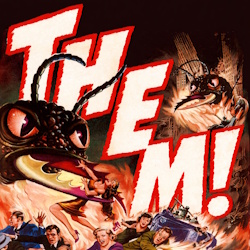
“Main Title” offers a brilliantly conceived film opening where Kaper sow aural terror to unsettle the audience. We open ominously with eerie formless rumbling by two pianos as the Warner Brother Logo displays. A crescendo di orrore swells and crests at 0:10 as “Them!” in blood red letters displays. We flow into the opening credits, set against a bleak desert vista. Repeating surges by strings del terrore propel a crescendo, which crests at 0:51 as Bronislau Kaper’s name displays, dissipating into an intangible misterioso of the Ant Theme borne by flute, piccolo, vibraphone and strings. We flow seamlessly into the film proper with “Lost Girl” where we see a New Mexico State Police plane and police car searching the desert below. The pilot Johnny spots the girl and directs the men below to her location. She is wandering with her doll with a vacant affect and does not respond to calls by the police. Kaper sow unease with an eerie misterioso borne by strings agitato, woodwinds and marimba draped with vibraphone, harp and piano textures. At 1:42 strings of flight carry Sergeant Ben Petersen to her, but she does not respond to his queries. The eerie misterioso resumes as he takes her back to the car and he an Ed proceed to investigate an abandoned trailer spotted by Johnny just up the road.
“Wreck” reveals trooper Ed Blackburn discovering that the camper’s side has been savagely ripped open. He calls Ben to join him, and an eerie and foreboding misterioso of unease pervades. As they search the interior for clues, Kaper supports at 1:05 in the form of the Ant Theme, which subtly shifts its articulation from flute and vibraphone to oboe and clarinet and then finally to English and French horns. At 2:23 we segue into “Intercommunication” atop the Fugato Agitato Motif as Ben orders Ed to call and update headquarters. As the ambulance medic attends to the girl, the calm is shattered by a shrill high pitch chirping sound effect that rises from nowhere. They fail to notice the girl sit up, and then lay back down when the noise ceases. Later after sunset in (*) “Gramps is Dead”, Ed and Ben travel to Gramp Johnston’s store to see if he has any knowledge of current events. They arrive in a wind storm to find a store wall ripped open and the store ransacked. The howling wind is very eerie and effective in sowing unease as Ben discovers a rifle with its barrel twisted. Dire horns sound as they discover the dead, bloodied body of Gramps in the cellar. Suring strings bellicoso support noise, which draws the men outside. As they discover sugar, just as they did at the camper, horns of alarm blare and are joined by the eerie Ant Theme. A misterioso of dread augmented with foreboding horns joins as Ben decides to return to headquarters, and Ed remains for the forensics crew to arrive. Ben departs, and the shrill chirping ant sound returns as Ed prepares his pistol. The chirping intensifies as he walks out, achieves a horrific climax as he fires his gun and screams.
Back at the station in (*) “Formic Acid”, Captain Fred Edwards coordinates his team in the aftermath of Ed’s death. FBI agent Robert Graham joins and admits that he is as confused as they are. He asks the impression mold be sent back to FBI headquarters for analysis. Dr. Putnam joins and relates an unusual autopsy finding for Gramps – enough formic acid in his body to kill twenty men. Kaper supports the disclosure with menacing woodwinds emoting the Ant Theme. Later a grim musical narrative supports a telegram informing them of the arrival of Doctors Medford of the Department of Agriculture, and that they extend all cooperation. In an unscored scene Dr. Harold Medford, and his daughter Dr. Pat Medford are greeted by Ben and Robert at the airport. Back at headquarters the doctors review the evidence and discover that the murder sites are all proximate to White Sands, where the first atomic bomb was detonated nine years earlier. Harold asks to see each site and to visit the girl. In “Little Girl Wakens” Harold jolts the girl out of her vegetative state by waving a glass of formic acid by her nose. She screams “Them!” and runs in terror supported by a grotesque crescendo orrore. A foreboding diminuendo supports their departure to the desert. At 0:24 violent piano hammering, shrill trilling woodwinds, and dire horns support the team’s drive in a sand storm and arrival at the trailer site.
In an unscored scene, Pat wanders off in search of more sand prints. The shrill ant chirping resounds as she is ambushed by a massive ant. She screams, runs and is rescued after Ben mows down the beast with a machine gun. They are all stunned by the discovery, which is worsened when Harold reveals that they need to find the nest and destroy it. The next day the team begins a search of the area with two helicopters. In “Ant Hole”, the team of Pat and Robert discover the conical ant hole entry to the nest. Kaper sow fear with a musical narrative using the Misterioso Motif borne by rumbling piano, eerie string, foreboding horns and bleak, forlorn woodwinds. The horrific ant chirping sound effect joins as an ant ascends up through the opening and discards the thoracic skeletal remains of Ed, which rolls down the mound to join other skeletal remains. At 1:18 we segue eerily into “Burning The Ant Hole”, which reveals Harold’s plan to drop cyanide gas into the nest, and then to descend to ensure eradication was successful. At 1:22 a tense and energetic Fugato Agitato Motif supports the military unloading phosphorus bombs, which will create fiery heat to force the ants deep into the nest. At 1:47 a gentle interlude with muted horns militare supports Ben and the general loading the bazooka. At 2:04 crescendo waves of blaring horns brutale propel the firing of multiple bazooka rounds. A diminuendo of uncertainty follows as we see the nest entrance consumed by flames. At 3:00 impressionist repeating phrases by clarinet, harp and xylophone support the approach of two men, and their tossing of many cyanide grenades into the nest, which explode and release their toxic gas.
“The Descent” reveals Ben, Pat, and Robert descending into the nest. Kaper creates uncertainty and anxiety with an impressionist musical narrative borne by an ensemble of eerie slithering violins, harp, piano, vibraphone, celeste and gong accents. The music darkens, full of foreboding as they walk through the nest’s tunnels encountering dozens of dead ants. At 1:48 we segue into “Ant Chamber”, in which the foreboding musical narrative is sustained, with the addition of grim muted horns. They encounter two ants that break through a wall and are killed by their flamethrower – survivors protected in a sealed chamber by a soil collapse. At 2:08 a diminuendo of unease follows as Robert makes the decision to continue. At 2:24 vibraphone joins with an eerie flute and bassoon that express the Ant Theme as they enter the queen’s egg filled chamber. The queen is dead, but they can see movement within the eggs. At 2:27 a horn empowered crescendo of alarm blares as Pat makes a grim discovery – two queen egg casings are empty, indicating that they hatched earlier and left the nest to establish new nests. Pat orders that everything be burned, and at 3:38 we conclude with a tempest driven by horns brutale and a rumbling storm by pianos as they depart. At 3:51 the music surges horrifically as Ben and Robert unleash Hell with withering blasts by the flamethrowers. We conclude eerily at 4:01 with a diminuendo of uncertainty as Harold reviews the photographs and concludes that the larval stage of these mutated ants has been lost and that adults emerge from the eggs. He says that two queens with their male consorts have escaped and if not found and destroyed quickly could lead to a catastrophic proliferation that will overwhelm humanity. Kaper punctuates this prediction with dire horns (not on the album) as a camera hot of the U.S. capitol building is seen.
Dr. Harold Medford offers a video documentary on the vicious and aggressive nature of ants to the assembly of military and government officials. Foreboding music enters the scene in “Conference Table” after Harold advises again that if the two queens are not found and destroyed quickly, they will proliferate and overwhelm humanity within a year. A dramatic intensification erupts at 0:06 by an ensemble of harp, marimba, piano, triangle, vibraphone, xylophone and horns as the command center begins monitoring reports of all strange phenomena. Tremolo strings and flute unleash at 0:43 a mechanistic ostinato to support reports coming in. At 1:08 strings bear the Ant Theme as a report comes in from a pilot who is hospitalized after seeing flying ants. At 1:15 a foreboding diminuendo supports Robert and Pat departing for Brownsville Texas to talk to the pilot. As the pilot relates his sighting, Kaper unnerves us with an ominous musical narrative replete with piano arpeggios and bleak woodwinds, which plays under the dialogue. Fragments of the Ant Theme are subtly embedded in the music. At 1:28 we segue into “The Wall Map”, which continues the ominous musical narrative as Robert directs the attending physician of a government order to hold the pilot incommunicado. At 2:28 the music intensifies, propelled with dramatic urgency by strings bellicoso and horns feroce as we see a ship’s crew desperately battling ants.
In an unscored scene, an Admiral reports that the U.S.S. Viking ship with the ants was destroyed by naval bombardment. Pat then informs the crisis management team that their best lead takes them to Los Angeles after the discovery of a dead male ant and a massive sugar heist from a train car. “Interior of Morgue” reveals Robert and Ben speaking to a doctor at the morgue about a man who died from horrific rending injuries. As they interview the grieving Mrs. Lodge who has lost her husband and two sons, Kaper provides a lamentation borne by strings and woodwinds tenero, which descend into heartbreak with a cello affanato as she breaks down and sobs. (*) “A Lead” reveals the interview of a man hospitalized for alcoholism, who says he saw giant ants in the L.A. River water channel below his window. Robert sees the large drainage openings, which would be a perfect haven to support a nest as bass grave emote the Ant Theme.
“Military Takes Over” reveals a police car driven by officer Ryan transporting Ben, Robert, and Major Kibbee through the concrete L.A. riverbed to a large tunnel opening empowered by an aggressive marcia militare. An intervening cue not on the album comes next. In (*) “Discovery” a dire stinger sounds as Kibbe alerts the men to an ant print in the dirt by the entrance to the tunnel. As Ben and Robert walk to the tunnel entrance, the rumbling pianos of the Misterioso Motif return to create anxiety. The music darkens on ominous strings as Ryan alerts them that the toy plane they found did belong to the boys and that their dad often took them here to fly it. The men are concerned that to evade the ants, the boys ran into the tunnels as their dad fought off the ants. The album cue resumes at 0:35 we segue into “Through The Tunnels”, a tour de force where Kaper propels the film’s final action scenes masterfully. An energetic rendering of the Fugato Agitato Motif supports as the army and city official brief news reporters chaffing at the bit. In the unscored news conference, Martial Law is declared and the populace is informed of an invasion of massive mutated ants of the Los Angeles underground drainage system. A dire musical passage unfolds as the Fugato Agitato Motif resumes with increased aggression and urgency, joined at 1:30 by a new horrific, aggressive, and martial rendering of the Ant Theme as the general orders his troops into the storm drains. At 2:11a crescendo orrore ratches up the tension and the convoy splits into multiple drain tunnels. At 2:31 a subtle reference to the lament motif from the “Interior of Morgue” cue joins a tension diminuendo to support a nervous and pacing Mrs. Lodge.
Ben hears banging, and crawls into a smaller service tunnel where he discovers the two boys trapped by two ants. He signals the alarm and General O’Brien announces a ‘Condition Red’, and orders an assault on tunnel 267. (*) “Condition Red!” reveals the military assault empowered by an aggressive rendering of the Fugato Agitato Motif. General O’Brien and Dr. Harold Medford board a jeep and also head towards tunnel 267. A crescendo of violence erupts as Ben finally enters the chamber and incinerates the two ants with his flamethrower. A diminuendo supports his rescue of the kids, but the Ant Theme rears its ugly head as another ant sneaks in as he is lifting the boys to safety. They escape but he is crushed by the ant’s mandibles, as Robert arrives and kills the ant with gunfire. “Ant Hole #2” offers a horrific dissonant reprise of the original “Ant Hole” cue empowered by a terrifying reprise of the Ant Theme. A tunnel collapse traps Robert alone and he fights for his life, rescued at the last moment by soldiers. At 0:48 we segue into “End of the Monsters” atop a last grim reprise of the Ant Theme as the queens and nest are incinerated by withering flamethrower blasts. Robert asks Pat about the possibility of the other atomic bomb blasts causing similar problems, and she answers “I don’t know.” An eerie and unsettling misterioso joins as Dr. Harold Medford relates of the uncertainty and unpredictability of what Man caused with the start of the Atomic Age. Kaper concludes the film with a reprise of his melody from the 1942 film Keeper of the Flame rendered as a crescendo grandioso.
“Ant Fugue” offers a wonderful concert piece, album highlight and one of the finest compositions in Kaper’s canon. It was originally attached to the documentary film scene where Dr. Harold Medford shows a short tutorial film about ants to the military and government officials. Unfortunately, it got the axed after the scene was shortened by a minute. The highly rhythmic fugue was written for two French horns, one trumpet, woodwinds and strings. It is note rich, chromatic, and impressive with its use of contrapuntal staccato woodwinds and pizzicato strings.
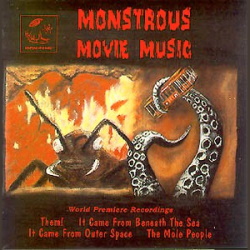 I would like to commend David Schecter and Monstrous Movie MusicTM for their commitment to acknowledging and resurrecting obscure science fiction and horror scores. We forget that more often than not, B Films of this genre in the 1950s and 1960s were provided imaginative, innovative, and well-conceived scores. I am therefore grateful for this “Monstrous Movie Music” album, which features Bronislau Kaper’s outstanding score, plus music from other horror movies of the era, including The Mole People by Herman Stein and Heinz Roemheld, It Came From Outer Space by Herman Stein, Irving Gertz, and Henry Mancini, and It Came From Beneath The Sea by Mischa Bakaleinikoff. The audio quality of the rerecording is excellent as is the performance of the Radio Symphony Orchestra of Krakow under Masatoshi Matsumoto. Kaper relished this assignment and in a masterstroke conceived one of his most riveting, terrifying, and original scores in his canon. He understood immediately that his music needed to offer mystery, suspense and aural terror. I believe he succeeded brilliantly on all counts.
The Misterioso Motif borne by an ensemble of two rumbling low register pianos, vibraphone, harp, marimba, woodwinds and strings agitato just unsettles you, provoking fear and anxiety. While the Fugue Agitato provided the vital energy to sow tension and maintain the film’s momentum and narrative pacing. The Ant Theme, although simple in construct, was masterfully rendered with a number of instrument pairings, and perfectly created their lurking menace. When militarized during their attacks, I believe it was more forceful and frightening then their actual on-screen appearances. When joined with the high-pitch chirping motif, a monstrous, unholy synergy of aural terror was achieved. Folks, this obscure modernist score from Kaper’s canon offers the road less traveled, which reveals his ingenuity, insight, and brilliance as a composer. I highly recommend this album as essential for your collection.
For those of you unfamiliar with the score, I have embedded a YouTube link to the outstanding Main Title: https://www.youtube.com/watch?v=hdzzyNAfVJ4
Buy the Them soundtrack from the Movie Music UK Store
Track Listing:
- Main Title (1:00)
- Lost Girl (2:00)
- Wreck/Intercommunication (3:15)
- Little Girl Wakens (0:42)
- Ant Hole/Burning The Ant Hole (3:29)
- The Descent/Ant Chamber (4:13)
- Conference Table/The Wall Map (3:11)
- Interior of Morgue (1:42)
- Military Takes Over/Through The Tunnels (3:06)
- Ant Hole #2/End of the Monsters (1:25)
- Ant Fugue (3:34)
Running Time: 27 minutes 13 seconds
Monstrous Movie Music MMM-1950 (1954/1996)
Music composed by Bronislau Kaper. Conducted by Masatoshi Mitsumoto. Performed by the Radio Symphony Orchestra of Krakow. Original orchestrations by Robert Franklyn. Recorded and mixed by Malgorzata Polanska. Score produced by Bronislau Kaper. Album produced by David Schechter.

Shop at the Movie Music UK Store

Member of the

 MOVIE MUSIC UK