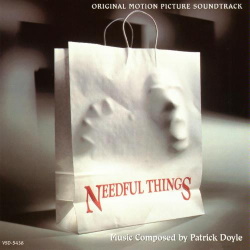
NEEDFUL THINGS – Patrick Doyle
 THROWBACK THIRTY
Original Review by Jonathan Broxton
Needful Things is a cautionary drama film with a horror-supernatural twist, directed by Fraser Heston (son of legendary actor Charlton), and based on a 1991 novel by Stephen King. The story revolves around a mysterious shop owner named Leland Gaunt (Max von Sydow), who opens a store called ‘Needful Things’ in the small town of Castle Rock, Maine. Gaunt sells various items to the townspeople, each one seemingly fulfilling their deepest desires and fantasies. However, these apparently innocent transactions come with a sinister price – they require the recipients to perform increasingly malevolent and destructive acts against their fellow townspeople. As the town becomes divided and chaos ensues, local sheriff Alan Pangborn (Ed Harris) starts to investigate the bizarre occurrences and tries to uncover the truth behind Gaunt and his shop. The film co-stars Bonnie Bedelia, J. T. Walsh, and Amanda Plummer, and was a reasonable success at the box office in the late summer of 1993, although it was less popular with critics – Roger Ebert famously compared watching it to enduring ‘Satanic water torture’.
The score for Needful Things was by Patrick Doyle, whose star in Hollywood was firmly on the rise off the back of such excellent works as Henry V, Dead Again, Indochine, and Much Ado About Nothing. It also marked the first time that Doyle would write music in the Gothic horror style that he would later explore in greater depth in such outstanding works as Mary Shelley’s Frankenstein, as well as the darker parts of Harry Potter and the Goblet of Fire. This side of Doyle’s musical personality has always been one of my favorites, and it’s so much fun to see how he took the large-scale orchestral forces for which he was becoming well known, and adapted them to suit this bigger, bolder, and at times quite violently horrific narrative.
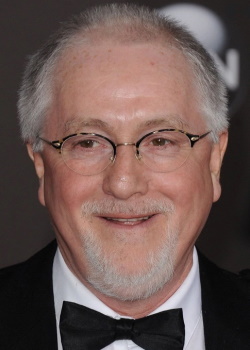 In its basic form, Needful Things is a three-way combination of slow orchestral lines – elegant, moody, mysterious – alongside devilish vocal textures and chanted chorales in Latin, and superb, rampaging action writing for strings and brass. This approach is best experienced in the opening cue “The Arrival,” which underscores Gaunt’s journey to Castle Rock in his sinister-looking black car, and which expertly moves between the three different styles, establishing the tone for the entire score. The use of church organs adds to the religioso overtones, and the whole thing ends with a subtly chilling lullaby for piano and harp, which is pretty but ominous in equal measure.
The rest of the score is, essentially, a series of variations on these three styles. Some commentators have expressed disappointment in the fact that the score at times feels a little repetitive, but personally I have never found that to be the case, and I especially appreciate the moments where Doyle throws off any pretentions of self-restraint and lets his orchestra reach its full power. Several cues stand out; “My Good Friend Brian” again features the rampaging strings from the opening cue, but this time they are offset by some creepily enticing woodwind passages and magical chimes that seek to mask Gaunt’s evil intent and lure little Brian into his store to buy a rare baseball card – the opening act that initiates the curse that eventually takes over the town.
“Needful Things” is a quirky, prancy, almost playful piece for woodwinds, which eventually becomes a creepily beautiful theme for piano and strings that acts as a sort of recurring ‘seduction motif’ for Gaunt and his store, and the corrupt little trinkets he sells to the unsuspecting townsfolk. “More Deeds” features some lovely rich interplay between different parts of the woodwind section, a florid string idea backed by a subtly unsettling choir, and some rhythmic passages that are quintessentially Doyle, especially the way in which the percussion is carried by a prominent xylophone; the echoes of both Henry V and Dead Again are very strong here.
“Art & The Minister,” which is used to underscore the increasing antagonism between two elderly men in town, contains a fulsome, graceful orchestral setting of the classic medieval plainsong – ‘dies iræ, dies illa, solvet sæclum in favilla’ – and is a wonderfully evocative reflection of the fact that one of the men is the local Catholic priest. The action sequences in “Gaunt’s Web” and “Racing Towards Apple Throwing Time” are superbly powerful, and it all builds up to a huge explosion of chaotic dissonance in “Nettie Finds Her Dog,” underscoring one of the film’s most brutal and shocking moments of violence. The subsequent “Go Upstairs” is perhaps the score’s most emotional cue, and is full of high, searching strings that speak of anguish and despair.
The longest cue in the score is the 12-minute “The Turning Point,” which is used in the first part of the film’s finale as Ed Harris’s increasingly desperate sheriff Pangborn attempts to convince the townsfolk to come to their senses, stop attacking each other out of fear and paranoia, and realize that Gaunt is their true enemy. Doyle scores the scene with luxuriant, brooding textures for cellos and lithe violins, places grave electronic enhancements under the strings, interrupts the menacing orchestral passages with almost militaristic percussion, and slowly builds up to a climax through a series of grand guignol crescendos. Eventually the townspeople come together and turn against Gaunt; he retaliates in “The Devil’s Here,” a massive eruption of dark action that clearly foreshadows the “Creation” cue from Mary Shelley’s Frankenstein. The use of the Latin choir here is reminiscent of Jerry Goldsmith’s The Omen, aggressive and tremendously effective.
The whole thing finishes with a literal bang in “Just Blow Them Away,” in which J. T. Walsh’s character Keeton – who has been the target of much of Gaunt’s manipulation, and had been threatening to kill himself and others with a shoddily-assembled suicide bomb vest – finally attacks Gaunt directly, and blows up the infernal shop, with him and Gaunt inside. Doyle’s music starts out with an air of melancholic elegance, but it builds to a large scale finale featuring a massive angelic choir, heroic brass triplets, and surging strings. The “End Titles” then revisits several of the score’s most important ideas, including the ‘Art & the Minister’ version of the Dies Irae, and the rampaging choral textures from ‘The Arrival,’ in what turns out to be a satisfying conclusion.
The album also includes two classical excerpts; Schubert’s famous choral piece “Ave Maria,” and Grieg’s wonderfully evocative “In the Hall of the Mountain King” from Peer Gynt, the orchestrations of which fit in well with Doyle’s own.
It’s interesting how often the score for Needful Things is overlooked in comparison to other works in Patrick Doyle’s career – most likely the relative obscurity of the film today has something to do with it. However, to ignore it entirely would be a disservice to what I consider to be one of his hidden gems. It contains many of the familiar hallmarks from Doyle’s earliest works, especially Henry V and Dead Again, and it provides a nice dry run for what would eventually be his gothic horror masterpiece Mary Shelley’s Frankenstein a year later. Either way, fans of Doyle’s uncompromising style will find a great deal of it to be superbly entertaining.
Buy the Needful Things soundtrack from the Movie Music UK Store
Track Listing:
- The Arrival (2:56)
- My Good Friend Brian (5:28)
- Needful Things (2:38)
- Brian’s Deed (1:37)
- More Deeds (2:24)
- Art & The Minister (1:48)
- Gaunt’s Web (2:52)
- Racing Towards Apple Throwing Time (4:43)
- Nettie Finds Her Dog (1:50)
- Ave Maria (written by Franz Schubert) (3:51)
- In the Hall of the Mountain King from Peer Gynt (written by Edvard Grieg) (2:15)
- Go Upstairs (2:58)
- The Turning Point (12:09)
- They Broke The Law (1:36)
- The Devil’s Here (4:31)
- Just Blow Them Away (2:46)
- End Titles (3:55)
Running Time: 60 minutes 17 seconds
Varese Sarabande VSD-5438 (1993)
Music composed by Patrick Doyle. Conducted by David Snell. Orchestrations by Lawrence Ashmore, John Bell and Gavin Greenaway. Recorded and mixed by Paul Hulme. Edited by Roy Prendergast. Album produced by Patrick Doyle.
Leave a comment

Shop at the Movie Music UK Store

Member of the

 MOVIE MUSIC UK
How does Doyle’s score for NEEDFUL THINGS contribute to the film’s atmosphere and tone?