BENEATH THE 12-MILE REEF – Bernard Herrmann
 GREATEST SCORES OF THE TWENTIETH CENTURY
Original Review by Craig Lysy
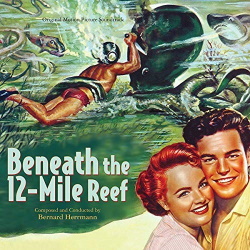
20the Century Fox revolutionized the film industry in 1953 with Stereophonic Cinemascope, which was used for “The Robe” and “How to Marry a Millionaire”. To further capitalize on the new technology Darryl F. Zanuck, who was in charge of film production envisioned taking it underwater. A.I. Bezzerides was hired to write the screenplay, which would incorporate an underwater narrative and feature a love story inspired by Shakespeare’s play “Romeo and Juliet” (1597). Robert Bassler was assigned production, provided a $1.56 million budget, and Robert D. Webb was tasked with directing. The film cast would include; Robert Wagner as Tony Petrakis, Terry Moore as Gwyneth Rhys, Gilbert Roland as Mike Petrakis, Angela Clarke as Mama Petrakis, and Peter Graves as Arnold Dix.
The story involves two competing fishing families: the Greek Petrakis, and the English Rhys. They gain their livelihood from the sponge trade, which becomes a war after Mike and Tony Petrakis are robbed of their catch. Mike decides to take sponge hunting to the far more lucrative but also the more dangerous 12-Mile Reef. The Petrakis suffer a grievous loss when the patriarch dies in a tragic accident. The family is devastated and Tony now assumes charge of the family and business but creates controversy when he falls in love with the daughter of their arch enemies Gwyneth Rhys. The film was a commercial success, earning a profit of $2.04 million. Critics praised the film for its storytelling, ensemble cast, and cinematic beauty. It earned one Academy Award nomination for Best Cinematography.
 Director of Music Alfred Newman normally assigned himself to Zanuck passion projects, however in this case he offered the assignment to Bernard Herrmann. The oceans depths offered an allure, which he could not refuse an took the assignment with passion. This would be his first score to be recorded in stereo and he meticulously documented instrument and microphone placement on his manuscript. For this film he was inspired by the underwater cinematography, and as he did in “The Ghost and Mrs. Muir”, sought to capture the very essence of the sea. He augmented his orchestra with nine harps to evoke the waves, wonder and mysteries of the ocean depths. Joining this would be synergistic aural auras draped by organ pedal, low register woodwinds, drums and electric bass.
The architecture of his soundscape consisted of two primary themes. The Main Theme offers a proud anthem empowered by horn bravura declarations, a rousing call to adventure, which fully captures the strength and confidence of the sailors who risk their lives in the sponge industry. Herrmann speaks to theme’s nautical connection by imbuing aquatic textures with a choral of harp glissandi. The Love Theme speaks to the love that develops between Tony and Gwyneth, a modern-day Romeo and Juliet as they come from different cultures, his Greek and hers English, and two families in competition for harvesting sponges. The theme offers a romance for strings and woodwinds, being borne by oboe d’Amore, then flute, and finally exquisitely by strings romantico. Two recurring motifs are provided, the Travel Motif Swirling exudes energy, excitement, and confidence and is borne by refulgent violins, muted trumpets, woodwinds animato and glockenspiel adornment. The Undersea Motif reveals Herrmann’s genius and singular talent for creating unusual and unique instrument sonorities. He supports the undersea realm with ethereal splendor, using multiple flowing glissandi by a chorale of nine harps, joined by tonal woodwinds, and strings shifting like undersea currents. The remainder of the score consists of Herrmann’s penchant for succinct repeating cell structure motifs, and a number of very well-crafted set pieces.
In a memo to his Director of Music Alfred Newman, 20th Century Fox Studio Executive Daryl F. Zanuck stated: “I thought “Beneath the 12-Mile Reef” was one of the most original scores I have ever heard. The manner in which Bernard handled the underwater sequence was simply thrilling. The entire picture has been enormously enhanced by this wonderful score. It gives the picture a bigness it did not originally have – yet the music never interferes but adds to the dramatic values”.
“Prelude” offers a score highlight, where Herrmann once again masterfully establishes the tone of the film. It opens dramatically with horns bravura declarations of the Main Theme cloaked with aggressive harp glissandi as 20th Century Fox Cinemascope displays against the Gulf of Mexico with cloud swept skies. At 0:19 horns grandioso declarations usher in the trumpet declared Main Theme draped with harp glissandi that support the flow of the opening credits, which display as red script against ocean vistas. At 0:52 the melodic line passes to sumptuous strings romantico embellished with harp adornment as fiery sunset vistas light up the screen. We close with a diminuendo of serenity. We enter the film proper with “The Undersea”, an astonishing score highlight, and a harp lover’s dream come true. As narration unfolds regarding the mysteries of the sea, Herrmann offers aquatic aural beauty with a misterioso of wonder. Shifting low register tones graced with harp glissandi as we see the underwater beauty of the eastern Gulf of Mexico off the coast of Florida. As we see sponge gatherers on the gulf floor, Herrmann’s tranquil music shifts and flows like underwater currents with the chorale of harps creating a sense of wonderment. Woven into the musical narrative are subtle foreboding currents on danger as we see predatory sharks, barracuda and morae eels swimming by the divers. As the divers ascend, we are bathed with the serene beauty of harp glissandi.
“The Boat” opens with tremolo violins, and a grim bassoon with harp adornment as the diver reaches the surface by the boat. At 0:29 as Mike, the patriarch of the Petraki family comes aboard and as his helmet is removed lush strings romantico full of thankfulness support his making of the sign of the cross. The music graces us with lyrical beauty as Mike accepts a cigar while crewmates assist in taking of his diving suit. “The Homecoming” reveals Mike, his son Tony and the crew returning to port amidst sunset auras. Herrmann propels their journey with the resplendent string borne and horn declared confidence of the Main Theme. At 0:14 we shift to a nautical motif empowered jaunty woodwinds and bass as their boat the Aegli enters the harbor. The music brims with happiness as mama and Penny wave joyously at the dock. We conclude with exuberant happiness as the Petrakis family is reunited, with Tony hugging his mother, and Mike hugging his daughter Penny.
“The Reef” Mike asks a fellow captain Sinan how he was able to get such a large cache of sponges? He answers that they went to the 12-mile reef, which reawakens painful memories for the Petrakis family as it was there that the eldest son Pete died. Herrmann sow a grim and foreboding musical narrative with growling bass and ominous horns to support the revelation. Sinan relates that he descended over 20 fathoms, which elicits Mike to challenge Sinan to describe the reef. At 0:33 we shift to an eerie misterioso with strings grave and dire horns, and he relates of a terrifying and treacherous place he will never visit again. (*) “The Contest” reveals a Greek Orthodox priest holding a prayer service on the dock supported by the crowd singing a traditional hymn. Tony and the sons of the other captains stand on opposing row boats in the harbor poised to dive. The priest throws a metal cross into the waters and the men all dive in hoping for the honor of retrieving it. After three attempts by the men, Tony wins the day, making Mike very proud. He returns to the priest who blesses him and gifts him the cross. We close supported by a reprise of the hymn as a wreath of victory is placed on the main mast of the Aegli. Later Mike and other men gather in town celebrate with singing and dancing to a festive danza greca.
Because most of the sponge groves in shallow waters have been depleted, Mike fashions a plan to harvest in the glades, which is considered very dangerous as it is considered to be the exclusive domain of the Conchmen (English fisherman) operating out of Key West. The next day in “The Glades” we see the Aegli entering the forbidden area carried by the Main Theme borne cautiously by woodwinds and tremolo violins. At 0:30 the music darkens with bass, joined by grave portentous horns as Mike forbids Tony to join him on the dive. He says that it is too dangerous, and that they need to be able to escape fast if detected. We close on an ominous crescendo as uncle Socrates frets over a spooked crane. In “The Quiet Sea” languorous strings gentile emotes the Main Theme as Mike dons his diving suit. We end conclude with trepidation as Mike jumps into the water. In “The Airline” Herrmann sow unease with bass grave, low register horns, plucked harp and tremolo violins as we see Mike harvesting sponge as the crew supports on deck. At 0:24 tension escalates with interplay by eerie tremolo violin figures and foreboding woodwinds as Socrates sights a small boat in the distance. Tony is not worried, but Socrates insists that they signal Mike to ascend. The small boat comes nearer as one man uses a lens to see Mike below at 1:09, supported by bass and plucked harp. He uses a pike to secure his airline and threatens to cut it unless they surrender all their sponges. The motif of bass and plucked harp sow tension as Tony pulls out his rifle, but is dissuaded by the axe hovering over his father’s airline.
The Conch sailor Arnold Dix fires a rifle shot, which brings in two rapidly approaching Conch vessels in “The Conch Boat”. Herrmann offers a short tour de force, propelling the Conch vessels aggressively with horns brutale and strident strings furioso. We close on an ominous diminuendo as the Aegli is surrounded. The conchmen seize all of their sponges, and the Conch captain Thomas Rhys says if they return and violate their waters again, that he will burn the Aegli to the waterline. In “The Harbor” a four-note woodwind and low register horn ostinato support the departure of the pirates and return of the Aegli to port. Captain Rhys returns to the harbor and is greeted by his daughter Gwyneth. Later crewman Arnold Dix proposes to Gwyneth but she deflects, saying she thinks she is too young. As the conchmen unload their stolen sponges, we segue into “The Search”, which reveals Mike bringing the Aegli into the harbor carried by an aggrieved and angry rendering of the Main Theme, buttressed with menacing horns. Mike tells Tony that they lack proof to present to the coast guard, so they will have to settle the matter themselves. At 0:39 a tremolo strings lead misterioso with ominous woodwinds and grim horns unfolds as they search the conchmen ship and docks for their stolen sponges.
In (*) “Tony Meets Gwyneth”, they carry their search into town and find Rhys with his sons, daughter and crew celebrating at a saloon. Mike is provocative but agrees to drinks Rhys purchases for them. They all sit together with each captain introducing their sons, and crewmates. We see right away that Tony and Gwyneth are smitten, and he asks her to dance, supported by a dance rendering of the song “It Had To Be You” (1924) by Gus Kahn. Arnold is jealous, and spoiling for a fight. He roughly pulls Gwyneth away, but the arrival of police deescalates the tension as Tony and Gwyneth resume their dancing while Arnold stews. “Flirtation” offers a beautiful romantic score highlight. It reveals Tony and Gwyneth running off to a park where they flirt, but Greek-Conchmen politics intrudes to spoil the moment. However, when he says he does not want to fight, and only hold hands, she warms to him. Herrmann supports our young lovers with a delightful exposition of his Love Theme, which is playful, youthful and abounding with joie de vivre. The flirtation ebbs and flows with each of them enticing the other. Finally, at 1:37 he wins her heart and she comes to him and initiates a kiss supported tenderly by the Love Theme borne by oboe d’amore, shifting to the flute, and finally exquisitely borne by strings romantico. Yet the music darkens as Arnold arrives, tears them apart and punches Tony. Mike arrives, pushes Tony aside and takes on Arnold for personal retribution. Mike pummels Arnold and the Greeks depart after Tony bestows a parting kiss.
“The Departure” reveals the Greeks returning to the Aegli and Mike declaring to Tony and Socrates that they are not going home, but to the 12-mile reef. Herrmann sow a foreboding misterioso draped with harp glissandi. The music is portentous and grim as Mike commits to the fateful voyage to the site of his son Pete’s death. We see the Aegli departing as Gwyneth watches from the dock. “The Marker” offers an amazing score highlight. Swirling refulgent violins, muted trumpets, woodwinds animato and glockenspiel adornment offer the exciting Travel Motif of the Aegli’s fateful voyage. The melody shifts to low register horns and woodwinds with the violins receding as glockenspiels twinkle. These two iterations shift back and forth as we see them reach the first marker. At 0:59 the music recedes as Mike worries about his promise to Tony, fearful of losing another son on a treacherous dive. He describes to him the wondrous beauty of the reef and the caves that house more sponges than he can imagine. Herrmann supports the storytelling with an exquisite passage for woodwinds, alluring strings and foreboding horns, informing us that in this realm, danger and beauty coexist. At 2:17 the music darkens with trepidation as Mike informs Tony of how fear grips you on your first deep dive. He says the reef’s beauty is inviting, but one day when you are not looking, it grabs you. At 2:38 tremolo violin and foreboding shifting chords support Mike giving the bad news to Tony; that he is breaking his word, and will not allow Tony to dive. The music though shifts to flute tenero joined by dispirited quotes of the Main Theme as Mike comforts his boy, informing him of his promise to his mother to protect him.
“The Undersea Forest” offers one of the most imaginative and unique compositions in Herrmann’s canon. Tony and Sinan prepare Mike for his fateful dive. Music enters as he jumps in and begins his descent. A foreboding descent motif carries him falling deeper and deeper into the watery depths. He finally reaches the bottom and the chorale of nine harps perfectly capture the beauty, and the wonderment of this undersea realm. They haul up the first cache of sponges and in a time lapse, we next see the boat draped with hundreds of sponges. At 2:04 the music begins to darken as the harps play against low register horns and woodwinds as Mike struggles on the reef and falls into a deep gorge, which severs his life line, raising alarm on deck. At 3:11 his air intake valve sticks, which causes his suit to over pressurize. He passes out and the men in desperation turn off the pump as we see him floating quickly ever upwards toward the surface carried by a harp glissandi ascent. At 4:11 the harp glissandi intensify as he reaches the surface and the men jump in to rescue him. In an unscored scene, Mike suffers excruciating pain from the bends. The men pack him in ice and race home in an effort to save his life. In port they get more ice and are told to go to Key West where a medical team will be waiting. Thomas’ son informs him of the accident, and Gwyneth, fearful that it may be Tony, runs to the dock.
“Elegy” offers one of the score’s finest compositions, where Herrmann achieves sublimity with heart-wrenching pathos. It reveals a physician treating Mike, but later informing everyone, that he is dead. The announcement is marked by a chord of death, which usher in a threnody by woodwinds and low register strings lamentosi. At 1:00 heart-wrenching strings affanato voice a passage of sublimity as Herrmann perfectly joins lyrical beauty and pathos to support Tony’s devastation. He tries to absorb his beloved father’s death as captain Rhys offers his condolences. Tony is inconsolable and leaves the docks to seek refuge in the park as Gwyneth follows. We close on a diminuendo despair and sadness when Tony finds his father’s hat that he left when he fought Arnold, and then sits dejectedly on a bench where Gwyneth comforts him. In “The Fire” Arnold brings the conch ship to dock and discovers the sponge laden Aegli. Believing that they again visited the glade, his crew overcome the Greek crew, steel the sponges and then torch the Aegli. Herrmann offers a brutal ostinato by swirling strings, trilling woodwinds, violent drum strikes and dire horn bursts. In an unscored scene Tony and Gwyneth go to see her father. Tony advises Thomas of the theft and burning of the Aegli and Thomas discovers that his two sons and Arnold, who are dining with him, confess that they are responsible. Arnold storms out, and Thomas promises Tony that he will be compensated in the morning.
“Sorrow” reveals Tony’s departure from the Rhys house carried by a solo oboe doloroso and aching strings. In an unscored scene Arnold ambushes Tony, and just pummels him, demanding that he clear out in the morning. In “The Dock” Arnold returns to the Rhys home and is ordered to be the one who will return to Tony the money he is due. He says he will not, as he has ‘convinced’ Tony to leave. Gwyneth overhears and runs to find Tony, pursued by Arnold. A dire variant of the Main Theme propels her run. A grim passage unfolds as we see Tony struggle to get up and then walk to the dock as Gwyneth pursues, and Arnold calls out for her. Tony collapses on the deck of the Rhys’ ship and at 0:57 the music softens and becomes tender as Gwyneth finds him. Tony tells her that Arnold burnt his father’s boat, as sympathetic strings voice her concern at his injuries and a Main Theme struggles to assert itself.
In “Escape” Arnold arrives, but Gwyneth casts off in the nick of time and throttles the boat out into the harbor. Arnold commandeers another Conch boat and pursues, with the chase propelled by ever shifting dramatic and aggressive variations of the Main Theme. At 1:08 a grandiose statement of the Main Theme supports her navigating the boat into open seas. The theme transfers to lyrical strings as she pilots the boat into the glades in the morning. At 1:49 the theme shifts to woodwinds gentile as Herrmann creates idyllic serenity as we see the boat anchored in a lagoon, in which Gwyneth swims while Tony sleeps on deck. Gradually dark foreboding strings emerge and pulse as we see Arnold’s boat enter the glade in search of Tony and Gwyneth. “The Lagoon” offers an idyllic score highlight. It reveals our two lovers diving into the lagoon as the romantic bond between them strengthens. Herrmann support the idyllicness and beauty of the moment with a string borne valzer romantico with wondrous harp glissandi adornment. Interludes that feature a solo oboe delicato support the harvesting of conch shells, which they deposit on the boat. At 1:34 intrusion of a lurking danger begins to intrude as a stingray enters. An ominous danger motif gradually comes to dominate the musical narrative as it closes and begins circling, causing them to surface and board the boat.
“Consolation” reveals Gwyneth becoming sad when Tony brings up her mother, who died when she was very young. A solo oboe triste and aching wistful strings speak to her loss, which elicits him to come and comfort her. She is thankful and at 0:52 we swell on a crescendo romantico of the Love Theme as she pulls him into her for a loving embrace. At 1:16 we shift to night and Herrmann offers a gentle nocturne as we see Tony preparing the boat for a quiet departure by sails from the glades under the cover of darkness. Yet woven into the musical narrative are lurking undercurrents of danger as Arnold, who is anchored nearby, listens for clues to their location. They depart successfully, and in the morning return to port carried at 2:00 by woodwinds gentile and soothing strings. On the dock Tony sadly looks at the burnt Aegli and then departs with Gwyneth hand in hand supported by a strolling rendering of the Love Theme. In an unscored scene Tony takes his girl home to meet his family, and is greeted with a loving hug by Penny. Tony introduces Gwyneth to Penny who advises that mother was at the cemetery. Tony leaves Gwyneth with Penny and Uncle Socrates and heads off to join his mother. “The Grave” reveals his mother placing flowers at the grave site supported by aching strings lamentosi. The melody shift to oboe and kindred woodwinds for a molto tragico rendering as she hugs him, and then throws herself on the grave cross as she weeps in heart wrenching agony. He takes her into his arms, consoles her, and convinces her that she belongs with her family and the living, not the dead. We close on a diminuendo of sadness as he takes her hand and departs for home.
When they get home Tony introduces his girl, Gwyneth. His mother likes her, but things go south when uncle Socrates informs her that Tony is joining the Conchmen so he can make the money necessary to restore the Aegli. In “The New Boat” his mother is very distressed telling Gwyneth that she lost Mike and Pete, and that she will spend her days worrying if Tony comes back alive. She begs Gwyneth to tell Tony not to do it, but she sides with her man, and Tony declares he has to work as he is now the bread earner for the family. The matter is settled when uncle Socrates sides with Tony. The next day they borrow a suit from store owner Demetrios and prepare to head out for a deep dive. Gwyneth wants to join him, and when she gets mama’s blessing, Tony takes her aboard.
Music enters as they depart supported with Main Theme declarations by confident horns bravura draped with shimmering strings brillante. At 0:16 an ominous chord supports an angry Thomas, joined by his two sons and Arnold. He has bought Arnold’s deception that Tony kidnapped Gwyneth and stole his boat, vowing revenge. They take a conch boat and prepare to hunt Tony down and rescue Gwyneth. At 0:24 we segue into “The Buoy” where Herrmann reprises his music from “The Marker” as the come upon the 12 Mile Reef marker. The Travel Motif’s swirling refulgent violins, muted trumpets, woodwinds animato and glockenspiel adornment support their arrival and preparations for the dive. The melody shifts to ominous low register horns and woodwinds with the violins receding as glockenspiel twinkle. The two motifs interplay as Tony overrides Socrates’ counsel to not dive in such rough seas. At 1:26 the music darkens with horns pensose declarations as Tony completes his preparations and moves to the rail. We close with a diminuendo of uncertainty as he moves into the water.
“Descending” offers a wondrous cue where Herrmann again demonstrates his supreme gift of creating mesmerizing ethereal textures. Twinkling xylophone and the chorale of harps create a repeating ethereal descent motif as Tony descends to the reef. In “The Sea Garden” Herrmann offers another score highlight in which he recreates the wonder, beauty and splendor of the undersea realm as we see Tony walking along the coral reef bottom bustling with life. The chorale of harps, tonal woodwinds, and strings shifting like undersea currents achieve a stirring cinematic confluence with Edward Cronjager’s under water cinematography. Tony finds a rich cache of sponges and begins harvesting them. On the surface, Socrates becomes concerned that Tony has been down for a long time and signals him to come up. “The Octopus” reveals Tony disregarding the rope tug and instead descending even deeper. The ethereal harp choral are joined by an eerie bassoon full of foreboding as Tony begins walking. At 0:32 monstrous reverberating low register horns and strings rumble ominously with harps that slowly become strident as we see an octopus moving along a ledge. Herrmann sow tension as Tony enters a cave and finds a rich cache of sponges, walking underneath a large octopus resting on a ledge above. The harps lose their harmonics, shifting to harsh plucking as the octopus extends its tentacles towards Tony. At 2:09 the orchestra surges with violence joined by strident harps as the octopus attacks. At 2:35 horrific and grotesque cacophonous orchestral shrieks support the octopus enveloping Tony. He repeated jabs the octopus with his sharp cutting hook, wounding it, and causing it to flee in a sea of ink. A diminuendo of expiration supports its departure and Tony’s ascent to the surface.
In an unscored scene Tony withholds his fight with the octopus and rests on deck with Gwyneth as the crew tends to the large cache of sponges. “The Hookboat” reveals Thomas’ boat rapidly approaching, which Herrmann supports with a menacing, escalating accelerando of anger. They fire a warning rifle shot, board the boat and Arnold begins a fist fight with Tony. The fall overboard in “The Fight”, which Herrmann supports with an ominous rendering of the undersea motif. At 0:14 horns irato shriek repeatedly as they surface, take in some air and resume fighting below the surface, again supported by an ominous rendering of the undersea motif. At 0:48 horns bellicoso and strident harp glissandi support Tony prevailing and surfacing as Arnold sinks to his doom. Gwyneth begs his to save Arnold and he goes back to retrieve him supported by strident harp glissandi and horns bellicose when he brings him back to the surface. In an unscored scene Thomas demands Gwyneth chose family or the Greek, and she says I choose my husband. Both she and Tony appeal to Thomas saying they are all family now and that he has a very handsome son-in-law, which elicits his laughter and acceptance. “Finale” reveals Tony sailing proudly into the harbor, and as mama and Penny wait on the dock, he takes Gwyneth into a passionate kissing embrace. Herrmann supports with a nautical paean of joy and happiness, which builds gloriously to a grand, crowning declaration of the Main theme!
I commend Bruce Kimmel and the late Nick Redman for this most welcome release of Bernard Herrmann’s exceptional score to “Beneath The 12-Mile Reef”. The score Restoration, remix and digitally mastering offers excellent stereophonic audio quality, and a truly unique listening experience. Herrmann was intrigued and fascinated by this assignment, which offered him the opportunity to create a wondrous undersea world full of mystery, beauty, and danger. During his career he became renown for abandoning the constraints of traditional orchestra, by utilizing unconventional instrument sonorities for his film scores. In “Citizen Kane”, he used of four flutes, four alto flutes, four bass flutes, contrabass clarinets, tubas, trombones, low register percussion and vibraphone to create the haunting cavernous nature of Kane’s Xanadu estate. For this film, he ingeniously conceived of using a chorale of nine harps to evoke the waves, wonder and mysteries of the ocean depths. Never before had this been done, and in my judgement the harp chorale brought the undersea world to life in a unique and wondrous way, which to this day has never been duplicated. The harps captured the very essence of water, fully expressing its fluidic properties. During the underwater scenes the harp chorale joined with tonal woodwinds, and strings shifting like undersea currents, to achieve an ethereal and stirring cinematic confluence with Edward Cronjager’s under water cinematography. Cues like “The Undersea Forest” and “The Sea Garden” offer testaments to Herrmann’s genius. The rousing Main Theme, which offers a bold call to adventure perfectly captured the film’s emotional core. Additional standout cues are; “Elegy”, which offers heart-wrenching pathos, “Flirtation”, a tender and youthful romance for strings, and “The Marker”, which features the excitement and unabashed confidence of the Travel Motif. Folks, critics praised the film for its storytelling, ensemble cast, and cinematic beauty. However, I believe that it was Herrmann’s innovative and masterful score, which allowed director Robert D. Webb to fully realize his vision. I consider this score one of the most unique and innovative scores of the Golden Age, and highly recommend you purchase this quality album for your collection.
For those of you unfamiliar with the score, I have embedded a YouTube link to eight-minute suite; https://www.youtube.com/watch?v=-KxnP2–wvY
Buy the Beneath the 12-Mile Reef soundtrack from the Movie Music UK Store
Track Listing:
- Prelude (1:28)
- The Undersea (2:32)
- The Boat (1:07)
- The Homecoming (1:05)
- The Reef (1:18)
- The Glades (1:03)
- The Quiet Sea (0:50)
- The Airline (1:53)
- The Conch Boat (0:44)
- The Harbor (0:42)
- The Search (1:37)
- Flirtation (2:17)
- The Departure (0:53)
- The Marker (3:58)
- The Undersea Forest (4:50)
- Elegy (2:44)
- The Fire (1:04)
- Sorrow (0:35)
- The Dock (1:41)
- Escape (2:29)
- The Lagoon (2:35)
- Consolation (3:11)
- The Grave (2:05)
- The New Boat / The Buoy (2:10)
- Descending (0:48)
- The Sea Garden (3:02)
- The Octopus (3:34)
- The Hookboat (0:25)
- The Fight (1:28)
- Finale (1:00)
Running Time: 55 minutes 08 seconds
Kritzerland KR 20029-8 (1953/2015)
Music composed and conducted by Bernard Herrmann. Orchestrations by Bernard Herrmann. Recorded and mixed by XXX. Score produced by Bernard Herrmann. Expanded album produced by Nick Redman and Bruce Kimmel.

Shop at the Movie Music UK Store

Member of the

 MOVIE MUSIC UK