INDIANA JONES AND THE DIAL OF DESTINY – John Williams
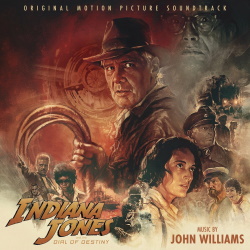 Original Review by Jonathan Broxton
WARNING: THIS REVIEW CONTAINS PLOT SPOILERS. IF YOU HAVE NOT YET SEEN THE FILM, YOU MIGHT WANT TO CONSIDER WAITING UNTIL AFTER YOU HAVE DONE SO TO READ IT.
When you look back at the film series that John Williams has been involved with over the course of his astonishing career, his musical legacy starts to come into sharp relief. Nine Star Wars movies. Two Jaws movies, with his themes used in multiple further sequels scored by other composers. The original Superman, plus themes in sequels. Two Home Alone movies, plus themes in sequels. Two Jurassic Park movies, plus themes in sequels. Three Harry Potter movies, plus themes in sequels. However, other than the three Star Wars ‘main trilogies,’ the only film series that John Williams has scored in its entirety is the Indiana Jones series, which began with Raiders of the Lost Ark in 1981, and continued through Temple of Doom in 1984, Last Crusade in 1989, and Kingdom of the Crystal Skull in 2008. His iconic Raiders March has underscored the escapades of the titular archaeologist and adventurer for more than 40 years, and has seen him clashing with death-worshipping cults, psychic communists, and far too many Nazis. Indiana Jones and the Dial of Destiny is the fifth film in the series and – if reports are to believed – will be the final cinematic adventure for the character.
The film again sees Harrison Ford returning to the lead role, at the ripe old age of 80, but as the film begins he is in a different place from where he was at the end of the last film. It’s 1969, and Neil Armstrong and Buzz Aldrin have just walked on the moon. Jones’s career is winding down to retirement, and he lives in a shabby apartment in New York, having recently separated from his wife Marion Ravenwood (Karen Allen). Any hopes Jones has of a quiet life are ruined when his estranged goddaughter Helena Shaw (Phoebe Waller-Bridge) appears and entreats him to help her find the missing part of the Antikythera mechanism, an artifact allegedly invented two thousand years previously by the Ancient Greek mathematician Archimedes, with which her late father Basil (Toby Jones) was obsessed. So begins a globe-trotting adventure which takes the pair from New York to Africa, to the Mediterranean, and beyond, as they try to find the relic before a rival group led by former Nazi scientist Jürgen Voller (Mads Mikkelsen) can find it and use it for their own nefarious plans. The film was directed by James Mangold, taking the reigns from Steven Spielberg (although he retains executive producer credit), and the expanded cast includes Antonio Banderas, John Rhys-Davies, Boyd Holbrook, Shaunette Renée Wilson, Thomas Kretschmann, and newcomer Ethann Isidore.
Initial reception to the film has not been especially kind, with many critics latching on to the ‘unusual’ chemistry between Ford and Waller-Bridge, the convoluted plotting, and the action sequences which many found to be overly-chaotic, replacing ingenuity with too much hyperactivity. I’m not going to go too much into my thoughts about the film except to say that, overall, I liked it a great deal. It’s certainly a better film than Kingdom of the Crystal Skull; I enjoyed the banter between Ford and Waller-Bridge, I liked the mythology surrounding the titular maguffin, and the whole ‘flashback’ sequence that the beginning of the movie with a digitally de-aged Ford helping stop a Nazi loot train was sensational. But, on the other hand, I do agree that the film has some problems. I didn’t like the new character Teddy, a wannabe Short Round with nowhere near the same level of charm or charisma. Some of the action sequences felt overly-long and repetitive – did we really need two madcap chases through the narrow streets of two different old cities? The motivations of some of the villains were a little poorly defined, and the finale felt a little anti-climactic, even a little downbeat, considering that it’s supposed to be the final sendoff of a legendary character.
 Some of this criticism has even extended to John Williams’s score, which some respected voices have criticized for being thematically underwhelming, slow, and even boring in places. This is where I diverge; I thought the music was outstanding. It’s tempting to give in to sentimentality and nostalgia when reviewing any new John Williams score; as I write this the man is 91 years old, and for any person of that age to do anything with this much skill and craft is astonishing. Not only that, he is working with a cache of music themes that I have loved since my childhood, writing music for a film franchise that I love, in a style that I love – it’s difficult to be objective when faced with those circumstances. But, having forced myself to try to be as unbiased as I can, I still think that Indiana Jones and the Dial of Destiny is an outstanding work, which composers half his age would sell their souls to be able to write.
There are several new themes in this new work, the most prominent of which is Helena’s Theme, for Phoebe Waller-Bridge’s character Helena Shaw. Director Mangold described Helena as a feisty, spunky character with rat-a-tat ‘machine-gun’ dialogue, similar to classic characters portrayed by actresses like Rita Hayworth and Barbara Stanwyck in the 1930s and 40s; as such, Williams’s theme for her drips with the stylistics of Hollywood’s Golden Age. The theme has both an A-Phrase (heard initially at the beginning of “Prologue to Indiana Jones and the Dial of Destiny,” which is actually an edited version of the film’s end credits, and then prominently at 0:10 of “Helena’s Theme”) which is warmly nostalgic, and a B-Phrase (heard prominently at 0:57 of “Helena’s Theme”) which is perhaps more broadly romantic, but both parts are gorgeous. His strings swoon and quiver with Alfred Newman-esque vibrato, the piano moves around them with beautiful cascades, and the woodwinds provide sweet, gentle accents. There are hints of previous classic Williams love themes in the overall sound and in the occasional chord progression – a little bit of Marion’s theme from Raiders, a little bit of Han Solo and the Princess from The Empire Strikes Back, a little bit of Sabrina, even – and it’s all just superb. It’s interesting to note that all these prior Williams scores I namechecked were for Harrison Ford films; make of that what you will.
The other main recurring themes are the ones for the evil scientist Jürgen Voller, and for the Antikythera dial itself, plus numerous smaller motifs associated with the different motivations of the Nazis, and the different aspects of the mythology of the dial – including its links to ancient Greece. Voller’s theme, and the various associated Nazi motifs and rhythmic ideas, are appropriately dark and menacing, relying on ominous chord progressions, low strings, and low brass to convey the danger they present. Tonally these themes all remind me in some way of the Nazi motifs Williams wrote for both Raiders of the Lost Ark and Last Crusade, as one would expect; the notes are completely different, but the feeling is the same, and I like that subliminal connective tissue. These different Nazi ideas run all through the “Prologue to Indiana Jones and the Dial of Destiny” (which, again, is an edited version of the film’s end credits) and then in the opening cue “Germany, 1944,” which underscores the brilliant opening sequence that sees a younger Indy and Helena’s father Basil trying to stop a Nazi train laden with stolen antiquities from leaving a castle, headed for Berlin and Hitler – and Indy having his first encounter with Voller himself.
The theme for Voller – an imposing cluster of strings backed by a flurry of agitated brasses – first appears on the album at the 0:48 mark of the “Prologue” and thereafter appears as a recurring marker for the character throughout the score. Interestingly, Voller’s theme is much more prominent in film context than it is on the album, which pays much more attention to the numerous different Nazi motifs, specifically a determined-sounding rising motif for strings that appears after the 2:00 mark in the “Prologue,” and then a more darkly aspirational one that appears just before the 3:00 mark of the same cue.
Williams’s themes and motifs for the Antikythera dial have a sense of mysterious wonderment, again similar in approach to the Ark theme, the Grail theme, and the theme for the Crystal Skulls, with a little added magic from some of his Harry Potter scores. In terms of color, Williams often uses what sounds like a harpsichord or dulcimer to lead the sound – you can hear it first during the final moments of the “Prologue” – while later in the score Williams uses some rhythmic ideas that appear to be drawn from regional Mediterranean folk music – a little bit of Greek, a little bit of Italian, a little bit of Spanish – to capture the sound of the ancient culture that created the dial in the first place.
Of course, no Indiana Jones movie would be complete without the famous Raiders March, and this score finds numerous ways to weave it into its fabric. It features prominently throughout the action of “Germany, 1944,” engaging in musical conflict with Voller’s theme and several of the Nazi motifs, and often erupting into brief moments of heroic bombast whenever Indy does something especially valiant. Interestingly, Williams also cleverly injects a couple of musical easter eggs into this cue, callbacks to the ‘On the Tank’ sequence from Last Crusade, and to the Nazi theme from the original Raiders, when director Mangold makes a visual callback to a similar scene from a previous movie. I really enjoyed these in the moment.
However, once the music shifts to Indy’s present day in 1969, the Raiders theme tends to mostly go away, and this represents one of the recurring ideas in the screenplay – how Jones is no longer the man he was. He’s older, obviously, less physically proficient, more world-weary, and even perhaps a little broken, emotionally, following the death of his son Mutt in Vietnam, the breakup of his marriage to Marion, and the imminent end of his career. The Raiders March has always represented Indy at his most vital, but throughout much of this film he is decidedly not, and Williams’ decision to hold back the Raiders March is actually a good way of conveying that. There are hints of it here and there, gestures, allusions, restrained statements, in the travelogue map cues “To Morocco” and “To Athens,” and then later in “Polybius Cypher” and “The Grafikos,” but it is not until the end of the score – when Indy gets his groove back, so to speak – that the Raiders March really comes back in full voice.
Instead, Helena’s Theme, the Voller/Nazi themes, and the Antikythera/Dial of Destiny themes dominate much of the central part of the score. “Voller Returns” is a moody, ominous cue that constantly shifts around between several of the Voller/Nazi/Antikythera identities as his motivations are revealed and his plan begins to unfold. “Auction at Hotel L’Atlantique” is a quirky and playful little dance full of sprightly and energetic textures, lithe passages for trumpets, and some whimsical caper-style string writing that has a similar tone to the swordfighting ‘Sir Francis and the Unicorn’ sequence from the score for The Adventures of Tintin from 2011. This then leads into the brilliant “Tuk Tuk in Tangiers” sequence, which is essentially a series of vivacious action variations on Helena’s Theme, accompanying Indy, Helena, and her precocious sidekick Teddy, as they race around the streets of the Moroccan city trying to escape from Voller and his goons with one half of the Antikythera dial. Here, Williams surrounds Helena’s theme with an array of sparkling string runs, brass explosions, clattering xylophones, and darting flutes, in his inimitable energetic contemporary action style – it’s just outstanding. Note that this music is all built around Helena’s Theme instead of the Raider’s March – in many ways, she is the lead here, and Indy is just along for the ride.
“Perils of the Deep” and “Water Ballet” underscore the scenes where Helena and Indy enlist Indy’s old friend, expert diver Renaldo (Antonio Banderas), to help them obtain an artifact from inside the shipwreck of an ancient Roman galleon off the coast of Sicily. These cues are more abstract and textural than most of the rest of the score, with very little direct thematic content, but they still enhance the sequence’s sense of mystery and danger, and sometimes erupt into angry-sounding dissonance, notably in one scene where Indy is assailed by a number of hungry eels while trying to leave the shipwreck. Eels – why’d it have to be eels? The subsequent “Polybius Cypher” and “The Grafikos” are again mostly low-key and textural, but they do offer several interesting statements of, and moody variations on, Helena’s Theme and the various Antikythera/Dial of Destiny themes, as the heroes try to decrypt the meaning of the artifact they find in the shipwreck, and figure out how it will help them find the missing other half of the Antikythera dial.
Eventually the trail leads the heroes to a location hidden deep within a cavern on the coast of Sicily, where they find the missing half of the Antikythera dial on the body of the revered mathematician Archimedes himself, only for it to be immediately taken from them by Voller. The “Archimedes’ Tomb” is a superb exploration of several of the Antikythera/Dial of Destiny themes, arranged with an emotional kick similar to the ‘revelation’ cues from previous Raiders scores – think “The Map Room: Dawn,” or perhaps “The Keeper of the Grail” – albeit without quite the same level of magnificent intensity. This leads into the brilliant action sequence of “The Airport,” a thematic battle between Helena’s Theme and the Voller/Nazi themes, as the pair fight on board a plane heading for a ‘fissure in the space-time continuum’. It is at this point that Voller reveals his actual plan: to use the Antikythera to travel back in time to 1939 so that he can kill Hitler – not to prevent World War II, but because he considers Hitler to have been a failure, and he believes that with a different leader Germany and the Nazis would have won the war. Williams pits Helena’s Theme and the Voller/Nazi themes against each other in an array of exciting action variations, peppered with moments of dark triumph for the antagonists.
Unfortunately, Voller’s mathematical calculations are incorrect, and instead of travelling through the fissure to 1939, everyone ends up back in the year 212 BC where the “Battle of Syracuse” is raging, and Archimedes himself is helping defend his city from the invading army of the Roman Empire. To illustrate the new ancient setting – and the ongoing battle – Williams places several of the Antikythera/Dial of Destiny themes in action arrangements, with a heavier rhythmic component, a more forceful performance of the dulcimer, and the revelation that one of the Antikythera/Dial of Destiny themes was a personal theme for Archimedes himself, now fully shown as a flesh and blood man, very much alive. There’s some terrific interplay between Helena’s theme and several of the Nazi motifs, climaxing with a final blast of Voller’s theme as his plane is shot down by a projectile from a Roman galleon – irony indeed. The fateful meeting between Indiana Jones and Archimedes himself in “Centuries Join Hands” sees their two specific themes playing off each other, and the long-awaited return of the Raiders March, although even here the theme is subdued, perhaps even a little regretful, considering that this will be the only chance Indy has to interact with one of his heroes before he must return to his own time.
The final cue, “New York, 1969,” offers lovely statements of Marion’s theme from Raiders of the Lost Ark, Helena’s Theme, and the Raiders March, as the lovers reunite and sweetly reconcile with a callback to the ‘where doesn’t it hurt’ scene from Raiders, but instead of it being a triumphant send off, it feels a slightly poignant one; Indy and Marion are old now, their kiss is tender rather than passionate, and his adventures around the world are over. I understand why Williams chose to end the score in this way – it’s a reflection of Indy’s reality – but the fan in me wanted a more rousing goodbye to one of the most iconic characters in the history of cinema. Still; any time you can hear the Raiders March once more in context is worthwhile.
Then the album ends, not with the film’s full end credits cue, but with a concert piece, “Helena’s Theme for Violin and Orchestra,” which Williams wrote for the virtuoso violinist Anne-Sophie Mutter, with whom he has developed a close professional friendship over the last few years. Mutter is no doubt an outstanding performer – you don’t get to her level of acclaim, or get to have John Williams’s respect, without it – but I have to admit that I really don’t care for her tone. When compared to, say, Itzhak Perlman, or Joshua Bell, or some of the other famous soloists Williams has worked with over the years, Mutter’s expressions and improvisations sound deeply unpleasant, at times almost grating, to my ears. I don’t have the technical knowledge to fully explain what I’m hearing or what she’s doing, but purely from a layman’s perspective it sounds *wrong* – instead of complementing what Williams has written, it sounds weirdly off-key. It’s such a shame, because it ends the album on something of a sour note, when I wanted something more emotionally compelling. Re-arranging the album so that the “Prologue” follows the “New York, 1969” cue helps, but even with that, the sequencing is frustrating.
With that one disappointment out of the way, everything else in this score is worthy of praise. Those who have criticized Indiana Jones and the Dial of Destiny for relying too much on the impact of the nostalgic legacy themes are just plain wrong; if anything, the legacy themes are not used enough in the score – personally I would have liked a little more Raiders March, especially in the finale – and there were several additional opportunities to quote the Nazi music from both Raiders and Last Crusade that, for some reason, Williams did not take. Similarly, those who have criticized Indiana Jones and the Dial of Destiny for not having any new thematic ideas are also just plain wrong; they may not be seared into your memory, yet, in the way that the themes from previous Indiana Jones scores are, but they *are* there, and the way Williams uses them is very creative, from the action arrangements of Helena’s theme, to the multiple motifs that represent different aspects of Voller and the Nazis, the Antikythera and its associated mysteries, and even Archimedes himself.
When Indiana Jones and the Dial of Destiny was first announced, and when it was revealed that John Williams would be scoring it, rumors swirled that this may be the last score the composer ever writes before retiring from film scoring for good. Williams has since contradicted that statement, saying he was mis-quoted, and has said that he would score more new films if he was offered something that was interesting to him, and if his health allowed him to do so. This is excellent news but the truth of the matter is that John Williams is 91, and virtually nobody at his age is working regularly. We have to take every opportunity to celebrate him that we can, and with this Indiana Jones score he proves beyond doubt that he still has every faculty he needs to write a compelling, exciting, emotional, intellectually stimulating score of the highest order. It’s not as good as any of the first three Indiana Jones scores and, truth be told, it probably wouldn’t crack my Top 50 Williams scores, such is the astonishing quality of his career overall – but even a low-ranked Williams score outstrips pretty much everyone else working today. From a nostalgic point of view Indiana Jones and the Dial of Destiny pushes many of the right buttons, but even when you take nostalgia out of the equation and try to assess it objectively, it still succeeds on multiple levels. Eureka!
Buy the Indiana Jones and the Dial of Destiny soundtrack from the Movie Music UK Store
Track Listing:
- Prologue to Indiana Jones and the Dial of Destiny (6:00)
- Helena’s Theme (3:30)
- Germany, 1944 (4:42)
- To Morocco (3:21)
- Voller Returns (3:06)
- Auction at Hotel L’Atlantique (2:58)
- Tuk Tuk in Tangiers (3:35)
- To Athens (2:17)
- Perils of the Deep (2:31)
- Water Ballet (4:53)
- Polybius Cypher (2:39)
- The Grafikos (4:39)
- Archimedes’ Tomb (3:01)
- The Airport (4:46)
- Battle of Syracuse (2:50)
- Centuries Join Hands (3:02)
- New York, 1969 (4:17)
- Helena’s Theme for Violin and Orchestra (feat. Anne-Sophie Mutter) (4:59)
Running Time: 67 minutes 06 seconds
Walt Disney Records (2023)
Music composed by John Williams. Conducted by John Williams and William Ross. Orchestrations by John Williams and William Ross. Recorded and mixed by Shawn Murphy. Edited by Ramiro Belgardt. Album produced by John Williams.
Leave a reply to Serena Cancel reply

Shop at the Movie Music UK Store

Member of the

 MOVIE MUSIC UK
Wonderful review! Just wanted to offer one small correction: Voller’s theme first shows up at 1:48 of “Prologue”—not 0:48.
Great review, completely agree with it. We desperately need a complete release of this because the score is so much better than the soundtrack album. The opening of the movie alone, together with the ten minute ‘tuk tuk chase’ are something else! All other composers need a dial of destiny to see how the old masters do it.
“…Mutter’s expressions and improvisations sound deeply unpleasant, at times almost grating, to my ears.”
Stay away from Williams’ Violin Concerto No. 2 then lol. He wrote that specifically for Mutter.
I’m surprised nothing has been mentioned about the poor quality of the recording itself. It all sounds horribly muted. The strings, when senza sord., sound like they are con sord. Ditto the brass. This is not the best performance or recording of JW’s music. His music is peerless but this recording is not.
I don’t agree with you on this one. I can’t live up to Indy 1, 2 and even 3. Maybe it’s fine for film music buffs but it doesn’t have fabulous themes like the older movies. And no, Helena’s theme is far too complicated to be one of those easy-to-the-ear themes that Indiana NEEDS. The score is too refined for the movie and its purpose.We needed fun, not complexity. The music is part of the failure of this movie.
3 was crap actually. The only good soundtracks were the first 2. The third movie was a dog turd in every sense.
Last Crusade was crap?? No. HARD disagree.
I don’t think “fun” and “complexity” are mutually exclusive. I had a ton of fun with this score.
This score was excellent…as are all the Indy scores…and especially Last Crusade.
JW completely nailed the emotional levels in LC….
This last entry is a very fitting send off to Indy…
Top review JB!
And it needs a double disc official re-release so come on La La Land!