THE FLASH – Benjamin Wallfisch
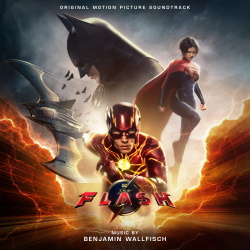 Original Review by Jonathan Broxton
WARNING: THIS REVIEW CONTAINS PLOT SPOILERS. IF YOU HAVE NOT YET SEEN THE FILM, YOU MIGHT WANT TO CONSIDER WAITING UNTIL AFTER YOU HAVE DONE SO TO READ IT.
There’s been a lot of talk lately about superhero fatigue, and how the movie industry has been eating itself alive with too many entries in the seemingly endless expanded universes from both Marvel and DC Comics. Director Andy Muschietti’s The Flash has been the recipient of a significant amount of criticism in this regard; it’s the 13th film in the DC series that was kickstarted in 2013 by Man of Steel, and the second of four DC entries slated for 2023, with the others being Shazam: Fury of the Gods, and the upcoming pair Blue Beetle and Aquaman and the Lost Kingdom. The film also came under fire for the fact that it’s star Ezra Miller, despite being inundated with legal issues stemming from his apparent real-life mental health problems, has been given the full support and backing of Warner Brothers, while the almost completed Batgirl film was unceremoniously scrapped back in August 2022. Whatever the case is; The Flash had problems from the get-go, and in the days since it’s release it has been a critical failure and a comparative flop with audiences.
But, here’s the thing. I loved it. I loved its tone, its energy, the look, the comedy, and the performances, even from Ezra Miller, who I really enjoy in this role. Separate the art from the artist, and all that. Most of all, though, I loved it for its nostalgia. The movie is a big fat love letter to the superhero movies I grew up watching, especially Tim Burton’s 1989 Batman, and every time those iconic moments from that film were referenced here I fell in love with it all over again.
The plot is both simple and very complicated – superhero and Justice League member Barry Allen aka The Flash discovers that he can use his super-speed to break the speed of light and travel back in time, and decides to use this power to try to stop his late mother Nora (Maribel Verdú) from being murdered, and his father Henry (Ron Livingston) being falsely imprisoned for the crime. Despite dire warnings from Batman/Bruce Wayne (Ben Affleck), Barry attempts to travel back through time – but instead of going to his own past, he inadvertently finds himself in an ‘alternate timeline’ where his parents are still alive, but there is also another version of him, without super-speed powers. While looking for a way to return to his own time by giving ‘Alternate Barry’ superpowers, Barry inadvertently loses his own powers, and is forced to try to seek out this universe’s Justice League members to help him: except that, in this universe, Batman is not the Batman he knows: it’s the Batman from the 1989 film (Michael Keaton), thirty years later. Worse still, this universe has no Superman, and this universe’s version of General Zod (Michael Shannon) has coincidentally arrived from Krypton intent on terraforming the Earth – and, unlike in the events of Man of Steel, there seems to be no-one who can stop him.
 What I liked most about The Flash, other than its fun and energy, is how it basically ret-cons the entire DC Comics universe by positing that all the different incarnations of the central characters that have appeared in television and film over the years are, in fact, canonical inhabitants of alternate timelines, existing in parallel with each other. There is a spectacular scene towards the end of the film where Barry – having repeatedly travelled back through time, over and over, trying to find a way to defeat Zod – starts to tear at the fabric of space-time, and pulls all the different universes together on a collision course. In the space of 10 minutes, and with the help of CGI deep-faking, Barry has brief encounters with the George Reeves version of Superman from the 1950s, the Adam West version of Batman from the 1960s, the Christopher Reeve version of Superman from the 1970s, the Helen Slater version of Supergirl from the 1980s, and even the Nicolas Cage version of Superman from Kevin Smith’s 1990s Superman that was never filmed, fighting a giant spider just as God and Jon Peters intended. This moment is a wonderful homage to classic comic book lore, and gave me waves of good nostalgia that have persisted for days.
The final piece of the puzzle in terms of positive nostalgia is the score, by composer Benjamin Wallfisch. Wallfisch chose to do this score for his It collaborator Muschetti instead of scoring the sequel to Shazam, and from my point of view he made absolutely the right choice. Wallfisch used The Flash not only as an opportunity to build on the classic superhero sound he explored in Shazam, but also to bridge the gap between Danny Elfman’s score for Batman and Hans Zimmer’s scores for Man of Steel and Batman v Superman: Dawn of Justice, resulting in a work which takes the best elements of both, and filters them through Wallfisch’s considerable talents. The score is essentially a 50-50 split; the first half, when Barry is in his own timeline, is mostly in the Zimmer sonic world, but then in the second half when Barry finds himself in the alternate timeline with Michael Keaton’s Batman, he moves into classic Danny Elfman mode. Then, during the finale, when Keaton’s Batman goes up against the General Zod from Man of Steel, the two styles collide. In between all this, Wallfisch himself offers up some impressive moments of pathos and emotion, as well as some intense and energetic action writing. Perhaps the only drawback of the score is the lack of a truly memorable and potentially iconic main theme original to this film, but that’s not to say that there are no thematic ideas, because there are.
Barry himself has a theme, a six-note motif that appears to be at least tangentially related to, or inspired by, the Flash theme from Justice League, but is not a direct continuation of it. It forms the main core of the opening cue, “Are You Actively Eating That Candy Bar,” where it is carried mostly by the brass, and is surrounded by fast, frantic string figures that give the whole thing a sense of restless kinetic energy and movement. The prominent electronic textures achieve similar goals – tonally, they remind me very much of some of the things Don Davis was doing on The Matrix back in 1999 – and the whole thing succeeds admirably at creating a portrait of who Barry is: tightly wound, like a coiled spring, all tics and nervous twitches, on the verge of bubbling over. There’s what I’m calling a ‘running variant’ on Barry’s theme too, which takes over whenever The Flash breaks out into super speed, and in these moments Wallfisch makes fantastic use of high woodwinds in counterpoint to the strings and brass, adding another layer of florid movement into the mix.
There’s a new theme for Affleck’s Batman in “Sounds About Right, Bruce,” a bold and punchy theme for heavy percussion rhythms and frantic orchestral textures, accompanying the Caped Crusader as he roars around Gotham on his Bat-Bike, in one of the film’s primary action sequences. It has a Hans Zimmer sound, as one would expect, and it’s to Wallfisch’s credit that while he plays around in the sonic world of both Christian Bale’s Batman and Ben Affleck’s Batman, he also breathes some new melodic life into things. Many of the subsequent action sequences – “Collapsing East Wing,” “Baby Shower,” and the brilliant “Run” – are cut from the same cloth, often featuring fragments of both the Flash theme and the new Batman theme, and even some outbursts of choral magnificence, and are exciting and energetic. What I especially like here are Wallfisch’s orchestrations; there’s SO much going on, so much vibrancy from the entire orchestra, little motifs and textures darting around and playing off each other. The piano motif in “Run” is outstanding. Some of it actually reminds me a little of modern John Williams, and that is entirely intended to be a compliment.
Thankfully, Wallfisch gives us time to breathe via cues like “Nora,” “Not This Time, Kid,” “Can of Tomatoes,” and “Please Work,” as well as later cues like “I Loved You First,” which are softer and more reflective pieces for strings and harp and occasionally a female vocalist, and speak to Barry’s relationship with his family, specifically his memories of his mother. It’s all quite ethereal – not really a theme, more a set of shifting chords and an overall mood – but it’s pretty nonetheless, and it adds a compelling level of pathos to Barry’s story. When it rises to a more emotionally pronounced state in “See You Soon” – again with the John Williams textures – the result is powerfully dramatic.
Once Barry makes the switch and arrives in the ‘alternate timeline’ there are some lightly comedic caper cues that accompany the two Barries as they infiltrate into, and then rapidly exfiltrate out of, the lab where he works, where they have been attempting to re-create the circumstances that gave Barry his powers in the first place. Wallfisch surrounds Barry’s theme with pizzicato textures, bubbling electronics, fluttering woodwinds, and more of those Matrix-style brass clusters, all to excellent effect; “Phasing” and “Escape from the Lab” are especially fun examples of this. However, all this is rudely interrupted by the unexpected arrival of “Zod,” very much alive in this timeline and very much bent on destroying and re-making Earth in Krypton’s image. I’m not sure whether Wallfisch directly quotes any of Zimmer’s Zod music from Man of Steel here, but the overall tone is similar – harsh, heavily distorted electronics and low, brooding orchestral tones with a menacing feel. Later cues like “I Gave You a Warning” revisit the harsh Zod textures prominently.
Faced with this existential threat, Barry and Barry automatically turn to their most trusted ally – Batman – and head off to Wayne Manor to try to find this timeline’s version of him. Of course, the big twist here is that, in this universe, Batman is not Ben Affleck – he’s Michael Keaton, the same Batman from the 1989 and 1992 Tim Burton Batman movies, thirty-something years down the line. Wallfisch hints at this change before we even see the reveal; in “What Is This Place” Wallfisch uses Danny Elfman’s slightly sinister orchestrations, and hints at his Gothic chord progressions, from his Batman score, without ever explicitly referencing the theme. The allusions are stronger in the subsequent “Spaghetti,” until eventually the A-phrase of the theme is heard in “Into the Batcave,” a truly magical moment. Wallfisch holds off on performing the B-Phrase, the famous Batman March, until Keaton speaks his immortal line “I Am Batman,” but when it comes it’s worth the wait. I never saw the 1989 Batman in the theater, and so experiencing this music in this context for what was essentially the first time was a tremendous thrill for me – and I don’t mind admitting I got slightly misty-eyed every time I heard those memorable notes.
What’s really clever about this, though, is how Wallfisch takes the essence of Elfman’s theme, everything that is good about it, but then blends it with the style and orchestration of his own Flash theme, and the contemporary action style, and turns it into something new. In “Batdoneon,” for example, Wallfisch takes the A-Phrase and turns it into a staccato brass motif that plays underneath the loud and bombastic action; it’s very clearly Elfman’s Batman theme, but it’s a completely new and original take on it. To do this to a piece of music as beloved as the Batman theme was to run the risk of messing it up – but Wallfisch doesn’t, at all. It’s fresh and invigorating, obviously familiar, but also very new. He does things like this time and again in several of the subsequent action cues – the exhilarating “Escape from Siberia,” for example – and it’s brilliant hearing all the mileage he gets out of it.
The final new theme in the score is the one introduced in the sequence where Barry, Barry, and Batman travel to Siberia in order to rescue what they believe to be Superman, imprisoned in a remote gulag. However, instead of finding Henry Cavill’s Kal-El, they instead find a girl, Kara, who in this universe made it to Earth from Krypton when the baby boy did not. Wallfisch’s theme for Kara/Supergirl is first heard at the end of “Now We Try Not to Die,” and all throughout the subsequent “Supergirl”. It’s is an aspirational and heroic theme for warm strings, tender woodwinds, soft vocals, and brass counterpoint, but which also has the capacity to turn darker and even become angry and violent – this Kryptonian is less enthused by ‘truth, justice, and the American way,’ having suffered immensely at the hands of humans.
Further statements of the Supergirl theme run through “Want Some Help,” and combine with an epic version of the Flash theme in “What Could Go Wrong” and “Let’s Get Electrocuted,” before reaching a high point in the magnificent, stirring “I’ve Got You,” wherein Kara flies Barry into the clouds and helps him regain his powers, as Wallfisch’s music reaches for the heavens. She’s got him – who’s got you?
The finale of the film sees Barry, Barry, Batman, and Supergirl coming together to take on General Zod and the Kryptonian forces in a massive battle in the desert, with the fate of the world at stake. Wallfisch takes all the main themes – Barry’s theme, the Flash/Speed variant with its bubbling electronica, the Supergirl theme, and Elfman’s Batman theme – and pits them against Zod’s theme and the guttural Kryptonian textures in a series of superb action sequences that really showcase his composing chops. What I like about these cues – particularly “Let’s Get Nuts,” “Cyclonic Diversion,” the exhilarating and tragic “I’m Not Going Alone,” and the fabulously brassy “We Can Fix This” – is how Wallfisch shows that you can take many of Hollywood’s modern scoring techniques, and imbue them with a great deal of compositional sophistication and dramatic musical storytelling. You don’t have to strip away melody, or emotion, or counterpoint, or interesting orchestrations, until you have nothing left but boring chords and pounding drums. You can have different themes playing off against each other to illustrate conflict, you can have rich and complicated orchestral writing, and you can have modern electronic sound design, all at the same time, and you can make it work in a contemporary superhero film. I know this because this is exactly what Benjamin Wallfisch does here.
Eventually, in a last ditch effort to change the tide of the conflict, Barry repeatedly uses his super-speed to travel back through time, constantly changing things and making new multiverses, until eventually he tears at the fabric of space-time and causes different universes to collide into each other. This is the scene where Barry encounters the other Supermen, the other Batmen, and the other Supergirls – Reeve, Slater, West, Cage, and so on – and Wallfisch underscores it with the appropriately apocalyptic pair comprising “The Dark Flash” and the wonderful “Worlds Collide”. In the latter, Wallfisch emotionally references John Williams’s 1978 Superman theme to coincide with the appearance of the Christopher Reeve version, adding yet another layer of emotional depth and nostalgia to the project. I would be interested to go back and listen to this sequence again in context because, although they are not credited, I wonder whether Wallfisch also paid sneaky homage to Jerry Goldsmith’s Supergirl, Neal Hefti’s Batman, or – in a really deep cut – Walter Greene’s score for the 1951 film Superman and the Mole Men, which features George Reeves as Superman. It’s something I could see him doing, as a nod to all the musical influences of the past, deep down in the mix. Either way, the sequence is remarkable.
The ending of the score – “You’re My Hero,” “Into the Singularity,” “Call Me” – is a little low key, and concentrates more on the emotional context of Barry eventually reconciling himself with his mother’s death and his own relationship with that, but finishes with a fanfare flourish at the end of the penultimate cue, and returns to the rousing and monumental magnificence of the “Worlds Collide” to close.
One or two moments that play prominently in the film didn’t make it onto the album, most notably the blast of the Wonder Woman ‘war cry’ motif to herald the cameo appearance of Gal Gadot’s character, and the staggering performance of the full Elfman Batman theme that underscores the moment where Batman ejects from the Batwing and sky-dives headlong towards the Earth, while the Batwing is silhouetted against the moon behind him in a wonderful callback to the iconic image from the 1989 film. Also missing from the album is some of music from the final scene where, having returned to what he thinks is his own timeline, Barry reconnects with ‘his’ Batman/Bruce Wayne, but instead of it being Ben Affleck, it’s George Clooney from 1997’s Batman & Robin! I couldn’t tell whether Wallfisch made any acknowledgement of Elliot Goldenthal’s score for that film in the scene, but again it wouldn’t surprise me – in fact, a lot of the brass phrasing in the action sequences has a distinctly Goldenthalian flavor, so perhaps Wallfisch was foreshadowing that reveal all along.
One final thing. The score for The Flash runs for a whopping 1hour 23 minutes 31 seconds, which is much too long. I have said before that, by and large, I find these massive album releases to be overwhelming, to the point that the running time ends up negatively impacting the score itself. I understand the argument for them; there are no physical constraints on how much music you can put on a digital album, so they put everything on there for the consumer, and then if they want to they can create their own shorter playlists. That’s fine – if you have the time and energy to pick out highlights or make such playlists. I don’t, and I’m not compelled to want to do so. For me, a soundtrack is all about the dramatic narrative journey the composer is taking me on. The album is supposed to present a representation of the drama, with a sensible beginning and end, intelligent flow and structure, and so on. Having a composer, or an album producer, capable of curating that experience is starting to become a lost art form, and for people like me, who more often than not don’t have the time to devote to listening to an album that long, it means that instead you have to listen to it in chunks – which means that you don’t fully get to appreciate the impact of what the music is actually doing from a dramatic standpoint. I devoted multiple hours to The Flash for this review, so I can appreciate what Wallfisch is doing here, but a more casual listener with less time may find themselves not able to appreciate the nuances of the score and the dramatic development of the music due to its extreme length.
With that one caveat in mind, everything else about The Flash is a triumph. With the possible exception of Hans Zimmer’s score for Wonder Woman 1984, this is the best score for a DC Extended Universe film since the project began in 2013. Everything about it works – the thematic ideas for Barry and Supergirl, the intelligent interpolation of Elfman’s Batman theme for the return of the iconic character, the emotional moments relating to Barry and his mother, the creativity and energy of the action, everything. I have been singing Benjamin Wallfisch’s praises ever since he stepped into the limelight in the early 2000s after being Dario Marianelli’s conductor and orchestrator for many years; through scores as excellent and varied as his debut Dear Wendy in 2005, The Escapist in 2008, Summer in February in 2013, A Cure for Wellness, Mully, the two It films, Shazam, and more, the Englishman has shown that his talent is deep, and The Flash just solidifies him as one of the most exciting voices in film music today.
Buy the Flash soundtrack from the Movie Music UK Store
Track Listing:
- Are You Actively Eating That Candy Bar? (0:58)
- Sounds About Right, Bruce (4:16)
- Collapsing East Wing (2:49)
- Baby Shower (2:08)
- Nora (3:22)
- Run (1:44)
- Not This Time, Kid (1:11)
- Can of Tomatoes (1:54)
- See You Soon (1:14)
- Please Work (1:28)
- Today’s the Day (1:44)
- Phasing (1:31)
- Escape from the Lab (2:01)
- Zod (1:15)
- What Is This Place? (1:20)
- Spaghetti (1:24)
- Into the Batcave (2:14)
- I Loved You First (1:35)
- Fate (1:03)
- I Am Batman (2:06)
- Batdoneon (0:56)
- Kal-El? (1:24)
- Escape from Siberia (2:18)
- Now We Try Not to Die (1:17)
- Supergirl (2:45)
- Want Some Help? (1:56)
- I Gave You a Warning (1:26)
- What Could Go Wrong? (1:25)
- Let’s Get Electrocuted (1:30)
- I’ve Got You (2:15)
- You Wanna Get Nuts? (1:56)
- Let’s Get Nuts (3:30)
- Cyclonic Diversion (2:30)
- I’m Not Going Alone (2:32)
- We Can Fix This (1:55)
- Inevitable Intersection (1:08)
- We Can Save Her (2:17)
- The Dark Flash (2:09)
- Worlds Collide (Superman Version) (2:32)
- You’re My Hero (1:43)
- Into the Singularity (1:00)
- Call Me (3:21)
- Worlds Collide (2:29)
Running Time: 83 minutes 31 seconds
Hollywood Records (2023)
Music composed by Benjamin Wallfisch. Conducted by Benjamin Wallfisch and Chris Egan. Orchestrations by David Krystal, Kevin Kliesch and Jeff Kryka. Recorded and mixed by Jake Jackson, Andrew Dudman, Lewis Jones, Jason LaRocca and Benjamin Wallfisch. Edited by Gary L. Krause. Album produced by Benjamin Wallfisch.
Leave a comment

Shop at the Movie Music UK Store

Member of the

 MOVIE MUSIC UK
One of the things I noticed while listening to the score is that almost all of the tracks has Mortal Kombat vibes, given that this and said MK soundtrack are from the same composer. For example, “Please Work” and “We Can Save Her,” reminded me alot of “Hanzo Hasashi.”
“Zod” is “Shang Tsung.” The electronics we hear has “Sub-Zero” vibes and etc. This for sure feels like a spin off of sorts to Mortal Kombat for sure!
You had lots of praise for Elfman’s 2017 score for “Justice League” (I LOVED it) but didn’t like how it halted the new sound Zimmer established for Batman and Superman. Why did you omit that?
I recall how in his review for Thor: Love and Thunder, he has stated to have “moved on” from theme continuity in the MCU, maybe he has done the same for the DCEU? Who knows? I kinda hope that, with the upcoming reset for that universe, Warner Bros are looking for an in-house composer for their upcoming movies to preserve said continuity.
I don’t really see James Gunn sticking to music thematic continuity for 2025’s “Superman: Legacy.” He’ll probably have John Murphy score it and not reference Williams’ or Zimmer’s motifs at all.
The theme for Batfleck isn’t new since it’s heard in Zimmer/XL’s Batman v. Superman (“Do you bleed”).