THE BISHOP’S WIFE – Hugo Friedhofer
 GREATEST SCORES OF THE TWENTIETH CENTURY
Original Review by Craig Lysy
Samuel Goldwyn came across the novella “The Bishop’s Wife” (1928) by Robert Nathan and decided its tender family tale would translate well to the big screen. He would manage production using his own production company to fund the project, with RKO Pictures distributing. The film suffered repeated setbacks that led to Goldwyn sacking his director William A. Seiter and replacing him with Henry Coster, switching the actors for the two male lead roles, tearing down and rebuilding all the sets, and rewrites of the original screenplay of Leonardo Bercovici and Robert Sherwood, by Billy Wilder and Charles Brackett. A fine trio of actors were cast, including Cary Grant as Dudley the angel, Loretta Young as Julia Brougham, and David Niven as Bishop Henry Brougham.
The story concerns a bishop’s wife, who feels emotionally neglected by her husband, who has become obsessed with constructing a grand cathedral. The bishop prays for divine guidance as he is frustrated by funding problems, however the angel who arrives mission is not to aide in the construction of the cathedral, but instead to aide in the restoration of Julia and David’s marriage. Complications arise when Dudley the angel develops feelings for Julia, yet she in the end asks him to move on. Although David never achieves his vision of building a cathedral, his loving marriage is restored, with Dudley reminding him that he prayed for divine guidance, not a building. The film was not a commercial success losing $700,000 as it could not overcome the huge production costs overruns by Goldwyn. It was however a critical success, earning five Academy Award nominations, including; Best Picture, Best Director, Best Film Editing, and Best Film Score, winning one for Best Sound Recording.
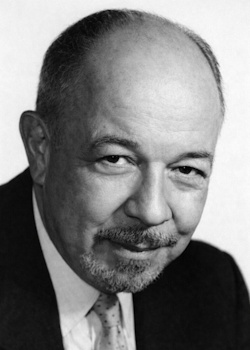 A year earlier Hugo Friedhofer won the Academy Award for his score “The Best Years of Our Lives”. He had worked for Samuel Goldwyn for some time and the studio executive advised that he was tasking him with scoring his latest film, “The Bishop’s Wife”. Upon viewing the film understood that he would have to speak to Heaven sending the angel Dudley to provide divine guidance so as to aid the Brougham’s marriage, David’s obsession with building a cathedral, Julia’s lack of fulfillment with her marriage, and lastly, Dudley unexpectedly developing amorous feelings for Julia.
In conceiving his soundscape, Friedhofer chose a leitmotif approach, creating themes for the principal characters, as well a number of non-character themes, including three themes associated with Heaven and Dudley; The From Another World Theme supports both Heaven, as well as Dudley’s divine mission. Friedhofer offers a two-chord, minor-major construct, often buttressed by angelic wordless choir, which imbues it with an other-worldliness quality. Dudley has two themes associated with his character, one impersonal, the other personal, which emote both as separate identities, or join synergistically together. The first, the often refulgent and Bachenesque Main Theme, permeates the film and speaks to the heavenly good-will brought by Dudley to humanity. The second Dudley theme embodies his personal identity and offers an ABAB construct, with the A Phrase expressed as an eight-note pentatonic statement, while the B Phrase assumes a hymn-like religiosity. The Miracle Theme speaks to miracles Dudley uses in some of his interventions. The theme offers a divine synergy brought by the fusion of the From Another World Theme and Dudley Theme 2. For the Broughams, the bishop has no personal theme associated with him. Julia’s Theme however offers a tender, and warm exposition by strings romantico, which speaks to her caring and loving nature. Daughter Debby is provided a tender theme borne with playful, child-like innocence by strings delicato. The “To Death do Us Part” Theme (titled by Friedhofer) emotes from Julia’s perspective and abounds with sadness, futility and resignation, a testament to the loss of fulfillment and happiness from her marriage.
Secondary themes include The Hat Theme, which is aspirational, and speaks to the store window display bonnet Julia loves and dreams becomes her as a Christmas present. Friedhofer interpolates phrasing from the traditional Christmas Carol “Away in a Manger”. The Professor’s Theme serves as the identity of the cantankerous Professor Wutheridge, a Brougham family friend. The gentile ABA theme borne by strings tenero offers the sensibilities of a traditional college hymn. The lyrical A Phrase is declarative, while the B Phrase warm and inviting. The Lost April Theme offers a piece by harp d’amore, which speaks of unrequited love by Agnes’ young, struggling, composer lover Allan, whose engagement she cancelled, her fear of poverty overcoming her love for him. The piece finds its most beautiful expression in the “Theatrical Trailer” where a full exposition is offered by solo violin d’amore, harp and string orchestra. Lastly, Friedhofer infused his soundscape with a number of contemporary and classical pieces such as “O Sing To God” from “Noël: Montez à Dieu” by Charles Gounod and Benjamin Webb, “Hark! the Herald Angels Sing” by Felix Mendelssohn and Charles Wesley, and “To Death Do Us Part”.[7]
“Main Title” offers a wondrous score highlight where Friedhofer masterfully sets the tone of the film with an homage to Johan Sebastian Bach. We open with choral exultation voicing the From Another World Theme, which supports the flow of the opening credits. A heavenly choir ushers in at 0:39, a hymn-like rendering of Dudley’s Theme. At 1:13 we segue into the film proper atop a choral rendering of “Hark The Herald Angels Sing” carol, descending to a snow bound New York City bustling with Christmas shoppers. Dudley smiles as he watches a children’s choir sing the carol as it snows. (*) “Toy Store” reveals Dudley walking past a window display of toys as we see children staring full of wonderment. The Christmas carol is sustained, joined by a contrapuntal flute line bubbling with delight. (*) “Blind Man” reveals Dudley assisting a blind man cross a busy street, earning a heartfelt thank you from the man. Dudley’s Tender theme supports his aid. (*) “The Rescue” reveals Dudley walking back to the toy store window carried by the Bachenesque rendering of his theme. As a mother lifts her son up to see the window display, her baby carriage rolls away towards a speeding car. Dudley, supported by his tender theme rescues the baby, earning an effusive thank you from the mother. (*) “The Bonnet” reveals Julia eyeing the bonnet she desires, hoping to receive it as a Christmas present. Friedhofer interpolates phrasing from the traditional Christmas Carol “Away in a Manger” to support her aspirations. As Dudley joins her at the window, she walks away, crossing the street where she sees the professor shopping.
“Professor And Julia” reveals Julia meeting up with professor Wutheridge as the both shop for Christmas trees. Friedhofer supports with a full AAAABA statement, of his theme with the 2nd and 4th A Phrases embellished. He perceives sadness and a lack of Christmas cheer in Julia, who discloses Henry’s trouble in funding his cathedral. His gifting of his lucky Roman coin for the cathedral fund elicits tears and a hug of thankfulness from Julia. We close atop the sparkling Miracle Theme as Dudley warmly greets the professor. “Professor and Dudley” reveals the two men conversing, with the professor politely playing along, unable to recall just when they met. Friedhofer supports with interplay of the shimmering refulgence of the Miracle Theme and the Professor’s tender theme. They cross the street and the Miracle Theme crests at 1:07 as Dudley miraculously saves the professor. They pause in front of Henry’s old church, which displays a sign “Help Save St. Timothy’s” and we are bathed with religioso auras by strings reverenti and organ solenne. The men part ways, their themes entwined as the professor queries a policeman about Dudley’s identity.
“Julie and Henry” offers a beautiful score highlight with a full exposition of Julia’s Theme. It reveals her arrival home late to witness the Cathedral Committee’s prime benefactor, Mrs. Hamilton berate Henry in front of the committee. She tries to console him, but he is clearly obsessed with the cathedral. She decries that the happiness has gone out of their marriage. Music enters as they sit down to eat dinner. Friedhofer introduces a theme he called “To Death do us Part”, a sad testament to the unfulfillment and unhappiness Julia feels with her marriage. As they say Grace, religioso chords support. At 0:29 Julia’s Theme joins on a solo cello triste attended by refulgent violins for a deeply moving exposition. Henry realizes he has been neglectful and offers to spend the afternoon together tomorrow followed by lunch at her favorite restaurant Michel’s. His plans are dashed however when he takes a phone call where he is coerced into a late morning funding meeting, and then reminded by his secretary of a speaking engagement at the hotel Hamilton at 1 pm.
“Enter Dudley” reveals the departure of Henry’s secretary Sarah. Low register strings abbandonato give voice to Henry’s suffering and despair as his plans with Julia have been foreclosed. He gazes at a painting of his planned cathedral and prays fervently to God for divine guidance. At 0:21 shimmering ethereal strings brillante, empowered by angelic choir and chimes, ascend upon the chords of the From Another World Theme offering divine splendor as Henry beholds the breath-taking illumination of the cathedral painting’s background. At 0:35 Henry hears a door open and close and asks who is there? Dudley’s personal theme informs us of his arrival, which startles Henry when he sees him standing by his desk. The From Another World and Dudley themes entwine with divine splendor as Henry struggles to accept Dudley’s assertion that he is an angel sent in answer to his prayers. In “Exit Dudley” Julia meets Dudley, Henry’s new ‘assistant’, and is happy Henry will have someone helping him. She excuses herself for dinner, and Friedhofer supports with the shimmering ethereal radiance of the Miracle Theme. At 0:58 we ascend and close upon a radiant crescendo brillante when Henry turns back to speak to Dudley, and finds that he has vanished, which unsettles him. A shimmering divine musical narrative carries his walk to the dining room, where he appears shaken by events. “Next Morning” reveals Dudley happily reporting to work, much to the surprise of Henry, who remains perplexed. He proceeds to make a very favorable impression with both Henry’s maid and secretary. Friedhofer once again channels Bach and supports with a spritely musical narrative of shimmering ethereal wonderment borne by bubbling woodwinds of delight, strings brillante and chimes as Dudley’s two themes interplay.
“Dudley Takes Over” reveals Henry departing for meetings as Dudley prepares to reorganize the donor cardex. A tender rendering of his theme glistening with ethereal radiance carries him into the study where he discovers the ancient Roman coin, which he examines, and pockets. At 0:51 little Debby arrives and meets Dudley carried by her gentle, child-like theme borne tenderly by strings delicato. Julia joins them and she and Debby depart for Christmas shopping. At 1:31 Bachenesque woodwinds emote Dudley’s heavenly goodwill theme and carry him to the study. He uses his angelic powers at 1:53 to miraculously sort and file the donor cards supported by woodwinds and harp in a swirling impressionistic breath of Heaven. His woodwind borne theme caries his departure as he walks to join Julia and Debby. We segue at 2:46 atop playful, child-like woodwinds of delight into “The Miraculous Snowball”, a score highlight. We see a group of children playing snowball war in the park. At 2:53 a sad rendering of Debby’s Theme carries her sobbing to Julia, where she says that the kids will not let her join as she is too small. At 3:07 Dudley arrives carried by his tender theme and takes Debby’s hand and says that is the most ridiculous thing he has ever heard. He is unable to convince the kids to let her play, and so fashions a magic snowball. She coaxes her to throw it at the leader and it flies miraculously to find its target! The boys all grab her, saying she is now on their team and a happy Debby joins in. Friedhofer masterfully supports with a wondrous child-like scherzando entwined with a playful Debby’s Theme. We close with sentimentality as Dudley joins Julia on a park bench, and she asks, what he is doing here?
In “Matilda Materializes” Dudley asks Julia to join him for lunch at Michel’s, but she declines, saying she cannot leave Debby alone. Music enters with the Miracle Theme as the housekeeper Matilda arrives unexpectantly, says she has finished her shopping, and offers to take Debby home. At 0:19 we close on the playful scherzando as Debby returns saying she wants to stay and continue playing. She is ecstatic when Julia consents. “Chez Michel” reveals Dudley taking Julia to her favorite restaurant as three old women gossip at Julia’s lack of propriety dining with a handsome man who is not her husband. Dudley orders lunch in French, which impresses Julia. Friedhofer supports the dining ambiance with a delightful, danza Polka felice. In (*) “Palm Reading”, the music becomes sentimental atop Julia’s Theme with subtle romantic undercurrents as Dudley reads her palm. He then diffuses the looming scandal of holding Julia’s hand in public, by using his irresistible angelic charm to invite the three gossiping ladies to join them for lunch. (*) “Matilda Spills the Beans” reveals Matilda informing the inquiring Henry that Julia was out having lunch with Dudley. Henry is clearly surprised and disagreeable, and a musical ker-plunk reinforces this as he slams the door in his study as Matilda voices “Oh, oh”.
“The Holy Bottle” reveals Dudley and Julia strolling to the From Another World Theme rendered as a promenade when they encounter the professor, who invites them to join him for sherry at his apartment. They sip the sherry as Julia inquiries about his new book’s manuscript, which makes him noticeably uncomfortable. A tender, sentimental exposition of the From Another World Theme with undercurrents of sadness support the extended scene, which features the professor’s admission that he has not written a single page, and Dudley’s disclosure that the Roman coin that he returns to the professor, is priceless. Interludes at 0:38, 2:13, 3:11 by ethereal harp glissandi and woodwinds comici support Dudley magically refilling the sherry glasses. We end happily, and with hope when the professor asks Dudley if he will have time to finish his book, and Dudley answers, yes. We close with Dudley and Julia departing, and the sherry bottle comedically refilling at 4:33 behind his back as the professor drinks his glass, which has again magically refilled.
(*) “Henry Confronts Dudley” reveals him locking them in his study and demanding Dudley perform a miracle to prove he is an angel. Friedhofer bathes us is religioso auras, with statements of the Not of his World and Miracle themes as Dudley offers no grand display, but instead departs opening the locked door and exiting. Henry follows but cannot open the door as it is locked. A shimmering Miracle Theme twinkles as Henry sits down, forced to accept the truth of Dudley’s angelic mission. “David And The Lion” offers a beautiful score highlight, and was Friedhofer’s favorite composition from his score. Henry Julia, and Mildred listen intently as Dudley obliges Debby’s request for a bible story, and chooses the story of David and the Lion where the boy brought down the great lion with a slingshot as. Friedhofer opens with sweet innocence of Debby’s Theme, which ushers in a tender Mahleresque musical narrative. We close musically with solemnity carried by strings reverenti, which join in a beautiful confluence with Dudley’s recitation of the inspired words of Psalm 23.
“Taxi Cab” opens with an ethereal Miracle Theme as Dudley jostles the car to prevent Henry from declaring he is an angel before Julia. The theme reprises as Henry pulls money out to give Dudley to cover the taxi ride. At Mrs. Hamilton’s estate, Henry apologizes and concede all his disagreements with the prime benefactor of his cathedral. At 0:28 we segue into “Dudley’s Dirty Trick” atop a refulgent Miracle Theme as Henry finds his chair firmly attached to his clothes as he repeatedly tries to depart to join Julia at the St. Timothy’s choir rehearsal. “Choir Rehearsal” reveals Dudley leading the boys’ choir in singing the Christian hymn of adoration “O Sing to God” supported by organ solenne. At 1:50 choral arranger Charles Henderson had angelic women’s voices overdubbed to create a celestial radiance to the final stanza.
“The Hat and Sylvester” reveals Henry still trapped in a chair at Mrs. Hamilton’s, as Dudley and Julia exit St. Timothy’s carried by a radiant harp glissandi descent. A pleasant musical narrative unfolds until 0:37 when a Hat Theme full joins atop strings full of longing as Julia sees her hat being removed from the store display widow. She and Dudley enter the store as a matronly woman dons the hat. At 1:02 silliness unfolds as woodwind comici support Dudley shaking his head, which the woman sees in the mirror. She decides against purchasing the hat and at 1:31, the Hat Theme resumes on strings of thankfulness as we see Julia wearing the bonnet during the cab ride home. In “Sylvester Misses The Truck”, the cabbie is distracted by Dudley and Julia and takes his eyes off the road. Ominous strings surge as we see the headlights of the approaching truck on a collision course until Dudley, supported by the Miracle Theme, taps Sylvester on the shoulder and he swerves to miss the truck.
“Central Park” offers a wonderful score highlight. While traveling through Central Park, they see ice skaters, and stop to join them. Dudley uses his angelic power to gift Julia and Sylvester figure skating skills. Friedhofer offers a wonderful valzer elegante, which joins a polka, the Main and Hat themes in inspired interplay. At 1:45 the musical narrative glistens with radiant energy as Dudley’s personal theme and the Miracle Theme join to propel him with professional figure skating skills including spins and jumps. At 2:15 a classic polka propels Julia joining him for a skate around the ring. At 2:43 the valzer elegante resumes as Julia marvels at her newly acquired skating skills. The music then becomes playful as Sylvester tries to skate, his careening travels causing other skaters to flee. Dudley comes to his aid and after a tentative start, Sylvester, thanks to angelic assistance, regains his youthful form and the valzer elegante resumes as Sylvester follows Dudley and Julia around the ring. At 3:04 the polka propels Sylvester racing and joining Dudley and Julia, and the three-line skate caried by the waltz imbued initially with playful accents, but which over time achieves a magnificent, and grand elegance.
(*) “Sylvester Says Thank You” reveals Sylvester refusing payment after he drops Dudley and Julia off, saying that the two had restored his faith in humanity. A reprise of the waltz carries his departure. Dudley’s and the Hat Theme interplay as Julia says this is the most fun, she has had in years, with Dudley agreeing, but substituting centuries for years. In “Dudley Vanishes” Dudley’s Theme carries his departure until 0:20, when the music sours after Henry tells Julia that he has fired Dudley because he is incompetent and cannot stand the sight of him. The music speaks of his anger and her sadness as Henry storms away leaving a stunned Julia. “Julia And Debby” reveals Debby expressing sadness that Dudley will not be returning, but is reassured by Julia that he will. Friedhofer provides interplay of their three themes, closing with that Hat Theme as Julia dons her hat, her thoughts turning to Dudley. “Sermon And Tree” offers an inspiring score highlight. It reveals Mildred typing Henry’s prepared Christmas Eve sermon when Dudley arrives and relieves her, saying he will type it so she may go shopping. She departs and he types a new sermon titled “The Story of the Empty Stocking”. Friedhofer supports with a splendid and very moving interplay of Dudley’s Theme, the Main Theme and From Another World Theme for one of the score’s finest moments. At 2:24 we flow into the carol “Hark the Herald Angels Sing” as Dudley relieves Matilda and begins decorating the Christmas tree magically supported by his theme rendered by an ethereal vibraphone joined with impressionist wonderment.
“Mrs. Hamilton & Lost April” offers a poignant score highlight where Friedhofer’s music speaks eloquently the pathos of regret and love lost. It reveals Dudley making an unannounced visit to Mrs. Hamilton. As he enters the drawing room, the harp magically plays a brief statement of his theme joined by quotes of the radiant Miracle Theme. He opens an ornate box on a table and discovers the manuscript “Lost April”. Strings romantico join as he reads a note; “This was composed for you, my darling, and you only – Allan.” He sits down and at 2:00 begins playing a glissandi rich romance for harp d’amore as a stunned Mrs. Hamilton slowly comes down the stairs. We close on the miracle Theme joined in a sad musical narrative full of regret as she explains that the piece was written for her by Allan, a struggling composer, with whom she was in love as a young girl. To this day she pines for him, regretting that she called off their engagement, as her fear of poverty was stronger than her love for him. “The Bishop Considers” reveals Henry and Julia arriving at Agnes Hamilton’s estate for dinner. She confides that Dudley has visited her, and then stuns Henry by saying that she has changed her mind regarding the cathedral. She declares that she intends to donate all her money to the poor, the homeless and unappreciated people in town, and that Henry should manage the money’s distribution. Henry is stunned, leaves awkwardly carried by ethereal violins brillante. Outside he walks past St. Timothy’s at 0:15 supported by liturgical hymn-like solemnity. At 0:34 a wistful rendering of the Professor’s Theme carries him to the professor’s flat, blossoming warmly as he graciously welcomes Henry, and invites him in.
In “You Are A Man” Henry is distraught believing Julia no longer loves him, having lost her to Dudley. The professor exhorts him to fight for love as you have the advantage – you and Julia are both mortals. As he departs, Friedhofer interpolates the hymn, “To Death Do Us Part”. At 0:09 we segue into “Dudley And Julia” a beautiful and very moving score highlight. We are graced by gorgeous interplay of Dudley’s and the Main Theme with ethereal wonderment as Julia and Matilda marvel at the beautiful decoration of the Christmas Theme done by Dudley. At 0:22 Dudley enters carried by his warm theme joined by an ethereal Julia’s Theme as he expresses happiness from decorating a Christmas tree again, and that his work here is almost finished. The musical narrative develops feelings of longing as he confides that he does not know his next assignment, but realizes it cannot be here again; Heaven’s rule so as to prevent an angel from becoming attached. He admits he does not want to leave as she has the rarest of gifts – the ability to create Heaven on Earth. At 0:55 yearning strings voice his aspirations for love, and a stirring romance for strings builds as his words make her uncomfortable. The From Another World Theme joins at 1:54, punctuated by two aching chords as she tells him to go away and never come back. Grieving violins carry her flight from him as Henry arrives home.
Henry calls out to a crying Julia, who runs past him up the stairs. He then challenges Dudley to a duel for trying to steal his wife and daughter who he loves, but Dudley calmly diffuses his anger. In “Dudley’s Farewell” an ethereal From Another World Theme supports Dudley informing him that he is leaving and when he does, that he, Julia, Debby and all the others will have no memory of him. Henry says he does not trust him, but Dudley counters that he should, as his prayer has been answered. Henry disagrees saying his prayer has not been answered as he was praying for a cathedral. Dudley reminds him, that he was praying for divine guidance, which he has been given. Henry asks that if needed in the future, would he return? Dudley answers no, as he stands warned because of his feelings for a mortal. A warm rendering of his theme carries Dudley’s departure as Henry turns to gaze at the painting of his cathedral. The background again becomes luminous, supported by a reprise of shimmering ethereal strings brillante, empowered by angelic choir and chimes, which ascend upon the chords of the From Another World Theme.
In “Reconciliation” Henry rushes upstairs and joins Julia who is kissing Debby goodnight. Music enters atop a shimmering Miracle Theme when Julia asks if he got Debby the angel doll above her bed. At 0:10 strings romantico voice Julia’s Theme as Henry rushes to embrace and kiss her. She is pleasantly surprised as he confides his inexplicable feeling of happiness. Her theme, so beautifully rendered supports their tender, intimate moment together. Organ solenne supports the arrival of the parishioners (not on the album), and at 1:00 we segue into “Sermon” a score highlight where we are graced by the score’s most eloquent exposition of Dudley’s Theme. The tender, heart-warming rendering of Dudley’s Theme supports Henry’s inspired sermon, “The Story of the Empty Stocking”, which was written by Dudley. At 2:13 a crescendo di esaltazione supports Dudley’s satisfaction and happiness as we see him outside the church smile and depart. As he walks away, we close the film at 2:28 with “End Title” atop a grandiose statement of the Main Theme empowered by horns nobile, which concludes with a flourish. At 2:41 we flow into “End Cast” and are graced by a sublimely beautiful exposition of Julia’s Theme. “Theatrical Trailer” offers a beautiful album highlight, which offers an extended molto romantico exposition of the score’s “Lost April” piece for string orchestra, solo violin d’Amore and harp.
I commend James d’Arc and Ray Faiola for their Herculean efforts to restore this wonderful score. The original acetate sources did not age well and several cues we damaged and required a rerecording. The disc transfer and restoration were largely successful; however, the archival sound has audio imperfections, and at times film sound effects intrude. Despite these imperfections, the magic and wonderment of Friedhofer’s handiwork shines through. Friedhofer often expressed his love for this score, which had a special place in his heart. The film offered a feel good, Christmas narrative of redemption, and Friedhofer just delivered the goods. He perfectly captured the refulgent ethereal essence of Heaven with his From Another World and Miracle Themes, while his themes for Dudley perfectly captured his endearing angelic kindness. Cues such as “David and the Lion”, “Central Park”, “Mrs. Hamilton and Lost April”, “Dudley and Julia”, “The Sermon” and “Theatrical Trailer” are some of the finest compositions in Friedhofer’s canon. Folks, Friedhofer’s music imbued this film with warmth, love, Christmas spirit, and a sense of wonderment, elevating its story-telling in every conceivable way. I consider it a masterpiece, and a testament to Friedhofer’s mastery of his craft. I recommend you watch the film, and purchase the album despite its audio imperfections, as this score is a treasure of the Golden Age.
For those of you unfamiliar with the score, I have embedded a YouTube link to a wonderful ten-minute suite: https://www.youtube.com/watch?v=eJxZHi5yfq4
Buy the Bishop’s Wife soundtrack from the Movie Music UK Store
Track Listing:
- Main Title (1:31)
- Professor And Julia (1:13)
- Professor and Dudley (1:46)
- Julie and Henry (1:38)
- Enter Dudley (1:46)
- Exit Dudley (1:19)
- Next Morning (1:31)
- Dudley Takes Over & The Miraculous Snowball (4:45)
- Matilda Materializes (0:37)
- Chez Michel (2:34)
- The Holy Bottle (4:45)
- David And The Lion (2:28)
- Taxi Cab & Dudley’s Dirty Trick (0:54)
- Choir Rehearsal (2:20)
- The Hat And Sylvester (1:39)
- Sylvester Misses The Truck (0:30)
- Central Park (5:36)
- Dudley Vanishes (0:49)
- Julia And Debby (1:13)
- Sermon And Tree (4:09)
- Mrs. Hamilton & Lost April (4:13)
- The Bishop Considers (0:54)
- Your Are A Man & Dudley And Julia (2:15)
- Dudley’s Farewell (1:09)
- Reconciliation, Sermon & End Title, End Cast (3:43)
- Intermission Music (3:00)
Running Time: 58 minutes 17 seconds
Film Music Archives FMA-HF109 (1947/2002)
Music composed and conducted by Hugo Friedhofer. Original orchestrations by Jerome Moross. Recorded and mixed by XXX. Score produced by Hugo Friedhofer and Emil Newman. Album produced by James d’Arc and Ray Faiola.

Shop at the Movie Music UK Store

Member of the

 MOVIE MUSIC UK