Eduard Artemyev, 1937-2022
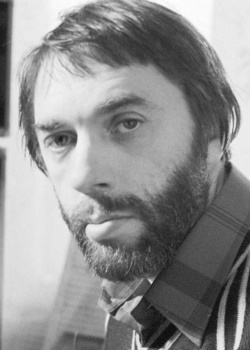 Composer Eduard Artemyev died in Moscow on December 29, 2022, at the age of 85, following hospitalization with COVID-19.
One of the great pioneers of electronic film music, Artemyev wrote music for more than 150 feature films, documentaries and animated productions during a career spanning six decades. Internationally he is best remembered for his collaborations with Andrei Tarkovsky, especially Solaris, Mirror and Stalker.
Eduard Nikolayevich Artemyev was born in Novosibirsk on November 30, 1937, and studied composition at the Moscow Conservatory under Yuri Shaporin, graduating in 1960. Soon afterward he met engineer Yevgeny Murzin, inventor of the remarkable ANS photoelectronic synthesizer. Artemyev became one of the instrument’s earliest champions, at a time when electronic composition remained almost entirely outside the Soviet musical mainstream.
His defining association began when Tarkovsky engaged him for Solaris (1972). Artemyev combined Bach’s chorale prelude Ich ruf zu dir, Herr Jesu Christ with electronic textures generated on the ANS, creating music that blurred the boundary between conventional score, sound design and the mysterious noises of the planet itself. The result was less a traditional science-fiction score than an otherworldly sonic environment, and it established Artemyev internationally as one of cinema’s most adventurous electronic composers.
He reunited with Tarkovsky on Mirror (1975), where his music was deliberately sparse, and on Stalker (1979), perhaps their most radical collaboration. For the latter Artemyev fused electronic sound with acoustic timbres to create an ambiguous musical landscape suspended between the mechanical and the spiritual. These three scores became central to Tarkovsky’s distinctive cinematic world and remain the work for which Artemyev is best known outside Russia.
At the same time Artemyev developed important relationships with Nikita Mikhalkov and Andrei Konchalovsky. For Mikhalkov he scored At Home Among Strangers (1974), A Slave of Love (1976), An Unfinished Piece for Mechanical Piano (1977), A Few Days from the Life of I. I. Oblomov (1980), Burnt by the Sun (1994) and The Barber of Siberia (1998). His music for these films revealed a warmer, more melodic side of his personality, frequently combining electronics with expansive orchestral and folk-influenced writing.
His work for Konchalovsky included Siberiade (1979), whose soaring theme, often known as “Campaign” or “Death of the Hero,” became one of Artemyev’s most famous compositions. He later scored Konchalovsky films including The Inner Circle (1991), The Odyssey (1997), House of Fools (2002) and The Nutcracker in 3D (2010). The Siberiade theme gained renewed international exposure when it was used during the opening ceremony of the 2014 Winter Olympics in Sochi.
Although cinema dominated his career, Artemyev remained committed to electronic and concert music. He created large-scale works, experimented extensively with synthesizers and studio technology, and became an important influence on later generations of Russian electronic musicians and screen composers. His achievements brought him numerous state honors and film awards, including multiple Nika and Golden Eagle prizes.

Shop at the Movie Music UK Store

Member of the


