Archive
Shirley Walker, 1945-2006
 Composer Shirley Walker died on November 30, 2006, in Reno, Nevada, from complications following a stroke. She was 61.
Born Shirley Anne Rogers in April 1945, in Napa, California, Walker was a musical prodigy. She had an early start performing as a teenager at various hotels, jazz and art bands in tje 1960s, and later attended both San Francisco State University and Berkeley. She began her professional music career in the late 1970s, and for several years she wrote jingles and composed for industrial films.
Her career in film began in 1979, when she was hired to play the synthesizers on Carmine Coppola’s score for Apocalypse Now, and she quickly established herself as one of the most in-demand arrangers, conductors, and orchestrators in Hollywood, working notably with composers such as Danny Elfman, Hans Zimmer, and Brad Fiedel. Notably, she is credited for being a major influence on the symphonic style Elfman adopted on scores like Scrooged, Batman, and Edward Scissorhands.
Walker was one of the few female film score composers working in Hollywood during her career, and became one of the first female composers to earn a solo score credit on a major Hollywood motion picture when she was hired to score John Carpenter’s Memoirs of an Invisible Man in 1992. Her work on the animated super-hero film Batman: Mask of the Phantasm (1993) remains a standout achievement, praised for its operatic intensity and emotional complexity; this film also initiated her long-standing relationship with DC Animation, as over the course of the next decade she would write music for shows such as Batman: The Animated Series, Superman: The Animated Series, The Flash, The New Batman Adventures, and Batman Beyond, among many others. Read more…
DÉJÀ VU – Harry Gregson-Williams
 Original Review by Clark Douglas
I’ve always wondered why so many critics and media personalities have tried to pin everything that is bad about Hollywood on Tony Scott. There are plenty of no-talent hacks working in the world of film today, but Scott simply isn’t one of them. He is a director who, without fail, turns in a reasonably intriguing popcorn film with slick production values and a high watchability factor. Has he inspired the so-called “MTV Movie” style of filmmaking, full of innumerable cuts and jerky camera work? Possibly, but when Scott himself is at the helm, it works. However, his recent films have simply been too much for some people, with all the insanely wild visual ideas he lathered over “Man on Fire” and “Domino”. Many people felt Scott needed to be reigned in a bit, to return to a slightly less hyper form. Who is the man to help guide Scott in this matter? Why, none other than Jerry Bruckheimer, of course! Laugh if you want, but it seems that Bruckheimer has helped Scott shape a reasonably-paced, smarter, sharper, more intelligent film than we’ve been seeing in recent years with “Déjà Vu”. Does it have the remarkable energy of “Domino” or the violent-religious-parable intrigue of “Man of Fire”? No, but it’s a better film than both of those, easily his strongest work since “Crimson Tide”. Read more…
THE FOUNTAIN – Clint Mansell
 Original Review by Jonathan Broxton
The Fountain is the latest film from director Darren Aronofsky, whose debut film Pi was a cult success in 1998, and whose 2000 follow up Requiem for a Dream earned massive critical acclaim, as well as an Oscar nomination for actress Ellen Burstyn. The Fountain, in terms of scope, is his most ambitious effort yet. It stars Hugh Jackman, Rachel Weisz and Ellen Burstyn (again) and is about nothing less than quest for immortality. Jackman stars as pharmaceutical drug developer Tommy Creo, who is desperately trying to save his wife Izzy (Weisz), who is afflicted with an inoperable brain tumour. Izzy is a writer, and has been researching a book about a medieval quest to find the fabled Fountain of Youth, with Queen Isabel (Weisz) sending a Conquistador (Jackman) to New Spain to find it. Intercut with these two stories is a third timeline which takes place in the 26th century, and focuses on a man named Tom (Jackman), who is taking a space trip in the company of a giant tree. Yes, you did read that last sentence correctly. Read more…
BOBBY – Mark Isham
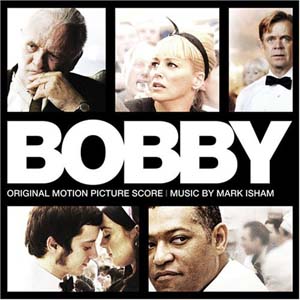 Original Review by Clark Douglas
“Hey, good evening ladies and gents, it’s time for a great big exciting night of entertainment, with all your favorite stars! Along the way, you’ll have some laughs, shed a couple tears, maybe learn a couple of things, and most of all, see a lot of the beautiful faces you know and love! We now take you live to the Ambassador Hotel for a great evening of entertainment! Oh, and you’ll also see Robert Kennedy get killed.”
Is it just me, or does “Bobby” feel way too much like “Grand Hotel 1968”, or perhaps an Irwin Allen movie? I’m not criticizing the fact that a politically-charged film dealing with a serious event in American history has a huge, star-studded cast, but I am criticizing the way the movie uses them. Emilio Estevez’s “Bobby” is, at it’s best, a vivid snapshot of a particular time in America. At it’s worst, it’s a cheap love letter to all things Kennedy, paired with some silly soap operas as dramatic filler. Read more…
CASINO ROYALE – David Arnold
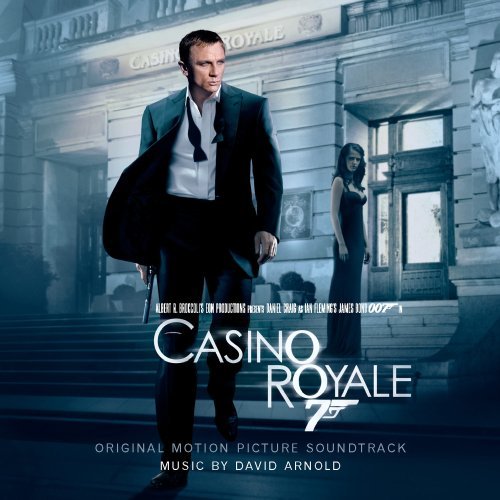 Original Review by Jonathan Broxton
When you think about it in terms of numbers, the James Bond franchise is pretty damn impressive. 007’s screen history reaches back 40 years, comprises 21 movies, and has a combined box-office gross of over $1.3 billion (or $3.3 billion if you adjust it for inflation). No wonder the franchise is considered to be amongst the most successful and important in all of cinema. We’ve had ten directors, nine composers, and now we’re on to our sixth leading actor: Daniel Craig, stepping into the sharp tuxedo vacated by Pierce Brosnan at the end of Die Another Day, and ordering the vodka martini with a broader, brusquer accent than heard in many years. Read more…
HAPPY FEET – John Powell
 Original Review by Clark Douglas
Australian film maker George Miller has never failed to impress me. His films are somewhat few and far between, but they’re all so brilliant. The “Mad Max” trilogy set the standard for post-apocalyptic thrillers. The “Babe” films are the best family movies of the past decade. “The Witches of Eastwick” is a wickedly funny comedy, “Lorenzo’s Oil” is a tremendously moving medical drama. His segment of the “Twilight Zone” movie blew away those made by Joe Dante, Steven Spielberg, and John Landis. He’s found amazing success in every genre he’s touched, so I was greatly anticipating “Happy Feet”, his first attempt at making an animated film. It is a success, but perhaps not quite the masterpiece I expected. Read more…
HARSH TIMES – Graeme Revell
 Original Review by Clark Douglas
At one point in “Harsh Times”, one character tells another, “You look like a turd dressed up in a fancy suit”. If you can accept the metaphor of a performance by Christian Bale being the equivalent of a fancy suit, then the same statement can be applied to this movie. It’s second-rate, warmed-over, run-of-the-mill material. It sure is galvanizing, though.
Bale plays Jim Davis, a troubled ex-Army Ranger looking to settle down. He’s applied for a job with the LAPD, has a lover in Mexico waiting to be taken across the border, and despite a taste for the wild side of life, he’s genuinely interested in making a decent life for himself. So is his best friend Mike (Freddie Rodriguez), who has been mooching off his wife’s (Eva Longoria) money for years. So, they go off job-hunting together, but things don’t work out so well for Jim. He’s rejected for psychological reasons, which simply sends him into an even deeper mental meltdown. Read more…
A GOOD YEAR – Marc Streitenfeld
 Original Review by Clark Douglas
If a lead character in a mainstream movie declares “Winning isn’t everything, it’s the only thing!” at the beginning (and his name isn’t Vince Lombardi), is there any doubt that he will change his mind by the film’s end? No, and I don’t suppose that’s a huge problem. “A Good Year” is a predictable message film, and in this case, I’m okay with that. However, I’m not okay with the fact that the film doesn’t even buy into it’s own message.
The theoretical character from the beginning of my review is indeed the leading character of the film. His name is Max (Russell Crowe), and he is a stock market go-getter with a large staff and a mean streak. He is a perfect “in need of redemption” candidate for the film’s purposes… greedy, selfish, uncaring, with a surprisingly gentle piece of his past buried away under piles of money. When Max learns of the death of the man who raised him, his Uncle Henry (played by Albert Finney in flashbacks), his reaction is basically a shrug. Well, until he learns that he’s inherited Henry’s estate (which includes a wine vineyard), which could bring in a pretty penny. Read more…
THE RETURN – Dario Marianelli
 Original Review by Jonathan Broxton
Following his Oscar nomination for Pride & Prejudice last year, and his subsequent arrival in the ‘Hollywood Studio System’ with V for Vendetta, it was sort of inevitable that, before long, Dario Marianelli would turn up scoring a studio horror flick. Every composer does at least one (although some spend their entire careers doing nothing else!) It’s almost a rite of passage, something you have to do to earn your spurs, and be accepted as a reputable and reliable figure in the cogs that make up the system, which establishes you as one of the great fraternity from whose ranks most Hollywood movie scores are written. Dario Marianelli’s flick, it turns out, is The Return. Read more…
Basil Poledouris, 1945-2006
 Composer Basil Poledouris died on November 8, 2006, at his home in Los Angeles, California, after a battle with cancer. He was 61.
Vassilis Konstantinos Poledouris was born in Kansas City, Missouri, in August 1945, to a family of Greek immigrants. A piano player from an early age, Basil moved to Los Angeles in 1964 to study filmmaking and music at the University of Southern California, where he was a contemporary of soon-to-be-directors George Lucas, John Milius and Randal Kleiser, who would go on to be lifelong friends and collaborators. Poledouris dabbled in acting – he had a non-speaking role as a crewmember on the original series of Star Trek – but concentrated on music following his graduation with a BA in film studies.
Poledouris composed music for over 100 educational films before getting his break in feature films, which came in 1978 following the release of the popular cult surfing movie Big Wednesday (directed by Milius), and which he followed by writing music for hit teen romance The Blue Lagoon in 1980, and the action fantasy epic Conan the Barbarian in 1982. The latter film launched the career of Arnold Schwarzenegger, and is considered one of the finest fantasy scores ever written. Read more…
BABEL – Gustavo Santaolalla
 Original Review by Clark Douglas
So this is what it feels like on the other side. Last year, I wrote an very positive review of Paul Haggis’ “Crash”. In fact, I went so far as to call it the year’s best film. I spent a good portion of time arguing with others who said the film was cheap, overdramatic, and contrived. Now, here is “Babel”, which is receiving reviews eerily similar to those “Crash” received, and they’re just as divided… some critics call it a complex and thought-provoking masterpiece, others call it hokey rubbish. This time around, I absolutely agree with the dissenters, for some of their reasons, and for some of my own. “Babel” was directed by the talented Alejandro González Iñárritu, who also made the acclaimed “21 Grams” and “Amores Perros”. Both of those films were contrived, but convincing. Not so here. Read more…
THE PRESTIGE – David Julyan
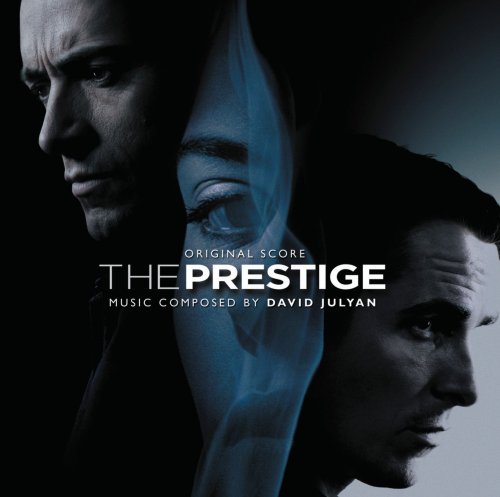 Original Review by Jonathan Broxton
Honestly, you wait ages for a film about magicians in turn-of-the-century Europe, and then two come along at once! This happens in Hollywood with quite amazing regularity, and seems to be a trend that shows no sign of going away. So, following on the heels of The Illusionist is The Prestige, which has a better pedigree in terms of filmmakers, and a more bankable cast. The film stars Christian Bale and Hugh Jackman as Alfred Borden and Robert Angier, two friends, aspiring stage magicians in London at the height of the Victorian era. However, when Alfred causes the death of Julia, Robert’s wife, their friendship becomes a deep animosity. Thereafter, the two magicians strive to outdo each other, both on stage and in life, trying to develop more and more elaborate and dangerous illusions, and carrying out acts of bitter vengeance. With a director in the shape of Christopher Nolan (hot from Batman Begins), a superb supporting cast that includes Michael Caine, Scarlett Johansson, Andy Serkis and David Bowie, and a talented production crew recreating the opulence of the time period, The Prestige has been a critical and commercial success. Read more…
FLAGS OF OUR FATHERS – Clint Eastwood
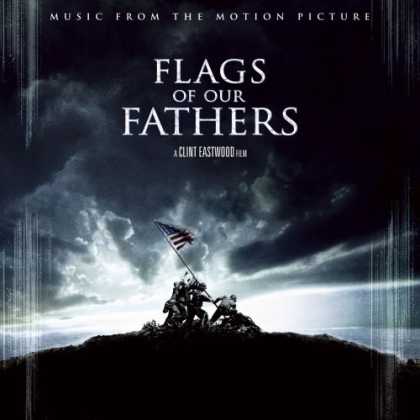 Original Review by Jonathan Broxton
It’s interesting to see how the public perception of Clint Eastwood has changed over the years. In the 1950s he was a TV cowboy, familiar from series such as Rawhide. In the 1960s, he moved to the big screen, and became an icon through his roles in classic spaghetti westerns like A Fistful of Dollars, For a Few Dollars More, and The Good the Bad and the Ugly. In the 1970s he became a bona fide Hollywood star, with leading roles in box office smashes like Dirty Harry, The Enforcer, Magnum Force and Every Which Way But Loose. By the 1980s he had moved sideways into directing, and enjoyed significant success with Sudden Impact, Firefox, and Heartbreak Ridge. The last 20 years or so, though, have seen him emerge as a true cinematic artist and a beloved member of the film-making fraternity, with the acclaimed Unforgiven, The Bridges of Madison County, Mystic River and Million Dollar Baby. Read more…
THE QUEEN – Alexandre Desplat
 Original Review by Jonathan Broxton
The death of Diana, Princess of Wales, in a car crash in Paris on 31 August 1997, was something of a turning point in the modern history of the United Kingdom. Up until that time, the British royal family were generally looked upon with fondness. Sure, they had their moments of scandal, Prince Phillip continually said stupid things to people on foreign tours, and there was a section of society which called for them to be abolished and the country turned into a republic. But, beyond this, the House of Windsor was seen as a mighty figurehead, as people who represented the best interests of Britain at home and abroad, as a family to be looked up to and admired. However, the reaction of the Royal Family to the death of Diana caused unprecedented resentment and outcry. The Royal Family’s rigid adherence to protocol was interpreted by the public as a lack of compassion, and all of a sudden the tide turned against them. Now, the Royal Family was cold and insular, out of touch with the thoughts and feelings of the nation they ruled, and totally irrelevant to modern British life. Queen Elizabeth II in particular came in for special criticism, initially for her refusal to allow the Royal Standard on top of Buckingham Palace to fly at half mast, and later for her seemingly forced and insincere broadcast to the nation several days later. Read more…
THE LAST KING OF SCOTLAND – Alex Heffes
 Original Review by Clark Douglas
There were several “based on true events” historical dramas in 2006 about different parts of Africa, and “The Last King of Scotland” is the best of them. It is a somewhat flawed film, but reaches remarkable heights during it’s best moments, and it lingers with you long after the credits have rolled. Nicolas Garrigan (James McAvoy) is a young Scottish man who’s just gotten his medical degree. Desperate not to become stuck in his father’s medical practice, he runs off to Uganda (of all places) and decides to work in a small medical clinic there, healing the needy and so on. The year is 1971, and Uganda is in the middle of being overthrown by an up-and-coming general named Idi Amin (Forest Whitaker). Read more…

Shop at the Movie Music UK Store

Member of the

 MOVIE MUSIC UK