Akira Ifukube, 1914-2006
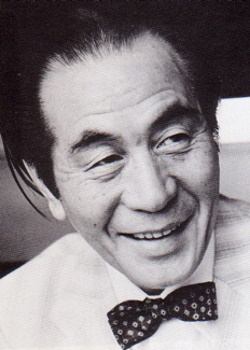 Composer Akira Ifukube died in Tokyo, Japan, on February 8, 2006, at the age of 91, from multiple organ failure.
One of the most important Japanese composers of the twentieth century, Ifukube wrote nearly 300 film scores during a career spanning half a century, but remains internationally famous for his association with Toho’s monster films and especially for creating the thunderous musical identity of Godzilla.
Ifukube was born in Kushiro, Hokkaido, on May 31, 1914. Growing up in northern Japan, he was exposed to the music of the indigenous Ainu people, whose rhythms and melodic patterns would profoundly influence his musical language. Largely self-taught as a composer, he originally studied forestry at Hokkaido Imperial University and worked in the timber industry before turning professionally to music. After World War II he began teaching composition in Tokyo and entered the Japanese film industry.
His first feature score was Senkichi Taniguchi’s Snow Trail in 1947, beginning an extraordinarily prolific period in which he worked with many prominent Japanese directors. Early assignments included Akira Kurosawa’s The Quiet Duel (1949), Kaneto Shindo’s Children of Hiroshima (1952), Josef von Sternberg’s Anatahan (1953), and Hideo Sekigawa’s Hiroshima (1953). His music already displayed the characteristics that would define his career: heavy rhythmic writing, powerful brass, modal melodies and a distinctive fusion of Western symphonic technique with Japanese musical traditions.
Ifukube’s defining film came with Ishirō Honda’s Godzilla in 1954. Taking the fantastic subject completely seriously, he wrote dark, monumental music dominated by low brass, pounding percussion and obsessive rhythms, giving the enormous creature a sense of weight and almost mythological grandeur. The famous Godzilla march and accompanying military material became inseparable from the character. Ifukube also participated in creating Godzilla’s roar, produced by manipulating the strings of a double bass, and devised the monster’s massive footsteps by striking an amplifier box.
The success of Godzilla began one of the most important composer-franchise relationships in film history. Ifukube returned for King Kong vs. Godzilla (1962), Mothra vs. Godzilla (1964), Ghidorah, the Three-Headed Monster (1964), Invasion of Astro-Monster (1965), Destroy All Monsters (1968) and other entries, while also scoring related Toho science-fiction spectacles including Rodan (1956), The Mysterians (1957), Varan (1958) and Battle in Outer Space (1959). Even when the films became increasingly colorful or fantastic, Ifukube generally refused to treat them as camp, instead writing with the same seriousness he would bring to historical drama.
His film career extended far beyond monsters. Kon Ichikawa’s anti-war masterpiece The Burmese Harp (1956) contained some of his most moving music, while The Tale of Zatoichi (1962) demonstrated his command of period drama. Other assignments ranged from historical epics and samurai films to intimate dramas and documentaries, establishing Ifukube as one of the busiest composers in post-war Japanese cinema.
After largely withdrawing from film scoring during the late 1970s, Ifukube made an unexpected return to Godzilla in the 1990s, scoring Godzilla vs. King Ghidorah (1991), Godzilla vs. Mothra (1992), Godzilla vs. Mechagodzilla II (1993), and finally Godzilla vs. Destoroyah (1995). The latter, conceived as Godzilla’s death, allowed Ifukube to bring four decades of musical history to an appropriately tragic conclusion.
Away from cinema, Ifukube was a major concert composer and teacher. Works including Japanese Rhapsody, Ballata Sinfonica and Sinfonia Tapkaara fused Western orchestral forms with rhythms and melodies inspired by traditional Japanese and Ainu music. He also served as president of the Tokyo College of Music and exerted considerable influence on subsequent generations of Japanese composers.

Shop at the Movie Music UK Store

Member of the


