Archive
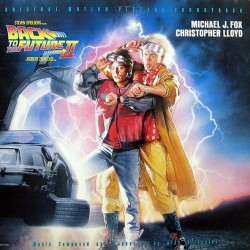
BACK TO THE FUTURE, PART II – Alan Silvestri
 THROWBACK THIRTY
Original Review by Jonathan Broxton
The enormous critical, cultural, and financial success of Back to the Future in 1985 meant that a sequel was inevitable. In the fall of 1989 director Robert Zemeckis returned with the first of not one but two further installments, shot back-to-back and ready to continue the time traveling exploits of Marty McFly, the suburban kid from 1980s California, and his eccentric inventor friend Doc Brown, who built a time machine out of a DeLorean. The ending of the original movie saw Doc picking up Marty and his girlfriend Jennifer literally the following morning after their adventure ended, and whisking them away in his now-upgraded flying automobile, promising them that “where they’re going they don’t need roads.” Where they end up going is the year 2015, to fix a problem with Marty and Jennifer’s future children – however, while they are there, Marty’s now-elderly arch-rival Biff Tannen contrives to steal the time machine himself, resulting in the creation of an alternate-timeline 1985 where Biff is a sleazy multi-billionaire and Marty’s stepfather. To fix things, Marty and Doc must travel even further back in time, once again to 1955, where they must re-restore the original timeline without screwing up the courtship between Marty’s parents Lorraine and George, which is happening at the same time! Read more…
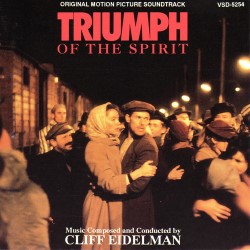
TRIUMPH OF THE SPIRIT – Cliff Eidelman
 THROWBACK THIRTY
Original Review by Jonathan Broxton
Triumph of the Spirit is a 1989 Holocaust-themed drama, directed by Robert M. Young, based on a screenplay by Shimon Arama, Zion Haen, Andrzej Krakowski, and Laurence Heath. It stars Willem Dafoe and is based on the true life story of Salamo Arouch, a Jewish former Olympic boxer who is taken as a prisoner during World War II and sent to he Auschwitz concentration camp. While there, Salamo is literally forced to fight for his life, taking part in brutal boxing matches for the amusement of the guards, who threaten to murder his family if he refuses to fight. With only the love of his girlfriend Allegra (Wendy Gazelle) to sustain him, Salamo fights over 200 matches while in captivity – knowing that every person he defeats will be killed – all the while dreaming of the day that he and his loved ones would again be free. The film co-stars Edward James Olmos and Robert Loggia, and was heralded at the time for the fact that it was the first major film to actually be shot on location at the real Auschwitz. The other aspect of the film – and the most pertinent one to me – is the fact that its score was written by the then 24-year-old Cliff Eidelman. Read more…
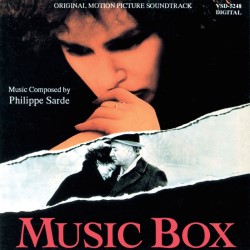
MUSIC BOX – Philippe Sarde
 THROWBACK THIRTY
Original Review by Jonathan Broxton
Music Box was a political thriller directed by the great Franco-Greek filmmaker Constantin Costa-Gavras, based on a semi-autobiographical screenplay by Joe Eszterhas. Although Eszterhas soon became better known for writing rather more sordid murder mysteries – Basic Instinct, Jade, and Showgirls, for example – Music Box is a very different, much more serious film. It stars Jessica Lange as Ann Talbot, a Chicago defense attorney, who learns that her father, Hungarian immigrant Michael Laszlo (Armin Mueller-Stahl), is in danger of having his U.S. citizenship revoked. As Ann digs deeper into her father’s past she discovers a shocking truth – that he may have been involved in atrocities during World War II while collaborating with Nazis. It was a moving, emotional film, which won the Golden Bear at the Berlin International Film Festival in 1989, and earned Lange an Academy Award nomination for Best Actress. Read more…
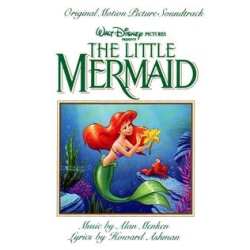
THE LITTLE MERMAID – Alan Menken, Howard Ashman
 THROWBACK THIRTY
Original Review by Jonathan Broxton
The Walt Disney Corporation is, for better or worse, probably the world’s biggest and most influential media and entertainment company. Not only does it own its own catalogue of classic live action and animated films, including those made by Pixar, it of course also owns Lucasfilm and the rights to the Star Wars universe, Marvel and the Avengers universe, and has recently bought Twentieth Century Fox and it’s entire cache of intellectual property. As I write this five of the six highest grossing films of 2019 are Disney features, and we haven’t even seen Frozen II or Star Wars: The Rise of Skywalker yet, which could lock out seven of 2019’s Top 10. It’s easy to forget that it wasn’t always this way, and even easier to forget that the film that turned it all around was an animated feature based on a classic story by a children’s author from Denmark. Read more…
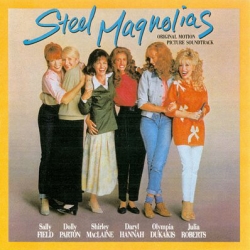
STEEL MAGNOLIAS – Georges Delerue
 THROWBACK THIRTY
Original Review by Jonathan Broxton
A classic Hollywood emotional melodrama based on the play of the same name by Robert Harling, Steel Magnolias is a close look at the lives of a group of women in a small town in Louisiana. It is a detailed examination of all aspects of life – weddings and funerals, children, husbands, and boyfriends, love and infidelity, loneliness, sickness, and death – and is mostly set around the town’s local beauty parlor, where the women often congregate to gossip, congratulate, commiserate, and mourn. The film is anchored by an astonishing ensemble cast of female acting brilliance, including Sally Field, Dolly Parton, Shirley MacLaine, Daryl Hannah, Olympia Dukakis, and most notably Julia Roberts in the role that made her a star. It’s one of those three-handkerchief movies that is entirely intended to wring every drop of emotion out of its audience, and it is considered somewhat manipulative and mawkish today, but in 1989 it was a huge hit, earning Roberts her first Academy Award nomination. The film was also the biggest box office success of director Herbert Ross’s career – despite him having previously made such acclaimed films as The Sunshine Boys, The Turning Point, The Goodbye Girl, California Suite, and Footloose – and it had a score by the great Georges Delerue. Read more…
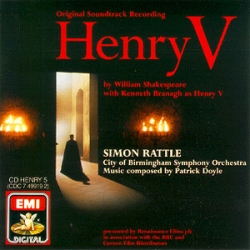
HENRY V – Patrick Doyle
 THROWBACK THIRTY
GREATEST SCORES OF THE TWENTIETH CENTURY
Original Review by Jonathan Broxton
In 1989 Kenneth Branagh was a brash, handsome, dazzlingly talented young actor and director, who emerged from the Royal Academy of Dramatic Arts in the early 1980s and set the British theatrical world alight with his electrifying Shakespearean productions. He was part of a group of talented contemporaries which included people like Emma Thompson, Alan Rickman, Jonathan Pryce, Stephen Fry, Hugh Laurie, and Rowan Atkinson, all of whom began to have a profound effect on British stage society through their respective careers in drama and comedy. Branagh then went on to create the Renaissance Theatre Company, which brought his troupe of players into the circle of beloved stage veterans like Judi Dench, Richard Briers, Derek Jacobi, and Sir John Gielgud. Together they made enormously successful stage productions of Much Ado About Nothing, Hamlet, As You Like It, and Twelfth Night, the latter of which directly led to Branagh receiving funding to make a big-screen adaptation of one of Shakespeare’s most beloved works, Henry V. Read more…
DAD – James Horner
 THROWBACK THIRTY
Original Review by Jonathan Broxton
Dad was a sentimental family drama starring Jack Lemmon, Ted Danson, and Ethan Hawke as Jake, John, and Billy Tremont, three generations of fathers and sons who are brought together when Jake’s wife Bette, played by Olympia Dukakis, suffers a health emergency. Needing to fend for himself for the first time in decades, Jake finds a new lease of life through his forced independence, and bonds with his workaholic son and free-spirited grandson, as well as members of his extended family that he has been neglecting. However, when Bette returns home, she baulks at the formerly-passive Jake’s new assertiveness, which leads to conflict and – eventually – more medical drama. The film was written and directed by Gary David Goldberg (the creator of Family Ties), adapted from a novel by William Wharton, and was an unexpected critical success, with special praise reserved for Jack Lemmon’s performance, and for the Oscar-nominated old age makeup. Read more…
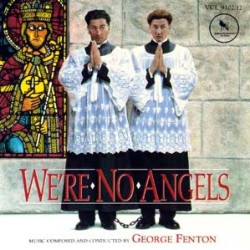
WE’RE NO ANGELS – George Fenton
 THROWBACK THIRTY
Original Review by Jonathan Broxton
We’re No Angels was a loose remake of a 1955 Humphrey Bogart film of the same name, which was itself adapted from a French play, La Cuisine des Anges, by Albert Husson. The film is set in the 1930s and stars Robert De Niro and Sean Penn as Ned and Jim, two amiable convicts who inadvertently escape from jail when they are caught up in a plot masterminded by Bobby, a vicious killer played by James Russo. The convicts eventually find themselves in a small upstate New York town near the Canada–US border, where Ned and Jim are mistaken for a pair of priests expected at the local monastery. Circumstances are such that crossing the town bridge into Canada is extremely difficult, so Ned and Jim decide to play the long game and embrace the misunderstanding until the time is right. However, as Ned and Jim spend more time in the town, they find themselves forming real bonds with the locals, especially a beautiful single mother played by Demi Moore, and soon they begin to wonder whether they have a shot at genuine redemption. The film was written by David Mamet and directed by Neil Jordan, but was unfortunately a massive box office flop, grossing just $10.5 million on a $20 million budget. Read more…
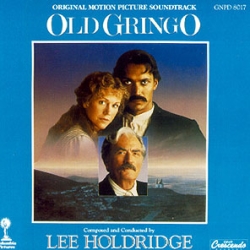
OLD GRINGO – Lee Holdridge
 THROWBACK THIRTY
Original Review by Jonathan Broxton
Old Gringo was intended to be a lavish Mexican epic film marking the English-language debut of Argentine filmmaker Luis Puenzo, whose film La Historia Oficial had won the Best Foreign Language Film Oscar in 1985. It was based on an acclaimed novel by Carlos Fuentes and starred Gregory Peck as Ambrose Bierce, an ageing acclaimed writer who moves to Mexico just prior to the outbreak of the Revolution in 1910. Bierce is dying of a terminal illness, but keeps it secret as he wants to end his days on his own terms. He befriends a revolutionary named Arroyo (Jimmy Smits), and also crosses paths with an American schoolteacher named Harriet (Jane Fonda), and as the violence escalates so does his friendship with Arroyo, something which is complicated by the romantic feelings they both have for Harriet. Old Gringo tries to tackle numerous weighty subjects simultaneously – the politics of the Mexican Revolution, the regrets of old age, the concept of legacy and fame, a love triangle – but the consensus was that it tried to take on a little bit too much; Roger Ebert, in his review, wrote that ‘there is a potentially wonderful story at the heart of Old Gringo, but the movie never finds it. The screenplay blasts away in every direction except the bulls-eye. It’s heavy on disconnected episodes, light on drama and storytelling.’ The whole thing was a critical and commercial failure, and Puenzo never made another film in English. Read more…
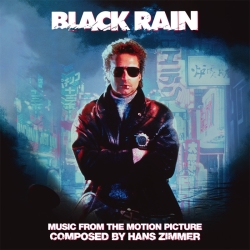
BLACK RAIN – Hans Zimmer
 THROWBACK THIRTY
Original Review by Jonathan Broxton
I’ve written this sentence about other scores before, so I apologize for the repetitiveness, but I think it’s important to acknowledge the fact that there are very few scores in the world that you can point to as being a literal turning point in the history of film music. Black Rain is one of them. The film itself is not especially famous these days, despite actually being rather good. The film stars Michael Douglas and Andy Garcia as Nick Conklin and Charlie Vincent, two New York City cops who witness a murder in a bar and arrest the assailant. The killer is a man named Sato (Yusaku Matsuda), who is a member of the Japanese Yakuza crime syndicate. Sato is extradited to Japan, and Nick and Charlie agree to accompany the gangster back to Osaka for his murder trial. However, when they arrive at the airport, Sato’s fellow Yakuza free him from police custody by tricking Nick, which brings shame and tension to the already fraught relationship between Nick and his Japanese counterpart, Detective Masahiro (Ken Takakura). Determined to find Sato at any cost, Nick enters the dangerous underworld of Japanese organized crime. The film was directed by Ridley Scott, and was a box office success, combining a classic cop thriller revenge story with one of the first mainstream American depictions of Japanese Yakuza gangster culture. Read more…
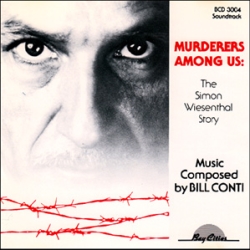
MURDERERS AMONG US: THE SIMON WIESENTHAL STORY – Bill Conti
 THROWBACK THIRTY
Original Review by Jonathan Broxton
Simon Wiesenthal had quite an amazing life. Born into a Jewish family in Austria in 1908, he was captured and sent to a concentration camp after the outbreak of World War II; after surviving against terrible odds, Wiesenthal spent the rest of his life as one of the world’s most famous ‘Nazi hunters,’ tracking down and gathering information on fugitive Nazi war criminals so that they could be brought to trial. He was involved as a key witness in the Nuremberg Trials, and instrumental in the 1960 capture of Adolf Eichmann, one of the major organizers of the Holocaust who personally sent hundreds of thousands of people to die in Auschwitz. Wiesenthal was also a writer and philanthropist, and lent his name to a research and human rights center in Los Angeles. He died in 2005, but not before this acclaimed TV movie of his life was released on HBO in 1989. The film was directed by Brian Gibson and starred Ben Kingsley in the titular role, with support from Craig T. Nelson, Anton Lesser, Paul Freeman, and Renée Soutendijk as Simon’s wife Cyla. Read more…
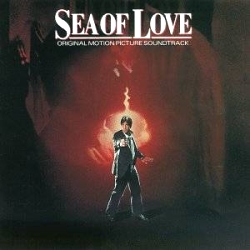
SEA OF LOVE – Trevor Jones
 THROWBACK THIRTY
Original Review byJonathan Broxton
Sea of Love was a slightly sordid murder-mystery thriller directed by Harold Becker. Al Pacino stars as Frank Keller, a burned-out alcoholic New York City police detective who finds himself involved in the case of a serial killer, who finds victims through the singles column in a newspaper. As the bodies rack up and the investigation continues, Keller meets Helen (Ellen Barkin), the sexy manager of an upscale shoe store, who he meets on the job during a sting operation to identify potential suspects. Against his better judgment Keller embarks on a relationship with Helen – until the evidence begins to support the idea that Helen is the killer. The film co-starred John Goodman and Michael Rooker and was a box office success; critically, it was favorably compared with similar movies like Body Heat and Jagged Edge, and now fits comfortably into the ‘femme fatale’ genre that also includes movies like Basic Instinct. By the way, the title of the film is a reference to the 1959 song of the same name by Phil Phillips with the Twilights; the killer has a calling card where a 45RPM LP of the song is left playing in the victim’s home after the crime. Read more…
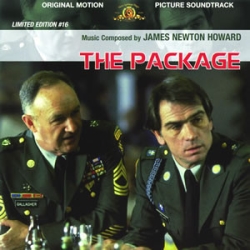
THE PACKAGE – James Newton Howard
 THROWBACK THIRTY
Original Review by Jonathan Broxton
The Package was an enjoyably tense political action-thriller directed by Andrew Davis from a screenplay by John Bishop. Gene Hackman stars as a US Special Forces army sergeant named Gallagher who is tasked with transporting a deserter named Boyette, played by Tommy Lee Jones, from West Berlin to the United States to stand trial. However, Boyette escapes en-route, and Gallagher quickly finds that he is being used as a pawn in a larger conspiracy: to assassinate the president of the Soviet Union and ultimately stop a disarmament treaty between the United States and the Soviets from being signed. The film co-starred Joanna Cassidy, John Heard, Dennis Franz, and Pam Grier, and was in many ways a dry-run for The Fugitive, which director Davis would make four years later with many of the same cast and crew. The Package has many of the same plot points as The Fugitive – a prisoner who escapes from custody, action sequences in Chicago, a dogged and righteous law enforcement operative tracking him down – which makes it an interesting comparison piece to Davis’s great, Oscar-winning classic. Read more…
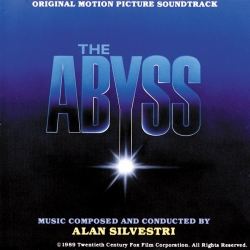
THE ABYSS – Alan Silvestri
 THROWBACK THIRTY
Original Review by Jonathan Broxton
The third and best of 1989’s claustrophobic underwater action thrillers, The Abyss was director James Cameron’s long-awaited follow up to Aliens. It stars Ed Harris and Mary Elizabeth Mastrantonio as Bud and Lindsey Brigman, an estranged husband-and-wife who work on a hi-tech underwater oil drilling platform which sits along the lip of a massive marine trench deep beneath the Caribbean Sea. When a military submarine sinks in mysterious circumstances near the platform, the government sends a team of Navy SEALS in to investigate, using the platform as a base of operations. There is immediate tension between the rough-and-ready oil drillers and the aggressive and testosterone-fuelled soldiers, and this is exacerbated even more when they encounter a mysterious creature that can seemingly manipulate and control water. The film co-starred Michael Biehn, J. C. Quinn, and Leo Burmester, and was both a critical success and a box office hit; it received special attention for its then-groundbreaking use of CGI special effects, which won its creative team an Academy Award. However, the film production itself was notoriously troubled; the shoot went massively over-budget, and the actors were subjected to near-torturous conditions by Cameron, who made them spend literally hours on end in freezing cold underwater temperatures. Cameron also spent a great deal of time editing the film, removing whole swathes of footage to try to create a more coherent cut, including the original ending which featured enormous special FX shots of tsunamis (although much of this was restored in a subsequent director’s cut). Read more…
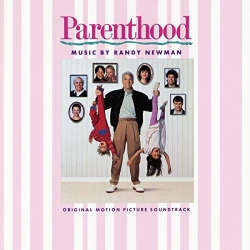
PARENTHOOD – Randy Newman
 THROWBACK THIRTY
Original Review by Jonathan Broxton
Parenthood was a successful and popular comedy-drama film directed by Ron Howard, based on the actual child-rearing experiences of Howard and his screenwriting partners Lowell Ganz and Babaloo Mandel, who between them had 17 children in 1989. The film starred Steve Martin and Mary Steenburgen as married couple Gil and Karen Buckman, and looks at the various trials and tribulations of their extended family, especially as the story relates to parent-child relationships, romantic problems, sibling rivalries, and the pressures that careers have on family lives. The film had an outstanding supporting ensemble cast, including Jason Robards, Rick Moranis, Tom Hulce, Martha Plimpton, 25-year-old Keanu Reeves, 15-year-old Joaquin Phoenix, and Dianne Weist, who received a Supporting Actress Academy Award nomination for her performance. It is also worth noting that, more than 20 years later, the movie was loosely adapted into a popular TV series of the same name, which ran on the NBC network for six seasons, although many of the characters and situations were different. Read more…

Shop at the Movie Music UK Store

Member of the

 MOVIE MUSIC UK