Archive
KNIGHTS OF THE ROUND TABLE – Miklós Rózsa
 GREATEST SCORES OF THE TWENTIETH CENTURY
Original Review by Craig Lysy
The enormous commercial success of Ivanhoe in 1952 served as a catalyst for invigorating the swashbuckling costume epic. MGM executive Don Schary decided to proceed with his studio’s first film in Cinemascope with an epic retelling of the story of King Arthur and the Knights of the Round Table. He assigned production to Pandro S. Berman with a $2.6 million budget. Talbot Jennings, Jan Lustig and Noel Langley were hired to write the screenplay, adapting the 1485 tale “Le Morte d’Arthur” by Sir Thomas Malory, and Alfred Lord Tennyson’s 1859 work “Idylls of the King,” and Richard Thorpe was tasked with directing. A stellar cast was assembled, which included Robert Taylor as Sir Lancelot, Ava Gardner as Guinevere, Mel Ferrer as King Arthur, Anne Crawford as Morgan Le Fay, Stanley Baker as Mordred, Felix Aylmer as Merlin, Maureen Swanson as Elaine, Gabriel Woolfe as Sir Percival, and Robert Urquhart as Sir Gawain. Read more…
ALL THE BROTHERS WERE VALIANT – Miklós Rózsa
 GREATEST SCORES OF THE TWENTIETH CENTURY
Original Review by Craig Lysy
In response to the commercial success of Captains Courageous in 1936, MGM purchased the film rights to the 1919 seafaring adventure novel All the Brothers Were Valiant by Ben Ames Williams. Remarkably it would take the studio fifteen years to finally get the project off the ground. In November 1951 Pandro S. Berman was assigned production and provided a $1.816 million budget, Harry Brown was hired to write the screenplay, and Richard Thorpe was tasked with directing. A stellar cast was assembled including; Robert Taylor as Joel Shore, Stewart Granger as Mark Shore, Ann Blyth as Priscilla Holt (a replacement for the Elizabeth Taylor who was recovering from childbirth), Betta St. John as Native girl, Keenan Wynn as Silva and James Whitmore as Fetcher. Read more…
YOUNG BESS – Miklós Rózsa
 GREATEST SCORES OF THE TWENTIETH CENTURY
Original Review by Craig Lysy
In 1945 MGM Studios took notice of the best-selling 1944 novel Young Bess by Margaret Irwin and believed they could present a grand adaptation for the big screen. The film rights were purchased and Sidney Franklin was assigned production with a budget of $2.423 million. In 1946 Katherine Anne Porter, Jan Lustig and later Arthur Wimperis were hired to write the screenplay, and George Sidney was tasked with directing. Casting problems and production postponements delayed filming until October 1952. After considering Deborah Kerr, Janet Leigh and Elizabeth Taylor for the lead role, Jean Simmons was chosen to play Elizabeth. Joining her would be; Stewart Granger as Thomas Seymour, Deborah Kerr as Catherine Parr, and Charles Laughton as King Henry VIII. Read more…
MADAME BOVARY – Miklós Rózsa
 GREATEST SCORES OF THE TWENTIETH CENTURY
Original Review by Craig Lysy
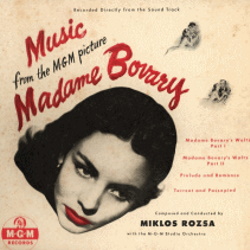
MGM Studios had a history of successfully adapting popular works of literature for the big screen. In that tradition, the 1857 French novel “Madame Bovary” by Gustave Flaubert was universally recognized as a classic of literature, which MGM believed merited a film presentation. The film rights were purchased, Pandro S. Berman was assigned production with a $2.076 million budget, Robert Ardey was hired to write the screenplay with instructions to maintain fidelity to the novel, and Vincente Minnelli was tasked with directing. A stellar cast was hired, including Jennifer Jones as Emma Bovary, Van Heflin as Charles Bovary, Louis Jourdan as Rodolphe Boulanger, and James Mason as Gustave Flaubert. Read more…
THE LOST WEEKEND – Miklós Rózsa
 GREATEST SCORES OF THE TWENTIETH CENTURY
Original Review by Craig Lysy
The genesis of the film arose as director Billy Wilder was directing his previous movie, Double Indemnity. His screenwriter Raymond Chandler was a recovering alcoholic, who returned to drinking during the stress of collaborating with Wilder. Wilder related that he made the film, in part, as an attempt to better understand Chandler. Wilder sold his story idea to Paramount executives who assigned production to Charles Brackett with a budget of $1.25 million. Brackett and Wilder collaborated in writing the screenplay, by adapting the novel The Lost Weekend by Charles R. Jackson. Notable was their excising of the novel’s homosexual overtones, which portrayed Don Birnam as a closeted homosexual. Wilder himself would direct and he assembled a fine cast, which included Ray Milland as Don Birnam, Jane Wyman as Helen St. James and Phillip Terry as Wick Brinam. Controversy arose from the liquor industry, which was willing to offer $5 million to kill the project as they feared it would reignite political efforts to restore prohibition. Most interesting is that Wilder later related that he would have accepted the offer and burned the negatives himself had they presented it to him personally. Groundbreaking is film’s uncompromising depiction of the pathos of personal destruction precipitated by alcoholism. Today the film is seen as catalyzing a paradigmal change in how Hollywood portrayed drunks, which up to this film had always been portrayed them comedically. Read more…
JUNGLE BOOK – Miklòs Ròzsa
 GREATEST SCORES OF THE TWENTIETH CENTURY
Original Review by Craig Lysy
In 1938 producer-director Alexander Korda decided to cash in on the commercial success realized by films based on novels by the famous English writer Rudyard Kipling. He purchased the film rights to his 1894 classic Jungle Book, with production slated to commence in 1939. The onset of WWII and Nazi Blitz forced him due to safety concerns, to relocate his company to Hollywood, which pushed production back to 1941. His own company, Alexander Korda Films would produce he film and he secured financial backing from United Artist who provided a $300,000 budget, which included filming in technicolor. Alexander Korda would produce the film, his brother Zoltan was tasked with directing, while his other brother Vincent was production designer. Screenwriter Laurence Stallings was hired to create a script derived from the nine Mowgli stories and drew inspiration from five of them: “Mowgli’s Brothers”, “Tiger! Tiger!”, “How Fear Came”, “Letting in the Jungle”, and “The King’s Ankus”. A fine cast was hired, which included Sabu as Mowgli, Joseph Calleia as Buldeo, John Qualen as the barber, Frank Puglia as the pundit, and Rosemary DeCamp as Messua. Filming was challenging due to creative differences between Alexander who wanted a fantasy adventure, and Zoltan who wanted a more realistic story. In the end, Alexander’s vision prevailed. Read more…
A DOUBLE LIFE – Miklós Rózsa
 GREATEST SCORES OF THE TWENTIETH CENTURY
Original Review by Craig Lysy
In 1946 producer Michael Kanin decided to collaborate with his brother Garson Kanin and his wife Ruth Gordon for his next project; a film noir with a Shakespearean twist. The husband-and-wife team crafted a fine screenplay and Michael Kanin used his own Kanin Productions company to fund the project, with Universal Studios agreeing to distribute the film. George Cukor was tasked with directing, and a fine cast was eventually assembled. Laurence Olivier was originally sought for the lead, but was unavailable, so a reluctant Ronald Colman was given the role of Anthony “Tony” John. He would be supported by a coach to refine his Shakespearean diction and delivery. Joining him would be Signe Hasso as Brita, Edmund O’Brien as Bill Friend, and Shelley Winters as Pat Kroll. Read more…
JULIUS CAESAR – Miklós Rózsa
 GREATEST SCORES OF THE TWENTIETH CENTURY
Original Review by Craig Lysy
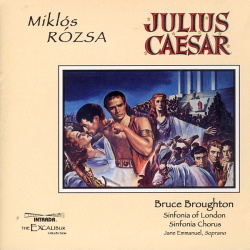
Metro-Goldwyn-Mayer studio executives were impressed by the commercial success of Henry V in 1944 and sought to adapt another of William Shakespeare’s plays for the big screen. They chose his 1599 work Julius Caesar and tasked producer John Houseman with the project with a generous budget of $2.0 million. Houseman had a vision for the film and hired Joseph Mankiewicz to direct, as the story would be dialogue driven, which was the type of film in which Mankiewicz excelled. Once attached to the project Mankiewicz made the creative decision to personally adapt the play and write the screenplay. Houseman did not want another lavish epic, but rather a small more intimate production, which explored the drama of ambition and power politics. Second, he insisted that the film be shot in black and white because “we wanted people to relate to the newsreels, to the Fascist movements in Europe, which were still relevant”. A cast for the ages was assembled, which included Marlon Brando as Marc Anthony, James Mason as Brutus, John Gielgud as Cassius, Louis Calhern as Julius Caesar, Edmund O’Brien as Casca, Greer Garson as Calpurnia, and Deborah Kerr as Portia. Read more…
KING OF KINGS – Miklós Rózsa
 GREATEST SCORES OF THE TWENTIETH CENTURY
Original Review by Craig Lysy
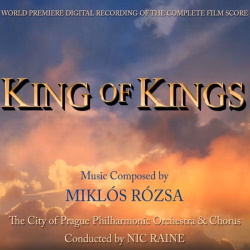
Producer Samuel Bronston related that the most impactful event in human history was the birth, life and death of Jesus Christ. He had long nurtured the dream to bring this remarkable tale to the big screen. His conception, which was presented to Metro-Goldwyn-Mayer Studios was to make Jesus more accessible, by presenting Him as a flesh and blood man living during tumultuous times. Given the stunning success of Ben-Hur in 1959 MGM decided to cash in on the public’s love of biblical epics and gave Bronston permission to proceed. He hired writers Philip Yordan and Ray Bradbury to write the screenplay, and brought in veteran director Nicholas Ray to direct. A splendid cast was assembled, which included Jefferey Hunter as Jesus, Siobhán McKenna as Mary, Robert Ryan as John the Baptist, Ron Randell as Lucius, Hurd Hatfield as Pontius Pilate, Frank Thring as Herod Antipas, Rip Torn as Judas Iscariot, Harry Guardino as Barabbas, Carmen Sevilla as Mary Magdalene, Brigid Balzen as Salomé, and Guy Rolfe as Caiaphas. Read more…
IVANHOE – Miklós Rózsa
 GREATEST SCORES OF THE TWENTIETH CENTURY
Original Review by Craig Lysy
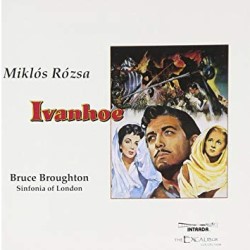
In 1935 MGM Studio sought to bring Sir Walter Scott’s epic Medieval Knight tale Ivanhoe (1819) to the big screen. After crafting a screenplay, the project never got off the ground as production delays resulted in selecting two different casts, one in 1935 starring Fredric March, Loretta Young and Gary Cooper, and another in 1938 starring Robert Taylor, Myrna Loy and Clark Gable. Another setback to production occurred with the onset of WWII, which caused filming on location in England to be put hold. New energy for the project arose in 1946 when Æneas MacKenzie crafted a new script, which satisfied MGM executives. Pandro S. Berman was given a very generous budget to produce the film and he brought in Richard Thorpe to direct. A third stellar cast was hired, which included; Robert Taylor as Ivanhoe, Elizabeth Taylor as Rebecca, Joan Fontaine as Rowena, George Sanders as Sir Brian De Bois-Guilbert, Emlyn Williams as Wamba and also the Narrator, Felix Aylmer as Isaac, Finlay Currie as Cedric, and Guy Rolfe as Prince John. Read more…
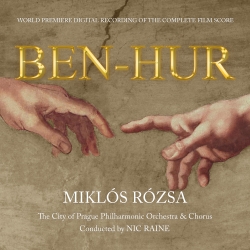
BEN-HUR – Miklós Rózsa
 GREATEST SCORES OF THE TWENTIETH CENTURY
Original Review by Craig Lysy
As a new decade dawned, MGM studio executives began searching for a grand tale to bring to the screen. They decided in 1952 to cast their lot with a remake of their epic 1925 silent film, Ben-Hur. The film’s source material would again reference Lew Wallace’s 1880 novel Ben-Hur: A Tale of the Christ. It would take six years before producer Sam Zimbalist could bring the project to fruition. It required twelve versions of the script, from four different writers, to finally satisfy the demands of director William Wyler. Casting was also challenging as over 5,000 people needed to be hired for minor roles and extras. The studio spared no expense, ultimately providing Wyler with an astounding $15 million budget. Charlton Heston secured the titular role of Judah Ben-Hur and was supported by a fine cast, which included Stephen Boyd as Messala, Jack Hawkins as Quintus Arius, Haya Harareet as Esther, Martha Scott as Miriam, Sam Jaffe as Simonides, Hugh Griffith as Sheik Ilderim, Cathy O’Donnell as Tirzah, Frank Thring as Pontius Pilate, and Finlay Currie as Balthazar narrator. Read more…
EL CID – Miklós Rózsa
 GREATEST SCORES OF THE TWENTIETH CENTURY
Original Review by Craig Lysy
Producer Samuel Bronston had just finished his epic film King of Kings (1961) and decided that the time was finally right to realize his long desired ambition to bring the story of El Cid to the screen. Fredric Frank, a longtime collaborator with Cecil B. DeMille, had written a brilliant story and Bronson tasked him, Philip Yordan and Ben Barzman with writing the screenplay. Anthony Mann was given the director reigns and a stellar cast was hired. Charlton Heston was cast for the titular role and joined by Sophia Loren as Doña Chimene, Herbert Lom as Ibn Yussuf, Raf Vallone as Count García Ordóñez, Geneviève Page as Doña Urraca, John Fraser as King Alfonso VI, Michael Hordem as Don Diego, and Frank Thring as Emir Al-Kadir. Controversy among the two principle actors arose when Heston found out that Loren was being paid one million dollars more than him. He became furious and his disdain leaked out into his performance. You will notice that he consistently refuses to look at Loren, even during romantic moments, which detracted from his performance and the film’s narrative. Read more…
THE THIEF OF BAGDAD – Miklós Rózsa
 GREATEST SCORES OF THE TWENTIETH CENTURY
Original Review by Craig Lysy
Renowned director Alexander Korda had long envisioned embarking on a remake of the 1924 fantasy adventure The Thief of Bagdad. He set his plans into motion early in 1939, selecting German director Ludwig Berger to manage the project. Creative differences however led to Berger’s replacement as well as his composer Oscar Straus. British director Michael Powell was brought in, however when World War II began, he was transferred to the War Office to begin work on a morale-boosting documentary. Because of the Nazi Blitz, Korda was forced to move film production to Hollywood and American director Tim Whelan was tasked with salvaging the film. The original cast was retained, which included; Conrad Veidt as Jaffar, Sabu as Abu, June Duprez as the Princess, John Justin as Ahmed, Rex Ingram as Djinn, Miles Malleson as the Sultan. The story takes inspiration from the classic Arabian tale One Thousand and One Nights, as well as the novel The Tower and the Elephant by Robert Howard, and offers a classic villain, the love story of a handsome young prince and princess, a heroic young boy, magic, and adventure. Read more…
SPELLBOUND – Miklós Rósza
 GREATEST SCORES OF THE TWENTIETH CENTURY
Original Review by Craig Lysy
The 1945 Alfred Hitchcock mystery/suspense film Spellbound dealt with the new field of psychoanalysis and the inner workings of the human mind. The story offers testimony to Hitchock’s supreme mastery of suspense, camera work, and cinematography. The stellar cast included Ingrid Bergman playing Dr. Constance Peterson, a psychoanalyst working at the Green Manors mental hospital and Gregory Peck playing her love interest, the dashing Dr. Edwards. This is, at its crux, a love story. We see a cool and analytical Constance lose her professional detachment and immediately fall in love with Dr. Edwards upon his arrival. Sadly unsettling aspects of his personality slowly begin to reveal themselves. As the story unfolds she discovers that her love interest is really an imposter, an outsider trying to falsely portray himself as Dr. Anthony Edwards. Driven by love, Constance seeks to illuminate his path back to sanity by trying to resurrect repressed memories without shattering him in the process, as such the story is a classic commentary on the eternal conflict of heart vs. mind. Read more…
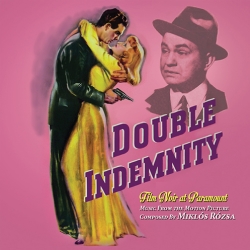
DOUBLE INDEMNITY – Miklós Rózsa
 GREATEST SCORES OF THE TWENTIETH CENTURY
Original Review by Craig Lysy
James Cain’s story “Double Indemnity” was first published in 1935 as an eight part serial in Liberty Magazine, but because of its sordid narrative studios were loathe buying the film rights, fearful of censoring by the Hayes Commission. When it was released as a successful novel in 1943, director Billy Wilder convinced Paramount to let him take on the project. Raymond Chandler was hired to collaborate with Wilder in writing the screenplay. Yet they clashed and Chandler stormed off the project, refusing to return unless his demands were met. The Studio agreed and work continued, although the two men detested each other. Casting was challenging as many actors were loathe to take on such reprehensible roles. Yet Wilder was persistent and eventfully secured a stellar cast, which included Fred McMurray as Walter Neff, Barbara Stanwyck as Phyllis Dietrichson, Edgar G. Robinson as Barton Keyes, Porter Hall as Mr. Jackson, Jean Heather as Lola Dietrichson, Tom Powers as Mr. Dietrichson and Byron Barr as Nino Zachetti. Read more…

Shop at the Movie Music UK Store

Member of the

 MOVIE MUSIC UK