Archive
HAMNET – Max Richter
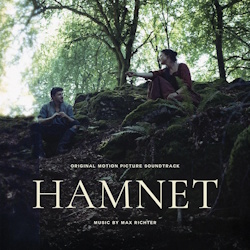 Original Review by Jonathan Broxton
Director Chloe Zhao’s film Hamnet, which is based on the 2020 novel by Maggie O’Farrell, is a lyrical reimagining of the brief life and death of Hamnet Shakespeare, the son of the legendary poet and writer William Shakespeare and his wife Agnes “Anne” Hathaway, musing on the fact that his passing may have inspired the creation of one of the greatest works of literature in history. The story centers mostly on Agnes, who is portrayed as a perceptive, intuitive woman with a deep connection to nature; the first half of the film looks at Agnes and William’s early courtship, their subsequent marriage, and offers a portrait of family life in Elizabethan England circa 1580, following the birth of their twin children Hamnet and Judith. In time William begins traveling to London to write and perform his plays, but eventually the spread of plague brings sickness to the Shakespeare household, and Judith falls gravely ill. Hamnet, who has been charged by his father with looking after the family in his absence, desperately attempts to help her, and asks God if he can swap places with her; Judith eventually recovers, but Hamnet contracts the plague too, and dies aged just eleven. After Hamnet’s death, the story then explores how Agnes and William grieve differently: Agnes’s sorrow is visceral and consuming, while William channels his grief into his work. Read more…
My Brilliant Friend: The Subtle Art of Max Richter
 by Mark Walker
There’s a moment in the second episode of the HBO-RAI TV series My Brilliant Friend that encapsulates for me everything about the subtle art of Max Richter’s film scoring. In a pivotal sequence the two young girls, Lila and Elena, decide to venture outside of their Neapolitan ghetto for the very first time. It is, naturally, Lila’s idea. She’s the daring, wilful, feisty one; contrast with middle-of-the-road Elena, always afraid to challenge the status quo, yet irresistibly fascinated by the allure of her brilliant friend. The scene is richly symbolic and tells us much about the relationship between the pair that will develop – in the course of Elena Ferrante’s wonderful novels and in this astonishingly faithful and utterly riveting TV adaptation – throughout their lives into adulthood and old age. As the girls pass under the ominous railway bridge – a literal and metaphorical gateway to the outside world – they hold hands, they shout joyfully making echoes in the tunnel, they are excited about the journey ahead.
Richter scores all this initially with just a piano – simple arpeggios, a very simple melody, his wistful motif for Elena and Lila in fact. As the girls walk along the dusty highway, the string ensemble joins in, solemn legato chords enhance the feeling of melancholy. This seems odd at first, since the trip has begun with such apparent optimism. Then, as thunderclouds build overhead and we see Lila start to drag her feet, there’s a touch of magic – a solo violin takes over the poignant melody, soaring above the ensemble. The music has been telling us all along that this is not going to be the jolly adventure we and the characters had imagined. Read more…
MARY QUEEN OF SCOTS – Max Richter
 Original Review by Jonathan Broxton
The rivalry that existed between Mary Stuart, the daughter of King James V of Scotland, and Elizabeth Tudor, the daughter of King Henry VIII of England and Anne Boleyn, came to be one of the defining elements of British political and royal life. Various complicated legal issues regarding legitimacy and succession meant that the two cousins had valid claims to the British throne, but it was Elizabeth who eventually took it, becoming queen in 1558. Within a year Mary had married King Francis II of France, but following his death just two years later she returned to Scotland to take up her throne there. Tragedy and death dogged Mary’s life – her first husband was murdered, and her second husband eventually fled to Scandinavia – and by 1567 she had been forced to abdicate her throne in favor of her one year old son. Seeking the help of her cousin, she left for London, but the increasingly paranoid Elizabeth saw her as a threat, and had her imprisoned for plotting to assassinate her; Mary was eventually executed in 1586. This story has been told many times on screen, most famously in a popular 1971 film starring Vanessa Redgrave and Glenda Jackson. This version of the story stars Saoirse Ronan and Margot Robbie as the two queens, and is directed by Josie Rourke from a screenplay by House of Cards creator Beau Willimon. Read more…
WALTZ WITH BASHIR – Max Richter
 Original Review by Jonathan Broxton
Waltz With Bashir is a very unusual animated documentary, directed by Ari Folman, which examines the horrors of the 1982 Lebanon war from the point of view of the director himself, when he was a 19-year old soldier in the Israeli Defence Force. The film has been the recipient of much praise on the independent film and festival circuit, receiving award nominations from the Cannes Film Festival, the European Film Awards, and the Los Angeles Film Critics Association. The score for Waltz With Bashir is by Scots-German composer Max Richter, a former student of Luciano Berio, and whose first major film score this is.
The word ‘eclectic’ doesn’t even come close to describing this score; it runs the gamut from modern dance music and percussive electronica Read more…

Shop at the Movie Music UK Store

Member of the

 MOVIE MUSIC UK