Archive
IL POSTINO – Luis Enríquez Bacalov
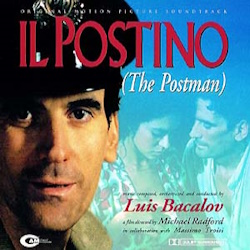 THROWBACK THIRTY
Original Review by Jonathan Broxton
One of the most surprising global hits of the 1990s was Il Postino, The Postman, an Italian romantic drama film based on the novel Ardiente Paciencia by Antonio Skármeta, and directed by English filmmaker Michael Radford. The film is set in the early 1950s on a small, picturesque island off the coast of Italy and centers on Mario Ruoppolo, a shy and uneducated local man who takes a job as a postman. His only task is to deliver mail to Pablo Neruda, the famous Chilean poet, who has taken refuge on the island after fleeing Augusto Pinochet’s government and going into political exile. As Mario and Neruda begin to interact, Mario becomes fascinated by the poet’s charisma, politics, and especially his romantic use of language; eventually, Mario seeks Neruda’s guidance in learning how to express himself, particularly because he has fallen in love with Beatrice Russo, a beautiful but reserved woman who works at a local café. Read more…
Luis Enríquez Bacalov, 1933-2017
 Composer Luis Enríquez Bacalov died on November 15, 2017, at his home in Rome, Italy, after suffering a stroke. He was 84.
Bacalov was born in August 1933 in Buenos Aires, Argentina, to a Bulgarian Jewish family and studied music from an early age; his teachers included Enrique Barenboim, the father of famed conductor Daniel Barenboim, and pianist Berta Sujovolsky. Bacalov relocated from Argentina to Italy in the 1950s, and spent the majority of the rest of his life living and working there.
He scored his first film, a low-budget ghost story called Questi Fantasmi, in 1954, and then for many years fronted a rock group in the 1960s called Luis Enrique and His Electronic Men, but first came to prominence in 1964 when he arranged the music for Pier Paolo Pasolini’s film The Gospel According to St. Matthew, which earned him an Academy Award nomination for Best Music Adaptation or Treatment when the film was released in the United States in 1967.
Bacalov quickly established himself as one of the most popular and successful composers in the Italian film industry in the 1960s and 70s; his most famous scores were for spaghetti westerns such as Django (1966), Sugar Colt (1966), Quién Sabe (1967), Lo Chiamavano King (1971), and Il Grande Duello (1972), and gritty crime thrillers such as The Summertime Killer (1972), Milano Calibro 9 (1972), Il Boss (1973), and I Padroni Della Città (1976). He scored Federico Fellini’s City of Women in 1980, Fellini’s first film after the death of Nino Rota, and then achieved arguably his most prominent international success when he won the Academy Award for Best Score in 1995 for Il Postino, The Postman. Read more…

Shop at the Movie Music UK Store

Member of the

 MOVIE MUSIC UK