Archive
INDIANA JONES AND THE LAST CRUSADE – John Williams
 THROWBACK THIRTY
GREATEST SCORES OF THE TWENTIETH CENTURY
Original Review by Jonathan Broxton
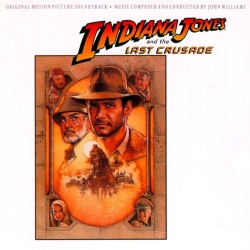
The third movie in director Steven Spielberg’s Indiana Jones series was Indiana Jones and the Last Crusade, and whereas 1984’s Temple of Doom was a prequel to Raiders of the Lost Ark, Last Crusade was a direct sequel, set just two years later in 1938. Harrison Ford returns as the titular archaeologist-adventurer, who is sent off on a globe-trotting escapade when he receives news from American billionaire Walter Donovan (Julian Glover) that his long-estranged father Henry Jones (Sean Connery) has gone missing while searching for the holy grail. Jones teams up with his old friends and colleagues Marcus Brody (Denholm Elliott) and Sallah (John Rhys-Davies) on the quest to find his father, and quickly becomes embroiled in a vast labyrinthine plot involving ancient myths and legends, a brotherhood of religious warriors, way too many Nazis, and a beautiful Austrian art professor named Elsa Schneider (Alison Doody) to whom there is more than meets the eye. The whole thing is a delight from start to finish, with several wonderfully exciting action set pieces, and beautiful location settings, but the cornerstone of the film is the father-and-son chemistry between Ford and Connery, whose outward gruffness and constant bickering masks a deep love and affection. Whereas Ford is an all-action matinee idol hero, Connery is a slightly bumbling academic, more at home with books and libraries than punching Nazis in the face, but who is still able to make his son feel like a 12-year old when he calls him ‘junior’. Read more…
JURASSIC PARK – John Williams
 GREATEST SCORES OF THE TWENTIETH CENTURY
Original Review by Craig Lysy
Steven Spielberg became aware of Michael Crichton’s novel Jurassic Park as the two collaborated on the television series E.R. A bidding war for the rights ensued, with Spielberg and Universal Pictures prevailing over Warner Brothers and Tim Burton, Columbia Pictures and Richard Donner, James Cameron and Joe Dante. Kathleen Kennedy and Gerald Molen would produce the film with Spielberg directing. Spielberg understood the challenges he faced bring the dinosaurs to life and sought at all costs to not repeat the technical nightmare he experienced in Jaws. He turned to George Lucas’ Industrial Light and Magic Company to create groundbreaking computer –generated imagery and ended up making history. Crichton was hired to adapt his novel to the screen but Spielberg was unsatisfied with the violence. Malia Scotch Marmo was tasked with the rewrite in late 1991, but she also did not satisfy Spielberg’s vision. Universal executives brought in Casey Silver and David Koepp who ultimately crafted the script used in the film. A fine cast was assembled with Sam Neill securing the role of Alan Grant after William Hurt and Harrison Ford both declined. Joining him would be Laura Dern as Ellie Sattler, Jeff Goldblum as Ian Malcolm, Richard Attenborough as John Hammond, Bob Peck as Robert Muldoon, Samuel Jackson as Ray Arnold, B.D. Wong as Henry Wu, and Ariana Richards and Joseph Mazzello as Hammond’s niece and nephew Lex and Tim. Read more…
THE ACCIDENTAL TOURIST – John Williams
 THROWBACK THIRTY
Original Review by Jonathan Broxton
The Accidental Tourist is a romantic drama film directed by Lawrence Kasdan, adapted from the acclaimed novel by Anne Tyler. It stars William Hurt as Macon Leary, an introverted travel writer whose relationship with his wife Sarah (Kathleen Turner) begins to break down after the death of their son. Sarah eventually leaves him and moves out, pending a divorce, and when Macon breaks his leg after tripping over his disobedient dog and falling down the stairs, he moves back into his childhood home with his eccentric siblings to recuperate. After a while, Macon hires the quirky Muriel Pritchett (Geena Davis) as a dog obedience trainer; despite the enormous differences in their personalities, a spark of attraction develops between the two, and they begin a relationship. However, Macon’s new life is thrown into turmoil when Sarah returns, wanting to re-kindle their marriage, forcing Macon to make some difficult decisions. The film was an enormous critical success, earning Academy Award nominations for Best Picture and Best Adapted Screenplay, and winning Geena Davis an Oscar for Best Supporting Actress. Read more…
SCHINDLER’S LIST – John Williams
 GREATEST SCORES OF THE TWENTIETH CENTURY
Original Review by Craig Lysy
The genesis of Schindler’s List lay with holocaust survivor Leopold Pfefferberg, whose tale of Oskar Schindler inspired Thomas Keneally to write his Booker Prize winning novel, Schindler’s Ark, in 1982. It came to pass that studio president Sid Sheinberg saw opportunity in the story and mailed Steven Spielberg a review of the book by the New York Times. Spielberg was deeply moved by the narrative and secured financial backing from Universal Pictures, which purchased the screen rights. Yet the then 37-year-old hesitated and ultimately delayed production ten years as he felt himself too young to take on the pathos of the Holocaust. When the time eventually came to begin production, he tasked Steven Zaillian with writing the screenplay, and the struggled to hire a director, soliciting several including Roman Polanski, Sydney Pollack, Billy Wilder and Martin Scorsese. Ultimately Spielberg took Wilder’s counsel to direct the film himself. For the cast he brought in an outstanding ensemble, which included Liam Neeson as Oskar Schindler, Ben Kingsley as Itzhak Stern, Ralph Fiennes as Captain Amon Göth, Caroline Goodall as Emilie Schindler, Jonathan Sagalle as Poldek Pfefferberg, and Embeth Davidtz as Helen Hirsch. Read more…
E.T. THE EXTRA-TERRESTRIAL – John Williams
 GREATEST SCORES OF THE TWENTIETH CENTURY
Original Review by Craig Lysy
Steven Spielberg, like most kids, suffered with the divorce of his parents. He was 14, and to cope with his circumstances, he created an imaginary alien friend, who became a surrogate brother. Over time this evolved into a story, which his sought to film called “Growing Up”. After the success of Raiders of The Lost Ark, he returned to fashioning his childhood story, which would now incorporate elements from another story he had written called “Night Skies,” where aliens terrorize a family. He brought in screenwriter to Melissa Mathison to craft a story of a special needs child bonding with a friendly alien. The result was a story to be called “E.T. and Me,” which Spielberg pitched to Columbia Studios. Remarkably they rejected the project, believing that it would only appeal to small kids. Well, Spielberg was undeterred, and approached Sid Sheinberg of MCA, who saw the success of Raiders of the Lost Ark, and agreed to fund the project. They bought back the script from Columbia Pictures for $1 million dollars and granted 5% of the film’s net profits. Spielberg and Kathleen Kennedy would produce the film, with Spielberg also directing. For his creative team, he brought in Carlo Rambaldi, who had created the aliens seen in Close Encounters of the Third Kind. The story required Spielberg to cast child actors, and he screened hundreds. His patience and hard effort paid off as he managed to secure a perfect cast, which included; Henry Thomas as Elliot, Drew Barrymore as Gertie, Dee Wallace as Mary, Peter Coyote as Keys, and Robert MacNaughton as Michael. Read more…
RAIDERS OF THE LOST ARK – John Williams
 GREATEST SCORES OF THE TWENTIETH CENTURY
Original Review by Craig Lysy
In 1973 George Lucas wrote a story titled “The Adventures of Indiana Smith”, drawing inspiration from adventure movies of the 1930s and 1940s. While on a shared vacation to Hawaii with Steven Spielberg, Lucas pitched his story, and convinced him to direct a trilogy of films. Upon Spielberg’s suggestion, the surname was changed to Jones and screenwriter Lawrence Kasdan was hired to create the script. The major Hollywood studios all rejected the project because of the $20 million price tag and Lucas’ exacting terms. Eventually Paramount took the gamble and Frank Marshall was tasked with producing the film. After exhausting efforts to cast the lead man, Spielberg convinced Lucas to cast Harrison Ford for the role of Indiana Jones. Joining him on the project would be Paul Freeman as Dr. René Belloq, Karen Allen as Marion Ravenwood, John Rhys-Davies as Sallah, Ronald Lacey as Major Arnold Toht, Denholm Elliot as Dr. Marcus Brody, and Wolf Kahler as Colonel Dietrich. Read more…
THE EMPIRE STRIKES BACK – John Williams
 GREATEST SCORES OF THE TWENTIETH CENTURY
Original Review by Craig Lysy
The stunning success of Star Wars caused George Lucas to rethink his original vision of a single stand-alone film. He now saw opportunity for a story arc, which would span additional films. To that end, he hired veteran science fiction writer Leigh Brackett to write the next screenplay, based on his story titled The Empire Strikes Back. Lucas did not like her first draft, and when she died shortly there after of cancer, he was left to rewrite the script himself. He shifted the story into a much darker narrative, which critics today acknowledge as the best film of the franchise. Lucas did not want to direct and so brought in trusted friend Irvin Kershner, his former professor. Most of the original cast would reprise their roles; Mark Hamill as Luke Skywalker, Harrison Ford as Han Solo, Carrie Fisher as Princess Leia Organa, Anthony Daniels as C-3PO, Kenny Baker as R2-D2, Peter Mayhew as Chewbacca, and David Prowse as Lord Darth Vader (voiced by James Earl Jones). Joining them would be Frank Oz as Yoda, Billy Dee Williams as Lando Calrissian, and Jeremy Bulloch as Boba Fett. Read more…
SUPERMAN – John Williams
 GREATEST SCORES OF THE TWENTIETH CENTURY
Original Review by Craig Lysy
In 1973 producers Ilya Salkind and Pierre Spengler believed it was time to bring a classic super hero to the big screen. After protracted negotiations with DC Comics, they secured film rights to produce two Superman movies, which they would shoot back to back. A number of screenwriters were hired and let go before until a team comprised of Mario Puzo, David Newman, Leslie Newman and Robert Benton took up the project. Yet Salkind and Spengler were still not satisfied and so hired Tom Mankiewicz to do the final rewrite, which was completed in July 1976. Thematic for the film was taking the long and tortuous road to hire a director and cast. Richard Donner finally won out over nine other directors. As for the titular role, almost all of the leading men of the day were either turned down, or showed no interest. As such, Spengler decided to cast an unknown, and after over 200 auditions, newcomer Christopher Reeve won the part – bu it was felt he was too skinny. Rather than wear a muscle suit, Reeve went on a weight-lifting regimen, adding a massive 24 pounds of muscle. Joining the cast would be Marlon Brando as Jor-El, Gene Hackman as Lex Luthor, Ned Beatty as Otis, Jackie Cooper as Perry White, Glenn Ford as Jonathan Kent, Phyllis Thaxter as Martha Kent, Margot Kidder as Lois Lane, and Valerie Perrine as Eve Teschmacher. Read more…
SOLO – John Powell
 Original Review by Jonathan Broxton
WARNING: THIS REVIEW CONTAINS PLOT SPOILERS. IF YOU HAVE NOT YET SEEN THE FILM, YOU MIGHT WANT TO CONSIDER WAITING UNTIL AFTER YOU HAVE DONE SO TO READ IT.
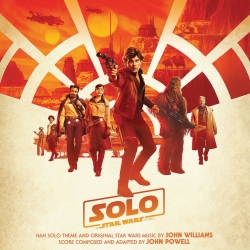
In the years since Disney bought the rights to Lucasfilm from Twentieth Century Fox, the Star Wars universe has grown exponentially. Not only have we had two films in the official sequel trilogy – The Force Awakens and The Last Jedi – but a number of side projects have also been greenlit, all expanding on the history and mythology of the franchise. The first of those ‘Star Wars stories’ was Rogue One in 2016, which looked at the events of how the Rebel Alliance came to possess the plans to the original Death Star, and eventually came to be seen as an immediate prequel to the first 1977 movie. Further movies are in development, including ones which would explore the origins of characters such as Obi-Wan Kenobi, Lando Calrissian, and Boba Fett. But, before all that, we have this movie: Solo, which looks at the early life of everyone’s favorite scoundrel and scruffy-looking nerf herder. The basic story of Han Solo’s life have long been known: he was an orphan and petty criminal on his home planet, Corellia, and eventually became an intergalactic smuggler, picking up a partner in the shape of the wookiee Chewbacca, and a ship in the shape of the Millennium Falcon, along the way – winning the latter in a card game from fellow smuggler and handsome playboy Lando Calrissian. What Solo does is look at the detail: his life on Corellia, the people he knew there at the time, how he first meets Chewbacca, how he acquires the Falcon, and what adventures he embarks up on during those first journeys among the stars. Read more…
CLOSE ENCOUNTERS OF THE THIRD KIND – John Williams
 GREATEST SCORES OF THE TWENTIETH CENTURY
Original Review by Craig Lysy
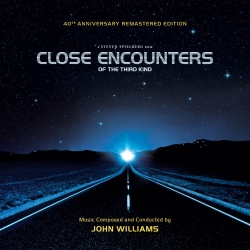
Since his youth, Steven Spielberg had aspired to create a feature length science fiction film. His 1970 short story Experiences was his initial conception, which explored teenagers witnessing a wondrous “meteor shower light show” in the night sky. He pitched his idea and secured backing from Columbia Studios to proceed with “Watch the Skies”. Rewrites caused delays, and it was decided that he proceed with another project first, “Jaws”. The enormous financial success of “Jaws” resulted in Columbia Studios granting him significant creative control, which allowed for the development of the science fiction film he had always dreamed of. The script was written by Spielberg, but had input and additional refinements by several screenwriters. The title was changed to its final form as a derivation of ufologist J. Allen Hynek’s classification methodology for “close encounters”. Spielberg assembled a fine cast anchored by “Jaws” star Richard Dreyfuss as Roy Neary, Francois Truffault as Claude Lacombe, Melinda Dillon as Jillian Guiler, Teri Garr as Veronica Neary, and Cary Guffey as Barry Guiler. Read more…
STAR WARS – John Williams
 GREATEST SCORES OF THE TWENTIETH CENTURY
Original Review by Craig Lysy
George Lucas conceived of a space adventure drawn from the Flash Gordon sequels in 1971 following the completion of his first feature film, THX 1138. When his efforts to secure film rights were rebuffed, he resolved to create his own fantasy adventure. He wrote a script in 1973 and producer Larry Kurtz assisted him in securing financing, but United Artists, Disney and Universal Studios all declined, stating that they found the story strange. Lucas however persevered and finally obtained backing by 20th Century Studio exec Alan Ladd Jr. The script evolved through several incarnations, finally coalescing into the film version in 1975. Lucas formed a visual effects company, Industrial Light & Magic to realize his technical vision, which would demand visuals not seen before by the industry. The film and company would provide a seminal event, which would usher in a new age of filmmaking. Read more…
JAWS – John Williams
 GREATEST SCORES OF THE TWENTIETH CENTURY
Original Review by Craig Lysy
As we today look back to 1975, we recognize that Jaws was a transformative film, which forever altered how the film industry would operate. Jaws inaugurated what has become known in the modern lexicon as, the Summer Blockbuster. After 1975 studio executives would thereafter conceive and fund big summer action and adventure films, which would take the public by storm, and fill studio coffers. The film was adapted from a Peter Benchley novel, which was originally conceived with the title “Leviathan Rising”, but later discarded for Jaws. It is as simple a tale as they come, man against the beast. We find the summer vacation community Amity Island plagued by a series of shark attacks, which threaten the island’s livelihood. Rogue seafarer Quint (Robert Shaw) is hired to hunt down and kill the beast with all dispatch. Accompanying him would be landlubber Police Captain Brody (Roy Scheider) and, oceanographer Hooper (Richard Dreyfuss). They wage war against this massive leviathan, which leads to Quint’s death, the loss of his boat, the Orca, and Hooper and Brody barely surviving. Well, the film was a massive commercial success, which spawned a franchise of sequels. It was also a critical success, earning four Academy Award nominations for Best Picture, Best Film Editing, Best Sound and Best Film Score, winning three; best Film Editing, Best Sound and Best Film Score. Read more…
EMPIRE OF THE SUN – John Williams
 THROWBACK THIRTY
GREATEST SCORES OF THE TWENTIETH CENTURY
Original Review by Jonathan Broxton
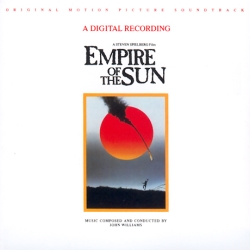
By the end of 1986, Steven Spielberg was probably the most famous and financially successful director in Hollywood. However, although he had directed a handful of the highest grossing films of all time – Jaws, Close Encounters of the Third Kind, Raiders of the Lost Ark, E. T. The Extra-Terrestrial, Indiana Jones and the Temple of Doom –he privately expressed a desire to make more serious films. The comparative failure of The Color Purple in 1985 just magnified that desire, so in 1987 he decided to try again, by making a movie based on J. G. Ballard’s semi-autobiographical coming-of-age novel Empire of the Sun. The film starred the then 13-year-old Christian Bale as Jim Graham, an upper class English schoolboy living with his diplomat parents in Shanghai in 1941, whose life is shattered by the outbreak of World War II, and who ends up desperately trying to survive in a Japanese prisoner of war camp. Unfortunately for Spielberg, the film – which also starred John Malkovich, Miranda Richardson, and Nigel Havers – did not ignite the passions of audiences like his popcorn blockbusters did, and it was only a moderate critical and commercial success; Spielberg would have to wait another five years for his breakthrough into cinematic respectability with Schindler’s List in 1993. In addition, the film was largely overlooked at the Academy Awards, receiving only six technical nominations, but not winning any. Read more…
THE POST – John Williams
 Original Review by Jonathan Broxton
In 1971 the Washington Post was still a comparatively small-scale regional newspaper, lagging behind such behemoths as the New York Times in terms of prestige and influence. That all changed when the Post’s hard boiled news editor Ben Bradlee found himself in possession of what became known as The Pentagon Papers: a leaked classified report which proved that the US government had lied to the American people about the scope of its involvement in the Vietnam War, and that multiple US presidents were involved in the cover-up. Director Steven Spielberg’s film The Post tells the story of how the newspaper came into possession of the Papers, and the subsequent protracted legal and ethical battles that ensued over whether or not to publish; it stars Tom Hanks as Bradlee, Meryl Streep as the Post’s owner Kay Graham, and has a stellar supporting cast including Bob Odenkirk, Bruce Greenwood, Tracy Letts, Bradley Whitford, Matthew Rhys, Carrie Coon, Michael Stuhlbarg, and Sarah Paulson. Read more…
STAR WARS: THE LAST JEDI – John Williams
 Original Review by Jonathan Broxton
WARNING: THIS REVIEW CONTAINS PLOT SPOILERS. IF YOU HAVE NOT YET SEEN THE FILM, YOU MIGHT WANT TO CONSIDER WAITING UNTIL AFTER YOU HAVE DONE SO TO READ IT.
With George Lucas’s prequel trilogy having received almost universal critical disdain in the decade that followed the release of Revenge of the Sith, it took the 2015 film The Force Awakens to re-ignite the Star Wars franchise and bring back the love that so many millions had for the original trilogy that began in 1977. Luxuriating in $2 billion worldwide grosses, and having introduced a cache of interesting new characters to sit alongside the story stalwarts, The Force Awakens allowed Lucasfilm and the Walt Disney company to push forward with their plans for new sequels, as well as several standalone side-stories, confident that people were happy to come back to the galaxy far, far away. The first side-story, Rogue One, premiered in 2016, and a second movie looking at the early years of Han Solo is scheduled for 2018. But before we get into that, 2017’s most anticipated film is Star Wars: The Last Jedi, written and directed by Rian Johnson, which is the second film of the third trilogy, and the eighth ‘main story’ Star Wars film overall. Read more…

Shop at the Movie Music UK Store

Member of the

 MOVIE MUSIC UK