Archive
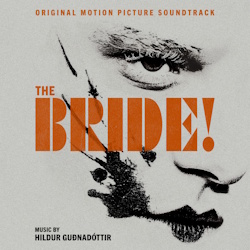
THE BRIDE – Hildur Guðnadóttir
 Original Review by Jonathan Broxton
An ambitious, audacious, controversial, and polarizing film from actress-turned-director Maggie Gyllenhaal, The Bride is a genre-bending combination of classic Gothic horror and old Hollywood gangster movies. Very loosely – and I do mean very loosely – based on both the 1818 novel Frankenstein by Mary Shelley and the 1935 film The Bride of Frankenstein directed by James Whale, it stars Christian Bale as the monster from the original novel who has, after a century of wandering, found himself in Chicago in 1936 and is now simply calling himself Frank. With the help of scientist Dr. Cornelia Euphronious (Annette Bening), Frank successfully reanimates the corpse of gangster’s moll Ida (Jessie Buckley), who was recently killed by the mob after unwittingly revealing the criminal activities of crime boss Lupino while possessed by the ghost of Mary Shelley. Frank convinces Ida – who has lost her memory – that she is his wife, but when the pair go on a crime spree, they are forced to go on the run with the police in hot pursuit. Just go with it. Read more…
A HAUNTING IN VENICE – Hildur Guðnadóttir
 Original Review by Jonathan Broxton
A Haunting in Venice is the third adaptation of an Agatha Christie novel by director Kenneth Branagh, after Murder on the Orient Express in 2017, and Death on the Nile in 2022. It’s also, by quite some significant margin, the worst. It’s very loosely based on Christie’s 1969 work Halloween Party and sees the Belgian master detective Hercule Poirot living in semi-retirement in Venice, when he is convinced to attend a Halloween party by his old friend novelist Ariadne Oliver; also at this party will be a supposed psychic medium, Joyce Reynolds, and Ariadne wants Poirot to help her unmask Reynolds as a fraud. However, as the night unfolds, Poirot gets drawn into a sinister plot involving murder, hidden family secrets, and a supposed curse of ghostly children haunting the palazzo where the séance takes place. The film stars Kenneth Branagh as Poirot, Tina Fey as Oliver, and Michelle Yeoh as Reynolds, plus Kelly Reilly, Jamie Dornan, Jude Hill, and Camille Cottin in supporting roles. Read more…
Academy Award Winners 2019
 The Academy of Motion Picture Arts and Sciences (AMPAS) have announced the winners of the 92nd Academy Awards, honoring the best in film in 2019.
In the Best Original Score category composer Hildur Guđnadóttir won the award for her score for the dark comic book origin story Joker, directed by Todd Phillips, and starring Joaquin Phoenix. With this win Guđnadóttir became the first female composer to win an Oscar since Anne Dudley for The Full Monty in 1997, and became the first composer in history, of any gender, to win all the big five composing awards – Oscar, Globe, Emmy, Grammy, BAFTA – in the same awards cycle. In accepting her award, Guđnadóttir said:
“Wow. This is so touching. Thank you to the Academy for welcoming me so warmly, it’s just… I don’t know what to say! My fellow nominees, masters of the craft, it’s been such an honor to get to know you all, so special. A film composer is only as creative as the dialogue with the director. Todd Phillips was so generous to invite me on this journey, and listen to me the whole way, so attentively, and I thank you for that, so deeply. And Bradley [Cooper] as well! Thank you Bradley. My family, my beautiful family, who are here with me tonight. My incredible husband Sam, my love, my best friend, my other set of ears, I’d be lost without you. My, mother, my son Cody, I can’t see you, but I love you so much! I love you. To the girls, to the women, to the mothers, to the daughters, who hear the music bubbling within: please speak up. We need to hear your voices.”
The other nominees were Alexandre Desplat for Little Women, Randy Newman for Marriage Story, Thomas Newman for 1917, and John Williams for Star Wars: The Rise of Skywalker.
In the Best Original Song category, the winners were Elton John and Bernie Taupin for “I’m Gonna Love Me Again” from the Elton John biopic Rocketman.
The other nominees were Kristen Anderson-Lopez and Robert Lopez for “Into The Unknown” From Frozen II; Joshuah Brian Campbell and Cynthia Erivo for “Stand Up” from Harriet; Randy Newman for “I Can’t Let You Throw Yourself Away” from Toy Story 4; and Diane Warren for “I’m Standing With You” from Breakthrough.
BAFTA Winners 2019
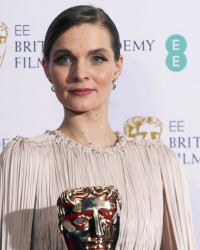 The British Academy of Film and Television Arts (BAFTA) have announced the winners of the 73rd British Academy Film Awards, honoring the best in film in 2019.
In the Best Original Music category, the winner was Hildur Guđnadóttir, who took home the award for her work on the dark comic book drama Joker, directed by Todd Phillips, and starring Joaquin Phoenix. With this victory Guđnadóttir became the first female winner of the award in BAFTA history. Accepting her award, Guđnadóttir said:
“Thank you BAFTA. I think my English in-laws are pretty proud of me right now, so I’d like to thank them! Joker… working on Joker was a journey of a lifetime, really, and Todd is a master for having steered that ship, and it was such an incredible, incredible honor to work on this film and create it with so many amazing artists that are here tonight who did such an incredible job, and I just really, really would like to share this with all of you. I’m such a fan of your work, and you are incredible. Thank you so much. Thank you”
The other nominees were Alexandre Desplat for Little Women, Michael Giacchino for Jojo Rabbit, Thomas Newman for 1917, and John Williams for Star Wars: The Rise of Skywalker.
Golden Globe Winners 2019
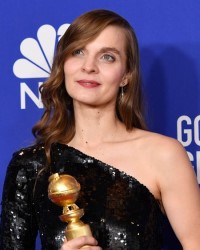 The Hollywood Foreign Press Association (HFPA) have announced the winners of the 77th Golden Globe Awards, honoring the best in film and American television of 2019.
In the Best Original Score category composer Hildur Guđnadóttir won the award for her challenging score for the comic book action-drama film Joker, a revisionist look at the origin story of Batman’s arch-nemesis. This is Guđnadóttir’s first Golden Globe, and in winning the award becomes the first solo female composer to win Best Score. The only other female composer to win was Lisa Gerrard, who shared the award for Gladiator with Hans Zimmer in 2000. In her acceptance speech, Guđnadóttir said:
“Wow. I thought they forgot the music! Well, this is truly… I’m speechless. This is unbelievable. Thank you Hollywood Foreign Press. Thank you Todd (Phillips) for inviting me on the journey of a lifetime, for all the trust and faith and your openness. Thank you, Joaquin (Phoenix) for making my job really easy with a spectacular, unbelievable performance. It’s mindblowing. Thank you Jason Ruder, music editor, for your fantastic job. Truly incredible. Conductor Jeff Atmajian. My brothers Gunnartin, Asthor, and Gunnarsson. My agent Patty, of course. My incredible family, and my mother, my husband and score producer Sam, my beautiful son Cody. That’s everything!”
The other nominees were Alexandre Desplat for Little Women, Randy Newman for Marriage Story, Thomas Newman for 1917, and Daniel Pemberton for Motherless Brooklyn
In the Best Original Song category, the winners were Elton John and Bernie Taupin for their song “I’m Gonna Love Me Again” from Rocketman, the biopic of John’s life starring Taron Egerton.
The other nominees were Cynthia Erivo and Joshuah Brian Campbell for “Stand Up” from Harriet; Beyoncé Knowles-Carter, Timothy McKenzie, and Ilya Salmanzadeh for “Spirit” from The Lion King; Robert Lopez and Kristin Anderson-Lopez for “Into the Unknown” from Frozen II; and Taylor Swift and Andrew Lloyd Webber for “Beautiful Ghosts” from Cats.
JOKER – Hildur Guðnadóttir
 Original Review by Jonathan Broxton
In this era where super hero movies are a dime a dozen, where in the past 30 years we’ve had at least three Supermen, five Batmen, three Spider-Men, and innumerable iterations of other DC and Marvel comic book characters, it was only a matter of time before someone tried to do something completely out-of-the-box different. While the majority of these films concentrate on the heroes, perhaps the most iconic villain in all of comic book history is the Joker, the long-standing nemesis of Batman. He has been portrayed on film multiple times himself; by Cesar Romero in 1966, by Jack Nicholson in 1989, by Heath Ledger in 2008, and by Jared Leto most recently in 2016, with Ledger’s Oscar-winning performance in The Dark Knight coming to be considered the gold standard. There have been multiple origin stories for the character, but he has never been the sole focus of a film before – until now. Read more…
CHERNOBYL – Hildur Guðnadóttir
 Original Review by Jonathan Broxton
On April 26, 1986, the Chernobyl Nuclear Power Plant, close to the Ukraine-Belarus border in what was then the Soviet Union, suffered a catastrophic accident in which one of the plant’s four nuclear reactor cores exploded. The explosion started a fire and released massive amounts of nuclear radiation into the atmosphere and across most of Eastern Europe; it entirely irradiated the nearby city of Pripyat and, although official totals are much lower, may have directly and indirectly lead to the deaths of hundreds of thousands of people. The new mini-series Chernobyl, produced jointly by HBO in the United States and Sky in the UK, is a detailed look at what happened: the events leading up to the disaster, the work of the emergency services in the immediate aftermath, the work of the scientists tasked with finding out what happened, and the fates of those directly affected. Many people have taken Chernobyl to be a cautionary tale about the dangers of nuclear power, but director Johan Renck and screenwriter Craig Mazin say that is not what the show is about at all. Instead, it’s supposed to be a damning indictment of government corruption, lies, and abuse of power, with parallels echoing the current situation involving global warming and climate change. Read more…
MARY MAGDALENE – Hildur Guðnadóttir, Jóhann Jóhannsson
 Original Review by Anže Grčar
The unfortunate and unexpected passing of Jóhann Jóhannsson in early February, sent shockwaves through the film community, and lovers of modernist music at large. Not only was he flourishing and enjoying a fruitful career highlight since the indie world took his scores for mainly Denis Villeneuve-helmed films to the heart, but the death of any person at barely 48 years of age is a sad reminder of how fragile our existence can be. Jóhannsson is leaving behind a stunning body of work, ranging from independent studio albums in his native Iceland, that gained a loyal following due to their experimental sonic blends of traditional orchestration with contemporary electronic elements, to his recent film scores, which exposed so many traditional scoring aficionados to variety of post-modernist styles – all coming from an artist who always managed to encapsulate life from a different, more introverted angle that was singular only to him. Read more…

Shop at the Movie Music UK Store

Member of the

 MOVIE MUSIC UK