VERITY – Volker Bertelmann
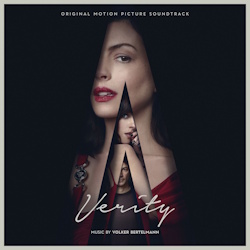 Original Review by Jonathan Broxton
Verity is a glossy, sinister psychological erotic thriller adapted from Colleen Hoover’s bestselling 2018 novel, directed by Michael Showalter from a screenplay by Nick Antosca. Dakota Johnson stars as Lowen Ashleigh, a struggling writer who is hired to complete the unfinished books of celebrated novelist Verity Crawford (Anne Hathaway) after a devastating accident leaves Verity incapacitated. Lowen relocates to the Crawford family’s isolated home, where she becomes increasingly entangled with Verity’s husband Jeremy (Josh Hartnett), while uncovering a manuscript that suggests the family’s tragedies may have much darker origins.
I really liked this film a lot. It feels like it’s been quite some time since there has been a good twisty, turny, sexy thriller like this, where you are constantly second-guessing who is doing what to whom and why, and where the ending sneaks up on you in surprising ways. The three leading cast members – Johnson, Hathaway, and Hartnett – are excellent, with Johnson impressing in a role that broadens her ‘resting bored face’ persona in clever new ways, and contrasting deliciously with Hathaway’s two-handed role as both femme fatale seductress and catatonic victim. The screenplay plays with the ideas of unreliable narrators, perception, and truth – the film is called Verity, after all – while offering up numerous red herring plot twists that I very much enjoyed.
The score for Verity is by German composer Volker Bertelmann, who, since winning the Oscar for Best Original Score for Edward Berger’s All Quiet on the Western Front, has become a ubiquitous presence in ‘prestige’ film and television music, with scores for movies such as Conclave and A House of Dynamite, and shows such as The Day of the Jackal and Dune: Prophecy. This year alone he has already scored four films (in addition to this one) – Pressure, La Bataille de Gaulle: L’Âge de Fer, 23,000 Leben, and The Uprising – and he has the DC comic book horror film Clayface and the psychological thriller Bunker yet to come, so his status as one of film music’s most prominent composers seems secure. However, one of the common criticisms of Bertelmann’s music, especially recently, is that he has a somewhat limited stylistic range, and that many of his scores follow similar patterns and have almost identical stylistic and thematic approaches. That may certainly be true for things like Conclave and A House of Dynamite, but on Verity he takes that sound into some unexpected places, resulting in a score that works like gangbusters within the film and is a great standalone listen.
 Bertelmann’s approach to Verity was deliberately thematic. The composer has said that, upon seeing the first shot of Verity’s house, he wrote an extended theme which subsequently became the musical foundation of the film, appearing in numerous variations as the story develops. This is consistent with Bertelmann’s broader compositional philosophy: he has spoken elsewhere about his fascination with taking a small piece of thematic material and continually reshaping it, changing its instrumentation, scale, and emotional character until the same musical idea can communicate something entirely different. It is an especially apt technique for Verity, a story in which perceptions of the characters continually shift and in which the same events can acquire radically different meanings depending on whose version of the truth one believes. Bertelmann also embraced the film’s horror elements as an opportunity for instrumental experimentation, combining his characteristic prepared piano writing with prominent solo string textures; the score’s featured musical soloists include Karina Michels on violin and viola, Laura Wiek and Ben Winkler on cello, and Bertelmann himself on piano.
The film’s main theme is introduced in the opening cue, “A Miracle,” and although it does share some superficial similarities with the music in Conclave and A House of Dynamite, there is an additional air of both opulent elegance and underlying menace here that I really appreciate. The fluid and dynamic way in which the piano combines with the strings is excellent, and I really like some of the different techniques Bertelmann employs, from the eerie descending slur of the cello to the staccato col legno pulses of the violin. This tonal approach and these performance techniques continue through much of the rest of the score. Both “People Like Me” and “How Does This Sound?” blend them with an array of unusual electronic textures that darken the atmosphere, while “Research” and “The Lake” add a layer of mystery to the revelations about Verity herself with a more urgent, inquisitive, pulsating undertone. It’s mood music, for sure, but mood music that somehow feels compelling.
“Villains Point of View” is an especially suggestive title in a story so concerned with unreliable narratives, and the score’s uneasy dramatic language suits that ambiguity perfectly. The creaking and groaning of Bertelmann’s prepared piano is joined by a slightly more substantial orchestral ensemble, with strings and low brass providing weight, while hazy, restless electronics shimmer around the edges. There is also an extrapolation of the main theme here, again for piano, but with a much more traditionally classical sound, which appears to represent Verity and her increasingly tragic backstory.
The middle portion of the score becomes increasingly psychological as Lowen and Jeremy become drawn to one another, while the uneasy specter of Verity looms constantly in the background. Cues like “Noise” and “Seeing Things” increase the tension significantly with a more assertive electronic component, forceful brass, and agitated rhythmic pulses that have a distinct horror/thriller/suspense vibe, underscoring some of the creepier scenes where Lowen starts to question her sanity. Similarly, cues like “You Are Making Progress” and “Different from You” have an excellent internal momentum, driving forward the scenes of Lowen’s research into Verity’s book and making her subsequent discoveries about Verity’s past feel appropriately revelatory.
In contrast to these passages, cues like “Happier Than Ever,” “Becoming a Writer,” and “I Want You” shift the focus to romance, initially accompanying Jeremy’s memories of how he and Verity first met – including many of their erotic encounters – but then also accompanying the attraction and sexual tension between Jeremy and Lowen. What I like about all this is how Bertelmann maintains an atmosphere of ambiguity, leaving you never quite sure whether what you are seeing is real or a figment of someone’s imagination. This is especially well done in “Feel for You,” which underscores the hot tub masturbation scene where Lowen fantasizes about making love first to Jeremy and then to Verity.
As the film builds to its dramatic climax, Bertelmann allows his music to do the same. “On the Lake” is underpinned by dark tragedy, heightened drama, and notably more imposing brass content, while the subsequent “Say Something” underscores the nerve-shredding confrontation between Lowen and Verity with more of those slithery string figures and unnerving electronic sonorities, as the former tries to bring the latter out of her catatonic state using deeply unconventional methods. “Read This” and “Like an Accident” underscore what appears to be the film’s shocking climax with real menace and occasionally brutal dissonance; the descending slurred motif, the nervous rattle of the strings, and the unsettling electronic layers work overtime to emphasize the revelation at the heart of the story, and then Jeremy’s shockingly violent reaction to it. It all becomes very grand by the end.
However, the eight-minute “Revelations” unravels everything we thought we knew about the story. The different components of the score – the main theme, the slurred descending cello motif, the electronic textures, the elegant piano, and the nerve-wracking extended string techniques – all build over the course of the piece, often reaching grand and wonderfully satisfying heights of musical revelation. The concluding “Ending Credits – Verity” then provides a final summation, allowing the score’s central ideas to linger after the film’s ambiguities have been left unresolved. This final piece is, honestly, one of the most beautiful compositions I have ever heard from Bertelmann – it rolls and sways in a way that is quite intoxicating, becoming a wonderful piece of darkly elegant romance.
Taken as a whole, Verity is another impressive thriller score from Bertelmann: intelligent, atmospheric, musically coherent, and substantially more interesting than the generic underscore that too often accompanies contemporary psychological thrillers. Its combination of a recurring thematic backbone, dark orchestral weight, piano-driven intimacy, and carefully judged experimentation makes it both dramatically effective and rewarding on album. Despite the slight sense of familiarity that has run through a lot of Bertelmann’s work lately, fans of Conclave, A House of Dynamite, and The Day of the Jackal should find plenty to admire here, with the extended “Revelations” and “Ending Credits – Verity” likely to be the cues that keep listeners coming back.
Buy Verity soundtrack from the Movie Music UK Store
Track Listing:
- A Miracle (2:03)
- People Like Me (1:23)
- How Does This Sound? (1:02)
- Research (1:08)
- The Lake (1:12)
- Villains Point of View (2:43)
- Noise (1:13)
- Happier Than Ever (1:31)
- Becoming a Writer (2:53)
- You Are Making Progress (1:32)
- Seeing Things (2:35)
- Different from You (2:22)
- No Longer (1:55)
- Feel for You (2:55)
- I Lied to You (1:17)
- I Want You (1:17)
- I Need to Know (0:57)
- On the Lake (1:53)
- Say Something (3:52)
- So Be It (1:15)
- Read This (4:21)
- Like an Accident (3:37)
- Best One Yet (0:57)
- Revelations (8:17)
- Ending Credits – Verity (4:51)
Lakeshore Records (2026)
Running Time: 59 minutes 01 seconds
Music composed by Volker Bertelmann. Conducted by Hugh Brunt. Orchestrations by Jan Andrees, Gregor Keienberg, Raffael Seyfried, Roman Maier and Florian Sonnleitner. Featured musical soloists Karina Michels, Laura Wiek, Ben Winkler and Volker Bertelmann. Recorded and mixed by Laurence Anslow and Daniel Kresco. Edited by Jason Ruder, Christian Wenger and Shari Johanson. Album produced by Volker Bertelmann, Philipp Kaminsky and Ben Winkler.

Shop at the Movie Music UK Store

Member of the


