SKYWARD SPIRIT – James Horner, Simon Rhodes
 Original Review by Jonathan Broxton
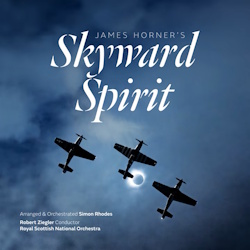
The death of a great composer usually creates a terrible finality. There may be expanded albums, previously unreleased cues, alternate takes, and new recordings, but the expectation of hearing something genuinely unfamiliar eventually disappears. This is what makes Skyward Spirit, a newly recovered concert work by James Horner, such an extraordinary and unexpectedly emotional gift for people like me, who have been fans of his work for most of our lives. More than a decade after Horner’s death, here is music that feels fresh, vibrant, unmistakably his, and connected to one of the great passions of his life: flying.
Skyward Spirit began as a commission from the United States Air Force for the Thunderbirds flight demonstration squadron, but the project was abandoned when the USAF elected to pursue a different musical direction. For years, it was assumed that Horner had never progressed very far with it. Then Horner’s friend and fellow aviator Ed Shipley, while looking through old photographs, discovered an image of Horner holding manuscript paper bearing the word ‘Thunderbirds’. Shipley contacted Simon Rhodes, Horner’s longtime recording engineer, producer, and close friend, and a subsequent search of the archives uncovered four pages of manuscript containing a substantial amount of thematic material. Rhodes, drawing on two decades of intimate familiarity with Horner’s musical language, developed those surviving ideas into the completed work with the blessing of Horner’s widow, Sarah, and the Horner estate.
The finished piece was recorded in Glasgow in late 2025 by the Royal Scottish National Orchestra, conducted by Robert Ziegler. The full Skyward Spirit runs a little over thirteen minutes, with the digital release also including a five-minute abridged version. Its world premiere in public performance took place just a couple of days ago, on September 4, 2026, at the International Ayr Show, where it accompanied an aerobatic display by Airborne Pyrotechnics above the Firth of Clyde in Scotland.
 Conceptually, Skyward Spirit has an obvious predecessor in Horner’s magnificent Flight, originally written in 2010 for the Flying Horsemen, the P-51 aerobatic team with whom Horner himself sometimes flew. That twelve-minute work, initially known as Write Your Soul, was specifically conceived as an orchestral accompaniment to aerial choreography: loops, rolls, dives, climbs, and formations transformed into what was essentially a ballet in the sky. Horner later described the idea as creating the sensation of a symphony orchestra performing beneath an enormous airplane-filled sky.
That love of aviation had been present throughout Horner’s life and frequently found its way into his film music. One thinks immediately of The Rocketeer, whose magnificent main theme and ecstatic end-title music seem almost to defy gravity, as well as other scores with ‘flying’ as a central concept, including the fire mare sequence from Krull, An American Tail, Project X, the takeoff scene from Apollo 13, The Man Without a Face, and many others. Horner had loved aircraft since childhood and spoke of flying in terms of freedom, making him perhaps uniquely qualified to capture the exhilaration of Cliff Secord taking to the skies. Apollo 13 approached the same idea from a different direction, finding awe, idealism, heroism, and danger in humanity’s desire to escape the earth altogether. Its noble trumpet writing, vast orchestral crescendos, and ethereal vocals remain some of the most potent musical expressions of flight and exploration in cinema.
Skyward Spirit belongs proudly in that lineage. It begins with a spectacular brass fanfare, immediately establishing an atmosphere of confidence and exhilaration, before the strings introduce a sweeping primary theme of the sort Horner seemed able to write more naturally than almost anyone. It’s classic Horner, full of little gestures, chord progressions, and instrumental combinations that will be immediately recognizable to anyone who has ever loved his work. The music surges forward with tremendous momentum, but Rhodes wisely allows it room to breathe. There are quieter pastoral passages for woodwinds and chimes that suggest the serenity of looking down upon the landscape from above, contrasting beautifully with the enormous orchestral statements surrounding them. Around the five-minute mark, the music adopts a more explicitly martial personality, with snares, busy woodwinds, and assertive brass counterpoint acknowledging the work’s military origins.
 The second half is even more affecting. A wistful new theme, carried by a rolling piano figure and tender strings, introduces a sense of introspection, almost as though the exhilaration of flying has prompted a moment of remembrance. The mood gradually becomes genuinely elegiac, bringing back wonderful memories of those cascading strings in the love theme from Braveheart, and, best of all, Horner’s famous four-note musical gesture appears almost like a ghost from the past – a wonderful acknowledgement by Rhodes of one of Horner’s signature calling cards. Then, in quintessential Horner fashion, the piece begins to climb again. Brass ideas return in stages, momentum builds, the main theme re-emerges, and the final minutes explode into a glorious, full-throated orchestral celebration. It’s utterly magnificent. As I noted on Facebook, for those opening moments I was fine, happily wallowing in the nostalgia, until the sequence that begins around the 10:00 mark properly kicked in; within 20 seconds, I was in tears. I’m not ashamed to admit that this is the first piece of music in years to have spontaneously made me cry the very first time I heard it.
The appearance of Skyward Spirit also comes at a fascinating moment in the reassessment of Horner as a concert composer. For decades, that side of his career was overshadowed by his immense success in Hollywood. His avant-garde piece Spectral Shimmers, written in 1978, received a single performance by the Indianapolis Symphony Orchestra in January 1979 before virtually disappearing. In May 2022, it was finally resurrected in Szczecin, Poland, alongside another long-lost concert piece called A Forest Passage, as part of the James Horner: The Emotionalist concert conducted by Torodd Wigum. That remarkable revival, forty-four years after Spectral Shimmers was first heard, helped turn attention back toward a concert catalogue that also includes Pas de Deux, Collage, and other works deserving a life beyond Horner’s filmography. Skyward Spirit feels like another important chapter in that welcome resurgence.
There is, inevitably, a heartbreaking irony at the center of all this. Flying brought Horner enormous happiness; it represented freedom, beauty, excitement, and escape. Yet on June 22, 2015, he died when the aircraft he was piloting crashed in California. That juxtaposition makes the reflective passages of Skyward Spirit almost unbearably poignant, irrespective of whether Horner himself intended them that way. But crucially, the piece does not allow tragedy to have the final word. It rises again.
James Horner was one of the supreme melodists of modern film music. What Simon Rhodes has accomplished here is both an act of musical archaeology and an act of friendship. We may never know precisely where Horner’s surviving manuscript ends and Rhodes’s sympathetic completion begins, but the emotional identity of the piece is unmistakable. Skyward Spirit is thrilling, beautiful, and deeply moving. It celebrates aviation, expands our understanding of Horner’s concert music, and gives his admirers the almost impossible experience of hearing James Horner soar again. What an extraordinary, emotionally devastating, powerfully nostalgic gift. It’s the best thing I have heard this year to date, bar none.
Buy the Skyward Spirit soundtrack from the Movie Music UK Store
Track Listing:
- Skyward Spirit (13:19)
- Skyward Spirit – Abridged Version (5:05)
Royal Scottish National Orchestra (2026)
Running Time: 18 minutes 24 seconds
Music composed by James Horner and Simon Rhodes. Conducted by Robert Ziegler. Performed by the Royal Scottish National Orchestra. Orchestrations by Simon Rhodes. Recorded and mixed by XXX. Album produced by Simon Rhodes and Hedd Morfett-Jones.
Leave a comment

Shop at the Movie Music UK Store

Member of the


Breathtaking music. Couldn’t agree more with your review, Jon. New Horner music definitely wasn’t on my 2026 bingo card, but what a gift this is. That gorgeous midsection likewise brought a tear to my eye.
Between this and Deep Impact getting a expanded release, it has been a beautiful month for us Horner fans. I still miss him and I’m glad that his music is still living on and we are still discovering new pieces (Pas De Deux already got a release when Horner was still alive).