MUPPET TREASURE ISLAND – Hans Zimmer, Barry Mann, Cynthia Weil
 THROWBACK THIRTY
Original Review by Jonathan Broxton
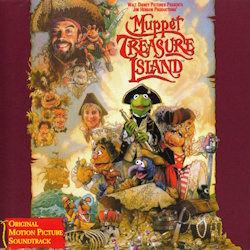
Several years before he and Klaus Badelt effectively redefined the musical sound of the Hollywood swashbuckler with Pirates of the Caribbean: The Curse of the Black Pearl, Hans Zimmer dipped his toes into the genre with a very different kind of pirate movie: Muppet Treasure Island, directed by Brian Henson. It is very loosely based on the famous 1883 novel Treasure Island by Robert Louis Stevenson, and follows the adventures of young Jim Hawkins, who discovers a mysterious map that leads to a legendary pirate treasure. He joins a sea voyage to search for it, traveling with a crew that includes the charming but mutinous Long John Silver and the more forthright Captain Smollett. As the journey unfolds, Jim realizes not everyone can be trusted, and danger grows as secrets and rival loyalties emerge on the island. The twist, of course, is that the majority of the cast is comprised of members of the Muppets, notably Kermit the Frog as Captain Smollett and Miss Piggy as a gender-swapped Benjamina Gunn, the queen of a native tribe of pigs. The human cast stars young Kevin Bishop as Jim and Tim Curry as Silver, plus Billy Connolly and Jennifer Saunders in supporting roles.
Muppet Treasure Island was the fifth Muppet movie and the second to be based on a piece of classic literature, following The Muppet Christmas Carol (1992). It was a moderate success upon release, grossing $47 million worldwide and receiving generally positive reviews from critics. However, its enduring legacy is significantly weaker than that of its predecessors – The Muppet Movie, The Great Muppet Caper, and The Muppets Take Manhattan. This comparative lack of public affection, coupled with the fact that the sixth Muppet film, Muppets from Space, was a flop, and the creative void left by Jim Henson’s death in 1990, led to a decade-long big-screen hiatus for Kermit and his pals.
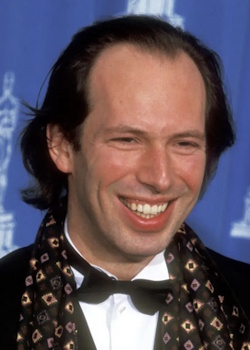 One of the main criticisms that Zimmer faced immediately after the release of Pirates of the Caribbean was that his music was not sufficiently “piratey.” Swashbuckler films were immensely popular during Hollywood’s Golden Age, and their music quickly developed into a subgenre of its own, with composers like Erich Wolfgang Korngold, Alfred Newman, Max Steiner, and Roy Webb providing rousing accompaniment for films like Captain Blood, The Sea Hawk, Sinbad the Sailor, and The Black Swan. Whereas Zimmer’s reinvention of the pirate score sound was controversial in 2003, his score for Muppet Treasure Island mostly avoided criticism. However what is interesting, when reexamined today, is how much it sits at the intersection of these two styles: there’s a reasonable amount of Korngold and Newman in it, but there’s also a significant amount of Jack Sparrow too.
The opening cue, “Treasure Island,” is a perfect example of this: a thunderous combination of Zimmer’s 1990s hypermasculine action sound – think Crimson Tide and The Peacemaker – blended with the brassy adventurousness of classic Korngold pirate music, and what can clearly be described as a dry run for what would later become the main theme for Pirates of the Caribbean, with its prancing, electronically sweetened strings. It’s fantastic to hear these two classic Zimmer styles merge so seamlessly, and fans of the Jack Sparrow sound will get a significant thrill from hearing him explore this new approach.
Much of the rest of the score is awash in Zimmer’s classic 1990s action sound, from the idiosyncratic ‘vowel choir’ he used so often in the decade to the rambunctious rhythms featured heavily in Crimson Tide, The Peacemaker, The Lion King, The Rock, and many others. Harry Gregson-Williams and Nick Glennie-Smith were also heavily involved in the score, and their symphonic sensibilities are present throughout. Some of the specific instrumental combinations and chord structures clearly foreshadow their early individual work on scores like Armageddon and The Man in the Iron Mask.
The opening moments of “The Map” have an unexpected sense of drama and gravitas, and as the cue progresses, the action becomes surprisingly intense and powerful, especially during the sequence around the 1:30 mark, when a prominent piano rhythm is added to the mix. There is also a menacing motif for Long John Silver that emerges during the second half of the cue, as well as numerous reprises of the flashy brass main theme. However, the nature of the film sometimes results in the music coming across as somewhat disjointed, jumping from style to style and theme to theme with such rapid hyperactivity that it occasionally loses focus. There is an abundance of fun and creativity, but it might have benefited from more room to breathe.
There is a wonderful sense of nostalgic adventure in the brassy enthusiasm of “Land Ho,” significant dramatic militarism in “Compass,” and a surprising level of sinister intent in “Long John,” which uses low strings and moody woodwind textures to present a deeply ominous version of his theme, capturing the character’s duplicity. It is genuinely impressive how Zimmer achieves this level of drama, excitement, and adventure for a Muppet movie; he avoids the potential for Mickey Mouse–style goofiness almost entirely and instead treats the characters’ emotions seriously, which is exactly the right approach.
The conclusive set piece, “Rescue,” again employs many of the action and dramatic stylistics that typified Zimmer’s 1990s writing, doing so with a sense of purpose and determination that is surprisingly compelling. Once more, the music sits at the intersection between classic pirate swashbuckling and the modern Jack Sparrow–influenced sound, juxtaposing hornpipe-style flutes and frenetic strings against brass enhanced by keyboards. Purists will still find things to criticize, and it occasionally comes across as slightly ungainly, but I enjoy it tremendously. The finale arrives in “Honest Brave and True,” which sounds exactly like its name suggests: a noble, forthright brass melody underpinned by warm strings, building to a stirring climax and a final reprise of the main theme.
Of course, like its predecessors, Muppet Treasure Island is also a musical, and for this film the producers turned to the well-established and highly successful songwriting duo Barry Mann and Cynthia Weil, who have written smash-hit records for artists such as The Righteous Brothers, Dolly Parton, The Drifters, and The Animals, as well as co-writing “Somewhere Out There” for An American Tail with James Horner. The soundtrack features seven songs, five performed in-character during the film and two appearing as end-credit pop songs. However, unlike their work on An American Tail, which is uniformly excellent, I find the songs here to be a mixed bag.
“Shiver My Timbers,” “Sailing for Adventure,” and “A Professional Pirate” are fun parodies of classic sea shanties that grow organically out of Zimmer’s stirring opening cue and occasionally veer toward Gilbert and Sullivan–style theatricality, especially in Tim Curry’s lead vocals in the latter. There’s also a fun piece of percussive tribal nonsense called “Boom Shakalaka” which was actually written by Zimmer and Nick Glennie-Smith to accompany the pirates arrival on the island and the first encounter with Miss Piggy’s Benjamina and her tribe of native hogs.
However, many of the others leave something to be desired. Kevin Bishop’s vocals on “Something Better” are weak and reedy, while “Cabin Fever” has an oddly anachronistic calypso/carnival vibe that comes across as more annoying than exotic – and not especially funny. Perhaps the biggest misstep is the soundtrack’s central romantic ballad, “Love Led Us Here,” performed by Steve Whitmire and Frank Oz as Kermit/Smollett and Piggy/Benjamina, with vocals that are sometimes painfully off-key. The melody is bland and unmemorable, the arrangements are clichéd, and the overall result is a profound disappointment given Mann and Weil’s credentials. They clearly didn’t make the rainbow connection.
The first pop song, “Love Power,” is a bland, inoffensive reggae track performed by Ziggy Marley and the Melody Makers, while the pop version of “Love Led Us Here,” performed by country artists John Berry and Helen Darling, is at least in tune – but even that cannot rescue the dullness of the composition.
In the end, most film music fans will be interested primarily in the approximately 25 minutes of Zimmer’s score, and despite its brevity, there is plenty to recommend. Those who never appreciated Zimmer’s 1990s action style – or his later reinvention of pirate music – will likely remain unconvinced, as will those who believe that Korngold alone defined the swashbuckler sound. For everyone else, however, Muppet Treasure Island offers a fascinating blend of styles: an unexpectedly serious and often wonderfully entertaining seafaring adventure. It is not without its issues, but the highlights are well worth experiencing – and will shiver the timbers of anyone willing to splice the mainbrace.
Buy the Muppet Treasure Island soundtrack from the Movie Music UK Store
Track Listing:
- Treasure Island (1:07)
- Shiver My Timbers (written by Barry Mann and Cynthia Weil, performed by the Pirates) (2:25)
- Something Better (written by Barry Mann and Cynthia Weil, performed by Kevin Bishop, Dave Goelz, and Steve Whitmire as Jim, Gonzo, and Rizzo) (3:00)
- Sailing for Adventure (written by Barry Mann and Cynthia Weil, performed by the Hispaniola Crew) (2:59)
- Cabin Fever (written by Barry Mann and Cynthia Weil, performed by the Hispaniola Crew) (2:18)
- A Professional Pirate (written by Barry Mann and Cynthia Weil, performed by Tim Curry as Long John Silver and the Pirates) (3:15)
- Boom Shakalaka (written by Hans Zimmer and Nick Glennie-Smith, performed by Island Natives) (1:21)
- Love Led Us Here (written by Barry Mann and Cynthia Weil, performed by Steve Whitmire and Frank Oz as Smollett and Benjamina) (2:23)
- The Map (4:35)
- Captain Smollet (2:04)
- Land Ho (2:39)
- Compass (1:07)
- Long John (3:57)
- Rescue (7:01)
- Honest Brave and True (3:55)
- Love Power (written by Barry Mann and Cynthia Weil, performed by Ziggy Marley and the Melody Makers) (3:42)
- Love Led Us Here (written by Barry Mann and Cynthia Weil, performed by John Berry and Helen Darling) (3:45)
Running Time: 51 minutes 33 seconds
Angel Records 37159 (1996)
Music composed by Hans Zimmer. Conducted by Harry Gregson-Williams. Orchestrations by Bruce Fowler and Ladd McIntosh. Additional music by Harry Gregson-Williams, Nick Glennie-Smith and Graham Preskett. Recorded and mixed by Paul Hulme. Edited by Adam Smalley. Album produced by Hans Zimmer.

Shop at the Movie Music UK Store

Member of the

 MOVIE MUSIC UK