FARGO – Carter Burwell
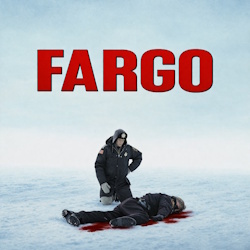 THROWBACK THIRTY
Original Review by Jonathan Broxton
Fargo is a groundbreaking crime drama written, directed, produced, and edited by filmmakers Joel Coen and Ethan Coen. It is a masterpiece of 1990s cinema, a brilliant film that merges noir-style crime storytelling with pitch-black humor. The central figure in the story is Jerry Lundegaard (William H. Macy), a financially desperate car salesman in Minneapolis who is deeply in debt and eager to get his hands on money without alerting his wealthy father-in-law, Wade Gustafson (Harve Presnell). In a reckless scheme, Jerry hires two criminals – Carl Showalter (Steve Buscemi), a talkative con man, and Gaear Grimsrud (Peter Stormare), a silent and intimidating enforcer – to kidnap his wife, Jean. Jerry’s plan is to have Wade pay a large ransom, from which he intends to secretly skim a portion. The kidnapping initially goes according to plan, but things unravel almost immediately when Gaear kills a highway patrol trooper, as well as two witnesses who happen upon the scene. Enter Marge Gundersen (Frances McDormand), the pregnant police chief of Brainerd, Minnesota. With her calm demeanor, sharp intuition, and methodical approach, Marge begins investigating the roadside murders. She quickly notices inconsistencies and starts connecting the crime to a suspicious vehicle and, eventually, to Jerry’s dealership – at which point he begins to panic and desperately tries to cover his tracks.
However, the plot summary doesn’t really do justice to the film’s greatness, which lies not so much in the crime story itself, but in its brilliant characterizations, interactions, and overall atmosphere. Set primarily in the snowy Midwest – especially Minnesota and North Dakota – the film draws heavily on regional culture, accents, and mannerisms, many of which have become cultural icons. Roger Deakins’s cinematography, with its palette of whites, grays, and icy blues, gives the film a distinctive visual identity. The Coens’ writing is especially brilliant: the way Marge’s folksy charm and aw-shucks demeanor mask her incisive investigative mind; the way Jerry becomes increasingly desperate and panicky, yet still tries to convince himself he’s a good person even as his scheme unravels; and the constant bickering between Carl and Gaear. The supporting characters are also wonderfully memorable, from Marge’s bizarrely emotional “date,” Mike Yanagita, to the nodding, gum-chewing, oddly wholesome Minnesota hookers who speak in unison. It is all outstanding.
The final “woodchipper” scene remains one of the most infamous moments in cinema, and the gentle coda, in which Marge quietly reflects with her husband on the events that have unfolded, contrasts sharply with the chaos that precedes it, reinforcing the film’s central theme: that greed and cruelty lead to pointless destruction, while decency and humility quietly endure.
 Today, Fargo is regarded as one of the defining films of 1990s American cinema and a standout in the Coen Brothers’ filmography. It was a major commercial success, grossing over $60 million against a $7 million budget, winning prizes at the 1996 Cannes Film Festival, and earning seven Academy Award nominations, including Best Picture. It ultimately won two – Best Actress for Frances McDormand and Best Original Screenplay – although it lost the top prize to The English Patient.
The score for Fargo is by composer Carter Burwell, who had scored all of the Coen Brothers’ previous films up to that point – Blood Simple (1984), Raising Arizona (1987), Miller’s Crossing (1990), Barton Fink (1991), and The Hudsucker Proxy (1994) – and continues his collaboration here. Burwell’s score plays a crucial role in shaping the film’s atmosphere, but rather than guiding the audience emotionally in a traditional sense, the music reinforces the mood with restraint and nuance. Drawing inspiration from Scandinavian folk traditions, Burwell builds his main theme around a Norwegian folk melody called “Den Bortkomne Sauen,” which translates to “The Lost Sheep,” performed prominently on the Hardanger fiddle. This choice reflects the region’s cultural heritage while also lending the score a haunting, almost otherworldly quality that has since become iconic. The theme evolves throughout the film, appearing in various forms – from delicate harp and celesta passages to fuller orchestral arrangements – always maintaining a sense of melancholy beneath its surface beauty.
The theme is first heard in the outstanding opening cue, “Fargo, North Dakota,” where it builds from a quiet, gentle opening for harp and celesta into a quirky but engaging Hardanger fiddle solo performed by Paul Peabody, before eventually culminating in a full orchestral statement, accompanied by appropriately wintry sleigh bells and dramatic percussion. This theme was originally intended as a character-specific idea for Jerry, referencing both his heritage and his slightly melancholy persona, but this specificity was eventually abandoned, and it became the overarching theme for the film as a whole. It receives further memorable statements in several subsequent cues: with a prominent clarinet in “A Lot of Woe,” in the brief “Chewing On It,” with more emphasis on the Hardanger fiddle in “The Mallard,” with elegance and a sense of impending drama in “Bismarck, North Dakota,” and finally with music-box intimacy in the reflective “Brainerd, Minnesota.”
A secondary musical idea introduces a slightly off-kilter rhythm associated with the criminals, incorporating elements of bass-heavy jazz and light, tinkling percussion that hint at their clumsy menace. Cues like the strangely elegant and dreamlike “Moose Lake,” “The Ozone,” “Dance of the Sierra,” and the more expansive “Paul Bunyan” present simple ascending chords, often arranged for violins and low-end piano, set against a subdued jazz countermelody.
Much of the rest of the score remains minimalist, often accompanying quiet scenes of travel or vast, empty landscapes, allowing the visuals and performances to carry the narrative weight. However, when tension escalates, Burwell shifts into more dissonant territory, using low tones and uneasy textures to underscore the film’s violence without overwhelming it.
 Cues like “Forced Entry,” the deathly sinister “The Trooper’s End,” “Rubbernecking,” and the unnerving “Delivery” enhance the film’s brutally realistic action scenes with increased use of clicking percussion, stepwise rhythms, and occasional bursts of dark symphonic power. Parts of “Rubbernecking” – which accompanies the scene in which Carl and Gaear stalk two unsuspecting drivers who witnessed them murdering the state trooper and run them off the road in the dead of night – are especially menacing. The whole sequence builds to a dark and brutal conclusion in “The Eager Beaver,” which underscores the famous climactic scene – “I guess that was your accomplice in the wood chipper?” – and does so in a way that stylistically recalls the final confrontation between Clarice Starling and Buffalo Bill in The Silence of the Lambs.
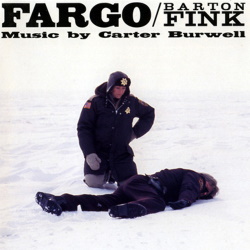
The soundtrack for Fargo was released on CD at the time of the film’s release by TVT Records, paired – due to its brevity – with just over 15 minutes of score from another Coen Brothers film, Barton Fink, and it remains a worthwhile purchase for fans. While the score is undeniably effective within the film, its sparse and somber nature can make it a more challenging listen on its own. Still, the main theme stands out as both memorable and evocative, capturing what Burwell once described as the characters’ “desperate cheerfulness.” Like the film itself, the music finds a peculiar harmony between bleakness and warmth, making Fargo a uniquely enduring experience.
Buy the Fargo soundtrack from the Movie Music UK Store
Track Listing:
- Fargo, North Dakota (2:49)
- Moose Lake (0:41)
- A Lot of Woe (0:54)
- Forced Entry (1:23)
- The Ozone (0:58)
- The Trooper’s End (1:04)
- Chewing On It (0:54)
- Rubbernecking (2:06)
- Dance of the Sierra (1:25)
- The Mallard (1:02)
- Delivery (4:48)
- Bismarck, North Dakota (1:05)
- Paul Bunyon (0:34)
- The Eager Beaver (3:14)
- Brainerd, Minnesota (2:41)
- Safe Keeping (1:45)
Running Time: 27 minutes 22 seconds
TVT Records SMMCD-614 (1996)
Music composed and conducted by Carter Burwell. Orchestrations by Carter Burwell. Featured musical soloist Paul Peabody. Recorded and mixed by Michael Farrow. Edited by Todd Kasow. Album produced by Carter Burwell.

Shop at the Movie Music UK Store

Member of the

 MOVIE MUSIC UK