THE CURSE OF FRANKENSTEIN – James Bernard
 GREATEST SCORES OF THE TWENTIETH CENTURY
Original Review by Craig Lysy
In 1956, having enjoyed success with their sci-fi film The Quatermass Xperiment the previous year, esteemed British film studio Hammer Film Productions decided to embark on an audacious new enterprise: resurrecting the horror film genre, which had suffered a decline after WWII. For their inaugural film, they decided to retell the story of Frankenstein. The threat of a lawsuit from Universal Pictures forced the studio to abandon using Boris Karloff as the Monster, shoot in black and white, change the film’s title, and rewrite the planned screenplay. Anthony Hinds was assigned as producer with a modest $270,000 budget, Jimmy Sangster was hired to write the screenplay, and Terence Fisher was given the reins to direct. The cast included Peter Cushing as Baron Victor von Frankenstein, joined by Christopher Lee as the Monster, Robert Urquhart as Paul Krempe, Hazel Court as Elizabeth, Valerie Gaunt as Justine, Noel Hood as Aunt Sophie, and Paul Hardtmuth as Professor Bernstein.
The story is loosely based on Frankenstein; or, The Modern Prometheus (1818). Set in Bavaria in 1860, the film opens with Baron von Frankenstein awaiting execution for the murder of his maid, Justine. As a priest arrives for the final confession, Frankenstein, in a flashback, recounts his horrific tale of hubris – how he dared to play God and create life in a grotesque experiment with fellow scientist Paul Krempe. While he succeeded in reanimating a dead man, the creature proves violent and pathologically psychotic, resulting in the deaths of a blind hermit and Justine. In trying to subdue the Monster, Frankenstein accidentally shoots his fiancée, Elizabeth. He eventually destroys the creature in a vat of acid, thus removing all evidence of its existence, which leads to his arrest, conviction, and death sentence for the murders.
The film was a massive commercial success, earning a profit estimated at more than seventy times its production costs. This success set Hammer on a course to produce similarly successful horror films, including Dracula (1958) and The Mummy (1959), thereby revitalizing the genre, launching a franchise of six Frankenstein films over the next two decades, and establishing Hammer Horror as a cornerstone of British filmmaking. Critical reception, however, was scathing, with accusations that the film was “depressing, debasing, and degrading” in its departure from – and perversion of – Shelley’s masterpiece. The film failed to receive any Academy Award nominations.
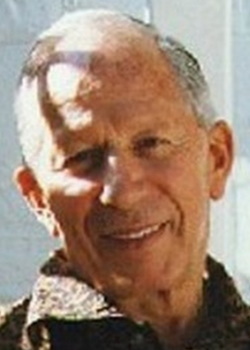 John Hollingsworth, Director of Music at Hammer Film Productions, had originally taken notice of composer James Bernard after hearing his score for The Duchess of Malfi in 1954; Bernard had previously won an Oscar as a screenwriter in 1952 for the thriller Seven Days to Noon. He hired him to score The Quatermass Xperiment (1955), X the Unknown (1956), and Quatermass 2 (1957), and these successes cemented Bernard’s position as the studio’s stalwart composer. In 1957, he began a seminal ten-film collaboration with director Fisher, commencing with The Curse of Frankenstein. In his prior assignments, the studio limited him to a string orchestra with some percussion, but for this film, he was permitted to use a full orchestra. Bernard understood the impetus of the studio’s grand design and set out to create an “aural blueprint” for its envisioned Gothic identity.
For his soundscape, Bernard composed seven themes. There are three themes associated with Baron Victor Frankenstein. The Main Theme is diabolically conceived, with Bernard utilizing the tritone (historically known as the “devil’s interval” or “diavolo nella musica” as a foundational element to establish the “Hammer Horror” sound. The interval is highly dissonant, harsh, tense, and unsettling, which results in an ambiguous, and unresolved sound, which is used to evoke fear, evil, or danger. The theme’s construct employs thematic syllabification, where Bernard musically synchronizes his six-note theme with the syllables of the film title: THE-CURSE-OF-FRAN-KEN-STEIN. As such it is the embodiment of Victor von Frankenstein, offering an expressive musical arch, with hubris, grotesque ambition, and ego, propelling the first three notes on an inexorable ascent upwards, which represents his blasphemous sacrilegious pride, and then downward to signify divine retributive damnation for his unforgiveable transgression of daring to co-opt God’s mantle as Creator.
The Baroque Theme embodies elements of that era of music, which is characterized by intricate ornamentation, polyphonic textures and a continuous animating rhythm. For me, it speaks to the ego-alter ego dichotomy of Victor’s psyche. I believe the theme expresses the social persona of Baron Victor von Frankenstein, an aristocratic gentleman, through its structured, intellectual, and aristocratic elegance. As such, it offers a juxtaposition to his alter-ego scientist persona, which manifests his darker, amoral, and diabolical impulses in the confines of the sterile, clinical, and empirical atmosphere of his laboratory. The Resurrection Theme offers a five-note construct, which embodies Victor’s scientific ambition, which over time becomes perverted, consuming him with an obsession that transforms him into an amoral monster. Bernard speaks to this with a truly repugnant and amelodic musical construct, which joins dissonance, clashing harmonies, and gothic menace into a horrific unholy synergy.
The Monster’s Theme supports Victor von Frankenstein’s Adam. Bernard’s conception speaks to one who has fallen into shadow, from a lack of humanity, and a life bereft of a soul. As such, dissonance, discordance, and terror are used to declare the horror of his existence, and hideous appearance. Rather than relying on traditional melodic structures, Bernard built the Monster’s Theme around dissonant intervals to musically represent the unnatural and abominable nature of Victor Frankenstein’s creation, often distilling it down to a single or repeating twisted and grotesque chord. Paul Krempe serves as Victor’s mentor, moral foil, and is in reality, and externalization of his conscience. As such his theme juxtaposes, Victor’s more obsessive theme, representing the voice of reason that eventually recoils in horror. Justine’s Theme offers one of the few respites from the other dominating horrific identities of the score. Bernard infuses her theme with melodic elegance borne by warm woodwinds teneri and strings delicato. Woven within is narrative are strains of vulnerability, and somber, melancholic undercurrents, which presage her eventual doom. Lastly, the Gibbet Theme supports the corpse of the hanged man that Victor steals to begin his macabre experiment. Bernard chooses to juxtapose the grave act of stealing his corpse with a flippant bassoon joined by stabbing dire chords.
“Main Title from The Curse of Frankenstein” offers a brilliant, yet monstrous score highlight. It opens ominously with a piano chord, bass drum and gong strike as narrative script, relates a tale of one hundred years ago in Switzerland where a man pursued strange experiments with the dead. This horrific legend is known worldwide as the legend of – “The Curse of Frankenstein”. At 0:25 Bernard uses thematic syllabification musically to synch his six-note declaration with the display of the film title: THE-CURSE-OF-FRAN-KEN-STEIN. This construct emotes with a stepped ascent by three malevolent notes, followed by a monstrous three-note descent. The flow of the opening credits unfolds as ornate white script against a blood red backdrop. Bernard empowers with his Main Theme to masterfully establish the film’s tone, employing the “diavolo nella musica”. A such the music is highly dissonant, harsh, tense, unsettling, and unresolving, evoking fear, evil, and danger. Bernard masterfully expresses the six-note Main Theme as a musical arch to set the film’s tone, with hubris, grotesque ambition, and ego, propelling the first three notes on an inexorable ascent upwards, which represents his blasphemous sacrilegious pride, and then downward to signify divine retributive damnation for his unforgiveable transgression of daring to co-opt God’s mantle as Creator. As the credits approach their end, the music slows, grows heavy and dissipates in a grotesque dissonance. (*) “I Will Tell You The Truth” reveals a priest on horseback arriving at a prison. His trek is supported by a foreboding tolling church bell. His is escorted in, and his request to meet with a raving prisoner unguarded, reluctantly granted. The guard announces you have a visitor Baron Frankenstein, and departs. He rejects the priest’s offer of spiritual guidance and insists on telling his story in hope that others may believe. The priest refuses and tries to leave, but relents due to the genuine fervor of Frankenstein’s request. He says he is an hour from execution, and hopes his story will shed light into the truth of what happened.
“A Brilliant Intellect” reveals the priest saying, start from the beginning, and music joins as Victor takes us back to him as a young man. His mother has died, he is the lone heir of the estate, and his uncle exhorts him to do his best. Using only his string section, Bernard offers a solemn piece with Baroque sensibilities. After guests depart, he goes and tells Aunt Sophie in a curt and dismissive manner, that he will continue to send her monthly stipend as it was his mother’s wish. She is thankful and departs with her daughter, and Victor’s cousin, Elizabeth. At 1:19 the music become lighter, brighter, with a dance-like rendering of Paul’s Theme, which supports the arrival of Paul Krempe. He presents himself as the tutor hired by the Baron, and Victor apologizes for the subterfuge, saying he wrote the letter. The two hit it off and Victor hires him. The Baroque musical narrative with interplay of Paul’s Theme resumes, which supports a montage with narration by Paul detailing the brilliant of Victor’s intellect. At 3:18 we now see Victor as an adult, who having mastered all subjects, now moves into a new domain, reanimation. The music devolves, shedding its vibrant happiness to embrace darkness, mutating into a new corrupted form. Victor is now consumed by hubris as he seeks forbidden knowledge to trespass into God’s domain. We close with grave discord as we see them ready for a new experiment. There is a musical pause between the cues as we witness bubbling solutions, vapors, and an electrical discharger that will be used to reanimate a dead puppy. At 3:48 we segue into “It’s Alive” where they celebrate the reanimation of the puppy supported by repeating four-note declarations of the Resurrection Theme, which soars upwards and crests on upper register strings. Yet the crescendo is not musically wholesome, but instead twisted with ill-purpose.
In an unscored scene Victor refuses Paul’s desire to publish a paper and take credit for a major advancement in medicine. Victor argues, that we have reanimated what was dead, now we must go further to create a new man constructed from parts and bring him to life. A man of perfect physique with hands of an artist, and the matured brain of a genius. Paul argues it is a revolt against nature, which can only end in evil. Yet Victor’s passion wins out, and Paul relents. Victor says step one is to procure a body, and informs Paul that they will use a robber, hanged on a gibbet outside of town. “The Gibbet” offers score highlight where Bernard masterfully expresses the grotesqueness, repugnance, and diabolical amorality of the scene. It opens with a dire chord as we see the hanged man’s corpse. Bernard offers the Gibbet Theme, in which he chooses to juxtaposes the grave, criminal act of stealing a corpse with a flippant bassoon joined by stabbing dire chords. At 1:16 Victor climbs up a ladder, reaches the top and an eerie string tremolo and a drum roll supports him cutting the rope. As the corpse falls, a repeating and portentous Resurrection Theme is rendered as a screeching, descent motif. At 1:29 we shift to the laboratory atop an ominous Main Theme draped with grave chords. Paul comments that the eyes and half the face have been eaten off by crows, only to watch Victor blithely grab a scalpel and say he is cutting off the head as he does not need this one. Paul recoils in disgust as Victor proceeds, severs the head, drops it in an acid pit, and then blithely asks Paul to assist him taking off the corpse’s clothes. Bernard unsettles us with grotesque dissonant atmospherics, offering a repugnant, unholy joining of grave violas and trombones fortified by quotes of diavolo nella musica. We close with a grotesque, diabolical chord as the camera reveals a bandaged, headless corpse floating in a glass tank. Victor complains at the gorilla like hands of the corpse, advises Paul that he is going away on a short trip, and they depart for dinner.
Elizabeth arrives unannounced, and advises that she will be moving in fulltime, which confuses Justine the maid and Paul as Victor never mentioned this. Victor arrives, offers condolences to Elizabeth for the death of her mother, and kisses her on the cheek. He tells Justine to take her to her room, and join him later for dinner. He then pulls Paul away, saying he has something to show him. In the laboratory he shows Paul the severed hands of Bardello, a great sculpturer who recently died. This is the last straw for Paul who says he will no longer participate in this horrific experiment. He also warns of the danger of Elizabeth discovering this to no avail. Victor, without blinking an eye, directs Paul to leave, to not return, and to advise Elizabeth that he will not dine tonight. Later a distraught Paul exhorts Elizabeth to leave, only to find out she is engaged. She refuses, they quarrel, and then they both apologize. We shift to the laboratory door and find Victor and Justine locked in a passionate kissing embrace. She said she is tired of meeting in dark corridors and making love in secret. She asks when they will marry, he asks what makes you so sure I will marry you, and she says because you promised, and because of this, as she initiates another round of passionate kissing.
The next day in “An Offer of Help”, reveals Victor departing on another two-day trip. His adoring fiancée Elizabeth, who is unaware of the horrific nature of his work, asks to assist him in his work. He, pauses, and says, perhaps some day you will and departs. Bernard supports with the Main Theme borne by foreboding strings, again joined by quotes of diavolo nella musica. As he walks the street to the Municipal Charmel House the Gibblet Theme and Resurrection Theme join the grotesque musical narrative. In an extended, unscored multi-scene interlude, the jailer is compensated for retrieving two eyes, which Victor places in a bottle with solution. Back at his lab, Victor studies the eyes, but is pleasantly surprised when Paul visits. We find out Victor invited him and asks him to evaluate his progress. Paul is appalled, and they again quarrel. Paul pleads with him to stop, arguing that this can only have an evil outcome. Victor is impervious, and relates the next, most vital stage of his experiment – obtaining a brain with a lifetime of knowledge. Later upstairs, Victor and Elizabeth entertain the renowned Professor Bernstein, and are joined by Paul. The professor declares he is fatigued, and at 0:29 we segue into “Goodnight Professor” as Victor escorts him up to his room supported by the Baroque Theme, which is offered with gentility. At 1:04 Victor begins to gaze around to assure they are alone and as he does, the melody loses consonance, and mutates into a grotesque corrupted form. Victor asks the doctor to view a painting at the head of the stairs, and then coaches him to stand back to better appreciate it, which he does until he rests against the banister. At 1:13 crescendo macabro supports and crests horrifically at 1:24 as Victor pushes the doctor backwards, shattering the banister. He falls to his death carried by a string glissando, and crowned by horrific shrieking declarations of the Resurrection Theme.
In an intervening scene, (*) “Funeral” opens with the professor’s casket being carried into church as church bells toll. Victor is thanked by a colleague for his magnanimity, for allowing the Professor, who had no remaining family, to be buried in the House Frankenstein vault. Later that night, Victor returns to the crypt and extracts and we return to cue 4, “The Professor’s Brain” atop a grotesque string glissando as we see him deposit the brain is a glass container with solution. A foreboding Main Theme joins, and supports the arrival of Paul, who declares he knew he would find you here. He asserts his belief that Victor murdered the professor, and is now mutilating him for his brain. When Victor says he has no further need of it, Paul says he will prevent it. They struggle and the glass container shatters, damaging the brain, and crowned by grotesque declaration of the Resurrection Theme. He orders Paul out and we close ominously on the Main Theme as he examines the brain. At 2:53 we shift to Elizabeth asleep in her bed. The Main Theme sheds its malevolence, and is transformed into a more tender and intimate rendering borne by solo violin. Paul arrives and wakes her up, advising that she is in danger, and again exhorting her to go before it is too late. She refuses once more and asks him to leave, which he does. Bernard supports the scene with Paul’s Theme transformed into a Pathetique borne by pleading strings tristi. The music after 4:27 was dialed out of the film as the film shifts back to Victor’s laboratory where he tries to extract glass shards for the professor’s damaged brain. On the album, the music sustains the Pathetique, until 4:41 when we close with a dire chord and grotesques declarations of the Resurrection Theme as Victor realizes the brain has been salvaged.
Victor takes the brain to the corpse, and we cut away to later with the implication that it was transplanted. For the creation scene, a creative decision was made to allow instrumental, electrical and chemical bubbling noises to support the scene. Distant thunder is heard as we see the fully wrapped corpse. Victor has wired the glass enclosure, and as the thunder nears, he turns on his chemistry array of bottles, flasks, spheres, all bubbling with different colored solutions. A mechanical electrical generator rod begins rotating, and will transmit the electrical charge to the glass tank, where it discharges to reanimate the creature, which begins breathing. However, Victor shuts it down in frustration and storms out of the lab. He enters Paul’s room and insists that he assist as it requires two operators to make the process work. He refuses, and Victor makes a veiled threat. We cut back to the lab and see the bubbling tank drain out. A lightning strike triggers the mechanical rods to begin rotating and electricity is channeled to the tank. We begin to see the creature breathing. Back upstairs, Paul relents, but his affect suggests, duplicity. Victor heads down first and outside the lab hears glass shatter.
“The Creature” reveals Victor entering and finding the creature standing in front of him. Bernard unleashes his Creature Theme, a stepped, crescendo del orrore empowered by monstrous, ascending, chromatic tone clusters as the creature tears off its facial bandages to reveal its horrific face. It then attacks Victor, begins strangling him with inhuman strength as we are engulfed in grotesque tone cluster strikes. Paul arrives, and shatters a chair on the creature to free Victor from its death grip as it passes out at 0:59 supported by a dark chord. As Paul goes to Victor, repeating, horrific Resurrection Theme declarations are heard, and sustained as we see Victor later strapping the creature down. Paul repeatedly tells him it’s a monster and to destroy it. Victor revels in his creation, and blames Paul for damaging its brain. He says he will just replace the brain, which causes an exasperated Paul to storm out. We close on horrific statements of the Creature Theme. At 1:29 we segue atop the Resurrection Theme into “He’s Gone”. The Main Theme cycles on foreboding strings as the camera pans the lab showing it destroyed, and surges at 1:55 as we see the windows shattered, indicated the creature has escaped. Victor is panicked and solicits Paul’s aid to search for the creature. As the camera pans the forest, Bernard now sows tension with repeated statements of a now transformed and monstrous Main Theme crowned with grotesque, high register dissonant strings and trilling flutes and clarinets.
“The Creature and the Blind Man” offers a frightful score highlight of terror. It reveals a young boy leading his blind grandpa through the forest. Grandpa is tired and sits down to rest as the boy runs to the riverbank to fetch some mushrooms. Grandpa hears footfalls and calls out asking why he has come back so soon, and we see the creature emerge. Bernard simulates his footfalls draped with eerie tremolo strings, which sow a rising fear as he walks toward grandpa. Grandpa becomes anxious and he pushes back with his hands in terror, then grabs a stick and pokes. The creature snaps the branch in two, and at 0:41 grandpa flees and trips carried by a stepped crescendo di terrore. At 1:01 the creature advances towards grandpa empowered by a grotesque, stepped crescendo di terrore, which crests at 1:19 as grandpa is killed. The boy hears the cry and an agitato by strings energico propel his run, and we close on a misterioso empowered by an ominous and lurking Main Theme. We shift to Paul and Victor pursuing the creature on his well-marked trail. They spot the creature, Paul raises his rifle to shoot, and Victor shouts, “No Paul” as he pushes it down. We segue at 1:47 into “You Shoot Well” atop the fire Footfall Motif as the creature advances. Paul shoots and strikes the creature in the left eye. At 1:57 a grotesque storm of swirling strings and trilling woodwind join in an unholy synergy with the Resurrection and Creature Themes, concluding with a string descent motif as the creature falls. We close on repulsive statements of the Main Theme, which sow uncertainty as Victor reveals his deception of not alerting the townspeople. He and Paul then bury the creature and then depart separate ways with Paul happy that he stopped this monstrous act before it was too late. Victor however replies that he will never forgive him, and never wants to see him again. Later Victor surveys the damage in his laboratory. Paul arrives, and he informs Victor that he is leaving as there is no reason for him to remain. Victor with a smirk replies you did keep Elizabeth safe, didn’t you? Paul then departs, Victor puts on gloves, and goes to an adjoining room where we find the creature hanging on a meat hook. We segue at 1:51 into “I’ll Give You Life Again” atop the Resurrection Theme as Victor looks up and says; “I’ll give you life again.”
Victor leaves is lab and is confronted by a distraught Justine. She asks if it is true, that he intends to marry Elizabeth. She adds, that you promised to marry me! He begins laughing, which infuriates her and she pounds on his chest. He throws her back and says do you really believe I would marry a woman like you? She counters that he has to marry her as she bares his child. He adds fuel to the fire, and callously recommends that she claims one of the many men in the village she has slept with as the father. Undeterred she threatens to tell Elizabeth and the authorities of what goes on in his laboratory. However, when he asks, for proof, she deflects, which informs him that she does not know, and so he fires her and departs. Later that night in “Justine’s Fate”, Bernard sow tension with a repeating, foreboding Resurrection Theme borne by bassoon and scurrying woodwinds, which support her stealth ascent to the lab door. She sees the light go out under the door and hides around the corner. Victor departs carried by a foreboding bassoon and eerie vortices of strings and woodwinds. As she returns to the lab door at 1:14 and walks in, a grotesque rendering of the Resurrection Theme by frenetic strings supports. Inside Bernard sow a lurking tension, gain draping us in grotesque dissonance with tone clusters. At 2:14 the music darkens and becomes ominous as she reaches a locked inner door, and unlocks it. As she searches the room a grotesque rendering of the Resurrection Theme supports woven into an ever-increasing narrative of tension. We see a shadow of his hand reaching out and a noise elicits her to turn around. At 3:40 she sees him as a horrific Creature chord resounds. She flees to the door only to have Victor lock it from the outside. A crescendo di terrore supports the creature’s moving towards her, cresting horrifically as she screams and is killed. The murder is punctuated with a coda of the Resurrection Theme as Victor contemplates yet another murder.
The next day at breakfast Elizabeth advises that she has invited Paul to their wedding. Victor says he is glad that she did as there is something he wants him to see. A week later in (*) “Welcome Party” Victor hosts a welcome party for the guests who have travelled to attend tomorrow’s wedding. Bernard supports with an original period piece, which offers gentility and establishes a formal party ambiance. After the guests have left, Victor says he will be going to his laboratory, which disappoints Elizabeth. She asks if she can attend, and he says, not yet, but in the near future. As Elizabeth prepares to head up to bed, Paul arrives, much to her delight. When she says Victor missed him and wanted to show him something, Paul’s interest is piqued and he heads to the lab. Inside Victor is preparing a plate of food, as Paul knocks. Victor lets him in and takes him to the back room. He sees the creature and says he leaving; however, Victor offers a demonstration.
“Get Up” Victor snaps his finger and commands the creature to get up. Repeating string declarations of the Creature Theme support the creature rising. He commands, come here, and the creature obeys, again supported by repeating string declarations of the Creature Theme. The chain stops his progress, and Victor commands, sit down and it does, although this time the Creature Theme is rendered pathetically. At 1:01 low register strings emote a grim rendering of the Main Theme with interplay of the Resurrection Theme as Paul mocks him for creating a “superior man”, saying its brains should be able to made life simple. The theme begins to swell as Victor declares he put the brain of a genius in him, and then accuses Paul of damaging that brain with a bullet. He adds, if I cannot cure it, then I will just keep adding new brains until I succeed. At 1:39 the Main Theme now rears its ugly head, with a surging ascent by string arrabbiati as Paul says he will stop him, notify the authorities, and make sure you are punished for these atrocities. He runs to the door carries his aggrieved theme joined by horrific string vortices, with Victor in pursuit. They fight, empowered Victor is injured, and Paul escapes, running past Elizabeth without a word. Victor follows empowered by a desperate Resurrection Theme, which dissipates at 2:26 as he seeks to find Paul.
At 2:27 we segue into “Final Confrontation as Victor sees Paul walking down he road, runs to him and pleads supported by a grim Main Theme. Inside Elizabeth slowly walks up the stairs to the laboratory and at 2:38 the Main Theme shifts to the upper register as the creature stands up. Bernard ratchets up suspense as she enters the laboratory and begins walking to the back door. At 2:54 Main Theme darkens and again descends to a grim lower register joined by string trills as the creature grabs the chain by its wall mount and rips it out of the wall. This horrific synergy of the Main Theme and screeching strings trills continues as Elizabeth grabs a lamp and reaches the door. She enters, but we see the creature has crawled out the window and observes from above. We shift outside where Victor argues that if Paul exposes him, it will be Elizabeth who suffers. This elicits a fight, which ends a 4:38 on a massive Creature chord as they behold the creature on the roof. Paul runs off to notify the authorities, as Victor runs to save his creation. The Main Theme now cycles ever upwards as Elizabeth ascends to the roof. At 4:52 the Main Theme shifts to a crescendo of desperation as Victor runs to his lab, grabs a pistol, and ascends to the roof. At 5:52 the Creature Theme erupts as he grabs Elizabeth. Victor shoots and hits Elizabeth in the left should. She falls and he shoots the creature, without effect. The creature moves towards him empowered by a horrific crescendo d’terrore. Victor is trapped and at 6:22 throws the oil lamp at the creature, which bursts into flames. The creature writhes in pain enveloped by a crescendo of horrific strings vortices of agony. At 6:38 he falls through a skylight into the acid pit, punctuated by a gong strike as his body disintegrates. The music after 6:46 until 7:35 is not in the film, and I surmise it was attached to an edited scene. It opens with racing, frenetic strings emoting the Creature Theme, which slowly dissipates into nothingness.
We return to the present where Victor asks if the priest believes him. He does not answer, but the guard advises that Paul has come for a visit, which makes Victor ecstatic. In the waiting room we see him waiting with Elizabeth. Paul is summoned, departs and is greeted by a desperate Victor who pleads with him to confirm his story. Paul however refuses to corroborate his tale, and declares Victor killed Justine. The priest departs and Victor in a rage starts to strangle Paul, who is saved by three guards. As Paul departs, Victor sobs and pleads with him to save him, to no avail. He tells Elizabeth there is nothing that can save him now, and they depart. At 7:36 we segue into “The Guillotine” atop a bass drum cadence of death as Victor is led to the gallows. The diabolical Main Theme empowered by dire horn joins with repeating declarations, transforms into a marcia della morte, as a testament to his monstrous crimes. We see the guillotine blade rising in the courtyard and we conclude the film with the march ending with horrific horn declarations descending into the bowel’s ho Hell.
I offer my praise to James Fitzpatrick for this extraordinary rerecording of James Bernard’s masterpiece The Curse of Frankenstein. The reconstruction of Bernard’s original orchestrations by Leigh Phillips is exceptional, and the recording offers clear, stunning, and dynamic digital sound. The film was a massive commercial success, earning a profit seventy times its production costs, and many film historians credit this movie’s success with resurrecting the horror genre, which had very much declined in popularity from its heyday of the 1930s and early 1940s.
Bernard developed an architecture for his score, which would employ the following methods; orchestration would be used as a means to create the impression of a massive orchestra, by filling every aural space to heighten power and drama. He would utilize suspenseful horns and foreboding strings that create a sense of gothic menace. Heavy percussion utilizing timpani and snare drums would propel the film’s often frenzied sequences. All Bernard scores feature his signature clashing harmonies, which are achieved by doubling a musical motif just one tone higher to create dissonance and tension. As in all horror films, the film’s narrative shifts between suspense to visceral horror, which requires the composer to shift between atmospheric and textural writing, with kinetic, high-energy writing to support the horrific scenes. He would also juxtapose the film’s horror with lush, gothic romanticism for romantic sub-narratives. Lastly, Bernard developed a signature use of building crescendos emerging from a plodding low-end take-off point, to create a sense of a lurking danger becoming manifest.
Folks, I believe that James Bernard achieved what every composer strives for; to set the tone of the film, and capture musically, its very essence. In a masterstroke of conception, he created a Main Theme that was the very embodiment of Victor von Frankenstein. A theme which offered an expressive musical arch, with hubris, grotesque ambition, and ego, propelling the theme’s first three notes on an inexorable ascent upwards, which represents his blasphemous, arrogance and sacrilegious pride, and then downward to signify divine retributive damnation for his unforgivable transgression of daring to co-opt God’s mantle as Creator. His theme for the Monster was also masterful, offering a hideous, dissonant, and discordant musical construct, which evoked terror, and the horror of his tragic existence. I believe the score from first to last reel enhances the film’s macabre narrative The use of “diavolo nella musica” greatly unsettles and disturbs us, masterfully evoking within Bernard’s musical storytelling, the film’s horror, terror, grotesqueness, repugnance, and tragedy. This compilation album is a Holy Grail for collectors as it also offers Dracula. As such I offer my highest recommendations.
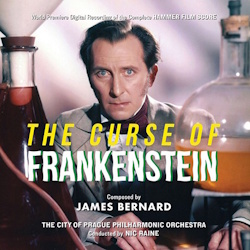
Editor’s note: This review is specifically of the 2019 release by Tadlow Music, which combines just over half an hour of score from The Curse of Frankenstein with similarly-reconstructed selections from one of Bernard’s other classic Hammer Horror scores, Dracula.
For those of you unfamiliar with the score, I have embedded a YouTube link to the Main Title: https://www.youtube.com/watch?v=wMpLuVsV4i0
Buy the Curse of Frankenstein soundtrack from the Movie Music UK Store
Track Listing:
- Main Title from The Curse of Frankenstein (1:48)
- A Brilliant Intellect/It’s Alive (4:31)
- The Gibbet (3:39)
- An Offer of Help/Goodnight Professor/The Professor’s Brain (4:56)
- The Creature/He’s Gone (2:48)
- The Creature and the Blind Man/You Shoot Well/I’ll Give You Life Again (2:59)
- Justine’s Fate (4:12)
- Get Up/Final Confrontation/The Guillotine (9:06)
Tadlow Music TADLOW032 (1956/2019)
Running Time: 33 minutes 59 seconds
Music composed by James Bernard. Conducted by Nic Raine. Performed by the City of Prague Philharmonic Orchestra featuring Lucie Švehlová. Orchestrations by James Bernard. Recorded and mixed by Jan Holzner. Edited by XXXX. Score produced by James Bernard and John Hollingworth. Album produced by Leigh Phillips and James Fitzpatrick.

Shop at the Movie Music UK Store

Member of the

 MOVIE MUSIC UK