UP CLOSE & PERSONAL – Thomas Newman
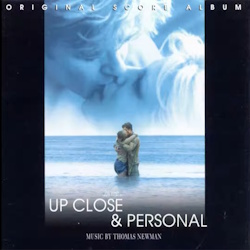 THROWBACK THIRTY
Original Review by Jonathan Broxton
Up Close & Personal is a romantic drama film directed by Jon Avnet that sought to turn the then-incandescent star power of Robert Redford and Michelle Pfeiffer into Hollywood gold. The film was written by husband-and-wife team Joan Didion and John Gregory Dunne – highly acclaimed, prize-winning journalists – and was originally intended to be an adaptation of Golden Girl: The Story of Jessica Savitch, a 1988 book about the troubled life of American news anchor Jessica Savitch. However, over the course of many years and numerous revisions, the film was altered substantially to the point that the finished product bears almost no resemblance to Savitch’s life.
Pfeiffer plays Tally Atwater, an ambitious young woman from a small town in Florida who dreams of becoming a television news reporter. With little experience but plenty of determination, she lands a job at a Miami news station, where she meets veteran journalist Warren Justice (Redford), a talented but emotionally guarded reporter with a complicated past. Warren recognizes Tally’s raw potential and takes her under his wing, mentoring her both professionally and personally. As Tally learns the craft of journalism – covering stories, reporting live, and developing her on-screen presence – she quickly rises through the ranks. Their professional relationship gradually deepens into a romantic one, though Warren’s reluctance to fully open up creates tension between them. As Tally’s career continues to flourish, eventually leading her to a prominent position in Philadelphia, she becomes more independent and confident, while Warren struggles with his own fears and insecurities. Their relationship is repeatedly tested by their differing ambitions and emotional needs, as well as the pressures of their demanding careers.
 Up Close & Personal marked the third collaboration between Avnet and composer Thomas Newman, following Fried Green Tomatoes in 1991 and The War in 1994. He had also scored several films produced by Avnet but not directed by him, including Less Than Zero (1987) and Men Don’t Leave (1990). In 1996, Newman was right in the middle of what I consider to be the strongest period of his career – this score was immediately preceded by career highs such as The Shawshank Redemption and Little Women, among others – and as such, this score is very much cut from the same general cloth as those works. The score reflects the tone of the film itself: earnest, accessible, and emotionally direct, with Newman employing many of his familiar stylistic trademarks in support of this approach. The film’s Miami setting inspires occasional Latin-inflected passages, though these are relatively brief; elsewhere, Newman makes use of more forceful and dynamic writing, especially in the film’s dangerous conclusion, which sees Tally reporting from inside a riot at a men’s prison.
The opening cue, “Miss Sierra Logger,” initially hints at something more playful and rhythmically vibrant with its brief mambo-inflected centerpiece, suggesting a livelier musical identity tied to the Miami setting. However, this energy quickly gives way to the more restrained, signature Newman sound – softly layered strings and delicate piano figures – which better represents the overall tone of the score. “A Week Eight Days” introduces a gentle, reflective idea built around piano and electric guitar, creating a sense of quiet romance that feels intimate and slightly dreamlike. Newman handles this kind of writing effortlessly, and while it may not break new ground for him, it remains undeniably effective.
The score’s central theme, first clearly presented in the sixth track, “Up Close,” stands out as the emotional anchor of the work. Carried primarily by strings, with occasional woodwind accents, it has a warm, lyrical quality reminiscent of Newman’s work on other dramas from the same era, especially The Shawshank Redemption or films such as How to Make an American Quilt. It’s really quite lovely, and as the score develops through its second half, it receives several prominent statements, notably during the quietly sentimental “So Much Cherry Piecrust” and the beautifully anguished “Upwind.”
I particularly like the darker writing in “Moral High Ground,” which showcases Newman’s remarkable command of string writing, producing a rich, expressive sound that carries considerable emotional weight and would have made his father, Alfred Newman, proud. I also admire the noble brass and piano writing in “So Much Cherry Piecrust,” which carries a similar dramatic weight to some of James Horner’s 1990s work, while the use of oboes in the tender “Philly Rebound” and lyrical piano in “No Justice” is quintessentially Newman-esque.
The more dramatic and suspense-oriented cues, such as the excellent “Uprise” and “Los Locos,” introduce exotic percussive elements and unusual, fluttering woodwind textures to underscore the tension of the characters’ reporting assignments. These moments show Newman reaching for something more dynamic and unconventional, which he often explored in films like this when given the opportunity. Later cues, such as the energetic and brutally dynamic “Cellblock C” and the moody “Bonefish,” lean into a similarly experimental soundscape, often layering percussion and electronic effects within the orchestra to create an uneasy atmosphere.
The conclusive cue, “She Knows Now,” offers a ravishing final statement of the main theme, with shimmering strings combining beautifully with lush, expressive oboes to deliver a genuinely moving conclusion to the score as a whole. It’s not quite among Newman’s all-time greats, but for fans of his most emotionally poignant work of the 1990s, it’s certain to hit the spot.
The soundtrack album also contains a couple of source pieces – the funky “Hong Kong Mambo” by Tito Puente and “Café” by Eddie Palmieri – but, somewhat inexplicably, it does not include what for many is the film’s standout musical element: the original song “Because You Loved Me,” written by Diane Warren and performed by Celine Dion. The song – which Warren has said was originally written as a tribute to her father – was an enormous success upon its release. Warren won the Grammy Award for Best Song Written for Visual Media and earned two additional Grammy nominations, as well as nominations for an Academy Award and a Golden Globe. It was also a massive hit for Dion, selling more than two million copies in the United States alone; it reached number one in the United States, Canada, and Australia, and the top ten in many other countries. It was Warren’s third Billboard Hot 100 number one and Dion’s second (after “The Power of Love” in 1993), and primed her to absolutely take over the airwaves with Titanic in 1997. I adore it.
One of the few issues with the album is its presentation. The cues are arranged for listening rather than chronological storytelling, which is typical for Newman but perhaps less effective here. Because the score relies so heavily on gradual thematic development and subtle shifts in tone, the lack of a clear narrative flow can make it feel more fragmented than it might within the context of the film. As a result, some of the emotional progression is lost, and the listening experience can feel like a series of loosely connected ideas rather than a cohesive whole. However, despite this shortcoming – and the absence of the Warren/Dion song – Up Close & Personal remains a score worth recommending. Newman’s craftsmanship is evident throughout, from his nuanced orchestration to his ability to create a compelling romantic atmosphere. Even when the music recedes into the background, it does so with a level of sophistication that elevates it above more generic efforts in the genre.
Buy the Up Close & Personal soundtrack from the Movie Music UK Store
Track Listing:
- Miss Sierra Logger (2:56)
- A Week Eight Days (2:33)
- Uprise (1:30)
- Vulgar Innuendo (0:58)
- Hong Kong Mambo (written and performed by Tito Puente) (3:47)
- Up Close (2:45)
- Moral High Ground (1:41)
- So Much Cherry Piecrust (2:31)
- Café (written by Robert Gueits and Fernando Lopez, performed by Eddie Palmieri) (6:37)
- Sun & Moon (1:11)
- Los Locos (2:11)
- Upwind (2:46)
- Cellblock C (2:38)
- Philly Rebound (1:21)
- No Justice (2:03)
- Bonefish (1:50)
- She Knows Now (2:23)
Running Time: 41 minutes 10 seconds
Hollywood Records HR-62053-2 (1996)
Music composed and conducted by Thomas Newman. Orchestrations by Thomas Pasatieri. Recorded and mixed by Dennis Sands. Edited by Bill Bernstein. Album produced by Thomas Newman and Bill Bernstein.

Shop at the Movie Music UK Store

Member of the

 MOVIE MUSIC UK