PROJECT HAIL MARY – Daniel Pemberton
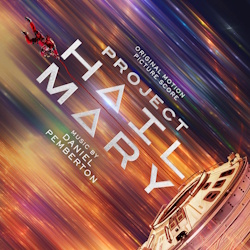 Original Review by Jonathan Broxton
WARNING: THIS REVIEW CONTAINS PLOT SPOILERS. IF YOU HAVE NOT YET SEEN THE FILM, YOU MIGHT WANT TO CONSIDER WAITING UNTIL AFTER YOU HAVE DONE SO TO READ IT.
One of the most anticipated films of the first quarter of 2026, Project Hail Mary is a science fiction drama directed by Phil Lord and Christopher Miller, and adapted by Drew Goddard from the popular novel by Andy Weir. Ryan Gosling stars as Ryland Grace, a science teacher who wakes up alone aboard a spacecraft with no memory of how he got there. As his memories slowly return, he realizes that he’s part of a last-ditch mission to save Earth from a microorganism called astrophage, which is draining the sun’s energy and threatening a global ice age. Though not an astronaut, Ryland was recruited for his scientific expertise by former space agency administrator Eva Stratt (Sandra Hüller), and must now rely on his knowledge of biology, chemistry, and physics to survive and carry out the mission. As he pieces together his past through flashbacks, he also works through immediate challenges aboard the ship, using experimentation and critical thinking to better understand the threat. Eventually, the mission takes him to a distant star system that appears unaffected by the astrophage, offering hope for a solution – but upon his arrival, he unexpectedly encounters an alien he names Rocky, whose species is facing a similar crisis. Despite their vast differences in biology and communication, Grace and Rocky form a cooperative partnership built on shared scientific curiosity and problem-solving, and together they try to save their respective worlds.
The film is similar to the previous big-screen Andy Weir adaptation, The Martian, in terms of tone, style, and content, but it expands the scope significantly, making Grace literally the last hope for humanity – the saving grace, if you will. There’s a lot of hard, complicated science in the screenplay, but there is also plenty of humor, especially in the scenes where Grace is trying to figure out where he is and what he is doing, and later when he is getting to know Rocky. Speaking of Rocky, the character is great and provides the film with a great deal of personality and emotional pathos, which is no mean feat considering that he is a five-legged, faceless rock monster. The film is visually spectacular – some of the space vistas are especially awe-inspiring – but I have to admit I did have some issues: ethically, with some of the actions of Sandra Hüller’s character, and narratively, especially with the ending. However, despite these small misgivings, it’s still an excellent piece of cinema and well worth experiencing on the big screen for genre fans.
The score for Project Hail Mary is by composer Daniel Pemberton, who previously collaborated with Lord and Miller on Spider-Man: Into the Spider-Verse (2018) and Spider-Man: Across the Spider-Verse (2023), which they produced; this is his first collaboration with them as directors. Pemberton is a fascinating, deeply unpredictable composer who is capable of outstanding traditional orchestral writing, but who also often takes wide, eccentric swipes at the conventions of film music, blending styles and textures that really should not go together and transforming them into something cool and interesting.
 The score here is a fascinating combination of the familiar and the strange. It uses a large, powerful symphony orchestra and a soaring religioso choir, but then augments these with an array of hugely unconventional instruments and textures – steel drums, mouth percussion performed by the experimental vocal ensemble Shards, opera singers, children from the Wells Cathedral School clapping and drumming on their bodies, wooden percussion, unusual electronics, eerie glassy textures (including a cristal baschet, an ondes Martenot, and a glass harmonica), and even some musique concrète samples, including the sound of a squeaky tap.
In many ways, Pemberton seems to be creating a musical collage that mirrors one of the film’s underlying premises: Grace is, by most metrics, a relatively normal man (albeit one with a genius-level understanding of science), but circumstances thrust him into a world that is markedly different, alien, and sometimes frightening – a very long way from home. This collision of the familiar and the unfamiliar lies at the heart of the story, and the ways Grace overcomes these challenges are captured in Pemberton’s score, which takes numerous seemingly disparate sounds and forces them to work together.
Then there’s also the dichotomy between the organic and the inorganic, and Pemberton spends a lot of time in the score playing around with sounds and instruments that are intentionally tactile, as a way of connecting the score to one of the core tenets of humanity on a subconscious level. I already mentioned the children from the Wells Cathedral School, clapping and stomping and drumming and tapping on their bodies to produce interesting rhythmic sounds, but then many of the percussion items are made of wood or glass. The music in the ‘fishing trip,’ for example, sequence starts out on a solo woodblock, and then the cristal baschet is played with wet hands in order to produce a sound similar to one you make when you run your finger round the rim of a glass.
A lot of the early part of the score is, frankly, quite unusual. There is a soft, shimmery, peaceful sound to the opening “Ryland Grace, Cognition Assessment,” which sees Pemberton initially combining the soft tones of the choir with electronics and percussive rhythms that start out in a way not too emotionally dissimilar from Grieg’s Morgenstemning from Peer Gynt, or perhaps something from Thomas Newmans more ambient scores, before becoming a little more moody and unnerving. Cues like “Last Man on Ship,” “Invalid,” and the lovely “Humanity” have a similar vibe, oscillating between gentle space vibes and more unnerving moments of drama and tension.
These sounds of these cues are echoed in some of the early flashback sequences to Earth, encompassing Grace’s first encounters with Stratt, and his experiments trying to discover what astrophage is. Pemberton’s music here is often quite rhythmic and dynamic , but also has a curious, inquisitive tone, mirroring the sense of discovery and innovation that comes with Grace’s scientific breakthroughs; cues like “Water Based, the quirky “Box in a Box, “Top Secret Clearance,” and the sometimes mystically eerie “Petrova Line” are great examples of this style.
“You Were Loved (Burial)” is a moment of high emotion as Grace performs a space burial for his two deceased astronaut colleagues, Ilyukhina and Yao, who died during the trip through space, leaving him alone on the ship. The subtle use of a sampled church organ to the choir, strings, and electronics, adds a touch of spirituality to the sense of quiet isolation and poignancy, resulting in powerful resonance. Hans Zimmer used church organs in his score for Interstellar in a similar way, and the more moving moments of that score are reflected here.
“Erratic Maneuver Detected” is the first of the score’s main action sequences, and is a fun, driving, intensely rhythmic sequence for wooden and human percussion, underpinned with all manner of unusual instrumental and vocal sounds and textures, and again comes across like something Thomas Newman might come up with at his most idiosyncratic. It’s very unusual, but very effective, and gives the score as a whole a distinct timbre that isn’t like really any other film music being written today. It has personality, and that counts for a lot these days
The sequence from “Cannister Catch” through to the end of “Rocky Moves In” essentially underscores the sequence where Grace arrives at Tau Ceti, discovers Rocky’s ship, makes ‘first contact,’ and then gradually develops a relationship with the alien life form through a gradual mutual understanding of language and technology. Musically it builds on much of what has come before it, but certain cues stand out. Parts of “Cannister Catch” are unexpectedly intense, building on the sound of the “Erratic Maneuver Detected” action cue, but then also have an unexpectedly funky groove. There is a balletic elegance to “Centrifuge” that I really enjoy. There is a weird sense of humor to the oddball voice-like synth effects and comedic grooves of “The Message,” “Clock Numbers,” and “Learning to Communicate,” while the deeper voices and shriller synth sounds give “Entering the Tunnel” an appropriate light horror sound. Then the first encounters with Rocky in cues like “Barrier Language” and “Connection” are filled with an equally appropriate sense of childlike wonder, as well as the first introductory statements of the ‘majesty of space’ theme that plays a big part in the final parts of the score.
The heavenly “God Willing” offers a major statement of the ‘majesty of space’ theme, but then in the subsequent “A Moment” Pemberton allows his music to erupt with a grandiosity that feels almost spiritual. The cue underscores a scene where Grace turns a machine on and sees astrophage in space for the first time, proving his and Rocky’s theories correct, and offering hope for the future. Pemberton’s majestic, emotionally overwhelming music – a staggering eruption of operatic vocals, brass and strings – combines with Grieg’s Fraser’s astonishingly beautiful cinematography of the cosmos, resulting in something that feels almost transcendent, and is one of the highlight cues not only of this score, but of Pemberton’s entire career to date.
From this point the score is much grander and emotionally expansive; Pemberton takes everything that has come before it – the different textures and ideas representing Grace and Rocky and their relationship, the unusual instruments and percussion items, the vocals – and inserts them into a much larger orchestral ensemble, increasing the scope and stakes of everything. There is an internal strength and determination to “Life is Reason,” and a sense of relief and palpable release to cathartic “Grace Go Home,” before the score hits its second major highlight: “Time Go Fishing,” an 8-minute action sequence which underscores the scene where Grace undertakes an incredibly dangerous spacewalk in order to gather samples from the surface of Tau Ceti, using a mechanism designed and built by Rocky.
Like the “Erratic Maneuver Detected” sequence from earlier in the score it starts with a simple percussive rhythm – in fact, the directors asked if it could be scored *solely* for percussion – but thankfully Pemberton talked them into something deeper, and instead allows his music to build and build, layer by layer, adding references to the ideas representing Grace and Rocky, and to the ‘majesty of space’ theme, into the increasingly throbbing action. The subsequent “Excessive Centrifugal Force” continues the action with anguished strings that sound as though they are screaming in pain, tortured by their players, before the sequence ends with desperate emotion in “Rocky Sacrifice,” which revisits some of the textures from the space burial sequence to heartbreaking effect.
The finale of the score begins with “Tau Amoeba,” which is essentially a gorgeous reprise of the ‘majesty of space’ theme for the full orchestra and choir, and is again staggeringly beautiful. There is a playful joyousness and a sense of optimism to “Amaze Amaze Amaze (Fist My Bump),” an infectious sound that reminds me of early Hans Zimmer in all the best ways, and the way Pemberton blends this with the ‘majesty of space’ theme is really quite outstanding. The emotion present in “Goodbye My Friend” as Grace and Rocky – having successfully figured how to return home to save their respective worlds – bid each other farewell, knowing they will probably never see each other again – is deeply moving.
In my opinion the film should have ended there, but no! That’s not all! In a surprising twist, Grace discovers a flaw in their plan that will likely destroy Rocky’s ship before he returns to his homeworld, and he is left with the impossible choice of returning to Earth, or going back and saving Rocky. Grace weighs his options in the serious “Xenonite Contamination,” and chooses to save his friend – but not before sending his research to Earth via probes named after the Beatles, so that they can save themselves. The ideas representing Grace and Rocky come back in force as they reconnect during the jubilant “Believe in the Hail Mary,” complete with a rock music drum kit and euphoric electric guitars, before the conclusive “Amaze Amaze Amaze (Life on Erid)” reprises that theme with music that at times sounds incongruously like a dance party mambo. Like I said; Pemberton takes wide, eccentric swipes at the conventions of film music in his scores. Sometimes they hit, sometimes they miss. I like it.
Listeners expecting a traditional orchestral score for Project Hail Mary may very well be confounded by what Daniel Pemberton has done here. There *is* traditional orchestral beauty – large amounts of it, in fact, especially in the emotional moments and whenever he pulls out his ‘majesty of space’ theme. There is also action, especially the intense ‘space fishing’ theme which at times really picks up a head of steam. However, for large stretches of the score, the music is quirky, offbeat, sometimes intentionally amusing, and uses a vast array of very unconventional sounds and instruments to create a uniquely idiosyncratic atmosphere, sort of if plinky-plonky Thomas Newman and 1980s Hans Zimmer had a five-legged musical space baby with the scores for Interstellar and Gravity. Personally, I like it; it has personality, style, and shows a great deal of creativity and innovation, which is always something one can rely on where Pemberton is concerned, and in the moments where the music rises and embraces all the awe and wonder it can muster, it reaches for the stars.
Buy the Project Hail Mary soundtrack from the Movie Music UK Store
Track Listing:
- Ryland Grace, Cognition Assessment (4:47)
- Last Man on Ship (2:36)
- Invalid (2:20)
- Water Based (1:01)
- Humanity (1:33)
- Box in a Box (4:24)
- Top Secret Clearance (2:35)
- You Were Loved (Burial) (3:53)
- Petrova Line (2:37)
- Erratic Maneuver Detected (3:45)
- Cannister Catch (2:27)
- Centrifuge (2:07)
- The Message (3:33)
- Entering the Tunnel (2:31)
- Barrier Language (2:22)
- Anybody Home? (2:37)
- Connection (4:46)
- Clock Numbers (2:06)
- Learning to Communicate (5:24)
- Finding Rocky Voice (3:02)
- Rocky Moves In (3:46)
- Grace Has Mate (1:12)
- God Willing (1:32)
- A Moment (3:22)
- Life is Reason (5:30)
- Grace Go Home (4:29)
- Three Days (0:49)
- Time Go Fishing (7:10)
- Excessive Centrifugal Force (1:33)
- Rocky Sacrifice (2:34)
- Gravitational Aftermath (2:31)
- Tau Amoeba (5:29)
- Wake Up Buddy (1:27)
- Amaze Amaze Amaze (Fist My Bump) (3:57)
- Goodbye My Friend (3:24)
- Xenonite Contamination (3:33)
- Believe in the Hail Mary (3:58)
- Amaze Amaze Amaze (Life on Erid) (3:04)
Milan Records (2026)
Running Time: 119 minutes 46 seconds
Music composed by Daniel Pemberton. Conducted by Edward Farmer. Performed by the Chamber Orchestra of London. Orchestrations by Andrew Skeet, Edward Farmer, Andy Kyte, Danny Ryan and Cameron Smith. Featured musical soloist Thomas Bloch. Special vocal performances by Grace Davidson and Shards. Recorded and mixed by Sam Okell. Edited by Seth Glennie-Smith, Barbara McDermott, and Jeanette Surga. Album produced by Daniel Pemberton.
Leave a comment

Shop at the Movie Music UK Store

Member of the

 MOVIE MUSIC UK
Love the review, Jon, absolutely agree with how quirky and beautiful this score is. Strongly recommend you read the book. And as for the ending – consider the character arc of Grace: firstly, he has to make a sacrifice to save Rocky, and secondly he has to rediscover his purpose. The very final scene achieves that at last. As well as it being incredibly fun and satisfying, it brings the character full circle, only this time he does it because he chooses to do it, not because he has failed and given up.
You mentioned Thomas Newman three times in this review. Did you listen to his latest score for In the Blink of an Eye? Talk about idiosyncratic and ambient…