THE SPIRIT OF ST. LOUIS – Franz Waxman
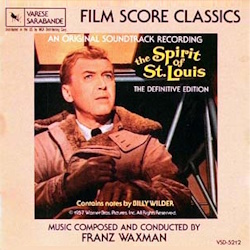 GREATEST SCORES OF THE TWENTIETH CENTURY
Original Review by Craig Lysy
Studio executive Jack Warner decided that the history-making tale of Charles A. Lindbergh’s pioneering transatlantic flight needed to be brought to the big screen. He assigned production to Leland Hayward with a $3 million budget, tasked Billy Wilder with directing (who also assisted with the screenplay), and hired screenwriters Charles Lederer and Wendell Mayes to adapt Lindbergh’s autobiographical account in his 1953 book The Spirit of St. Louis. Casting the lead role was problematic, as Warner’s choice of John Kerr was turned down by the actor, who was offended by Lindbergh’s pro-Nazi sympathies and antisemitism. James Stewart lobbied for the role and was chosen by Wilder despite Warner’s misgivings that, at 47 years of age, he was too old for the role, given that Lindbergh was 25 years old when he made the flight. Joining Stewart would be Murray Hamilton as Bud Gurney and Patricia Smith as Mirror Girl.
The film is set circa 1927 and offers a biopic of Charles Lindbergh’s history-making transatlantic flight from New York City to Paris. Lindbergh is an airmail pilot, and one day he learns of the Orteig Prize, a $25,000 prize offered by hotel magnate Raymond Orteig to the first man who can fly nonstop from New York City to Paris. He secures backing from Frank Mahoney, president of Ryan Airlines, who agrees to build a special monowing, single-engine plane stripped of most of its heavy instrumental equipment to support a much larger 450-gallon fuel tank. Lindbergh takes off in The Spirit of St. Louis, and during the harrowing flight averts a number of catastrophes to successfully land in Paris. His feat makes him a national hero, and a welcome-home parade in New York City is attended by 4 million people. The film was a commercial disaster, suffering a $4 million loss, and critical reception was mixed, with many citing Stewart’s miscasting. The film received one Academy Award nomination for Best Special Effects.
Director Billy Wilder greatly admired Franz Waxman’s Oscar-winning collaboration on Sunset Boulevard in 1950, as well as Stalag 17 in 1953, and so secured his services for this project. Upon viewing the film, I believe Waxman understood that this was the story of one of the greatest and most audacious aeronautical feats in human history, and that four core elements would need to be supported musically. First and foremost, the story was an adventure, which he would need to empower dramatically. Second, I believe he understood that he needed to express both the loneliness of the flight, the sleep deprivation, and the resultant hallucinatory and dreamlike states that plagued Lindbergh. Third, he would need to speak to the perils of the flight, and lastly, to three stages of achievement: the beginning of the flight of destiny from New York to Cape Cod, landfall over Ireland, and journey’s end at Le Bourget. Lastly, he needed to speak personally to Lindbergh himself—a man who rises from airmail pilot obscurity to become an American hero and international icon.
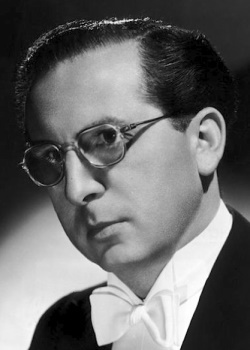 Waxman was provided a large budget, and so he hired an extremely large orchestra, which included a massive percussion section, two harps, three pianos, a Novachord, vibraphone, celeste, and a female choral quintet (three sopranos and two mezzo-sopranos). Waxman’s soundscape is empowered by two primary themes: the Spirit Theme and the Flight Theme. They are both used throughout the film, and when joined, they create a breathtaking synergy. The Spirit Theme offers a monumental, sweeping, bold, and majestic exposition, which serves as a unifying idée fixe that appears throughout the score. On a literal level, I believe it is associated with the technical challenge and ambition of building the plane. Yet I also believe it operates inwardly as the nexus of Lindbergh’s spirit of adventure. It speaks to his desire to embrace the wonders of the firmament by breaking free of the constraints of earthly bonds, as well as his desire to push the boundaries of human accomplishment.
The Flight Theme evokes the wonder of exploration, the excitement and exhilaration of flight, and ultimately, the triumph of the journey. It is brilliantly conceived by Waxman in that he uses ascending fifths—specifically a pattern of: C–G, E–B, G–D, B–F♯, D–A. He conceived this musical ascent to mirror the plane’s physical climb into the sky. It is often borne by refulgent strings, augmented by more rhythmic and energetic woodwinds. The St. Christopher Theme is associated with the medallion gifted to him by Father Hussman. St. Christopher is held by Roman Catholics as a protector of wayfarers against bridgeless waters. Waxman bathes us in an ethereal, hymn-like religiosity, joining upper-register woodwinds sereni and Novachord. Late in the film, when Lindbergh discovers that Frank stowed it in his sandwich bag, it blossoms with profoundly moving religiosity on refulgent strings brillante.
There are two non-melodic motifs that Waxman uses, which are impressionistic, textural, and atmospheric in form. The tension-filled and often dramatic Suspense Motif deals with environmental, technical, and mechanical issues that arise and imperil the flight. The Fatigue Motif is used to express Lindbergh’s battle with fatigue, loneliness, sleep deprivation, and resultant hallucinatory and dreamlike states during the flight. What is masterful is how Waxman augments, diminishes, and fragments his main theme to match Lindbergh’s emotional state by embedding it within these two motifs. One source song is incorporated, “Rio Rita” by Harry Tierney, with lyrics by Joseph McCarthy.
Unfortunately, the film was received poorly by preview audiences, which led the studio to extensively edit the film and shoot additional footage. Franz Waxman had moved on to write the score for Love in the Afternoon and was not available to rescore, so director of music Ray Heindorf hired Roy Webb to assist in composing new music based on Waxman’s style and original themes. In the end, about fifteen minutes of new music was mixed into the final score. The Main Title was altered to add “La Marseillaise,” which concluded the cue. Other cues were rewritten, with “Le Bourget,” the dramatic finale depicting Lindbergh’s approach and landing in Paris, receiving extensive revision.
“Prelude opens with the sound of an airplane propeller engine, which supports the Warner Brothers Pictures logo. As the logo vanishes, we see a panoramic view of a solitary airplane flying against a mountain backdrop. (Original Version) At 0:09 trumpets audaci resound, declaring with confidence, and a sense of wonderment, the questing Spirit of St. Louis Theme, as the opening credits display in bright red script. At 0:26 we soar on a stepped ascent by layered refulgent violins brillante as the Flight Theme soars with a sense of ethereal wonderment. At 0:50 the theme loses vitality and becomes beleaguered; a technique Waxman will use for times Lindbergh is under duress. At 1:07 Waxman closes the credits with a coda of the Spirit Theme, which ends in a flourish. (Film – Roy Webb Version) At 0:14 trumpets audaci resound, declaring with confidence, and a sense of wonderment, the questing Spirit of St. Louis Theme, as the opening credits display in bright red script. At 0:24 we soar on refulgent violins brillante as they reprise, the Flight Theme with a sense of ethereal wonderment. Webb’s string writing is more ornate and embellished versus Waxman’s. Webb also sustains the sense of wonderment and adventure, omitting the theme’s beleaguered duress in the original. At 1:15 the credits close with a declaration of La Marseilles by trumpet solenne. When all is said and done, Webb sustains the optimism, wonderment and sense of adventure, while Waxman presages the trials and tribulations Lindbergh will face.
(*) “Lindbergh’s Historic Flight” opens with a reprise of the beginning part of Waxman’s prelude with horns audaci declaring the Spirit Theme to support a solitary plane flying against a mountain back drop. Narrative script informs us Lindbergh historic feat – a non-stop trans-Atlantic Ocean crossing of 3,610 miles from New York City to Paris. Webb concludes the que with a reprise of the La Marseilles declaration. (*) “The Night Before” reveals our entry into the film proper on a chord of unease as we see the Garden City Hotel on Long Island draped in a night time rain storm. Inside we see the lobby converted into a press room with a phone bank and many journalists typing. A reporter narrates that Lindbergh has gone upstairs to sleep before his historic flight tomorrow. The camera takes us upstairs where we see Frank Mahoney sitting vigil outside his room. Suddenly the love ballad “Rio Rita” blares from a phonograph in the next room, causing Frank to bolt and turn it off. He goes into Lindbergh’s room, finds him awake, and apologizes for the song waking him. After he leaves, Lindbergh frets about the rain, and plane preparations, as we see the plane being fueled and serviced in the hanger. He then recalls his days as an airmail pilot and we flashback
(*) “Destiny in the Making” reveals a flashback sequence where we see a mail truck arriving at Peoria airstrip carried by a foreboding textural musical narrative, embedded with repeating four-note woodwind figures. Lindbergh makes a night landing in his biplane at the airfield to refuel on the way to Chicago. In a fateful decision, he decides to take off despite bad weather. As he lifts off Burt receives a phone call advising that a blizzard has closed the Chicago landing field. Waxman sounds the alarm as he runs out to wave Lindbergh off, but it is too late. Enroute Waxman sow tension with a terrifying dissonant musical narrative, again propelled by repeating four-not figures. Lindbergh is forced to bail out in a snow storm after running out of fuel. Undeterred, he grabs all the mail from the wreckage and continues to Chicago by train. In unscored scenes, Lindbergh has a fateful meeting with O. W. Schultz, a suspender salesman who tells him that two airmen just died competing for the Orteig Prize for the first nonstop flight from New York City to Paris. Lindbergh is intrigued, and in an audacious move telephones Columbia Aircraft Corporation in New York from a small diner at the Lambert-St. Louis Flying Field. He is quoted a price of $15,000 for a Bellanca high-wing monoplane, which requires him to seek out and recruit St. Louis financiers to finance his trans-Atlantic flight of 40 hours in the stripped-down, single-engine Bellanca aircraft.
(*) “Spirit” reveals Lindbergh making his pitch to potential wealthy benefactors at his bank. When one benefactor, Major Lambert declares that his investment would not be made to make money, but instead for the spirit of man’s quest to challenge his limitations. At this moment, Harold Bixby, President of the bank writes down on paper; “S P I R I T”, in which Waxman punctuates each letter with a Novachord note progression of the Spirit Theme. As he wins benefactors over one by one, Waman keeps reprises the six-note Novachord Motif “S P I R I T”. In the end, all the backers agree to finance Lindbergh’s vision and name the plane, Spirit of St. Louis, crowned with the six-note Novachord motif “S P I R I T”. (*) “New York City” a spritely musical narrative, within which is woven fragments of the Spirit Theme carry Lindbergh’s walk along bustling streets of New York. He meets with the president, who imposes a late sale caveat – they will sell the plane, but retain rights to choose the pilot. Lindbergh is flummoxed, and when he is unable to persuade the president of his flying credentials, he storms out. At the train station, the benefactors present a Plan B; take a train to San Diego and finalize a deal for Ryan Airlines, a small manufacturer owned by Frank Mahoney, who promises to build a suitable monoplane in just 90 days. A quote of the Spirit Theme buttressed with spritely strings carries Lindbergh’s boarding of the train.
(*) “San Diego” reveals Lindbergh arriving at Ryan Airlines Inc. carried by a bluesy jazz number. A repeating six-note figure offers a misterioso of unease as he walks past two men sleeping on the street. As he walks in, the jazz motif carries him into the factory floor. He meets and bonds with the owner Frank Mahoney, and Donald Hall, the design engineer. We flow into “Building the Spirit”, which offers a montage revealing the construction of the Spirit of St. Louis, from its metallic fuselage, wood wing frames and propulsion system. Waxman offers a complex, energetic, and textural, industrial musical narrative propelled by hustling and bustling woodwinds, frenetic strings, metallic chords, and horn declarations of the Spirit Motif, replete with piano and xylophone effects. At 1:05 a diminuendo of uncertainty supports dialogue discussing Lindberg’s highly unusual specifications; placing the gas tank in the front of the cockpit, which means no cockpit glass view forward, no radio, no heavy equipment to decrease weight, no parachute, no autopilot with plans to navigate by “dead reckoning”. All this means that Lindbergh will not be able to sleep during the 40-hour flight. At Lindbergh and Hall’s insistence, Frank shifts operations to a 24-hour work day, which reduces completing the project to just 62 days. At 1:24 the construction motif resumes as a textural tour de force! At 2:19 a second diminuendo commences to support dialogue. Lindbergh beholds the ground-breaking J-5 whirlwind mount through which the propeller shaft passes to attach to the propeller. At 2:34 Lindbergh learns that competitors Wooster and Davis died in a test plane crash, and struggles to absorb the news. The music darkens and a grim musical narrative unfolds atop a repeating three-note descending figure. At 3:15 the frenetic energy of the Construction Motif resumes in full force as the cockpit control panel is assembled. At 3:32 repeated declarations of the Spirit Fanfare support the assembly crew each signing with a paint marker, the internal side of the final metal panel of the fuselage. As they mount it, the Spirit Fanfare resounds as we see the plane’s name plate; “Spirit of St. Louis”.
“First Test Flight” offers a score highlight. It reveals Steward’s narration of hauling he plane out to Dutch Flats for shakedown testing. We see Lindbergh successfully performing take-offs, flight maneuvers, and landings. Waxman in his notes uses one word to describe this composition; “Sublime”. I must agree. He offers a musical translation of the exhilaration, liberation and wonderment felt by flight using trilling woodwinds and strings, joined with vibraphone and celeste with harp adornment. I interpret the solo trumpet as Lindbergh’s quest to fulfill his destiny. Afterwards Lindbergh gives a speech to the workers and press on how he plans to fly to St. Lous, then to New York City, and then the big one – Paris. As they prepare to take photos, Frank takes him away to deliver bad news that the French team of Nungesser and Coli had left Paris and were sighted off the Newfoundland coast. Lindbergh is despondent, yet returns to take photos and carry on. He then departs in “Flight to St. Louis” where we see the plane flying against a magnificent backdrop of the Rocky Mountains supported by a lyrical and embellished rendering of the Spirit Theme. Inside we hear in Lindbergh’s mind thoughts of taking of the Pacific Ocean. As he comes into land, portentous horns support as we see Harry waiting. He informs him that Nungesser and Coli never made it to New York and that there are reports of wreckage off the coast of Newfoundland. Inside a radio announcer reports that Clarence Chamberlain and Commander Byrd are making preparations at Roosevelt Field, Long Island. In the café Lindbergh and his financers are at odds regarding the flight, with the financers arguing that after so many deaths, the time is not right, while Lindbergh insists, despite the losses, that the time is now, more so because of these deaths. Later, we return to the present at the Garden City hotel as he frets, unable to sleep.
In “St. Christopher” Lindbergh, who is unable to sleep, opens a letter from Father Hussman. Inside he finds a gift; the medal of Saint Christopher, who protects wayfarers against bridgeless waters. He is encouraged to wear it, and Waxman bathes us in an ethereal, hymn like religiosity joining upper register woodwinds sereni and Novachord. (*) “Father’s Flying Lessons” offers a flashback to Lindbergh’s unsuccessful attempts to teach Father Hussman to fly. After the latest rough landing, Father asks, why he never sees him attend church? He adds, does he believe? Tender strings religiosi join to support his response, in which he lists all the plane’s instruments, things that he can see and touch. He adds, I can’t touch God, to which father replies, you are not supposed to as He touches you. Lindbergh is moved by father’s testament of faith, and we return to the present as we see him smiling. (*) “It Is Time” reveals that the moment is lost as he looks at his watch, supported by a foreboding, otherworldly low register, binary ticking clock motif. He gets up, splashes water on his face, and Waxman sow a foreboding uncertainty as Frank joins. Lindbergh says he is ready as he dresses, tells Frank to keep all his personal effects, including the St. Christopher medallion, and to send them to his mother in Detroit if he does not return. As he checks out, he is swarmed by reporters, as we shift to a caravan of cars taking him to the airfield in heavy rain. He wades through a crowd to reach the plane, where his ground crew is completing an inventory. He again refuses a parachute because of its weight, but does accept a small compact mirror from a woman admirer to assist him read his compass.
(*) “A Fateful Choice” reveals his team reporting that the rainstorm and fog remain problematic, but believe conditions will be perfect if he delays twenty-four hours. He refuses to postpone, fearful that Chamberlain may take off first. He walks out of a side door of the hanger, looks at the skies, and ponders. Waxman again sow a foreboding uncertainty as Lindbergh returns to the hanger and says, “let’s roll her out. The musical narrative up shifts to support, joined by pensive horn declarations of the Spirit Theme. A foreboding, plodding, two-stepped cadence, embedded with reserved quotes of the Spirit Theme carries the plane being towed to the take-off area of the airfield. At the take-off point, the plane is readied but Frank is concerned about the muddy runway. Lindbergh asks to drive up to his take-off marker as the cloth that shows the wind vector is missing. Waxman continues to use atmospherics to drape the scene with a heavy, foreboding feeling of uncertainty as Lindbergh attaches a new white cloth, and Frank continues to fret over the muddy runway suppressing take-off causing the plane to crash into the end runway trees. They return and top-off the tank that now holds 425 gallons of fuel. As Lindbergh dons his flight suit, Frank drops the St. Christopher medal into his sandwich bag. Lindbergh boards, and verifys that his flight instrument gauges are all functional. They start the engine, he puts cotton in his ears, and dons his cap. He sees an ambulance arrive while he gazes at the end-runway trees and power lines. Lindbergh then shakes Frank’s hand, and says it’s time to go.
“New York to Cape Cod” reveals ten men pushing the plane forward, and then releasing as Lindbergh throttles up. The plane is struggling to gain speed on the muddy runway and he fails to take off at the take-off marker. He finally lifts off, the tail skid clips one of the power lines, and he barely clears the trees. Music enters with a sweeping and glorious exposition of the Spirit Theme as he gains altitude and sets off to his destiny. A montage follows of Frank packing his personal effects, as Hall joyously celebrates, and the people of the diner listen on the radio. At 0:57 upper register muted trumpets declare La Marseillaise as the woman who gifted her compact mirror puts on her make-up. Refulgent violins brillante reprise the Flight Theme, joined by warm French horns as the suspender salesman Schultz smiles at the newspaper headline “LINDY IS OFF!” We return to a flight musical narrative empowered by the Spirit Theme. At 1:53, a diminuendo takes up into the cockpit where Lindbergh relates that after two hours an air speed of 93 mph, a light tail wind, and a distance traveled of 200 miles. If he can sustain this for thirty-eight hours, success awaits. A new musical narrative is benignly introduced by Waxman, as he has an animated conversation with a stowaway – a fly. This narrative will slowly darken as he will use it to express both the loneliness of the flight, the sleep deprivation, and resultant hallucinatory, and dream-like states that will plague Lindbergh. At 3:03 the soaring Flight Theme returns as an exterior shot reveals the plane flying over the maritime coast populated by fishing and pleasure boats. At 3:14 we shift back to the interior as he notates him turning off one gas valve and opening another, something he must do hourly to ensure the gasoline weight is equally distributed among the four tanks. The Interior Flight Motif supports with a lonely meandering piccolo, and foreboding atmospherics. At 3:49 we return to the soaring Flight Theme buttressed by Spirit Theme Horns as his map indicates passing Cape Cod and the city of Boston, which we see out the plane’s window. At 4:53 we see Lindbergh tired from lack of sleep for 28 hours and the monotony of his confinement. He splashes water on his face as his mind tells us of his regret not sleeping at the hotel. Music after 5:07 seems to be attached to a scene edited out of the film. It offers a dramatic and violent musical narrative.
(*) “Reminiscence” reveals a flashback montage of how easy it was to sleep as a boy along railroad tracks while fishing. A plodding, repeating, low register two-note motif has a mesmerizing effect. As we shift to his story as a flying cadet at Brooks Field, Texas, the motif shifts to a slower paced and more foreboding rendering as a sergeant comes in to inspect while he and his mate’s sleep. We shift to the barnstorming days when he relates sleeping well under the wing of his old Jenny.
Here the two-note motif oscillates by woodwinds as we see him sleeping. We flow seamlessly into “Nova Scotia” sustaining the motif until 0:06 when tremolo strings of alarms and a dire four-note motif reveal that the altimeter shows the plane descending. A fly wakes him in time, he steadies the plane, and at 0:28 the music brightens on the questing magnificence of the Flight Theme as he sees Nova Scotia below and waves ecstatically at a man on a motorcycle below. AT 1:01 the Flight Theme again soars gloriously, enriched by contrapuntal horns declaring the Spirit Theme. The music after 1:29 was evidently lost with editing, and consists of the atmospheric Fatigue Motif, which consisted of shifting, nebulous orchestral textures, and fragmented melodies. (*) “My First Airplane” reveals a flashback to the days when Lindbergh bartered his motorcycle and $425 to buy his first airplane. He climbs aboard, starts the engine, and an exuberant musical narrative propels his take off. He lifts off, yet falls back to the ground and the seller and his helper get on the motorcycle and pursue to a raucous slapstick musical narrative as Lindbergh ends up chasing them. They stop, he offers his money back, but Lindbergh refuses, determined to fly or bust. He takes off again, supported by sardonic music and finally succeeds, much to the amazement and relief of the seller.
“St. John’s” reveals him seeking his Land’s End check point before setting off across the vast Atlantic Ocean. This is a well-conceived and executed cue, offering a nebulous, intangible, and impressionistic musical narrative as he is enveloped in a massive fog bank while flying over mountains. A solo trumpet speaks of Lindbergh’s questing spirit, as well as fragments of the Spirit Theme. At 1:57 dire horns dramatico resound as he makes a bold decision to descend as he must sight St. John’s to set his course for Ireland. He nervously scans for mountain crests and the tension rises as there may not be sufficient time to avert a collision if one suddenly appears. At 2:28 the fog dissipates, he enters clear skies, and to his relief, he sees the port of St. John’s below. The music brightens, but then sobers with uncertainty as his stowaway fly abandon’s ship, and he reviews his map, with his mind informing us that it is now 1,900 miles over water with no land. Yet at 3:44, as he flies across the harbor, the soaring Spirit Theme joins with the Flight Theme taking him out to the vast Atlantic, with one of the score’s grandest expositions. Yet a 4:25 the music returns us to the cockpit for a more intimate narrative as he records wind speed 30 mph from the northwest and shifts his course 10 degrees north to compensate for drift. He records a speed of 90 mph with and altitude of 300 ft, and decides to ascend to provide more time to deal with any problem that arises. Waxman supports with a meandering flute wandering in a formless void as once again Waxman uses impressionism to speak to the confines of the cockpit and Lindbergh’s mental state. At 6:35 an airplane engine becomes for prominent as he again has a flashback.
“Barnstorming” reveals Lindberg recalling his barnstorming days, where he enticed people to fly with him at a cost of $5 for 10 minutes. The music from 0 – 1:00 was dialed out of the film. It was intended to support his selling pitch with a mocking-comedic musical dialogue between bassoon and a tuba and base unison. At 1:01 see we a montage of Lindbergh flying with a varied assortment of people, supported by a fun, and truly wild and frenetic circus-like adventure; an old man, newlyweds, and an American Indian. At 1:53 drums energico usher in the Spirit Theme as we see him earning another means of income – flying special deliveries. As he flies over the countryside, he narrates being joined by another gypsy of the skies – Bud Gurney. The men bond, and Lindbergh is convinced to join a flying circus with him in Texas. (*) “Flying Circus” reveals the two performing daring wing stands, barrel rolls, and loops, acrobatics, and parachuting to cheering crowds, supported by a festive, carnivalesque musical narrative. In (*) “Fatigue” we flash forward back to the cockpit where Lindbergh relates; 16th hour and 1,700 miles. In his mind he does math equations to keep his mind active, while Waxman weaves a somnolent narrative with harp and woodwind figures. We shift to eerie woodwinds as he mistakes an iceberg for a ship. He struggles to keep his eyes open and relates that he would never pass inspection like this at Brooks Field.
(*) “Brooks Field” reveals command inspection of airmen and their planes with a musical narrative that weaves a faux military pomp, with mocking, comedic satire. Lindbergh lands, and offers papers saying to report here for duty. We descend musically into slapstick comedic farce as the captain orders his dirty, dilapidated plane off his air field. Lindbergh lifts off and as the captain yells to never bring that plane back, and we close with a comedic thump as a wheel falls off and barely misses the captain. In (*) 18th Hour” we return to the present with Lindbergh smiling carried by a haunting textural and nebulous musical narrative joined by wordless ethereal women’s voices. A foreboding two-note ostinato commences as we see ice building up on the plane, which Lindbergh senses and confirms with his hand out the window. Waxman sow a rising panic as Lindbergh relates the need to climb fast to get out of this before we become too heavy to fly. Dire horns sound as the plane starts to stall and Lindbergh yells to get out of here and find warmer air. The plane becomes too heavy and begins a forced descent, and he checks his raft and emergency equipment. As he nears the water, woodwinds of hope join as the air warms, and we see a piecemeal of ice chunks flying off the plane. We surge on a charging crescendo, which unleashes a strings dramatico ostinato as he pulls up and at the last moment. His return to safety is crowned by a declaration of the Spirit Theme as he maneuvers to get back on course.
(*) “Fly By The Stars” reveals that both the induction and magnetic compasses have failed, which forces him to seek the big dipper constellation and fly by the stars. Waxman sow tension and uncertainty with a nebulous atmospheric narrative. He gains sight of Polaris, keeps it off his left wing to fly east, and when it sets, he will follow the Sun. An exterior of the plane is supported by a renewed questing Spirit Theme. In the morning trumpets audaci declare the Spirit Theme as compass function resumes. In “Asleep” both compasses say east, but he is not sure what that means, and Waxman sow uncertainty with and undercurrent of unease as he wonders how far off course is he. He uses mental equations to for his mind to stay awake as a chiming textural nebulousness joins. Waxman now masterfully shifts his musical narrative back and forth and from a misterioso by somnolent strings, Novachord, vibraphone, and ethereal wordless women’s voices when he is losing consciousness, and foreboding trumpets, which support him trying to remain awake. A rising panic follows as he realizes he is losing the battle to stay awake. A harp glissando marks his loss of consciousness as he falls asleep. Waxman ingeniously creates a rotational cycling effect that syncs with the plane cycling ever downwards. Three surges by wordless women’s voices mark the passage of sun rays reflected by the mirror crossing over his face. After the third passage he wakes, see the plane about to crash into the water, and at 3:30 a crescendo of alarm surges as he pulls up at the last moment. As pulsing horn driven ostinato propels the plane back up to its cruising altitude.
“Fishing Boats” opens darkly with a bass ostinato, shifting to woodwinds as we see Lindbergh relieved to still be alive. At 0:20 an aerial flute takes wing as he sees seagulls flying, which means near-by fishing boats. Kindred woodwinds join and usher in hunting horns and swirling strings of anticipation as he spots two fishing ships. At 0:56 horns giubianti resound as he happily flies over them. At 1:38 Waxman sow frustration as Lindbergh circles low, and yells twice; “Which way to Ireland, but the men are dumbfounded and do not answer. He flies away baffled as to why they did not answer, and Waxman evokes uncertainty and confusion with a beleaguered Spirit Theme. The loneliness, fatigue and sleep deprivation again rear their ugly heads as nebulous atmospherics close in as a weakened Spirit Theme fails to assert itself. The following three cues were edited out of the film. “The Old Jenny” was lost along with the scene to which it was attached. It features an energetic and syncopated piece where Waxman offers an homage to Shostakovich. “The Spirit of St. Louis” features the Spirit Theme, which transforms into a six-note ostinato by clarinet and bassoon, enriched by contrapuntal strings. For “Rolling Out”, some of Waxman’s music was incorporated into scene “A Fateful Choice”. As the plane is rolled out to the runway, I discern his vision to be darker and more foreboding, presaging the loneliness of the flight, the sleep deprivation, and resultant hallucinatory, and dream-like states, which would plague him, rather than the adventure.
“Ireland” reveals a stuporous Lindbergh leaning on the control lever as tiny islands appear. He slowly stirs to life as strains of a Gaelic gigue emerges on woodwinds with string ascent. He is stunned as the mainland now comes into view. The music becomes tense when he becomes flummoxed as he tries to determine, just where he is. At 3:35 Gaelic woodwinds join as he considers if he has reached Dingle Bay. He checks his map, the topography matches and we soar on a paean of jubilation as he flies over docks filled with men waving welcome, and then inland over the Emerald Island’s verdant countryside. The Irish Gigue joins with festive energy as he marvels at the countryside. At 3:15 we close on a diminuendo as we see him drawing a line on his map, stopping to circle the port of Plymouth. “Plymouth” reveals him marveling that he has flown over Plymouth Massachusetts, and now, Plymouth England. Waxman’s composition for this extended scene is masterful. He pits two versions of the Spirit Theme against each other, with version one emoted by low register pizzicato strings and version two emoted by upper register woodwinds. At 1:04 he decides to have lunch, and as he lifts a sandwich out of the bag, the St. Christopher medallion dangles from it. The St. Christopher Theme joins, empowered by its theme rendered by refulgent strings brillante. At 1:36 we soar on a lyrical rendering of the Flight Theme as we see him crossing the English Channel. At 2:15 a chorale of horns declares a repeating, descending five-note motif as he reaches the coast of France. The music becomes pensive as he relates that he must fly northeast until he reaches the mouth of the Seine River, Crique de Rouen. At 2:39 a celebratory declaration of La Marseilles supports his sighting of Crique de Rouen. He calculates 98 miles and 58 minutes to go. The Flight Theme carries his progress as he freshens up in the cockpit to make himself, presentable. The Four-note Tension Motif joins as the engine goes silent and he begins frantically scanning his gauges to determine the cause. He realizes he did not switch tanks; he switches tanks, the engine restarts, and the Flight Theme regains its vitality as he gains back altitude.
For “Le Bourget/End Title”, Waxman was not available to rescore the edited film, as such, Roy Webb and Ray Heindorf reworked the music, keeping some of the original elements, but rewriting others. In the Waxman version, we open with the somnolence of the intangible Sleep Motif as Lindbergh makes a perilous night time approach to the Le Bourget air field. Glockenspiel and tremolo strings form a bridge, from which arises at 0:40 a vibrant and sparking Spirit March, which slowly swells on a crescendo. The Spirit Theme and St. Christopher entwine into a new identity. At 2:20 a repeating five-note horn motif sounds over muted percussion. At 2:36 we shift to a resplendent, and sparking metallic statement of the Spirit Theme, which concludes with a fortissimo climax. At 2:55 a solemn Flight Theme, abounding with thankfulness reprises. At 3:47 a dissonant and distressed Spirit Theme joins and begins a crescendo appassionato, climaxing dramatically at 4:28 atop a chorale of horns brillante. We flow into the Spirit Theme borne by drums and horns, buttressed by strings trionfanti, which play over a pizzicato bass. Waxman, further embellishes the melodic line with shimmering metallic tresses, as we ascend to a stirring climax. At 5:37 we conclude with a breath-taking, refulgent declaration of the Flight Theme, crowned with a grandiose coda of the Spirit Theme, which ends the film in a flourish.
In the Webb-Heindorf version, we open with the somnolence of the intangible Sleep Motif as Lindbergh make a night time approach to the Le Bourget air field. Trumpets of hope sound as he sees Paris alight in the night. A soaring Flight Theme joins as he yells; “There it is!” The theme carries his over flight over Paris landmarks; Arc de Triomphe, the Eiffel Tower, Notre Dame Cathedral, each crowned with declarations of the Spirit Theme. The music darkens on a dissonant Tension Motif as he examines his map and tries to locate Le Bourget Airfield, which he finds is Northeast of the city. He frets that he is tired, having not slept for three days, and that he must push on. Night lamp beams mark Le Bourget ahead. As he descends to confirm and we see buildings underneath dangerously close, as the musical tension builds. The lights blind him, and we see a rising panic borne by a distressed Spirit Theme, which surges on a crescendo di orrore as he struggles to orient the plane. Yet horns dramtico resound as he catches a large building, whose roof displays; “Le Bourget”. The landing approach is perilous in the night and musical tension is palpable. As he descends, he panicks, calls out to God, and he glides down for a flawless landing empowered by the Spirit Theme. A paean of celebration erupts as crowds break through police barricades and rush the plane. He is exhausted, shuts off the engine, as deafening crowds cheer. He is stunned as he watches a massive crowd run towards him. They open the door, pull him out, and carry him over their heads as their hero. Later, solemn music supports the plane being taken for safety into a hanger, where Lindbergh reunites. It has been damaged by souvenir seekers, but he turns away empowered by the Spirit Theme as he hears people repeatedly yelling; “Lindbergh!”. The refulgent Flight Theme joins as he caresses the name plate, “Spirit of Saint Louis”. We close with his narration, that there was 200,000 people there that night, and when he came home, there were four million people waiting. We close the film with a ticket parade in New York City empowered by a marching band playing “Star and Stripes Forever”.
My assessment of the Album’s audio quality finds that the original mono recording was digitally mastered and suffers from somewhat muffled mastering typical of early CD releases, which diminishes the impact of the large orchestra. What is needed is a re-recording that will bring out the magnificence of Waxman’s handiwork. Franz Waxman’s score for “The Spirit of St. Louis” (1957) is anchored by two primary themes, the monumental, sweeping, and majestic Spirit Theme, which speaks to the human quest to break free of the constraints of earthy bonds, as well as the desire to push the boundaries of human accomplishment. For me, the theme is the embodiment of Charles Lindbergh. The Flight Theme evokes the wonder of exploration, the excitement and exhilaration of flight, and ultimately, the triumph of the journey. When the two melodies are joined, we are graced with sublimity. What makes Waxman’s score outstanding, is that he correctly perceived that the film’s story offered two separate narratives; one outward, and one inward. The Flying and Spirit Themes expressed the outward narrative of Lindberg’s quest. However, in my judgement, it is in the inward narrative, which expressed the loneliness of the flight, the sleep deprivation, and resultant hallucinatory, and dream-like states, that Waxman excels. He eschews the beautiful, soaring melodies of the Spirit and Flight Themes, and instead expresses Lindbergh’s mental challenges with exceptional impressionism, texturalism, and atmospherics. These passages are often nebulous, intangible, dream-like, yet also emotionally potent. We feel Lindberg’s doubts, anxieties, fears, and confusion, a testament to Waxman’s mastery of his craft. In scene after scene, it is Waxman’s music that carries the film.
As to the controversy surrounding the scoring, for the finale, Waxman chose to score the external narrative by composing melodically with the Spirit and Flight Themes to empower the historic and spectacular achievement of Lindbergh’s accomplishment. Producer Leland Hayward and director Billy Wilder were dissatisfied with the music for this climatic scene because they believed it to be too “Hollywood”, too melodic, symphonic, and traditional. They argued for a more modernist and innovative approach, which spoke to the tension of concluding the perilous and difficult historic flight. As such, the rewritten film version focused on the second, or inward narrative, which spoke to Lindbergh’s fear, anxiety and confusion as he makes his landing. I believe musically Waxman’s version offers the most inspiring music, however, having watched the film, I believe the revised version worked best supporting Stewart’s acting. Folks, since this is a collectable, I recommend purchasing the score and streaming the film. Waxman’s writing is exceptional, well-conceived, and executed. Truth be told, the two primary themes are wondrous, and are essential compositions in my Aerial Flight Themes Playlist.
For those of you unfamiliar with the score, I have embedded a YouTube link to the Main Title: https://www.youtube.com/watch?v=08sb1PtY2Hg
Buy the Spirit of St. Louis soundtrack from the Movie Music UK Store
Track Listing:
- Prelude (Main Title) (1:24)
- Building The Spirit (4:06)
- First Test Flight (1:19)
- Flight To St. Louis (1:13)
- St. Christopher (0:41)
- New York To Cape Cod (7:04)
- Nova Scotia (3:03)
- St. John’s (6:52)
- Barnstorming (2:37)
- Fishing Boats (2:57)
- The Old Jenny (1:27)
- The Spirit Of St. Louis (1:16)
- Rolling Out (5:24)
- Asleep (4:07)
- Ireland (4:08)
- Plymouth (3:28)
- Le Bourget/End Title (6:47)
Varèse Sarabande VSD-5212 (1957/1988)
Running Time: 57 minutes 53 seconds
Music composed and conducted by Franz Waxman. Orchestrations by Leonid Raab. Additional music by Roy Webb and Ray Heindorf. Recorded and mixed by XXXX. Edited by XXXX. Score produced by Franz Waxman. Album produced by John W. Waxman.

Shop at the Movie Music UK Store

Member of the

 MOVIE MUSIC UK