BEFORE AND AFTER – Howard Shore
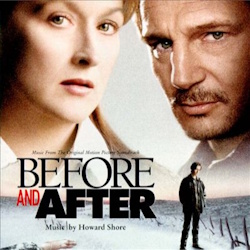 THROWBACK THIRTY
Original Review by Jonathan Broxton
It’s always fascinating to me how a movie, on paper, can have the absolute best possible pedigree in terms of filmmaking and acting talent, and yet completely flop at the box office and immediately fade into obscurity. Before and After is one of those films. It’s directed by Barbet Schroeder, who received an Oscar nomination for directing Reversal of Fortune in 1990, and later went on to make Single White Female in 1992. It was adapted from the original novel by Rosellen Brown by Ted Tally, who won an Oscar for writing The Silence of the Lambs. The cast is led by Meryl Streep and Liam Neeson, alongside Alfred Molina and Edward Furlong, fresh from his breakout role in Terminator 2: Judgment Day.
Streep and Neeson play Carolyn and Ben Ryan, a respectable upper-middle-class Massachusetts couple whose lives are turned upside down when their teenage son Jacob (Furlong) becomes the prime suspect in the murder of his girlfriend. When the police arrive at the Ryan residence, they discover that Jacob has disappeared, leaving his parents in a state of panic and uncertainty. While searching for Jacob, Ben discovers evidence that may incriminate him and secretly disposes of it to protect him. However, as the investigation intensifies, the family is forced to confront painful questions about truth, loyalty, and morality, and must ultimately decide how far they are willing to go to protect their child—and whether continuing to do so is worth the consequences.
It’s an interesting but somewhat low-key film, and much of the story focuses less on the crime itself and more on its emotional and ethical impact on the family, giving the film a slow, character-driven tone that may have contributed to its lukewarm reception. Contributing significantly to this understated atmosphere is the score by Howard Shore. This was the second collaboration between Schroeder and Shore after Single White Female, and it finds Shore in an equally subdued mode.
 The score is performed by the London Philharmonic Orchestra, but is quite sparse and restrained in its orchestration. For the most part, Shore avoids overwhelming the story with large dramatic themes, and instead uses subtle strings and low-register instruments to create tension, with somber harmonies and minimal motifs that reflect the film’s moral ambiguity and the growing pressure on the family. Rather than manipulating the audience emotionally, the music places psychological emphasis on the uncertainty surrounding Jacob’s guilt, revealing little until the narrative reaches its moment of truth.
In general, the film is scored quite sparingly; much of it is quiet, with music appearing mainly in transitional moments or scenes of significant intensity. The majority of the score recalls works like Dead Ringers, the less horrific passages of The Silence of the Lambs, perhaps Philadelphia, and parts of The Client, resulting in a brooding, understated melodrama that often sits quietly in the background. But that’s not to say the score is without highlights; on the contrary, several moments stand out.
Both the “Main Title” and the conclusive piece “Before and After” are lovely, lilting, lyrical compositions played by the full orchestra, with an unexpectedly warm, inviting, and wholesome tone. They come across like a more serious version of something like Big, Mrs. Doubtfire, or Nobody’s Fool, while also containing early hints of what would later become the “Breaking of the Fellowship” theme from The Lord of the Rings: The Fellowship of the Ring. As a musical portrait of an all-American family, it’s excellent, but of course we know that things are going to change for the Ryans, and Shore reflects this with minor-key chords that gradually creep into the theme, hinting at the darkness to come.
Tremolo strings underpin much of “Searching for Clues,” and in the subsequent “Destroying Evidence,” the music erupts into a startling explosion of brassy power to coincide with the fateful moment when Ben makes a decision that will change his life forever. The throbbing, painful motif that moves from brass to woodwinds to strings, and back again, is deeply dramatic and full of portent. There is a palpable sense of distress and agitation throughout “Looking for Jacob,” which contrasts with the tragic hopefulness in the strings of “First Postcard” and the unexpectedly lovely lyricism of “Dr. Ryan,” before reaching dramatic heights in “Apprehended.”
There is a sense of childlike nostalgia in the delicate “Treehouse,” which underscores a scene where Carolyn and Ben reminisce about happier times during Jacob’s childhood, set to Shore’s waltz-time woodwinds. However, in the anguished “The Confession,” Shore allows his music to become deeply tragic, especially when the strings reach their zenith in the cue’s distressing finale. The music reaches even greater dramatic heights in the haunting “It’s Your Fault,” which underscores the film’s final revelation with distinctly Stravinsky-esque brass passages and low, churning strings. By the time “Jacob’s Gone” arrives, the music has adopted a tone of resignation and closure; the gentle woodwinds from “Treehouse” interweave with darker string and brass writing, ending the score on a thoughtful note.
Before and After is a strong score for listeners drawn to Howard Shore’s more tonal and approachable side. Emotionally, it tends to inhabit darker territory, exploring themes of familial guilt and latent trauma, but Shore approaches these ideas in a way that results in a surprisingly engaging album listening experience. The sonic similarities to several of his most admired works from the 1980s and 1990s, along with foreshadowing elements of his later Lord of the Rings scores, will appeal to fans of his style. Overall, this is a score that deserves to be better known and more widely appreciated.
Buy the Before and After soundtrack from theMovie Music UK Store
Track Listing:
- Main Title (4:03)
- Searching for Clues (1:54)
- Destroying Evidence (3:03)
- Looking for Jacob (2:07)
- First Postcard (1:48)
- Dr. Ryan (0:51)
- Apprehended (3:12)
- Preliminary Hearing (1:05)
- Ben & Carolyn (1:27)
- Treehouse (2:55)
- The Confession (4:49)
- The Grand Jury (1:46)
- Carolyn (2:11)
- It’s Your Fault (1:54)
- The Truth (1:41)
- Jacob’s Gone (2:00)
- Before and After (4:14)
Running Time: 41 minutes 10 seconds
Hollywood Records 162-039-2 (1996)
Music composed and conducted by Howard Shore. Performed by the London Philharmonic Orchestra. Orchestrations by Jeff Atmajian. Recorded and mixed by John Kurlander. Edited by Suzana Peric. Album produced by Howard Shore.

Shop at the Movie Music UK Store

Member of the

 MOVIE MUSIC UK